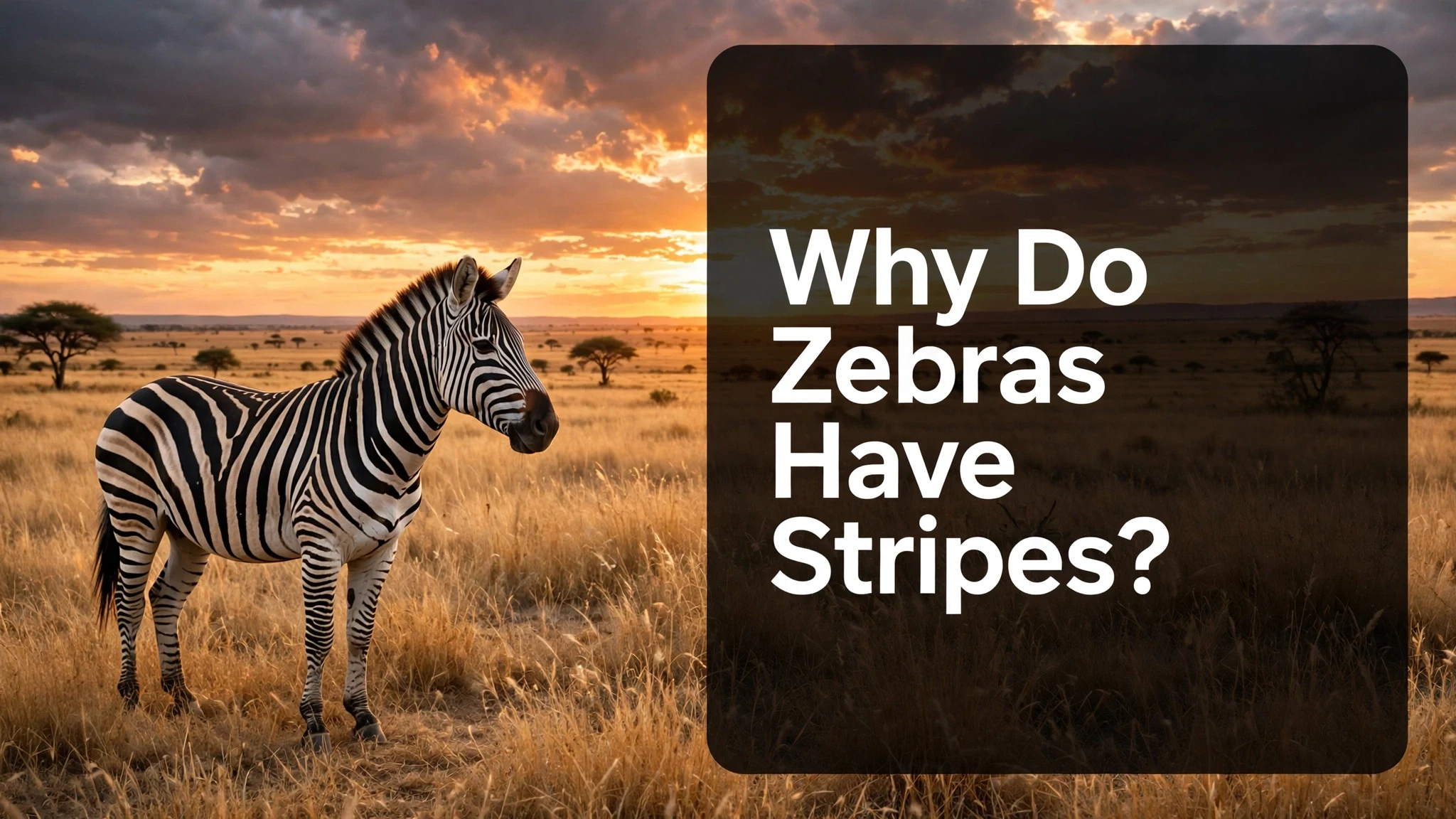
Why Do Zebras Have Stripes? Explained Simply
In this post
A zebra is one of the most recognisable animals on Earth, yet its stripes have puzzled people for a long time. Black and white stripes seem like the worst possible camouflage for an animal that lives in golden grassland. They should make the zebra easy to see, not hard to see. Yet zebras have kept their stripes for millions of years, which suggests the stripes do something useful. The answer is not one simple reason, but several, and science is still testing them.
This guide looks at the main ideas: camouflage, confusing predators, keeping flies away, staying cool, and telling zebras apart. It explains what the evidence supports, what is still uncertain, and why the stripes are more than just a pretty pattern.
The Puzzle: Stripes That Should Not Work
Stripes look like bad camouflage, yet zebras thrive, so the stripes must be doing something else.
In practice, A zebra’s stripes are bold, black and white, and they stand out against grass and trees. If camouflage were the only goal, a brown or golden coat would be better, like a lion’s or a deer’s. Yet zebras have stripes, and they have kept them, which means the stripes must help in a way that is not obvious. So the puzzle is real, and it has driven scientists to test several different ideas. A zebra’s stripe pattern is its fingerprint, and once I treated it that way, the herd stopped looking like a blur of black and white and started looking like a crowd of individuals.
Look closer and Each zebra’s stripe pattern is unique, like a human fingerprint. No two zebras have exactly the same stripes, and a mother can recognise her foal by its pattern. That uniqueness is useful for telling individuals apart, but it does not explain why stripes exist at all. So the pattern is personal as well as practical, and it serves more than one purpose. Zebra stripes are not a single answer; the dazzle, the flies, and the cooling all play a part, and the way scientists tested the fly idea with striped horse coats proves the pattern is doing real work.
The key point is that Zebras are also social animals that live in herds, and their stripes may help them stay together. In a herd, the stripes blur together, making it hard for a predator to pick out one zebra. That blurring is called dazzle camouflage, and it is one of the main ideas scientists test. So the stripes may work best in a group, not alone, and a lone zebra may be easier to see than a herd. Up close, stripes look less like camouflage and more like a practical defence, confusing lions in a running herd and putting off the biting flies that carry disease.
Idea One: Dazzle and Confusing Predators
The oldest idea is that stripes confuse predators, especially when zebras run in a herd.
What makes this work is that When zebras run together, their stripes create a moving pattern that is hard to follow. A lion trying to pick out one zebra may lose track of it, because the stripes blur and merge. That confusion can give the zebra a split second to escape, which can be enough. So the stripes are not about hiding; they are about confusing, and confusion can save a life. People assume stripes are for hiding, yet that easy answer misses the strongest evidence, which points to flies landing less often on striped coats.
Step back for a moment and Stripes may also make it hard for a predator to judge how far away a zebra is, or how fast it is moving. The high-contrast pattern can trick the eye, especially in bright sunlight. That trick is similar to the dazzle paint used on ships in wartime, which made it hard to judge a ship’s speed and direction. So the idea has a history in human design too, and it shows how a bold pattern can be a defence. One coat packs identity, protection, and a little cooling into a single pattern, and the zebra pays nothing extra to wear it, because the stripes grow with the animal.
The surprising part is that The evidence for dazzle is mixed, because lions hunt at night and may not rely on stripes in the same way. Some studies suggest stripes help against predators, while others find little effect. That uncertainty is honest: dazzle may be part of the answer, but it is probably not the whole answer. So the predator idea is plausible, but it needs more testing, and it is not the only explanation. Link the stripes to the flies to the running herd, and the separate theories, dazzle, repellent, and cooling, start to fit together instead of competing.
Idea Two: Keeping Biting Flies Away
The newest and strongest evidence is that stripes keep biting flies away, and flies are a serious problem for zebras.
In practice, Biting flies, such as horseflies, carry disease and cause pain, and they are a major problem for horses and zebras. Flies are attracted to large, dark animals, and they land on them to bite. Studies have found that flies land less often on striped surfaces than on plain ones. So the stripes may be a fly repellent, built into the coat, and that would be a big advantage. A zebra’s stripe pattern is its fingerprint, and once I treated it that way, the herd stopped looking like a blur of black and white and started looking like a crowd of individuals.
Look closer and Scientists tested this by putting striped coats on horses and by using striped models. They found that flies approached striped coats but landed less often, as if the stripes confused their landing. The effect was strongest with thin, high-contrast stripes, like a zebra’s. So the test was direct, and the result was clear: stripes reduce fly landings, which is a measurable benefit. Zebra stripes are not a single answer; the dazzle, the flies, and the cooling all play a part, and the way scientists tested the fly idea with striped horse coats proves the pattern is doing real work.
The key point is that Flies are more common in some places than others, and zebras live in places where flies are a problem. That fits the fly idea: stripes are most useful where flies are worst. It also explains why zebras have stripes while other grazing animals in the same place do not. So the fly idea fits the geography and the experiments, which is why many scientists now see it as the strongest explanation. Up close, stripes look less like camouflage and more like a practical defence, confusing lions in a running herd and putting off the biting flies that carry disease.
Idea Three: Staying Cool in the Sun
Another idea is that stripes help zebras stay cool, because black and white heat up differently.
What makes this work is that Black stripes absorb more heat from the sun than white stripes, which reflect it. That difference may create small air currents over the zebra’s body, which cool it down. The idea is that warm air rises over the black stripes and cool air moves in over the white stripes. So the stripes could act like a natural air conditioner, using the sun’s own heat to create cooling. People assume stripes are for hiding, yet that easy answer misses the strongest evidence, which points to flies landing less often on striped coats.
Step back for a moment and The evidence for the cooling idea is weaker than for the fly idea. Some studies have found little temperature difference between striped and plain coats. Others have found small differences, but not enough to explain the stripes on their own. So cooling may be a small benefit, but it is probably not the main reason for stripes. One coat packs identity, protection, and a little cooling into a single pattern, and the zebra pays nothing extra to wear it, because the stripes grow with the animal.
The surprising part is that Zebras also cool themselves by sweating, panting, and standing in shade. Those methods are more important than any cooling from stripes. The stripes may help a little, but they are not the zebra’s main cooling system. So the cooling idea is interesting, but it is likely a side benefit, not the main story. Link the stripes to the flies to the running herd, and the separate theories, dazzle, repellent, and cooling, start to fit together instead of competing.
Idea Four: Telling Each Other Apart
Stripes may also help zebras recognise each other, which matters in a social herd.
In practice, Each zebra’s pattern is unique, and zebras can recognise each other by sight. A mother zebra can find her foal in a herd by its stripes, even when many foals look similar. That recognition is important, because a foal needs its mother for milk and protection. So the stripes are a name tag, and they help a mother find her own child in a crowd. A zebra’s stripe pattern is its fingerprint, and once I treated it that way, the herd stopped looking like a blur of black and white and started looking like a crowd of individuals.
Look closer and Zebras also use stripes to recognise each other as members of the same group. They groom each other, stand close together, and use body language to communicate. The stripes may make it easier to see another zebra’s body and movements. So the pattern is part of social life, and it helps zebras live together in a herd. Zebra stripes are not a single answer; the dazzle, the flies, and the cooling all play a part, and the way scientists tested the fly idea with striped horse coats proves the pattern is doing real work.
The key point is that This idea does not explain why stripes are black and white, or why they are so bold. Any unique pattern could help with recognition, not just stripes. So recognition may be a benefit of stripes, but it is probably not the reason stripes evolved in the first place. So the social idea is a useful extra, but it is not the main driver. Up close, stripes look less like camouflage and more like a practical defence, confusing lions in a running herd and putting off the biting flies that carry disease.
How Stripes Form: A Zebra’s Skin and Coat
A zebra’s stripes are not painted on. They are part of its skin and hair, and they form before birth.
What makes this work is that A zebra’s skin is dark, and its stripes come from the hair: black hair grows in some areas and white hair in others. The pattern is set by genes that control where black and white hair grows. That pattern is already visible in a foal, and it does not change much as the zebra grows. So the stripes are built in, not added later, and they are part of the zebra’s body from birth. People assume stripes are for hiding, yet that easy answer misses the strongest evidence, which points to flies landing less often on striped coats.
Step back for a moment and The stripes are widest on the body and narrowest on the legs and face. That variation may be related to how flies land, or to how the pattern looks in motion. The belly is often plain white, which may help with heat or with flies. So the pattern is not uniform; it changes across the body, and those changes may have their own reasons. One coat packs identity, protection, and a little cooling into a single pattern, and the zebra pays nothing extra to wear it, because the stripes grow with the animal.
The surprising part is that Zebras can also have brownish stripes when they are young, which darken as they grow. That change is normal, and it does not mean the zebra is a different species. The three zebra species have slightly different stripe patterns, which helps scientists tell them apart. So the stripes are a family trait, with variations between species and individuals. Link the stripes to the flies to the running herd, and the separate theories, dazzle, repellent, and cooling, start to fit together instead of competing.
What Science Says Now
The current view is that stripes probably do more than one job, and flies are the strongest lead.
In practice, Most scientists now think stripes help against biting flies, and that is the best-supported idea. The fly experiments are direct, repeatable, and they show a clear effect. That does not mean other ideas are wrong; it means the fly idea has the strongest evidence so far. So the answer is not one reason, but a main reason with several smaller benefits. A zebra’s stripe pattern is its fingerprint, and once I treated it that way, the herd stopped looking like a blur of black and white and started looking like a crowd of individuals.
Look closer and Dazzle, cooling, and recognition may all play a part, even if they are not the main reason. Evolution often keeps a trait because it helps in several ways at once. A trait that helps against flies and also confuses predators is more likely to survive. So the stripes may be a multi-purpose tool, and that is why they have lasted so long. Zebra stripes are not a single answer; the dazzle, the flies, and the cooling all play a part, and the way scientists tested the fly idea with striped horse coats proves the pattern is doing real work.
The key point is that Scientists are still testing the ideas, by studying zebras in the wild and by using models and coats. That testing is slow, because zebras live in remote places and flies are hard to study. But each new study adds a piece to the puzzle, and the picture is getting clearer. So the stripe mystery is not fully solved, but it is closer to solved than it was ten years ago, and the fly answer is leading the way. Up close, stripes look less like camouflage and more like a practical defence, confusing lions in a running herd and putting off the biting flies that carry disease.
My Take:
I used to think zebra stripes were camouflage, because that is what most books said. Now I think the fly answer is more interesting, because it is less obvious. A pattern that keeps flies away is not something you would guess from looking at a zebra. It is something you find by watching flies, counting landings, and testing striped coats on horses. That is the kind of science I like: it starts with a simple question, it tests it directly, and it gives an answer you did not expect.
I think the fly idea is the most convincing, because it was tested, not just guessed. Scientists put striped coats on horses and counted fly landings, which is a direct test. That is a better kind of evidence than a clever story, and it is why I trust it more than the older ideas. The fly experiment is the part I keep coming back to, because scientists did not just guess about stripes; they dressed horses in striped coats and counted the landings. Zebras are no longer a camouflage puzzle for me; they are a reminder that the obvious answer can be wrong, and that tests, not guesses, settle the question.
The dazzle idea still appeals to me, even if the evidence is mixed. I can imagine a lion losing track of one zebra in a running herd, because the stripes blur together. It is a vivid picture, and it feels true, even if it is hard to prove, which is a reminder that a good story is not the same as a proven fact. For me, the honest test for a zebra’s stripe pattern is simple. Zebra theories that sound clever but cannot be tested are dropped, and I count the flies instead. I trust a zebra explanation when it lets me predict what I will see, like flies avoiding striped coats, and this piece kept making predictions I could check. That is the kind of zebra detail I would tell a friend on safari, so the stripes become a story about flies and survival rather than a pretty pattern.
I also like that each zebra’s pattern is unique. It turns a coat into a fingerprint, and it lets a mother find her foal in a crowd. That personal detail makes the zebra feel less like a pattern and more like an individual, which is a good way to think about animals. Understanding zebra stripes took me longer than I expected, because four different ideas all sound plausible, and I had to weigh them one by one. For me, learning about a zebra’s stripe pattern was not one dramatic moment. A dazzle test here, a fly count there, a cooling measurement in the sun, and the separate experiments gradually sorted themselves into a ranking I could trust. I am more patient now with simple questions about zebras, because asking why the stripes are unique led me to mothers recognising foals in a crowd.
The cooling idea taught me to be careful with neat explanations. Black and white heating differently sounds clever, yet the tests found only a small effect. It is a reminder that a neat idea can be wrong, and that the test matters more than the neatness. If a friend asked about zebras, I would tell them to watch the flies first, because the flies tell you more about the stripes than the lions do. Ask what a lion sees in a running herd, who gains when flies stay away, and what the stripes cost, and the coat turns into a set of trade-offs. My old view of zebras was a textbook picture labelled camouflage, and the fly-tested view that replaced it arrived quietly, without any fanfare.
If I saw zebras in the wild, I would watch the flies, not just the stripes. I would look at how often flies land, and whether they land more on the legs or the body. That is a small, practical way to test an idea yourself, and it turns watching into learning. Learning about zebras has made me slower to accept the first neat explanation, because a pattern that looks like hiding can turn out to be about insects. The more I learn about zebras, the less I trust a single, tidy theory, and that discomfort feels like a sign I am thinking more carefully. A second look at a zebra pays off, because the first sees stripes and the second sees flies landing less often. I would rather keep one zebra image clearly, a mother finding her foal by its stripes in a moving herd, than memorise ten stripe theories I will forget by summer.
The lesson I take from zebras is that the obvious answer is not always the right one. Stripes look like camouflage, yet the strongest evidence points to flies. I think we should all be ready to change our minds when the evidence points somewhere else, even if the new answer is less glamorous. If I could keep one zebra idea, it would be the unique pattern, because it turns a coat into an identity card, and that personal detail is the one I remember. Describing zebra theories from memory, without the guide open, showed me where I had tangled dazzle and camouflage together.
Going back to the puzzle section, I noticed how much of the zebra story depends on asking the right question, and how the wrong question, why hide, misled me for years. Camouflage, the idea everyone starts with, is less revealing than the fly counts, which is where the zebra story actually gets its evidence. That quiet counting reassures me, because it shows that a good experiment can overturn a century of confident guessing.
The dazzle section changed how I talk about zebras, because it gave me a vivid image, a lion losing track of one animal in a running herd, to describe. Now I start by asking what a predator actually sees, then I describe the fly tests, and only then do I offer my own view of which idea wins. Evidence first, ranking second: that way the listener can see why I put the fly idea ahead of the others, and disagree if they wish. It also leaves room for a different ranking, and a zebra discussion that welcomes disagreement is far more interesting than one that insists on a single answer.
Thinking about the fly idea at the end, I saw a pattern across the whole piece that I had missed on a first reading. Testing, watching, and revising the first guess kept appearing together, in the dazzle, in the flies, and in the cooling measurements. Those habits reach beyond zebras into how I test ideas generally, so I will return to this piece on a different day and read it slowly. I will look at the next zebra I see, in a photograph or a documentary, and check the flies first, expecting that second look to teach me more.
Frequently Asked Questions
Why do zebras have black and white stripes?
The strongest current evidence is that stripes help keep biting flies away, because flies land less often on striped surfaces. Stripes may also help confuse predators, keep zebras cool, and help zebras recognise each other.
Are zebra stripes the same for every zebra?
No, no two zebras share the same stripe pattern. Each zebra has a unique stripe pattern, like a human fingerprint. A mother can recognise her foal by its pattern, and scientists use patterns to tell individual zebras apart.
Do zebra stripes help with camouflage?
Not in the usual sense. Stripes stand out against grass, but in a running herd they can blur together and make it hard for a predator to pick out one zebra. That is called dazzle camouflage.
Do stripes keep flies away from zebras?
Yes, studies suggest so. Flies land less often on striped coats than on plain coats, and the effect is strongest with thin, high-contrast stripes like a zebra’s. That is now seen as the strongest explanation for stripes.
Why are zebras striped but horses are not?
Horses and zebras live in different places and face different pressures. Zebras live where biting flies are a serious problem, and stripes help with that. Horses have other defences, such as swishing their tails and moving to windy places.
Do baby zebras have stripes?
Yes, foals are born with stripes, although their stripes may look brownish at first and darken as they grow. The pattern is set before birth and does not change much as the zebra grows.