Zelenskyy Accuses Musk Over Starlink
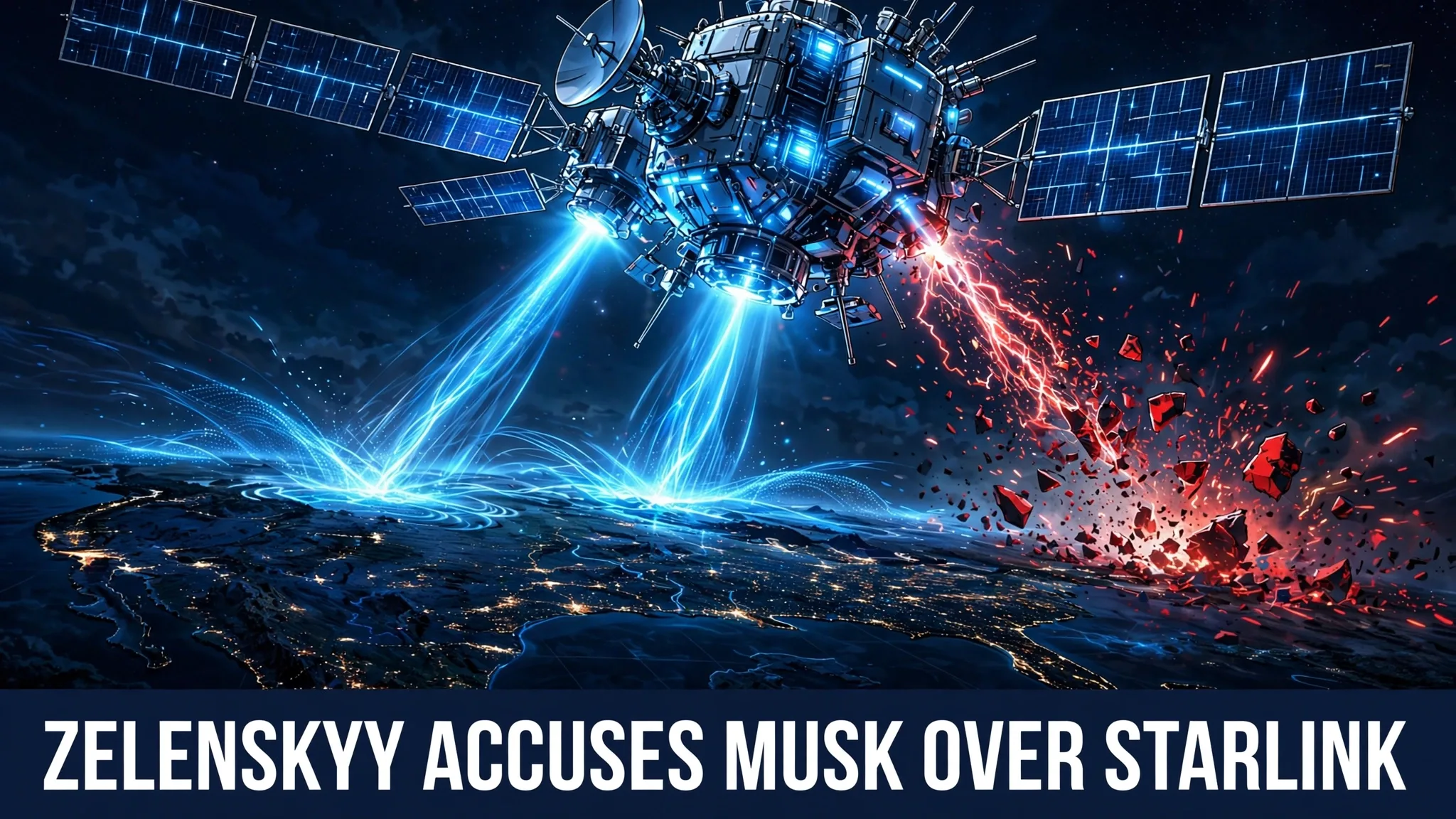
In this post
Imagine a soldier in a muddy trench, far from any city. There are no phone towers standing near him. The cables that once carried the internet were destroyed long ago. Yet he can still send a message, still see a map, still talk to his commander — because far above his head, hundreds of small satellites are quietly passing across the sky, carrying his words down to Earth.
Now imagine that connection suddenly slowing down, stuttering, failing at the worst possible moment.
That frightening picture sits at the heart of a very public argument that has now reached the front pages. On one side stands Ukraine’s President, Volodymyr Zelenskyy, pointing a finger at the richest man on the planet. On the other side stands the United States government, calmly saying: we ordered no such thing. Between these two voices — an accusation from Kyiv and a denial from Washington — sits one of the most important technologies of this war.
The Accusation From Kyiv
President Zelenskyy has accused Elon Musk of disrupting the Starlink network in Ukraine. It is a serious charge, and it is worth pausing to understand why.
Starlink is not an ordinary phone company. It is a satellite internet system run by SpaceX, the company Musk built to launch rockets. Instead of cables under the ground, Starlink uses a vast web of satellites moving in low orbit around the Earth. A small flat dish on the ground talks to those satellites, and the internet arrives from the sky itself. Where wars destroy towers and wires, a dish can be carried in a box, placed on a roof or beside a tent, and switched on.
Since the war with Russia began, this sky-internet has become a lifeline for Ukraine. Soldiers use it to communicate along a long and dangerous front line. Commanders use it to share information quickly. Hospitals, officials, journalists and ordinary families have also depended on it when normal networks went dark. In modern war, information moves as fast as weapons do, and the side that can talk, see and coordinate clearly holds a powerful advantage.
So when Ukraine’s president says the network was disrupted, he is not complaining about slow video calls. He is talking about something his country treats as part of its defence. That is why the accusation travelled so fast around the world. A president does not publicly blame a man like Musk unless he believes the matter is grave — or unless he wants the whole world to hear the complaint loudly and clearly.
Kyiv’s message, in simple words, is this: the connection our people depend on was interfered with, and the man whose company controls it bears responsibility.
The Denial From Washington
Then came the second voice.
The United States has denied ordering any slowdown of the Starlink network in Ukraine. The denial matters because of the close relationship between America, Ukraine and SpaceX. The US has been Ukraine’s strongest supporter in this war, supplying weapons, money and intelligence. Contracts and arrangements involving satellite services have passed through this partnership. If Washington had quietly asked for the network to be slowed, that would be a political earthquake. Washington’s answer says the opposite: no such order was given.
So now the world is left holding two statements that do not fit together. Kyiv speaks of disruption linked to Musk. Washington says it requested nothing of the kind. Somewhere between accusation and denial lies a tangle of technology, business and wartime politics that is very hard for outsiders to fully untangle.
It is also a reminder of something unusual about this war. The network in question does not belong to a government. It belongs to a private company, run by one very famous man. In earlier wars, communications were controlled by states and armies. In this war, a civilian billionaire’s company carries signals that soldiers rely on to survive. That simple fact makes every disagreement around Starlink bigger than a normal business dispute. When the owner of the network and the leaders of nations fall into a public argument, the argument itself becomes world news.
Why A Satellite Network Matters So Much In War
To a person living in peace, the internet is entertainment, schoolwork, office files and family calls. In a war zone, it becomes something else entirely: eyes, ears and a voice.
Armies today depend on constant communication. Units spread across fields and towns must know where they are, where their friends are, and where the danger is moving. Information from drones and observers has to travel quickly to the people who make decisions. Orders must arrive in seconds, not hours. When normal networks are bombed, jammed or switched off, a satellite system that keeps working becomes priceless.
This is exactly why Starlink earned its central place in Ukraine’s defence. Its dishes are small, portable and hard to knock out all at once, because the satellites above keep moving and there are so many of them. Destroy one dish and another can be unpacked. There is no single tower whose fall silences a whole region.
But this strength hides a weakness of a different kind. The system still has an owner. It still runs through accounts, decisions and company policies made far from the battlefield. A soldier in a trench cannot repair a decision taken in an office on another continent. That dependence — on technology the country does not own, controlled by a man it cannot command — is the deeper worry behind Zelenskyy’s words. The accusation is about disruption, but the anxiety underneath it is about dependence itself.
In my view, this is the real lesson hiding inside the quarrel: modern nations have allowed a tool of war to rest in private hands, and now even presidents must argue in public to protect their connection to the sky.
A Grim Day Behind The Headlines
This argument did not appear on a quiet day. On the same day these reports spread, Russian aerial strikes killed nine people in Ukraine, while President Zelenskyy was meeting US and European officials in Norway. Talks about support, weapons and the future of the war were happening in calm rooms far away, even as families at home faced the oldest and saddest reality of this conflict: bombs still falling on their country.
That contrast explains the emotion behind Kyiv’s accusation. For Ukraine’s leaders, every discussion about networks, aid and promises happens against the sound of real attacks. A disrupted connection is not an abstract policy problem for them. It is measured in danger for people they are responsible for protecting. When a president is travelling to ask allies for help while his citizens are being killed, his words carry a weight that pure technology arguments never could.
It also explains why Washington’s denial came quickly and clearly. America’s leaders know that any suggestion they weakened Ukraine’s lifeline — while Ukraine was under attack and its president was sitting with Western officials — would damage trust badly. In wartime alliances, trust is a weapon too, and both sides in this argument are fighting to keep hold of it.
What This Quarrel Tells The World
Step back from the two voices for a moment, and a bigger picture appears. Wars used to be fought with the tools governments owned. Today, a private satellite network, a single company and one outspoken owner can stand near the centre of a battlefield argument between presidents. The technology is marvellous — internet from the sky, available almost anywhere. The politics wrapped around it are anything but simple.
For ordinary readers, the story carries a quiet warning about the world we now live in. The services we all depend on — for talking, working, learning and staying safe — increasingly belong to a small number of giant companies. Most days, that fact is invisible. On days like this one, when a president accuses and a superpower denies, the whole world suddenly sees the wires — or in this case, the invisible beams — that hold modern life together.
Whether the disruption Ukraine describes is ever fully explained, one thing is certain: as long as this war continues, the small dishes pointing at the sky will remain some of the most important pieces of equipment in Ukraine, and every word spoken about them, in Kyiv or in Washington, will be listened to very carefully indeed.
Frequently Asked Questions
What exactly is Starlink?
Starlink is a satellite internet service run by SpaceX, the company founded by Elon Musk. Instead of sending the internet through cables and towers, it beams connections down from a large group of satellites orbiting close to the Earth. Users connect through a small dish that can be set up almost anywhere.
What is President Zelenskyy accusing Elon Musk of?
Zelenskyy has accused Musk of disrupting the Starlink network in Ukraine — the same network that Ukraine’s military and civilians rely on heavily for communication during the war with Russia.
What has the United States said about the accusation?
The United States has denied ordering a slowdown of the Starlink network in Ukraine. Washington’s position is that it gave no such instruction.
Why does Ukraine depend on Starlink so much?
Because the war has damaged or destroyed much of Ukraine’s normal communication infrastructure. Starlink’s portable dishes keep working where towers and cables cannot, giving soldiers, officials, hospitals and families a connection that arrives from the sky and is very hard to shut down completely.
Sources
- ABP Live (news headlines, 23 October 2026) — https://news.abplive.com/education/school-assembly-news-headlines-today-october-23-top-national-international-sports-business-news-1872688
- Jagran Josh (news headlines, 23 October 2026) — https://www.jagranjosh.com/lite/articles/school-assembly-news-headlines-october-23-2026-ca-result-jee-mains-neet-ug-and-other-news-1800018111-1