Container Ship Sinks in the Strait of Hormuz: GFS Pride Goes Down After Projectile Hit, Second Ship Damaged
In this post
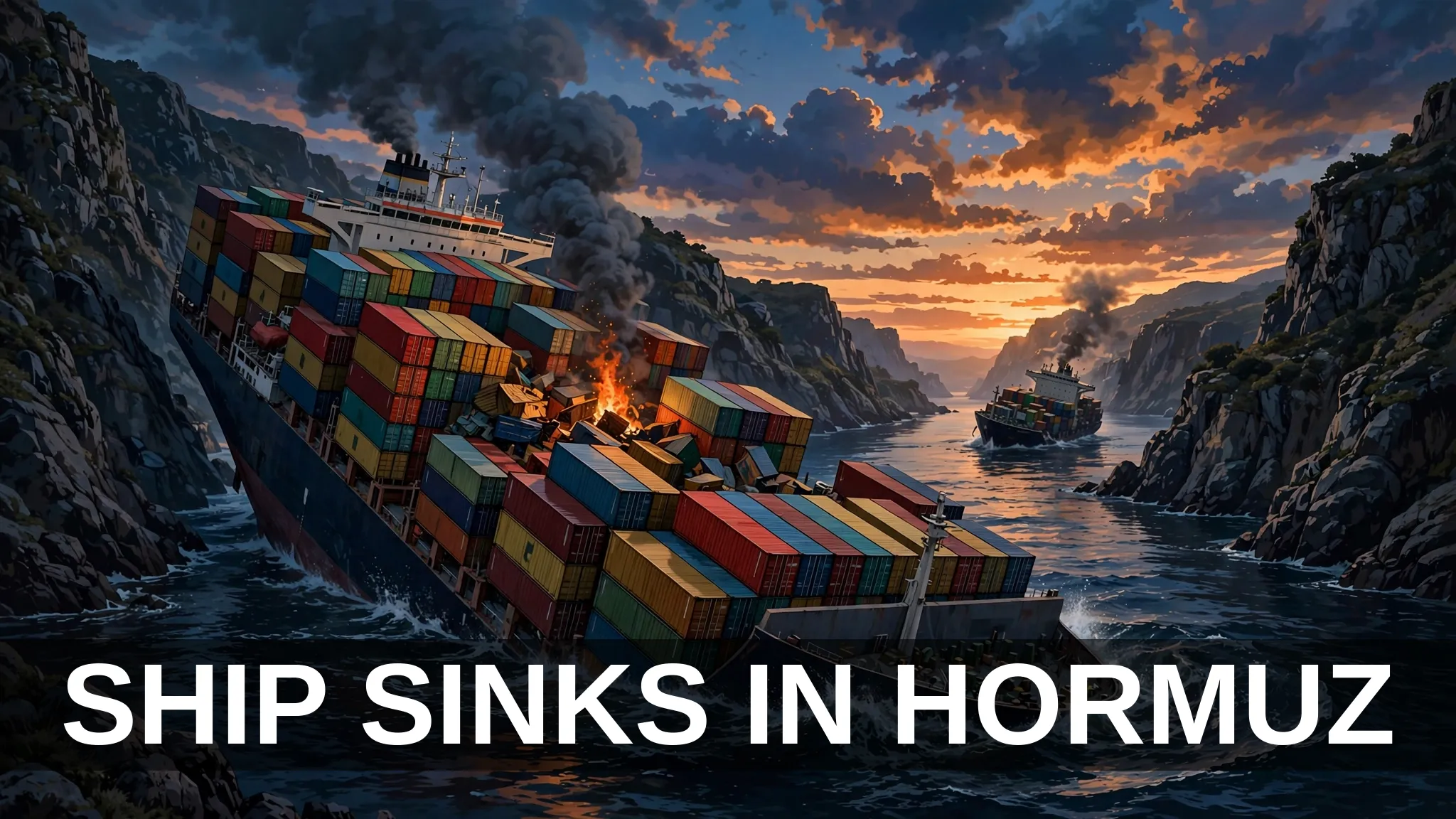
A container ship has gone to the bottom of the sea in the Strait of Hormuz, the narrow waterway the whole world’s oil passes through — and the frightening part is that nobody has officially said who fired the weapon that sank it.
The ship, named GFS Pride, was hit by an unknown projectile, caught fire, and sank. A second ship was hit a day later. Between them, 43 sailors were on board. Every single one of them survived. Here is the full story, in simple words.
What exactly happened?
Singapore’s Maritime and Port Authority (MPA) said on Wednesday 14 October that two Singapore-registered container vessels were struck by unknown projectiles while passing through the Strait of Hormuz.
The first was GFS Pride, struck on Tuesday 13 October. The ship was damaged, a fire broke out on board, and it later sank. All 21 crew members were safely evacuated, and no injuries were reported.
The second was GFS Giselle, struck on Wednesday 14 October. Its hull was damaged, but the ship was able to keep moving under its own power and reached a safe anchorage. All 22 crew members on board were safe, and again no injuries were reported.
The MPA said there were no Singaporeans among the crew of either vessel, and that it is in contact with the ships’ management company and watching the situation closely.
GFS Pride was a small container ship with a capacity of 2,824 TEU — TEU is the standard measure for containers, based on a 20-foot box. Reuters reported that ships in the area were even warned about floating containers in the water after the sinking.
The second ship to sink since the war began
This is not just one bad day at sea. According to data from the International Maritime Organization (IMO), the United Nations’ shipping agency, the loss of GFS Pride makes it the second vessel to sink since the US-Iran war began on 28 February.
And the attacks are speeding up. The Straits Times reported that at least ten vessels have been attacked in or near the Strait of Hormuz since 11 October — the highest level since the war started — based on data from the security firm Vanguard, the IMO and the British maritime agency UKMTO. Two seafarers were reported missing in that wider wave of attacks.
Separately, maritime security sources told Reuters that another ship, the Antigua and Barbuda-flagged bulk carrier Cape Dao, which was hit by a projectile on 23 September, was also reported to be sinking near the strait after a rescue attempt failed.
Who fired the projectiles? Nobody has officially said
Here is the part of the story that needs care. The MPA and maritime agencies describe the weapons only as unknown or unidentified projectiles. No government has been officially named as responsible for these two hits.
Iranian state television carried a different claim about GFS Pride: the Islamic Revolutionary Guard Corps (IRGC) said the ship sank after hitting a naval mine while taking an unauthorised route through the strait. That claim does not match the projectile account given by the MPA and UKMTO, and it has not been independently confirmed. Readers should treat both the attacker and the exact weapon as not yet officially established.
What is not in doubt is the pattern: commercial ships — the ordinary working vessels that carry food, fuel and goods — are being hit again and again in one of the most sensitive waterways on Earth.
Why the Strait of Hormuz matters so much
The Strait of Hormuz is a narrow strip of sea between Iran and Oman. Before this war, about a fifth of the world’s oil and liquefied natural gas (LNG) trade passed through it, according to Reuters. There is no easy alternative route for most of that energy.
That is why every attack there is world news. When ships are hit, insurance costs rise, shipping companies get nervous, and oil markets feel it. A sunken container ship in this strait is not only a story about one vessel — it is a warning light for the whole global economy.
What did Singapore say?
The MPA said it was deeply concerned about the continued attacks on commercial shipping in the strait, calling such attacks a breach of international law and saying that actions affecting international shipping must not endanger the safety of seafarers and ships at sea.
For the sailors themselves, the human side of this story is simple. Forty-three sailors went to work on two ordinary cargo ships. One ship burned and sank beneath them. The other limped to safety with a damaged hull. All of them are alive — and that, in a week when at least ten vessels have been attacked in these waters, is the one piece of luck in this story.
Frequently Asked Questions
Which ship sank in the Strait of Hormuz? The Singapore-registered container ship GFS Pride. It was struck by an unknown projectile on 13 October 2026, caught fire and sank, the Maritime and Port Authority of Singapore said.
Were any sailors killed or injured? No. All 21 crew members of GFS Pride were safely evacuated, and all 22 crew members of the second ship, GFS Giselle, were also safe, with no injuries reported on either vessel.
What happened to the second ship, GFS Giselle? It was struck on 14 October and its hull was damaged, but it continued under its own power and reached a safe anchorage.
Who attacked the ships? No one has been officially named. Agencies describe the weapons as unknown projectiles. Iran’s IRGC claimed GFS Pride hit a naval mine, but that claim conflicts with the projectile account and is not independently confirmed.
Why is the Strait of Hormuz so important? Before the war, about a fifth of the world’s oil and liquefied natural gas trade passed through the strait, so attacks there can affect fuel supplies and prices around the world.
Sources: Reuters, 14 October 2026; Channel NewsAsia, 14 October 2026; Malay Mail (Bernama), 15 October 2026; The Straits Times, 15 October 2026.