AI Robots, Jobs and the Future of Work 2027
In this post
- What AI Robots Can Do Well Today
- Where AI Robots Still Struggle
- Which Jobs Are Most Exposed, and Which Are Less So
- New Jobs and Changing Roles Created by AI
- Skills That Grow More Valuable, Not Less
- A Practical Plan for Workers and Students
- What Employers and Governments Should Get Right
- The Future in 2027 and Beyond: A Balanced View
- My Take:
The conversation about AI robots and jobs often swings between two extremes: one says robots will take every job, the other says nothing will change. The truth in 2027 is more useful and less dramatic. AI and robots are changing tasks inside jobs faster than they are removing whole jobs, and the effect is uneven. Some roles become easier and more productive, some become harder to enter, and some new roles appear that did not exist a few years ago. Understanding that pattern matters more than any single prediction about how many jobs will disappear, because predictions vary widely and depend on definitions, timeframes, and local economies.
This guide explains what AI robots can already do well, where they still struggle, which kinds of work are most exposed, and which human skills are becoming more valuable rather than less. It also offers a practical plan for workers, students, freelancers, and small business owners who want to prepare without panic or hype. The aim is not to promise that any particular job is safe forever. No honest guide can do that. The aim is to help you see the direction of change, judge your own exposure clearly, and take steps that remain useful even if the details turn out differently.
A helpful starting point is to think in tasks, not job titles. A job is a bundle of tasks: some routine and predictable, some social and creative, some physical and unpredictable. AI and robots tend to take over the most routine, data-heavy, or repetitive parts first. The parts that involve judgement, trust, care, persuasion, and work in messy real-world environments are harder to automate. When you look at your own work through that lens, the future becomes less abstract and much easier to plan for.
What AI Robots Can Do Well Today
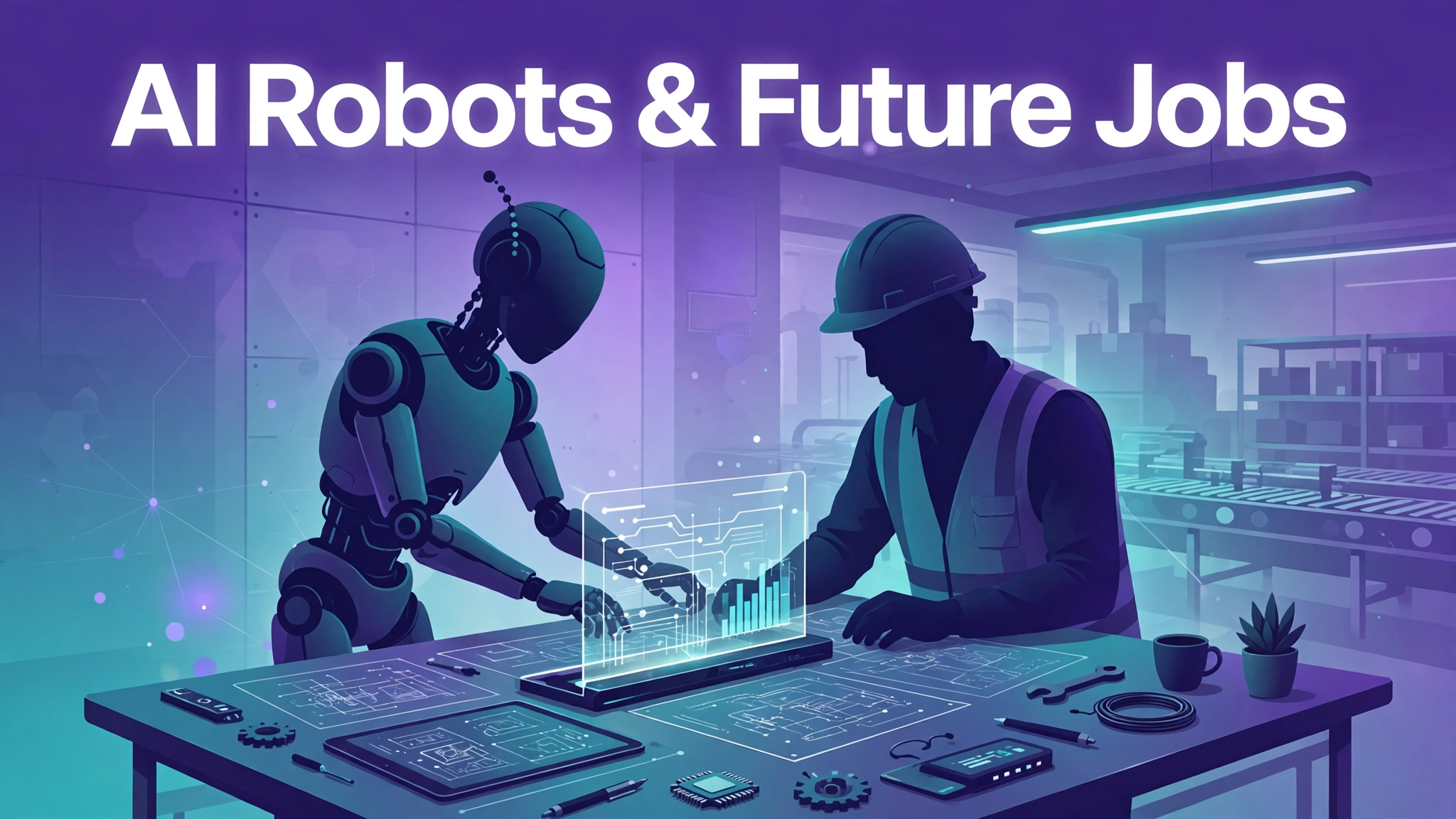
Modern AI systems are strong at recognising patterns in large amounts of data, generating drafts, summarising documents, translating language, and answering questions based on learned patterns. Robots add physical ability to that intelligence: they can move items in a warehouse, weld parts on a production line, clean floors, deliver goods along set routes, and assist surgeons with precise movements under human control. Together, these abilities make AI robots excellent at repetitive, high-volume, and data-rich work where the environment is structured and the goal is clear.
In warehouses and factories, robots already sort, lift, and transport goods with speed and consistency that is hard for humans to match over long shifts. In offices, AI tools draft emails, summarise meetings, search documents, and flag unusual transactions. In customer service, chat systems answer common questions instantly, day and night. In agriculture, machines guided by sensors plant, spray, and harvest with increasing precision. None of this means the human disappears; in many of these settings, the human moves to supervision, exception handling, maintenance, and customer relationships.
It is important to be precise about the word robot. Some AI robots look like machines with arms and wheels, while others are software robots that work entirely on a computer, moving data between systems. Both matter for jobs. A software robot that processes invoices may affect an office worker more directly than a humanoid robot that appears in a video. When you hear a claim about robots, ask which kind is meant, what task it performs, and whether it works alone or with human supervision. Those details change the job story completely.
Where AI Robots Still Struggle
AI robots struggle most where the world is messy, unpredictable, or deeply human. A home with clutter, a patient who cannot describe symptoms clearly, a customer who is upset and needs reassurance, or a negotiation where trust and reading the room matter: these are environments where human judgement, empathy, and adaptability still outperform machines. Robots also struggle with tasks that require common sense across many domains at once, such as deciding what matters in a chaotic situation and improvising a safe solution.
Physical dexterity in unstructured settings is another limit. A robot can assemble identical parts on a line, but it finds it much harder to repair a leaking pipe in an old building, care for a small child, cut hair to suit a person’s face and mood, or cook in a busy kitchen where orders change constantly. These tasks combine touch, vision, judgement, and social interaction in ways that are difficult to programme fully. That does not mean they will never be automated, but it does mean the path is slower and more partial than for structured factory work.
AI systems also make mistakes in ways humans do not expect. They can produce confident-sounding answers that are wrong, misread unusual cases, or repeat biases present in their training data. That is why human oversight remains essential in medicine, law, finance, hiring, and safety-critical work. A tool that is right most of the time still needs a person who can spot the exception, take responsibility, and explain a decision to another human. Accountability, in particular, cannot be handed to a machine: a patient, a client, or a court wants a person who answers for a choice.
Which Jobs Are Most Exposed, and Which Are Less So
Jobs most exposed to change tend to share features: they involve large amounts of routine data processing, predictable text or image work, or repetitive physical movement in a controlled environment. Examples often discussed include basic data entry, simple document drafting, routine customer queries, standard image sorting, and repetitive assembly. Exposure does not automatically mean disappearance. In many cases, the job changes: the worker uses AI to do the routine part faster and spends more time on exceptions, quality checks, and customer contact.
Jobs less exposed tend to involve physical work in unpredictable places, hands-on care, skilled trades, creative direction, leadership, and complex human relationships. Plumbers, electricians, nurses, teachers, therapists, chefs, and builders all work in environments that change constantly and require trust. That does not make them immune to change: they will use AI tools for scheduling, diagnosis support, lesson planning, or design, but the core human task remains. Even in highly exposed fields, senior roles that involve judgement, strategy, and client trust are usually harder to automate than entry-level routine tasks.
The greatest risk is often not a whole profession vanishing overnight, but entry-level pathways narrowing. If AI handles the simplest tasks that juniors once learned on, newcomers may find it harder to gain experience. That makes internships, apprenticeships, portfolios, and supervised practice more important, not less. Employers, educators, and workers all need to think about how beginners learn when the first rung of the ladder changes. A future of work that only works for experienced people is not a sustainable one.
New Jobs and Changing Roles Created by AI
Every major technology wave has created roles that were hard to imagine before it. AI is already creating work in data preparation, model evaluation, AI safety and oversight, robot maintenance, prompt and workflow design, and the integration of AI tools into existing businesses. These are not only jobs for computer scientists. Hospitals need people who can check AI outputs clinically, law firms need people who can verify AI research, and factories need technicians who can maintain robots and interpret their data.
More common than entirely new job titles is the changing mix inside existing roles. A marketer may spend less time writing first drafts and more time on strategy, audience research, and campaign testing. A teacher may spend less time marking routine work and more time on individual support. A designer may generate many options quickly and spend more time on taste, client understanding, and final judgement. In each case, the worker who learns to direct the tool, check its output, and add human value becomes more productive, not less relevant.
Small businesses also gain new possibilities. A one-person shop can now produce professional-looking marketing, translate product descriptions, analyse sales patterns, and automate routine admin without hiring a large team. That lowers the barrier to starting a business, but it also raises competition, because rivals can do the same. The advantage shifts from access to tools, which becomes common, to judgement, reputation, and customer relationships, which remain scarce.
Skills That Grow More Valuable, Not Less
As routine tasks become cheaper to automate, distinctly human skills rise in value. Clear communication, critical thinking, creativity, empathy, negotiation, and the ability to learn quickly are repeatedly named by employers and researchers as durable strengths. These are not vague soft skills; they are practical abilities with visible results. A worker who can explain a complex decision simply, spot a flawed AI output, calm a worried customer, or lead a team through change is doing work that is hard to replace.
Technical literacy also matters, but it does not mean everyone must become a programmer. It means understanding what AI tools can and cannot do, how to ask them good questions, how to check their answers, and how to protect privacy and data. A nurse who understands an AI triage suggestion, a builder who uses a digital plan, or a shop owner who reads sales data critically is technically literate in a useful sense. Short, practical training in these habits often helps more than a long theoretical course.
Learning how to learn is the meta-skill beneath all of this. Tools will change again, job descriptions will be rewritten, and the specific software you learn this year may be replaced. Workers who can pick up a new tool, test it on a real task, judge its output, and teach a colleague will adapt repeatedly. That habit can be practised in small ways: take one new tool each month, use it on a real piece of work, note what went wrong, and keep the parts that genuinely save time or improve quality.
A Practical Plan for Workers and Students
Start with a task audit of your own work. List your weekly tasks, mark the routine ones, and try an AI tool on one routine task with careful checking. Note how much time it saves, where it makes mistakes, and what human judgement it still needs. That experiment teaches you more about your exposure than any headline. Then choose one skill to strengthen over the next three months: a technical skill your field values, a communication skill, or a practical skill that involves working with people or in physical environments.
Build evidence of your work, not only certificates. A portfolio, a set of solved problems, references from clients or managers, and examples of work where you caught an error or improved a result all speak louder than a list of courses. If you are a student, seek placements, projects, and part-time work that put you beside experienced people, because supervised practice is where judgement is learned. If you are mid-career, consider mentoring, cross-training, or a side project that lets you practise a new skill without risking your main income.
Protect yourself financially and professionally while you adapt. Keep an updated record of achievements, maintain a professional network, and avoid depending on a single employer or a single platform for all your income if you can. Learn the basics of data privacy and intellectual property for your field, so you do not share sensitive work with tools in ways that create problems. These are not dramatic steps, but together they give you options when change arrives, and options are the real form of job security.
What Employers and Governments Should Get Right
Employers have a responsibility that goes beyond buying tools. They should train staff to use AI well, redesign roles so that humans keep meaningful judgement, and be honest about which tasks are changing and why. Rushing to automate without retraining creates fear, errors, and loss of trust, while involving workers in redesign often reveals better uses of the technology. The most successful adoptions tend to be those where workers help decide how a tool fits their real workflow, rather than having it imposed from above.
Governments and educators face a parallel task: updating curricula, supporting retraining, and protecting workers during transitions. That includes accessible short courses, recognised credentials for practical skills, and safety nets for people whose roles change quickly. It also includes rules on transparency, bias, privacy, and accountability, so that AI decisions affecting hiring, credit, health, or justice can be questioned and corrected. Technology policy is also jobs policy, even when it is not labelled that way.
There is also a fairness question. If AI raises productivity but the gains go only to a few owners, workers may rightly feel that progress is not shared. Shorter working hours, higher wages, better training, or new public services are all ways societies have historically shared productivity gains, and the AI wave will require a similar conversation. The future of work is not decided by technology alone; it is decided by the choices employers, governments, and workers make together.
The Future in 2027 and Beyond: A Balanced View
In the near term, the most likely picture is hybrid work: humans and AI robots working together, with machines handling scale and repetition and humans handling judgement, relationships, and exceptions. Some roles will shrink, some will grow, and many will change shape. That change can be stressful, especially for workers in the most exposed roles, and it deserves honest support rather than reassurance that everything will be fine. At the same time, history suggests that new tasks, new services, and new demands will appear, often in areas we cannot yet name clearly.
Longer-term predictions about humanoid robots in every home or fully automated workplaces should be treated with caution. Demonstrations in controlled settings are not the same as reliable, affordable, safe operation in messy real life. Costs, regulation, energy use, and public trust all shape adoption speed. A technology can be impressive in a laboratory and still take years to become practical at scale. Watching adoption in real workplaces, not only in videos, is the best way to judge the pace.
The balanced view, then, is neither panic nor complacency. Prepare for change, keep learning, protect your ability to judge and connect with people, and demand a fair share of the gains. The workers who thrive are unlikely to be those who compete with machines on speed or volume. They will be those who do what machines cannot: care, judge, create, lead, and take responsibility for decisions that matter to other people.
My Take:
My view is that the task lens changes everything. When I stop asking whether AI will take my job and start asking which of my tasks are routine, I get a plan instead of a fear. The routine parts are where I should use the tool, check it carefully, and free time for the parts that actually need me. That shift, from job title to task list, is the most useful idea in this whole debate, and I think every worker should try it once, honestly, on their own week.
I am also sceptical of both extremes. The people who say nothing will change are ignoring visible change in offices, warehouses, and studios. The people who say everything will vanish are ignoring how messy, human, and trust-based most work really is. Reality is in the middle, and it is moving at different speeds in different places. A warehouse task may change this year, while a care task may change slowly over a decade. Treating all jobs as equally exposed is a mistake.
What worries me most is not the technology but the entry-level gap. If juniors lose the simple tasks where they learned, we need new ways for them to learn: supervised projects, apprenticeships, portfolios, and patient mentoring. Without that, we risk a workforce where only experienced people can work, which helps nobody in the long run. Employers who invest in juniors now are investing in their own future staff.
I also think we should talk more about sharing the gains. If AI makes a business more productive, workers should see some of that benefit, whether in pay, training, time, or better conditions. Otherwise the story becomes one of progress for owners and pressure for everyone else, and that story will rightly lose public trust. A fair transition is not a luxury; it is what makes adoption sustainable.
In the end, my advice is practical and calm: audit your tasks, learn one useful skill at a time, build evidence of good judgement, and keep people close. Machines will get better at scale and repetition. Your advantage is judgement, care, creativity, and responsibility. Invest there, and you will remain valuable even as the tools change around you.
If I were worried about my own job tomorrow, I would not start by reading predictions about how many jobs will disappear. I would start by listing my tasks for a typical week and marking which ones are routine, repetitive, or data-heavy, and which ones involve judgement, trust, care, or messy real-world problem solving. That list is personal, concrete, and actionable, while a global prediction is abstract and often wrong for any single person. Once I see my routine tasks clearly, I can try an AI tool on one of them, check its output carefully, and learn where it helps and where it fails.
The mistake I would avoid is either ignoring AI entirely or assuming it will do everything. Ignoring it leaves me slower than colleagues who use it well, while blind trust leads to errors I cannot explain and skills I stop practising. The middle path is to use AI as an assistant, keep my judgement sharp, and build evidence of work where I caught a mistake, improved a result, or handled a difficult human situation well. That evidence, in a portfolio or a record of achievements, is what employers and clients actually trust.
After a few months, I would judge my preparation by whether I feel more options, not by whether I feel certain about the future. Certainty is unavailable, but options are real: a new skill practised on a real project, a contact in a related field, a side project that could grow, or a qualification that opens a second path. If I have more options than I had before, I am safer, even if the future still holds surprises. If I have only anxiety and no new skill, then my plan needs changing, not my attitude alone.
I would also pay attention to younger colleagues and beginners, because a future that works only for experienced people is fragile. If AI takes the simplest tasks that juniors once learned on, then mentoring, supervised projects, and patient practice become more important, not less. Helping a beginner learn judgement, even while tools handle routine work, is an investment in the whole team. The future of work will be judged not only by productivity, but by whether new workers can still enter, learn, and grow.
If a friend asked me in two minutes how to prepare, I would say: list your weekly tasks, try an AI tool on one routine task with careful checking, and strengthen one skill that machines do poorly, such as communication, judgement, or hands-on problem solving. That is a plan you can start this week, without a course, a career change, or a prediction about the future. It also gives you evidence: you will know, from your own experiment, where AI helps you and where it fails, which is more valuable than any headline.
What changed my mind over time is how much I used to think in whole jobs, as if a job were a single thing that either survived or vanished. In reality, jobs are bundles of tasks, and AI changes the mix inside the bundle long before it removes the bundle itself. A marketer still markets, but spends less time drafting and more time on strategy. A teacher still teaches, but spends less time marking routine work and more time supporting individuals. Seeing that mix clearly makes the future less frightening and much more practical to plan for.
Looking five years ahead, I expect hybrid work to become normal: humans directing AI tools, checking outputs, and handling exceptions, while machines handle scale and repetition. New roles will appear, entry-level pathways will need redesign, and societies will argue, rightly, about how productivity gains are shared. The workers who thrive will not be those who compete with machines on volume, but those who combine technical literacy with judgement, creativity, and trust. Those qualities are hard to automate precisely because they involve other people.
My final decision rule is simple: audit tasks, learn one useful skill at a time, build evidence of good judgement, and keep options open. If a skill, project, or contact increases your options, it is worth your time, even if its payoff is not immediate. If a tool, course, or prediction only increases anxiety without increasing options, set it aside. The future of work rewards people who can adapt, judge, and connect, and those abilities are built daily, in small, deliberate steps, not in a single dramatic change.
Frequently Asked Questions
Will AI robots take all jobs?
No credible picture suggests all jobs disappear. AI and robots change tasks inside jobs, remove some routine work, and create new roles, but work involving judgement, care, trust, and messy physical environments remains heavily human.
Which jobs are safest from AI?
Jobs involving unpredictable physical work, hands-on care, skilled trades, teaching, leadership, and complex human relationships are generally less exposed, though they will still use AI tools for parts of the work.
What skills should I learn for the future of work?
Focus on clear communication, critical thinking, creativity, empathy, and practical technical literacy: understanding what AI tools can do, how to check their output, and how to protect privacy and data.
How can students prepare for AI changing jobs?
Seek supervised practice, build a portfolio of real work, learn to use AI tools critically, and develop skills in judgement and communication alongside any technical qualification.
Should I be worried if AI can do part of my job?
Concern is reasonable, but it is also a signal to adapt. Use AI for routine parts, strengthen the judgement and relationship parts of your role, and keep learning so your value grows rather than shrinks.
Will new jobs appear because of AI?
Yes, new roles are already appearing in AI oversight, data work, robot maintenance, and AI integration, and many existing roles are gaining new tasks. The exact titles will keep changing, which is why adaptable skills matter.