He Was Asia's Richest Man. Now He Is in Prison for Life: The $300 Billion Evergrande Collapse
Evergrande was once China's biggest property company. Then it fell under $300 billion of debt, its founder got life in prison, and now the company is being sold piece by piece. Here is the full story — and why it is still not over.
In August this year, a man stood in a courtroom in the Chinese city of Shenzhen and heard the words no billionaire ever expects to hear: prison, for the rest of his life.
His name is Hui Ka Yan. A few years ago, he was the richest person in all of Asia. His company, Evergrande, was the biggest property builder in China — a country of 1.4 billion people. Today, that company owes around $300 billion, its offices are controlled by court-appointed liquidators, and its founder will never walk free again.
How does a company fall this far? And why is this story suddenly back in the news this month? Let us go step by step.
First, Understand How Big $300 Billion Really Is
Numbers like this are hard to feel, so here is a simple way to picture it.
If you spent one million dollars every single day, it would take you more than 800 years to spend $300 billion.
That is the size of the hole Evergrande fell into. It defaulted — failed to pay back — most of its $300 billion in liabilities, according to Reuters. Banks, investors, suppliers, and ordinary families who had paid for homes were all left standing in line, waiting for money that may never fully come back.
The Rise: Selling Homes That Did Not Exist Yet
Evergrande grew huge using a model that was common in China. The company would sell apartments years before they were built. Families paid in advance — often their life savings — trusting that their tower would rise and their flat would be ready one day.
With that money, the company bought more land, started more projects, and sold even more unbuilt homes. As long as prices kept rising and new buyers kept coming, the machine worked beautifully. Evergrande became China’s premier developer, and Hui Ka Yan became Asia’s richest man.
But the machine had a weakness. It only worked while the money kept flowing in. The whole empire was standing on borrowed money and advance payments.
The Fall: When the Music Stopped
About six years ago, China’s government decided the property market had become too dangerous. Regulators cracked down hard on developers who had borrowed too much.
For Evergrande, the crackdown was like someone suddenly closing the tap while the bath was still filling with bills. Loans became hard to get. Buyers grew nervous. Sales slowed. And one by one, the payment deadlines arrived — and the money was not there.
The company defaulted on most of its $300 billion debt. Construction stopped on project after project across China. In January 2024, a Hong Kong court gave the order nobody thought they would ever see: Evergrande would be liquidated — closed down, piece by piece, so that whatever could be sold would be sold to repay creditors. Last year, its shares were removed from the Hong Kong stock exchange entirely. The giant was officially dead.
The Founder’s End
Then came the part of the story that sounds like a film.
On August 20, 2026, Hui Ka Yan stood in the Shenzhen Intermediate People’s Court for sentencing. He was convicted of crimes ranging from misuse of funds to bribery, and the court gave him life in prison.
The man who once stood at the very top of Asian wealth — above every businessman in China, India, and Japan — ended his story in a prison cell. Reports say his personal assets were confiscated as well.
If the story ended there, it would already be one of the biggest business collapses in history. But it did not end there.
Why Evergrande Is Back in the News This Month
The company is dead, but its ghost is still being sold — and this October, that sale reached an important moment.
The court-appointed liquidators, whose job is to find money for the people Evergrande owes, have been trying to sell the company’s remaining valuable pieces. The biggest one is Evergrande Property Services, the part of the empire that manages buildings. This month, Reuters reported that an investment firm called PAG is in exclusive talks to buy the liquidators’ 51% controlling stake in that unit.
Some details show how far the mighty have fallen:
- The whole property services unit is now worth slightly under $1.6 billion — small change next to a $300 billion debt.
- Its share price has dropped 87% since it listed in 2020.
- The exclusive talks end on October 27 — after that date, anything can happen.
And the court fights are not over either. On October 6, the liquidators sued two former associates of the founder in Hong Kong, claiming about HK$19.15 billion over money transfers made between 2014 and 2020. One of those men has reportedly fired back with his own claim of about HK$10.1 billion. Everyone is fighting over what is left of the fortune.
Here is the number that tells the saddest part of the story: as of last August, the liquidators had managed to sell only about $255 million worth of assets — against creditor claims of around $45 billion. For every $176 owed, about $1 has been found.
The Real Victims Are Not Billionaires
It is easy to read this as a story about rich men and big banks. It is not. The deepest pain belongs to ordinary families.
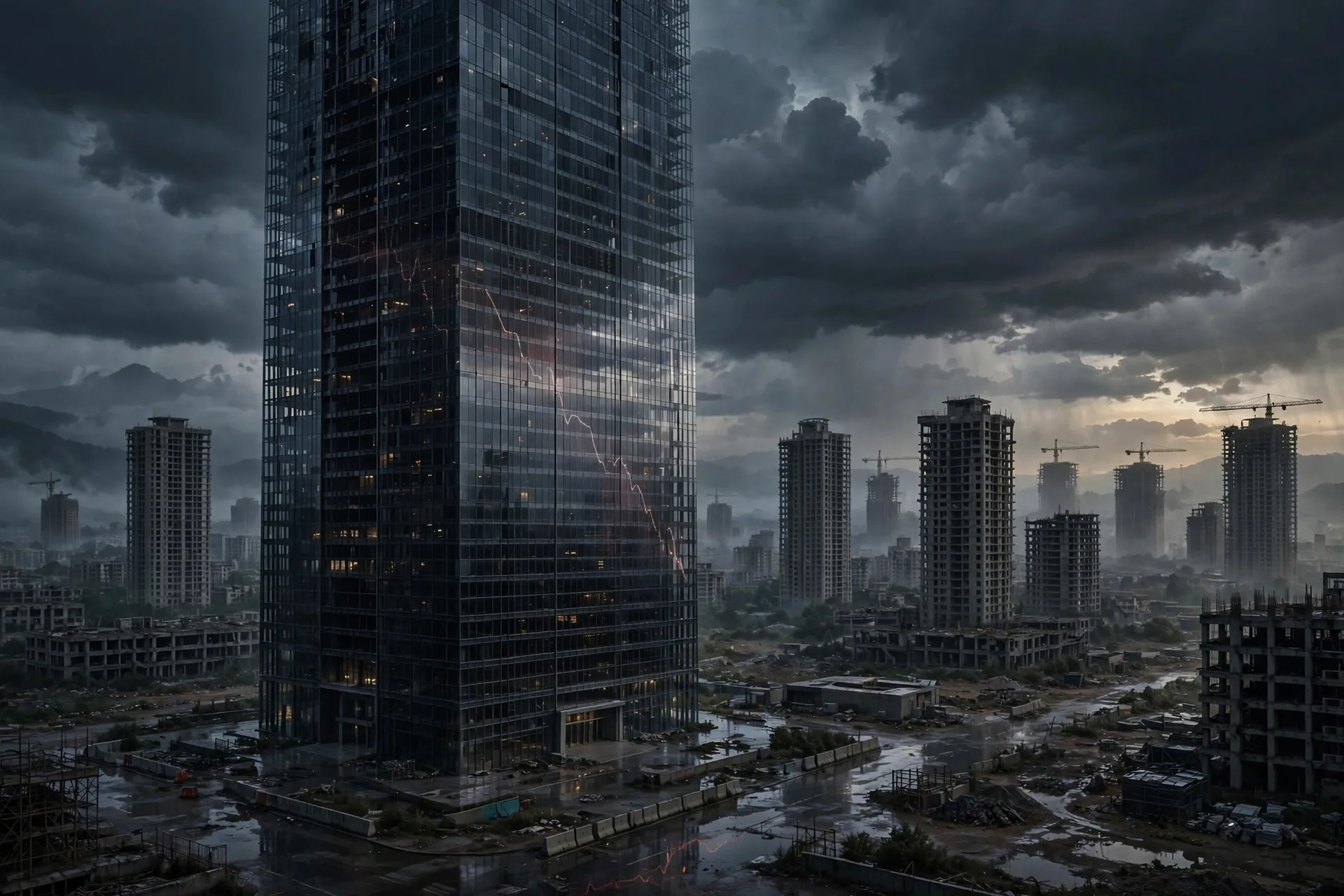
Across China, millions of partially built properties sit unfinished and empty — concrete towers where families were supposed to live. People who paid in full for homes that were never completed are still waiting, years later. In smaller cities, second-hand home prices have fallen by almost a quarter from their 2020 levels, shrinking the savings of families who owned just one flat.
China’s property crisis is now in its sixth year, and it is still dragging on the whole country. China’s economy grew 4.3% in the three months to June — its slowest pace in more than three years — and the broken property market is one of the main reasons why.
The Questions Nobody Can Answer Yet
And this is where the story refuses to end.
First: October 27 is coming. Will the big sale go through — or will the last valuable piece of Evergrande fail to find a buyer, like so much else?
Second: $45 billion is claimed. Only $255 million has been recovered. Will the families who paid for homes that were never built ever see even a small part of their money again?
Third — and this is the one that keeps experts awake: Evergrande was the first giant to fall. China’s property market is still shrinking, prices are still sliding, and other builders are still carrying mountains of debt. Was Evergrande the end of the earthquake… or only the first building to come down?
The biggest property collapse in modern history is not finished. It has only entered its next chapter — and the whole world is still watching.
Quick Questions
Is Evergrande completely finished? As a working company, yes. A Hong Kong court ordered it liquidated in January 2024 and its shares were delisted last year. What remains is a legal process: liquidators selling its pieces and fighting court cases to recover money for creditors.
How much money does Evergrande owe? It defaulted on most of its roughly $300 billion in liabilities. Formal creditor claims in the liquidation are reported at around $45 billion.
What happened to Evergrande’s founder? Hui Ka Yan, once Asia’s richest person, was sentenced to life in prison by a Shenzhen court on August 20, 2026, after being convicted of crimes including misuse of funds and bribery.
Will homebuyers get their money back? Nobody knows, and the numbers are not hopeful: only about $255 million in assets had been sold by last August against around $45 billion of claims. Ordinary buyers are still waiting.