Amityville Horror True Story Explained
In this post
- The Crime That No One Disputes
- The Trial And The Sentence
- The Lutz Family Moves In
- Twenty-Eight Days In The House
- What Visitors Said They Felt
- The Book, The Film And The Flood Of Visitors
- A House Made Less Recognisable
- What The Town Thinks Today
- Fact, Claim And Legend, Side By Side
- The Saddest Line In The Story
- You may also like
Few houses in the world are as famous as the one at 112 Ocean Avenue in Amityville, a quiet village on Long Island, New York. Its name is attached to a book that sold millions, a film that frightened a generation, and a story of a family that fled their home after less than a month. But behind the horror legend sits a real and terrible crime, and a long argument about what is true and what is not.
This post separates the facts from the claims, using the record reported by A&E. What happened in the house in 1974 is documented. What happened after the next family moved in is claimed, disputed, and still argued about today.
The Crime That No One Disputes
The indisputable facts begin in the early-morning hours of 13 November 1974. Ron and Louise DeFeo, along with four of their five children, were shot dead in their beds at 112 Ocean Avenue. The house became a grisly crime scene in a placid village along Long Island’s south shore.
The eldest child, Ron DeFeo Jr., was the only survivor. He eventually confessed to police that he was the one who fired the rifle. A&E quotes his words to police: “Once I started, I just couldn’t stop.” DeFeo added that “voices from the house” turned him into a killer. That claim about voices would later become central to the haunting legend, but in court it did not save him.
The Trial And The Sentence
At his trial in 1975, defence lawyer William Weber argued, without success, that DeFeo was innocent by reason of insanity. On 21 November 1975, DeFeo was convicted on six counts of second-degree murder and sentenced to six consecutive sentences of 25 years to life in prison. He died in prison in 2021, at the age of 69.
These are the facts of record: six people murdered, one killer convicted, a life sentence that ended in prison. Nothing about the haunting claims changes that record. Whatever else is said about Amityville, it begins with a family destroyed in one night, and that loss should not be lost inside a ghost story.
The Lutz Family Moves In
Less than one month after DeFeo’s conviction, a new family moved into 112 Ocean Avenue. George and Kathy Lutz, with their three children, bought the house for the bargain price of 80,000 dollars, furnishings included. It was a large house at a low price, and the reason for the low price was no secret. Everyone in Amityville knew what had happened there.
The condition of the house added to the grim picture. Investigative reporter Laura DiDio, who covered the story for New York television, recalled to A&E that the homicide forensics team had not cleaned anything up. Kathy Lutz moved in and was scrubbing blood and bone and brain matter off walls, floors and bed frames. Whatever the family expected from their new home, the first days were spent cleaning the traces of a massacre.
Twenty-Eight Days In The House
The Lutz family lasted just 28 days in the house before they fled, leaving everything behind. That short stay is the heart of the Amityville legend. Twenty-eight days, then flight in alleged terror, with furniture, clothes and food abandoned. The family said they had been driven out by forces in the house. Sceptics have always asked a simpler question: why would anyone leave everything behind unless they were truly frightened, or unless leaving everything made a better story?
George and Kathy Lutz described eerie paranormal experiences in the house, including swarming flies, red-eyed apparitions and menacing voices. DiDio summarised their account with a memorable line: it was like they had been visited by every type of haunting except Dracula, Frankenstein and the Wolfman. The claims were dramatic, varied and, for believers, convincing precisely because they were so many.
What Visitors Said They Felt
DiDio herself visited the house while working as a news producer for New York City’s WNEW Channel 5. She earned several exclusive interviews with the Lutzes and was entrusted with a key to the house to gather footage. During one visit, the station’s news anchor reported feeling a chill, and the cameraman inexplicably doubled over halfway up the stairs to the scene of the murders. On another visit, DiDio’s dog stood at the foot of those stairs, staring upward, baring its teeth and growling.
DiDio’s own verdict, given to A&E years later, is carefully balanced: “I was like, how come I don’t feel anything inside the house? A lot of this stuff was made up, but there were a lot of creepy things that did happen.” That sentence captures the whole Amityville problem. Some things in the house felt genuinely unsettling to visitors. Some parts of the story, in DiDio’s view, were invented. Telling the two apart, fifty years later, is no longer possible with certainty.
The Book, The Film And The Flood Of Visitors
The Lutzes’ story became a book, The Amityville Horror, by Jay Anson, and then a film in 1979. By 1981, Anson’s book had sold 6.5 million copies and had been reprinted 37 times. The story spread far beyond Long Island, and the visitors followed.
Scores of curious sightseers came to Ocean Avenue, clogging traffic on the roads and waterways of the town of about 9,700 people. DiDio recalled: “They came by busloads and in boats on the Amityville River. I was getting calls at the TV station from local teenagers asking if they could have sleepovers in the house.” For the village, the horror story became a local nuisance, a stream of strangers staring at a family home.
A House Made Less Recognisable
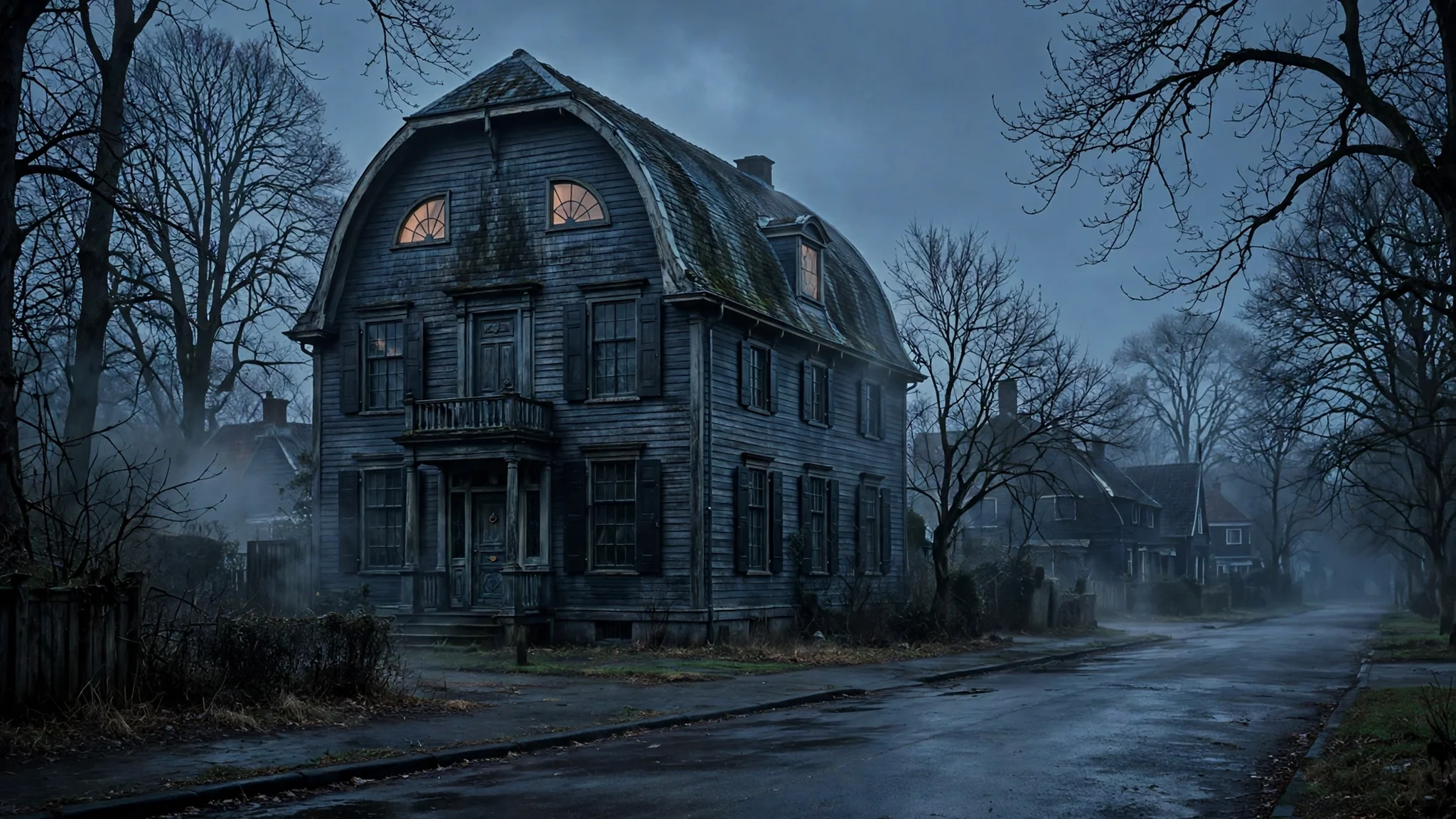
Later owners tried to make the house less recognisable, in the hope that visitors would stop coming. The dark exterior was repainted a pale off-white. The official address was changed from 112 to 108 Ocean Avenue. The swimming pool was filled in. The quarter-circle third-storey windows, rendered on the 1979 movie poster as fiery orange eyes facing the road, were replaced.
None of it fully worked. The house still gets some attention from tourists, according to a lifelong local resident quoted by A&E. The building can be repainted and renumbered, but its story cannot be removed. A house that appears in a famous film keeps its screen face long after the paint has changed.
What The Town Thinks Today
For the people of Amityville, the legend has long outstayed its welcome. There was briefly talk of the village buying the property and tearing it down so that it would just go away, and talk of moving the house to the village centre as a tourist attraction. Neither happened. Asked whether the town ever thought of changing its name, the local resident answered: “No, no, no. Not a chance.”
The same resident, who was the listing agent when the house last went on the market in 2016 for an asking price of 850,000 dollars, describes it simply as a big, beautiful house, a classic with a great location on the water, a grand centre hall and a wide centre staircase. It sold in 2017 at the reduced price of 605,000 dollars to a young family of four with a small wellness business in town. Of all the residents since the Lutzes, A&E reports, none have run from the house screaming or reported any kind of disturbance, aside from gawkers in the street.
Fact, Claim And Legend, Side By Side
It helps to lay out the three layers clearly. Fact: six members of the DeFeo family were murdered in the house in 1974, and Ronald DeFeo Jr. was convicted of the murders. Fact: the Lutz family bought the house cheaply, lived there for 28 days, and left in a hurry. Claim: the Lutzes experienced hauntings, including flies, apparitions and voices. Claim, disputed: that the house itself drove them out, rather than fear, money, publicity or some mix of all three.
The book and film added a fourth layer: legend. In legend, the house is evil itself, with glowing eyes and a history reaching back before the murders. No evidence in the A&E account supports that version. What the record supports is more modest and more human: a terrible crime, a frightened family, a story that grew with each retelling, and a town that wishes the whole thing would go away.
The Saddest Line In The Story
The local resident quoted by A&E gives the story its saddest summary: “All because of a tired old ghost story that was not true. We just wish it would go away. The only horror about that house is the fact that a kid killed his whole family there.” It is a reminder that behind every haunted house tale, there are real victims whose names are easily forgotten when the ghost story takes over.
Amityville endures because it has everything a horror legend needs: a real crime, a short and dramatic stay, a bestselling book, a famous film, and a house that still stands. But the most honest version of the story is also the simplest. Six people were murdered. A family left after 28 days. Everything after that is claim, argument and legend, and readers should know which is which.
You may also like
Frequently Asked Questions
Is the Amityville horror story true?
Only part of it is proved true. It is a documented fact that on 13 November 1974, Ron and Louise DeFeo and four of their five children were shot dead at 112 Ocean Avenue, that Ronald DeFeo Jr. confessed and was convicted of six counts of second-degree murder in 1975, and that George and Kathy Lutz bought the house cheaply and left after 28 days. The haunting claims, including swarming flies, red-eyed apparitions and menacing voices, were described by the Lutzes but are disputed, and later residents have reported no disturbances, so the paranormal part of the story is claim and legend rather than proved fact.
What happened to the DeFeo family at Amityville?
In the early-morning hours of 13 November 1974, Ron and Louise DeFeo and four of their five children were shot dead in their beds at 112 Ocean Avenue in Amityville, Long Island. Their eldest son, Ronald DeFeo Jr., the only survivor, confessed to police that he fired the rifle, saying that voices from the house turned him into a killer. He was convicted on six counts of second-degree murder on 21 November 1975, sentenced to six consecutive terms of 25 years to life, and died in prison in 2021 at the age of 69.
How long did the Lutz family live in the Amityville house?
George and Kathy Lutz and their three children lived in the house for just 28 days before fleeing, leaving everything behind. They had bought it less than a month after DeFeo’s conviction for the bargain price of 80,000 dollars, furnishings included, and Kathy Lutz spent the first days scrubbing blood and bone and brain matter from walls, floors and bed frames, because the forensics team had not cleaned the house. The Lutzes said eerie experiences, including flies, apparitions and voices, drove them out, though that explanation has always been disputed.
Why did the Amityville house become so famous?
The house became famous through Jay Anson’s bestselling book The Amityville Horror and the 1979 film based on it, with the book selling 6.5 million copies and being reprinted 37 times by 1981. The story drew busloads of sightseers and boatloads of visitors to Ocean Avenue in a town of about 9,700 people, clogging roads and waterways and turning the house into a local nuisance. Later owners repainted the dark exterior pale off-white, changed the address from 112 to 108 Ocean Avenue, filled in the pool and replaced the famous quarter-circle attic windows, but tourists still come to see it.
Do people still live in the Amityville house today?
Yes, the house is a private family home. It last went on the market in 2016 for an asking price of 850,000 dollars and sold in 2017 for 605,000 dollars to a young family of four with a small wellness business in Amityville. According to A&E, none of the residents since the Lutzes have run from the house screaming or reported any kind of disturbance, apart from gawkers in the street tying up traffic, which is why many locals describe the ghost story as a tired legend they wish would go away.