The Lift That Stopped Nowhere
In this post
Note: This is a fictional horror story. It is not real, and any resemblance to real people or places is purely coincidental.
Sara had worked late in the Meridian Building for three years, and she knew its lift the way you know an old colleague. It was slow. It sighed. It stopped with a small jolt on every floor, as if it were thinking about it. On the night it began, she was the last person left on the seventh floor, finishing a report that should have been finished at six. At twenty past eleven, she switched off her desk lamp, locked the office door, and pressed the lift button.
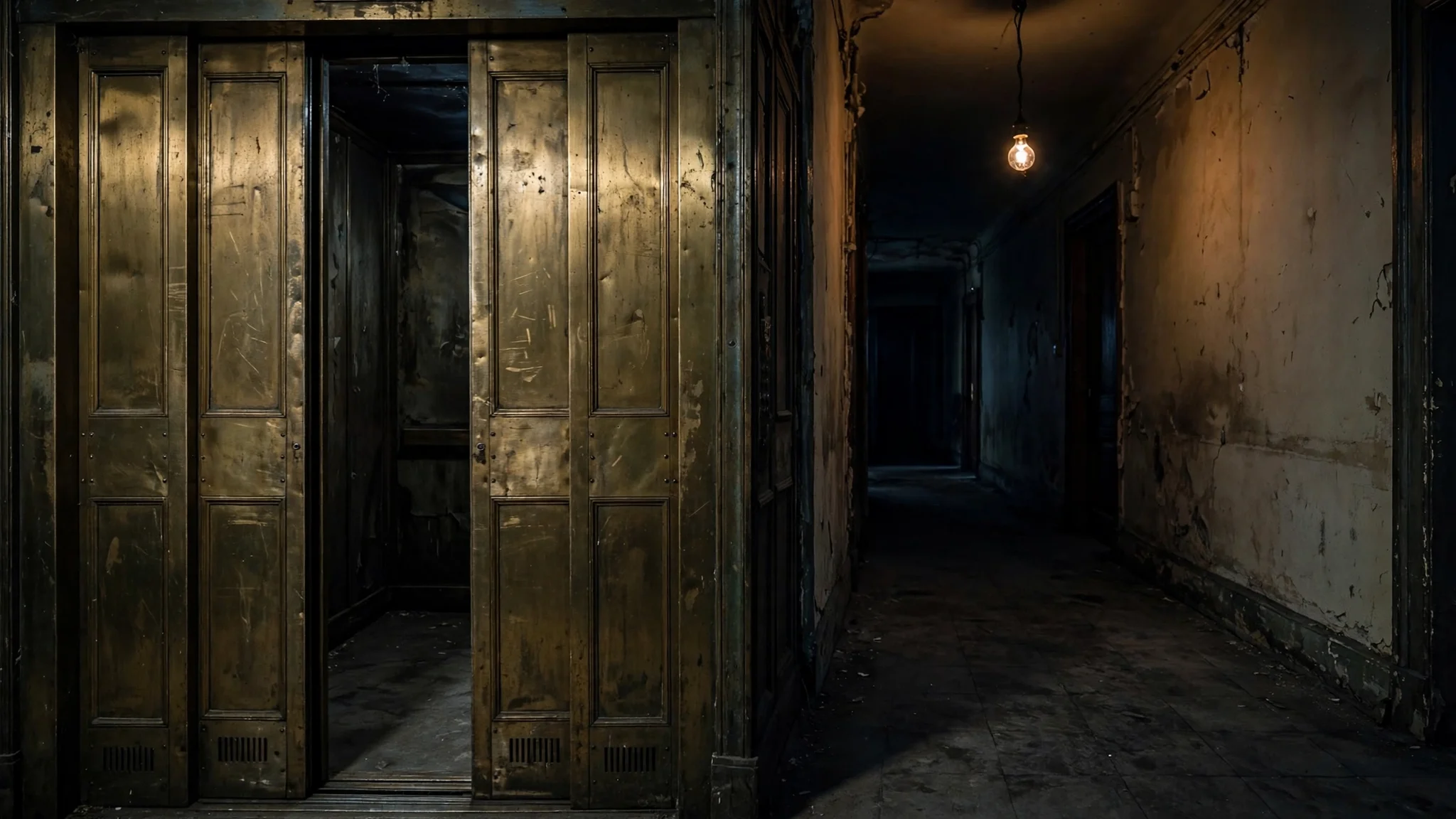
The lift arrived at once, which was strange. The Meridian lift never arrived at once. It always took its time, humming up through the floors like a man climbing stairs. Tonight the doors opened before her finger had left the button, as if the lift had been waiting for her, doors closed, in the dark shaft, listening for the call.
She stepped in. She pressed G for the ground floor. The doors closed. The lift began to go down.
It stopped at the sixth floor. That was normal. The lift always paused at the sixth floor, even when no one had called it, and the doors would open onto an empty corridor, and close again. Sara had stopped noticing. Tonight the doors did not open. The lift waited, humming, for a long moment, and then it went on down.
The Floor Between Six And Five
Between the sixth floor and the fifth, the lift stopped again. This time the small panel above the door, which had always shown numbers, showed something else. It showed a symbol Sara had never seen before: a short horizontal line, like a floor that had no number at all.
The doors opened.
Beyond them was a corridor. It was not the fifth floor corridor, which Sara knew well, with its blue carpet and its row of office doors and its humming water cooler. This corridor had a green carpet, worn thin in the middle. Its lights were the old round kind, set into the ceiling, and one of them was flickering. At the far end stood a door with frosted glass, and on the glass, in faded gold letters, was a word: ARCHIVE.
Sara did not step out. She pressed the door-close button, hard, twice. The doors stayed open. The lift, which had always obeyed her, waited. From the corridor came a sound she had not heard in an office building before: the sound of a telephone ringing, far away, in a room with no one in it.
Then the doors closed, slowly, as if someone had changed their mind, and the lift went down to the fifth floor, where the doors opened onto the blue carpet and the water cooler, exactly as they should.
The Man Who Got In At Five
At the fifth floor, a man got in. Sara had never seen him before, which was odd, because the building was not large, and after three years she knew most faces. He was older, perhaps sixty, in a grey suit that looked too heavy for the warm night. He carried a leather briefcase, scuffed at the corners, and he smelled faintly of rain, though it had not rained all day.
He nodded at her, politely, and pressed no button. Sara watched the panel. The lift was going down. The man stood beside her, looking straight ahead, the way people do in lifts, and after a moment he said, without turning his head, “You should not have stopped.”
Sara’s mouth went dry. “I didn’t stop it,” she said. “It stopped by itself.”
“That floor,” the man said, “does not like to be noticed. It has been quiet for a long time. You noticed it. Now it knows your floor.”
The lift stopped at the fourth floor. The doors opened onto darkness and a corridor that should have been lit. The man did not get out. The doors closed. Sara tried to say something else, but her voice would not come. The man was looking at her reflection in the lift doors now, and his reflection was smiling, though his face was not.
The Buttons That Would Not Light
Sara pressed G again, and then the ground floor button, and then the alarm button, one after another, her thumb shaking. None of them lit up. The panel above the door showed the number 3, then 2, then the strange horizontal line again, and the lift stopped, and the doors opened onto the green carpet corridor.
This time the corridor was closer. Sara could see the frosted glass door at the end more clearly. The gold letters said ARCHIVE. The telephone was still ringing, nearer now, and under it there was another sound: the sound of many papers being shuffled, quickly, by many hands, in a room full of people who were not there.
“Don’t look at the door,” the man said quietly. “Look at the floor. If you look at the door, it will open. That is the rule. That is the only rule.”
Sara looked down at the green carpet. Her shoes were shaking. The lift doors stayed open for a long time. The flickering light at the end of the corridor went out, and then came back on, and then went out again, and in the dark between, Sara heard footsteps coming down the corridor, slow and heavy, as if someone were walking with a briefcase in each hand.
The Passenger Who Was Not Going Down
The doors closed. The lift went down to the ground floor. The doors opened onto the lobby, bright and empty, with the security desk and the revolving door and the street beyond, wet with the light of the lamps. Sara stepped out so fast she nearly fell. She turned to look back, to see the man, to say something, anything, to make the night make sense.
The lift was empty. The doors were closing on nothing. There was no grey suit, no briefcase, no smell of rain. The panel above the door showed G, and then the lift began to rise again, smoothly, without being called, past the first floor, the second, the third, until the numbers stopped and the small horizontal line showed again, and Sara understood, with a coldness that started in her stomach and spread to her hands, that the lift was going back up to the floor that did not exist, to collect someone else.
She ran out into the street and did not stop until she was two blocks away, under the lights of the all-night garage, where a man in an orange jacket was drinking tea and the world was ordinary again.
The Morning After The Long Night
Sara did not sleep that night. She sat in her flat with every light on, the television talking to the walls, and told herself, over and over, the sensible things. Lifts break. Panels glitch. Tired minds invent passengers the way tired eyes invent shapes. She had worked too late. She had eaten nothing since lunch. It was stress, and heat, and an old building with old wiring.
In the morning, she went back to the Meridian Building early, before anyone else, because she needed to prove to herself that the building was ordinary in daylight. The lift was waiting on the ground floor, doors open, empty. She stepped in and pressed 7. The lift rose smoothly. It stopped at the sixth floor, paused, and went on. It did not stop between six and five. The panel showed only numbers. The corridor on the fifth floor was blue-carpeted and ordinary.
On the seventh floor, her office was exactly as she had left it. Her report was on her desk. Her lamp was off. Everything was normal, and Sara felt the fear loosen its grip, just a little, until she reached her desk and saw the small thing sitting on top of her keyboard, in the exact centre, where it could not be missed.
The Briefcase On Her Desk
It was a brass key, old and heavy, with a small paper tag tied to it with string. On the tag, in faded handwriting, were two words: ARCHIVE. Sara did not touch it. She stood looking at it for a long time, while the office filled with morning light and the sounds of other people arriving, laughing, switching on computers, starting an ordinary day in an ordinary building.
She called building security. The guard came up, a young man with a clipboard, and looked at the key, and frowned. “We don’t have an archive,” he said. “There is no archive floor in this building. There never has been. The building has seven floors and a basement. That is all.”
“Then what is this key for?” Sara asked.
The guard turned the tag over. On the back, in the same faded handwriting, was a second line. He read it aloud, slowly, and his voice changed as he read it, the way a voice changes when a joke stops being funny. It said: FOR THE NEXT ONE WHO STOPS.
The Rule Of The Lift
Sara left the key on her desk. She did not take it home. She did not throw it away. She put it in her drawer, under a pile of old notebooks, and tried to forget it. For a week, she took the stairs. Her legs ached. Her colleagues teased her about her new fitness plan. She smiled, and said nothing, and arrived at her desk every morning a little out of breath and a little safer.
On the eighth night, she worked late again. The report could not wait. At twenty past eleven, she stood in the corridor and looked at the lift doors, and at the stairwell door beside them, and she chose the stairs, as she had chosen every night that week. She was halfway down when she heard it: the lift, humming, stopping on her floor, doors opening onto an empty corridor, waiting.
She did not go back up. She walked down, flight after flight, counting the floors aloud to keep herself company. Seven. Six. Five. Four. And between the floors, in the stairwell, where there should have been nothing but concrete and painted walls, she heard the telephone ringing, far away, and the sound of papers being shuffled by many hands, and a voice she recognised, polite and tired, saying, “You should not have stopped.”
The Lift In Daylight
In the days that followed, Sara watched the lift the way you watch an animal you no longer trust. In daylight, it behaved perfectly. It arrived when called. It stopped at the right floors. The panel showed only numbers. Colleagues rode it up and down all day, laughing, carrying coffee, complaining about the weather, and nothing strange happened to any of them.
But twice, when Sara was alone in it, the lift paused between the sixth floor and the fifth, just for a second, and the panel flickered, as if a number were trying to appear and thinking better of it. Twice, the doors opened on the fifth floor onto the blue carpet, and Sara thought, for half a breath, that she could smell old carpet and hear a telephone ringing, far away, in a room with no one in it. She never told anyone. She did not want to be the woman who was frightened of the lift. She wanted to be the woman who had imagined it all, and who would, in time, forget.
The Key That Moved By Itself
Sara kept the brass key in her desk drawer, under a pile of old notebooks, where she had put it on the morning the guard had read its tag aloud. She checked the drawer every morning, the way you check a locked door twice, and every morning the key was there, under the notebooks, exactly where she had left it.
On the tenth morning, it was not under the notebooks. It was on top of them, in the exact centre of the drawer, with its paper tag facing up, as if someone had opened the drawer in the night, lifted the notebooks, and set the key down carefully, where it could not be missed. Sara closed the drawer. She opened it again. The key was still there. The notebooks were still under it. No one else had a key to her desk. No one else came into her office at night. The cleaning staff, when she asked, said they never opened drawers, and they had never seen a brass key, and they looked at her the way people look at someone who has not been sleeping well.
Sara put the key back under the notebooks, and she put a heavy book on top of them, and she told herself that she had moved it herself, and forgotten, and that tired people do such things all the time. She did not believe herself. She knew, with the same cold certainty she had felt in the lift, that the key had been moved by hands that were not hers, and that the hands had been careful, and patient, and in no hurry at all.
The Night Shift Nobody Wants
Sara left the Meridian Building three weeks later. She found a job in a new building, all glass and bright lights, with a lift that was fast and new and had a voice that announced every floor in a cheerful tone. She never worked late again. She never took a lift alone at night. She told no one what had happened, because she knew how it would sound, and because some stories, told aloud, become invitations.
But sometimes, in her new office, when the lift stops between floors for no reason, and the panel flickers, Sara holds her breath. And sometimes, in the quiet of the evening, her phone rings with a number she does not recognise, and when she answers, there is only the sound of a telephone ringing far away, in a room with no one in it, and a voice, patient and polite, saying, “We have a key for you. The archive is waiting. The lift is on its way down.”
She does not answer anymore. She keeps her phone in a drawer now, switched off, after dark. But she knows, in the way that people know things at twenty past eleven when they cannot sleep, that the lift in the Meridian Building is still stopping at a floor that does not exist, and that somewhere, in a corridor with a green carpet and a flickering light, a door with frosted glass is waiting for the next person who notices it, and looks at it, and lets it open.
Frequently Asked Questions
What happens to Sara in the lift at night?
Sara works late in the Meridian Building and takes the lift down at twenty past eleven, but the lift stops between the sixth and fifth floors at a floor with no number, where the doors open onto a green-carpeted corridor with a flickering light and a frosted glass door marked ARCHIVE. A telephone rings in an empty room, the doors close on their own, and a strange man in a grey suit gets in at the fifth floor, warns her not to look at the archive door, and then vanishes from the empty lift at the ground floor.
Who is the man in the grey suit in the lift?
The man is an older stranger Sara has never seen before, wearing a heavy grey suit and carrying a scuffed leather briefcase, who smells faintly of rain although it has not rained all day. He presses no button, tells Sara that the floor does not like to be noticed and now knows her floor, warns her to look at the floor and not at the archive door because looking at it will make it open, and his reflection smiles in the lift doors although his face does not. When Sara reaches the ground floor and turns back, the lift is empty and he is gone.
What is the archive floor in the scary lift story?
The archive floor is a floor that does not officially exist in the Meridian Building, reached only when the lift stops between the sixth and fifth floors and shows a short horizontal line instead of a number. Its corridor has a worn green carpet, old round ceiling lights, one flickering bulb, the sound of a ringing telephone and papers being shuffled by unseen hands, and a frosted glass door marked ARCHIVE in faded gold letters. Building security tells Sara there is no archive and never has been, since the building has only seven floors and a basement.
What does Sara find on her desk the next morning?
The next morning Sara finds a heavy brass key sitting in the exact centre of her keyboard, with a paper tag tied to it with string that reads ARCHIVE, and on the back of the tag a second line reading FOR THE NEXT ONE WHO STOPS. She leaves the key in her drawer under old notebooks, takes the stairs for a week, and later leaves the building for a new job, but she still hears the telephone ringing and a polite voice saying the archive is waiting whenever a lift stops between floors at night.
Is the lift story a true story?
No, the lift story is a fictional horror story, and the note at the top of the post states that it is not real and any resemblance to real people or places is purely coincidental. It was written as a short scary story to read at night, in the same fictional-story shape as the other horror stories on this blog, with invented characters, an invented building and an invented floor that does not exist.
More stories to read
Some lifts do not take you where you asked to go. They take you where you were noticed.