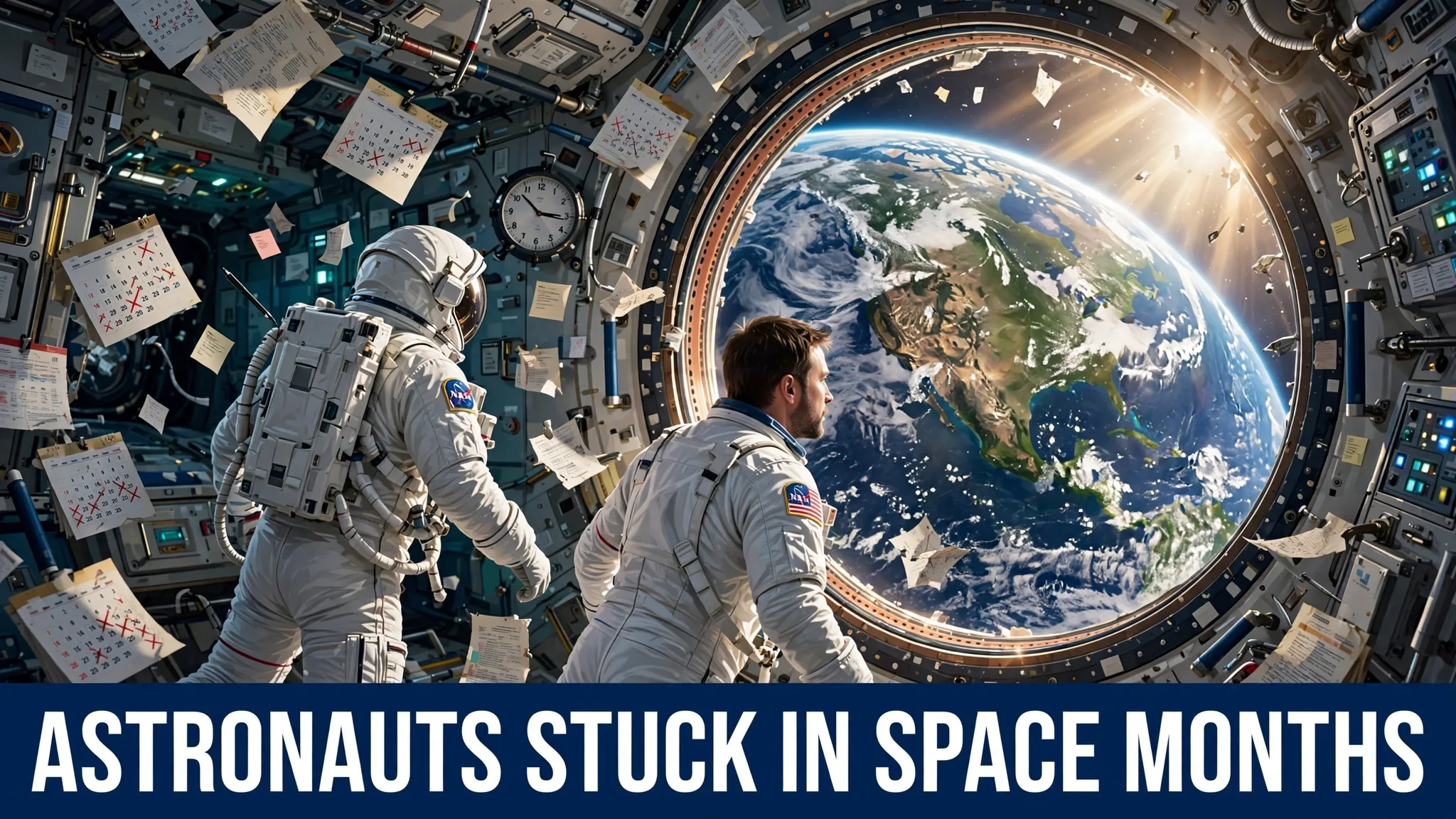
Astronauts Stuck In Space Months
In this post
- June 2024: A Trip That Was Meant to Last Eight Days
- July and August 2024: A Summer of Tests
- 24 August 2024: The Decision Nobody Wanted
- September 2024: Their Spaceship Goes Home Without Them
- October and November 2024: Guests Become Crew
- December 2024: Christmas in Orbit
- January 2025: A Record Written in a Spacesuit
- February 2025: The Last Long Month
- 18 March 2025: Home at Last
- What 286 Days Does to a Human Body
- Sources
Imagine packing one small bag for a trip of eight days. Now imagine the trip stretching into weeks, then months, then most of a year — while you circle the Earth, with no way to book a flight home. That is what happened to American astronauts Sunita “Suni” Williams and Barry “Butch” Wilmore. They flew to the International Space Station in June 2024 for a short test flight. They came home in March 2025, after 286 days in space. Their story is best told the way they lived it: one month at a time.
June 2024: A Trip That Was Meant to Last Eight Days
On 5 June 2024, at 10:52 in the morning Florida time, a rocket lifted off from Cape Canaveral carrying Boeing’s brand-new crew capsule, Starliner, with people inside it for the very first time. Wilmore was the commander and Williams the pilot. Both were veteran travellers in space and retired captains of the United States Navy.
The plan was simple: fly to the space station, test the new ship, and come home in about eight days.
The trouble began quietly. Even before launch, engineers knew about one small leak of helium, the gas used to push fuel through the ship’s pipes. They studied it and decided the ship could fly safely with it. But during the flight to the station on 6 June, more helium leaks appeared. Worse, five of the capsule’s 28 small steering thrusters — the little jets that point the ship in the right direction — stopped working properly as it crept towards the station.
Williams and Wilmore kept their nerve, flew carefully, and docked safely that afternoon. Four of the five faulty thrusters later came back to life. But everyone understood the problem: those same thrusters would be needed again for the most dangerous part of the journey — the trip back down through Earth’s atmosphere.
July and August 2024: A Summer of Tests
So the short visit turned into a long investigation. All summer, NASA and Boeing engineers fired Starliner’s thrusters in tests, studied the numbers coming down from space, and rebuilt the problem in a test centre at White Sands, in New Mexico.
Slowly, a likely explanation appeared. When the little jets fired again and again, heat could become trapped around them, and that heat could bend a small Teflon seal inside a valve, choking off the flow of fuel. It was a sensible theory. But a theory is not a promise. The damaged parts could never be opened up and inspected, because that section of the ship is thrown away before landing. NASA had to decide whether it truly understood the problem well enough to trust it with two human lives.
24 August 2024: The Decision Nobody Wanted
On 24 August, NASA gave its answer: Starliner would fly home empty. The risk was not that the ship would certainly fail. The risk was that nobody could be sure enough — and with a safer option available, “probably fine” was not good enough for a crew.
Williams and Wilmore would stay on the station as full members of its long-term crew. Their ride home would be a different ship entirely: a SpaceX Dragon capsule, on a mission called Crew-9. That capsule would launch with only two astronauts instead of four, leaving two empty seats for the journey back down.
Just like that, an eight-day test flight became an open-ended stay in orbit.
September 2024: Their Spaceship Goes Home Without Them
On 6 September, Starliner undocked from the station and flew away — without its crew. Early on 7 September it landed safely in the desert at White Sands Space Harbor, parachutes open, right side up. The ship had made it home.
Does that mean NASA chose wrongly? Not really. One safe landing does not prove every landing would have been safe, and on 24 August nobody knew how that flight would end. NASA chose the path it could defend with the facts it had at the time.
Later that month, on 28 September, the Crew-9 Dragon launched to the station carrying just two people, NASA astronaut Nick Hague and Russian cosmonaut Aleksandr Gorbunov. The two spare seats were spoken for. The way home now existed — but the calendar said the trip down was still months away.
If I am honest, this is the moment of the story I find hardest to imagine: watching your own spaceship drift away into the dark without you, knowing your ride home is half a year away — and then simply turning around and going back to work. That is exactly what both of them did.
October and November 2024: Guests Become Crew
From the autumn onwards, Williams and Wilmore were no longer visitors waiting for a lift. They were station crew, with a station crew’s workload. They ran science experiments, repaired equipment and kept the orbiting laboratory running. Three months into the stay, Williams became commander of the space station.
Their days settled into a rhythm. Like every long-stay astronaut, they exercised for two hours or more every single day, strapped to special machines, fighting to protect their bones and muscles from the weakness that weightlessness brings. Williams helped tend an experiment growing red romaine lettuce in space. In November, they even voted in the United States elections from orbit, using encrypted ballots sent up from mission control in Houston. The station circles Earth about 16 times a day, so they saw 16 sunrises and 16 sunsets in every 24 hours.
Life on the ground, of course, did not pause. Wilmore, who was 62, missed most of his younger daughter’s final year of high school. Williams, 59, kept in touch with her husband and family through internet calls. Both astronauts were cheerful in public, but they never hid the fact that the long separation was hardest on the people waiting at home.
December 2024: Christmas in Orbit
December brought the strangest Christmas of their lives. The crew recorded a festive video message for everyone back on Earth. They wore Santa Claus hats and reindeer antlers, passed a floating microphone from hand to hand, and spoke while candy canes drifted slowly through the air around their heads. In weightlessness, Williams’s hair stood straight up, as it did in almost every photograph from those months.
The message they sent down was warm and steady, and people all over the world watched the crew celebrate the holidays inside their metal home, circling the planet high above the family tables they were missing.
January 2025: A Record Written in a Spacesuit
The new year brought hard work outside the station. In mid-January, Williams went out on a spacewalk with crewmate Nick Hague to carry out repairs. Then, on 30 January, she and Wilmore stepped outside together. Their main job was to remove a stubborn radio antenna assembly from the station’s frame — a task earlier crews had struggled with — and to collect samples from the station’s outer surface so scientists could study them.
During that spacewalk, Williams quietly passed a record. Her total time spent spacewalking across her career reached 62 hours and 6 minutes — more than any woman in history, beating the mark of Peggy Whitson, and placing her fourth on NASA’s all-time list. It was her ninth spacewalk. Not bad for an astronaut who was supposed to be home in time for the summer holidays.
Behind the scenes, the return date was moving too. Plans at first pointed to February. Then problems with getting a fresh SpaceX capsule ready pushed the homecoming back by about another month, into March.
February 2025: The Last Long Month
February was the quiet month — no emergencies, no records, just the final stretch of waiting. The newspapers kept calling the pair “stuck” and “stranded,” but the two astronauts themselves never complained in public. As retired Navy captains, they described the long stay in the language of their old lives: a prolonged deployment, and they said openly that they supported NASA’s decisions from the start.
Most of us grow annoyed when a train is twenty minutes late. These two waited through season after season, missed birthdays and family milestones, and still spoke about their situation with a smile.
18 March 2025: Home at Last
On 16 March, the replacement crew arrived at the station aboard the Crew-10 capsule, and after a short handover, the way was clear. Early on 18 March, the Crew-9 Dragon undocked with four people aboard: Hague, Gorbunov, Williams and Wilmore.
That evening, at 5:57 p.m. Florida time, the capsule splashed down in the Gulf of Mexico, off the coast of Tallahassee, Florida. Dolphins circled the floating capsule as rescue teams moved in — an unplanned welcoming party from the ocean itself. The astronauts were helped out one by one, smiling and waving, Williams second to last and Wilmore last of all, holding up two gloved thumbs. Like all returning crews, they were carried away on reclining stretchers for routine medical checks, a normal safety step after months without gravity.
The final numbers tell the story in one breath: 286 days in space, 278 days longer than planned, 4,576 circles of the Earth, and about 121 million miles travelled — all from a test flight that was meant to last eight days.
What 286 Days Does to a Human Body
Living without gravity slowly changes a person. Bones lose density, muscles weaken, the body’s fluids shift upwards, and even eyesight can change. Space radiation adds another long-term risk. That is why the daily two hours of exercise mattered so much, and why doctors watch returning astronauts so carefully.
After splashdown, flight surgeons checked the crew, who then flew to Houston to be reunited with their families. Officials said the astronauts would be allowed home after a day or two, once their bodies had begun adjusting to gravity again. For Williams and Wilmore, the strangest sensation of all must have been the simplest one: the solid weight of their own bodies, pressing down into an ordinary bed, on an ordinary night, back on Earth.
Frequently Asked Questions
Why were Suni Williams and Butch Wilmore stuck in space for so long?
Their Boeing Starliner capsule developed helium leaks and thruster failures on the way to the space station. NASA studied the problems all summer and decided in August 2024 that the risk of bringing the crew home on Starliner was too uncertain, so the capsule returned empty and the astronauts waited for a SpaceX Dragon instead.
How many days were the astronauts in space?
They spent 286 days in space, from 5 June 2024 to 18 March 2025 — 278 days longer than the roughly eight days originally planned.
Were the astronauts ever in real danger?
They were not in immediate danger. The space station had food, oxygen, power and a full crew, and NASA always had a plan to bring them home. The problem was only that their own capsule could not be trusted enough for the return flight, and the replacement ride followed the station’s normal crew rotation schedule.
How did the astronauts finally return to Earth?
They came home aboard SpaceX’s Crew-9 Dragon capsule, together with Nick Hague and Aleksandr Gorbunov. The capsule splashed down in the Gulf of Mexico, off the coast of Florida, on 18 March 2025.
What spacewalking record did Suni Williams set?
During a spacewalk on 30 January 2025, Williams reached a career total of 62 hours and 6 minutes of spacewalking time — the most by any woman in history — across nine spacewalks.
Sources
- NASA — Spacewalkers Complete Radio Hardware Removal and Microbe Search: https://www.nasa.gov/blogs/spacestation/2025/01/30/spacewalkers-complete-radio-hardware-removal-and-microbe-search/
- Associated Press via Phys.org — NASA astronauts Butch Wilmore and Suni Williams return to Earth after 9 months stuck in space: https://phys.org/news/2025-03-nasa-astronauts-butch-wilmore-suni.html
- Space Daily — Suni Williams and Butch Wilmore launched aboard Boeing’s Starliner for an eight-day test flight: https://spacedaily.com/t-starliner-williams-wilmore-286-days-nasa-return-risk/
- The Indian Express — From space farming to celebrating Christmas: how Sunita Williams and Butch Wilmore spent 9 months away from Earth: https://indianexpress.com/article/world/sunita-williams-butch-wilmore-space-nasa-9893995/lite/