Moon Is Drifting Away Yearly
In this post
On a clear night, at a handful of observatories around the world, a telescope does something that sounds almost too simple to be real science. It fires a pulse of laser light up at the Moon. The light travels across roughly 385,000 kilometres of empty space, strikes a small panel of mirrors sitting in the lunar dust, and bounces straight back down to Earth. Then the scientists wait for the flash to return, and they time it — very, very carefully.
Those mirrors were not placed there by a robot. Astronauts carried them. When the Apollo 11 crew landed on the Moon in 1969, they set out an array of small prisms, and the crews of Apollo 14 and Apollo 15 later left bigger arrays of their own. This quiet experiment, called lunar laser ranging, has been running ever since — and the numbers it keeps sending back contain a surprise. The Moon is leaving us. Slowly, measurably, and without any plan to stop, our nearest neighbour in space is drifting away from Earth every single year.
What exactly did the astronauts leave on the Moon?
The panels are called retroreflector arrays, and they work like the reflectors on a bicycle, only far more precise. Each array is a panel filled with special prisms known as corner cubes, which have one beautiful property: any beam of light that hits them is sent straight back the way it came, no matter the angle. According to NASA’s Jet Propulsion Laboratory, the Apollo 11 and Apollo 14 arrays contain 100 of these quartz glass prisms each, while the Apollo 15 array is the largest, with 300.
The loveliest detail is what the arrays do not have. They carry no batteries, no electronics, and no moving parts. They need no power at all, which is exactly why they still work more than half a century after being unpacked in the dust. Telescopes at observatories in New Mexico, France, Italy and Germany fire lasers at them and measure how long each pulse takes to make the round trip. Because light always travels at the same speed, that travel time reveals the distance — and it reveals it to within a few millimetres, across nearly 400,000 kilometres of space. It is like measuring the length of a football stadium and being sure of your answer to the width of a grain of sand.
How fast is the Moon actually moving away?
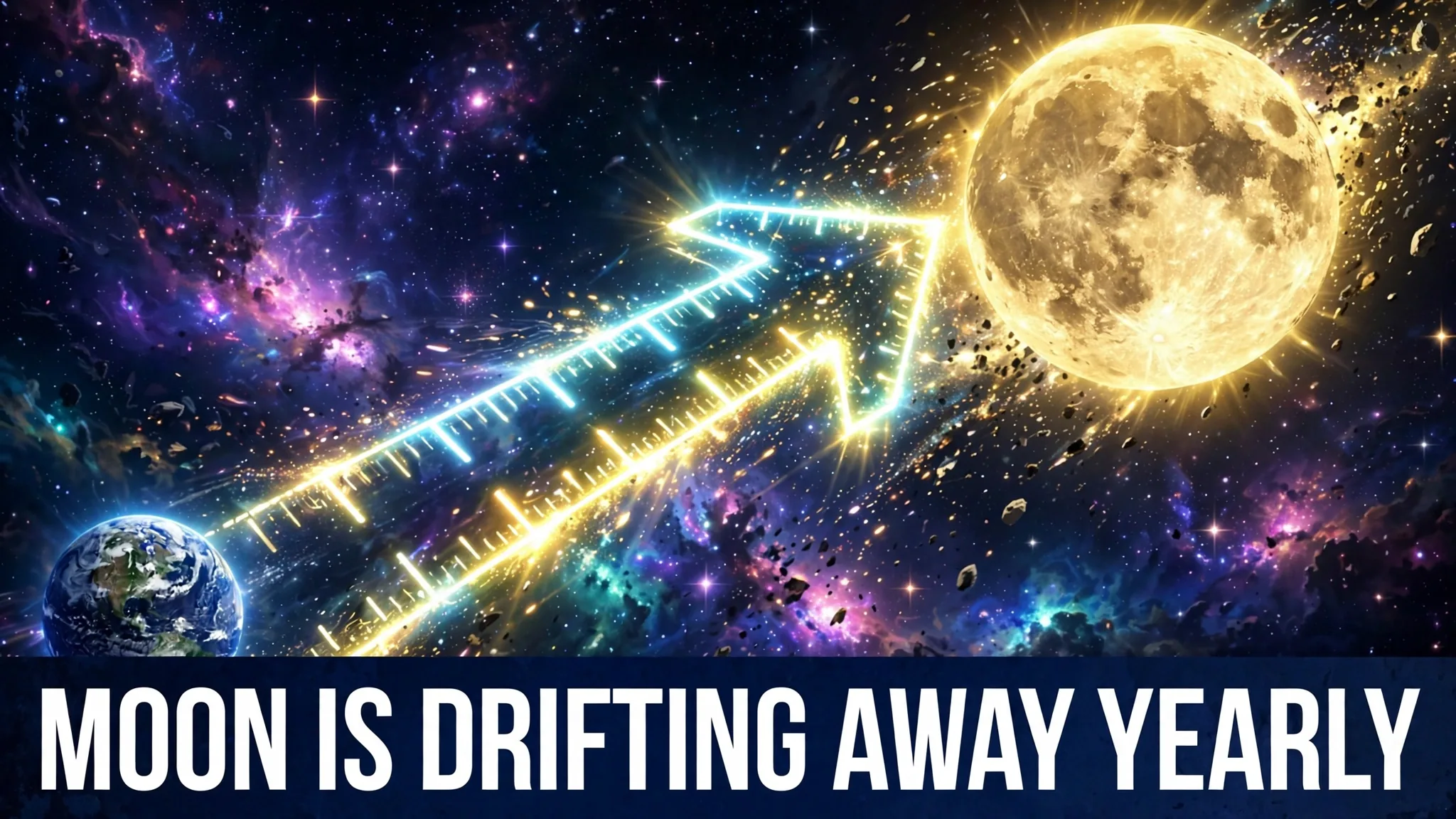
Year after year of these measurements point the same way. Lunar laser ranging has shown, in the words of NASA’s Jet Propulsion Laboratory, that the distance between Earth and the Moon increases by about 1.5 inches — 3.8 centimetres — every year. That works out to roughly 3 millimetres a month.
To picture 3.8 centimetres a year, scientists often compare it to something growing quietly on your own body: it is about the speed at which your fingernails grow. Nobody has ever watched a fingernail grow, and nobody will ever watch the Moon drift. But leave either one alone for long enough and the change becomes undeniable. In a single human lifetime the Moon retreats by roughly three metres. In a million years, it retreats by about 38 kilometres. The measurement is too small to notice in a night, and far too steady to argue with across fifty years of data.
To me, the most comforting part of the whole story is that the answer was sitting up there in plain sight all along — left behind by astronauts, needing no power and no repairs, patiently flashing back at anyone on Earth who cared to ask the question properly.
Why is the Moon drifting away from Earth?
The answer begins in the ocean, with the tides. The Moon’s gravity pulls on Earth’s oceans and raises two bulges of water — the high tides — on opposite sides of the planet. If Earth stood still, those bulges would point directly at the Moon and nothing much would change. But Earth does not stand still. Our planet spins once every 24 hours, while the Moon takes about 27 days to complete one orbit. Because Earth spins so much faster than the Moon travels, the movement of the planet drags the tidal bulges slightly ahead of the Moon, so the highest tide sits a little to the east of wherever the Moon is in the sky.
That small offset changes everything. The bulge of water has mass, and mass has gravity. Sitting ahead of the Moon, the bulge gives the Moon a gentle, constant tug forward, in the same direction the Moon is already moving. A body moving in orbit that gets pulled forward gains energy, and a body that gains energy settles into a wider orbit. So the Moon climbs, little by little, into a higher and more distant path around Earth. The energy has to come from somewhere, and it comes from us — from the spin of the Earth itself.
Is Earth’s day getting longer too?
Yes, and this is the other half of the same bargain. The friction between the turning Earth and its ocean tides works like a very gentle brake on our planet’s rotation. Astronomy teaching material from Ohio State University puts the figure plainly: the day is getting longer by about 2.3 milliseconds every century — 0.0023 seconds in a hundred years — while the Moon recedes by about 3.84 metres in the same hundred years.
Two milliseconds a century sounds like nothing, and for us it is nothing; no clock in your home will ever notice. But the effect never pauses and never reverses, and across millions of years it adds up to something enormous. The same physics that pushes the Moon outward today has been running since the Moon was young, and it has been quietly rewriting the length of Earth’s day the whole time.
What was the Moon like long ago?
Run the story backwards and the past looks wild. NASA notes that the Moon began its existence much closer to Earth, and researchers who study Earth’s deep history describe a young planet spinning far faster than it does today. When the Moon first formed, some 4.5 billion years ago, a day on Earth lasted less than 10 hours, according to a University of Toronto study published in the journal Science Advances. The newborn Moon hung much nearer in the sky, enormous to look at, and its stronger pull raised tides far more powerful than any we know.
The slowing was not perfectly steady, either. The Toronto researchers found that from about two billion years ago until 600 million years ago, tides in Earth’s atmosphere — pushed by the Sun — worked against the Moon’s braking effect, and the length of the day stayed nearly stuck at about 19.5 hours for more than a billion years. Only after that long stalemate broke did the day resume its slow climb toward the 24 hours we live by now. The calm, familiar Moon in tonight’s sky is the product of a tug-of-war that has been running for almost the entire history of the planet.
Will total solar eclipses really come to an end?
Here is where the drift touches something people actually love. A total solar eclipse works because of a happy accident of sizes. The Sun is about 400 times wider than the Moon, but the Moon is about 400 times closer to Earth, so the two appear almost exactly the same size in our sky, and the Moon can cover the Sun’s bright face completely for a few magical minutes.
NASA points out that this arrangement will not last forever. As the Moon keeps drifting outward, it looks a little smaller in the sky each century. Once it has travelled roughly another 23,500 kilometres away, it will appear too small to cover the Sun at all — and NASA’s estimate gives us about another 600 million years before that border is crossed. After that, Earth will still have eclipses, but they will be annular ones, where a bright ring of the Sun remains visible around the Moon’s dark edge. We already get a preview of that future during annular eclipses today. Total darkness at midday, the sudden stars, the Sun’s ghostly outer glow — those belong only to this chapter of Earth’s story, and we happen to live in it.
Frequently Asked Questions
How do scientists measure the distance to the Moon so exactly?
They use lunar laser ranging. Observatories fire laser pulses at reflector arrays left on the Moon by the Apollo 11, 14 and 15 missions, then time how long the light takes to return. Since light’s speed is constant, the time gives the distance to within a few millimetres.
How fast is the Moon moving away each year?
About 3.8 centimetres (1.5 inches) per year, according to NASA measurements — roughly 3 millimetres a month, about the speed your fingernails grow.
Why does the Moon move away instead of falling toward Earth?
Earth spins faster than the Moon orbits, so our rotation drags the ocean tidal bulges slightly ahead of the Moon. The gravity of that extra water pulls the Moon forward in its orbit, giving it energy, and that extra energy lifts it into a wider, more distant orbit.
Is the Moon’s drifting dangerous for life on Earth?
Not in any human timescale. The change is a few centimetres a year. Its effects — slightly longer days and slowly weakening tides — only become dramatic across millions and billions of years.
When will the last total solar eclipse happen?
Scientists estimate roughly 600 million years from now. By then the Moon will have drifted about another 23,500 kilometres away and will look too small to cover the Sun completely, so only annular and partial eclipses will remain.
Sources
- NASA Jet Propulsion Laboratory, “The Apollo Experiment That Keeps on Giving”: https://www.jpl.nasa.gov/news/the-apollo-experiment-that-keeps-on-giving/
- NASA Science, “Eclipses and the Moon”: https://science.nasa.gov/moon/eclipses/
- Ohio State University, Astronomy 161 Lecture 20: Tides (Prof. Richard Pogge): https://www.astronomy.ohio-state.edu/pogge.1/Ast161/Au06/Unit4/tides.html
- University of Toronto study coverage, Web India 123 (ANI): https://news.webindia123.com/news/Articles/Science/20230706/4096320.html