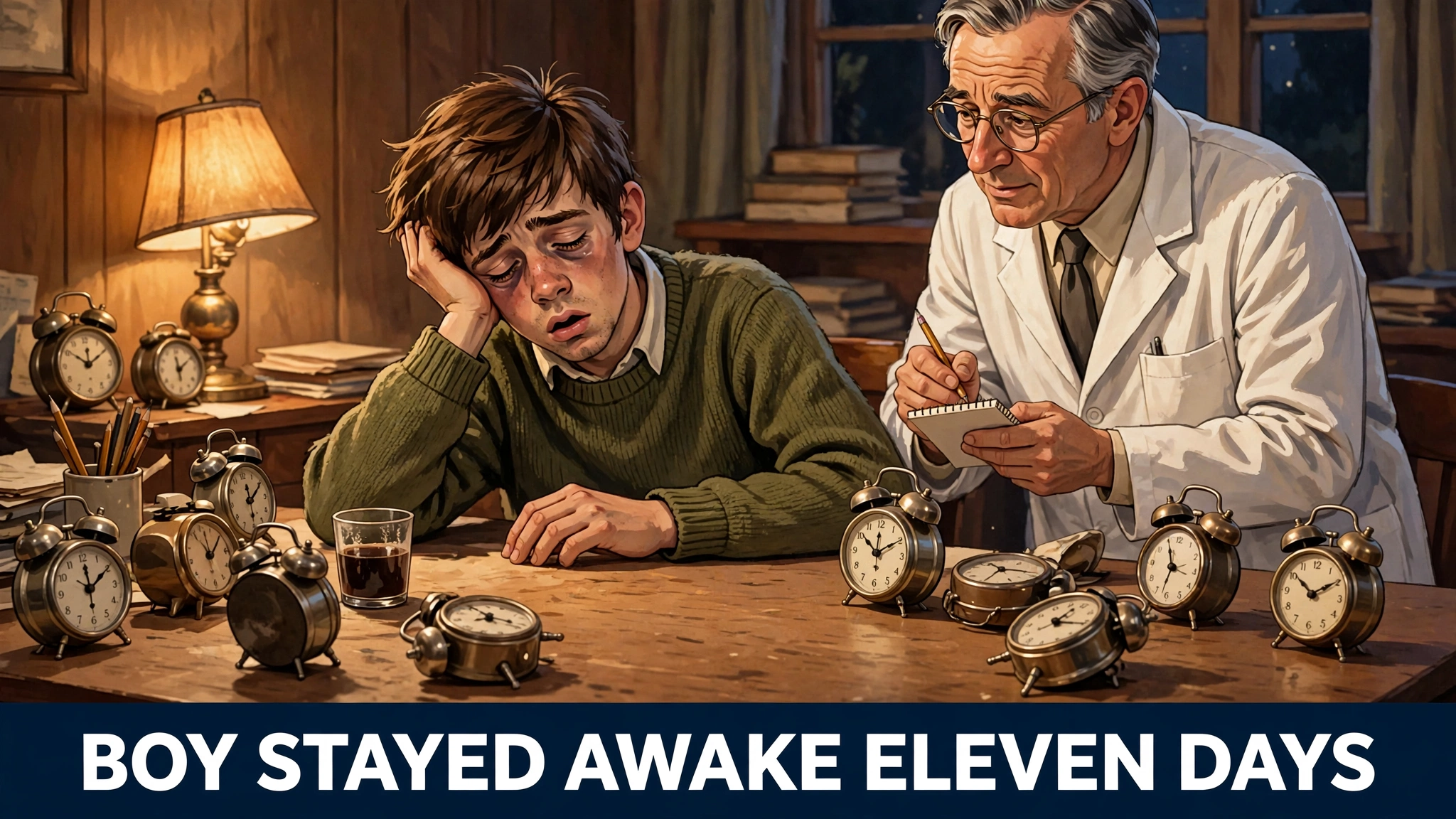
Boy Stayed Awake Eleven Days
In this post
Could you stay awake for two days? Most of us become useless after one bad night — forgetful, clumsy, snapping at people we love. Now imagine eleven days. Not eleven hours. Eleven full days and nights without a single moment of sleep.
In the winter of 1963, a 17-year-old schoolboy in California actually did it, in front of witnesses, as a science fair project. His name was Randy Gardner, and what happened to his mind and body across those eleven days is still one of the most famous sleep stories ever recorded. This post tells that true story — and it ends with a warning that matters more than the record itself.
This article is general information only. It is not medical advice, and nothing in it should encourage anyone to stay awake on purpose. Sleep loss is genuinely dangerous.
A Science Fair Idea That Grew Teeth
Randy Gardner was the oldest of four children in a military family that moved to a new town every couple of years. In every town, young Randy entered the science fair — and, by his own cheerful admission, he usually took first prize. In late 1963 the family had just arrived in San Diego, and Randy wanted his project at the Greater San Diego Science Fair to be unforgettable.
Radio disc jockeys of that era had made a sport of staying awake on air. One DJ in Hawaii had lasted 260 hours — nearly eleven days — and his stunt was the standing record. Randy and his school friend Bruce McAllister decided that two schoolboys could beat a radio star, and learn something real while doing it: they would study what sleeplessness does to the mind and to physical performance.
Somebody, of course, had to be the one who did not sleep. The friends tossed a coin. Randy lost. Bruce and a third friend, Joe Marciano, would take turns watching him around the clock, testing him, writing notes — and, above all, keeping him awake.
The experiment began on 28 December 1963, during the school holidays. The boys’ first plan was charmingly simple. It did not stay simple for long: Bruce, trying to stay up with Randy, fell asleep after three nights and woke to find he had been writing his notes on the wall.
The Experts Come To Watch
Word of the experiment reached local newspapers, and the newspapers carried it to Stanford University, where a young sleep researcher named William Dement read about what the boys were doing. At that time, sleep science was so new that almost nobody had studied what a long stretch without sleep does to a healthy person. Dement drove down to San Diego to watch for himself.
Randy’s parents were relieved to have a professional in the room. Nobody on Earth could honestly promise them their son would be safe. The unanswered question of that age hung over the whole experiment: if a person goes without sleep long enough, can it kill them? Animal experiments had given frightening answers, but no one knew the human truth.
A United States Navy doctor, Lieutenant Commander John J. Ross, also helped check on Randy as the days passed. Dement did more than observe — he played basketball and pinball with the exhausted boy, because moving, playing and laughing were the best tools they had for keeping him conscious. If Randy sat still and closed his eyes, he would be asleep in seconds.
Day By Day: What Eleven Days Did To Him
The first two days were surprisingly easy. Randy stayed out of bed, stood as much as he could, and in the daytime — surrounded by people, noise and light — he felt almost normal. The danger hours were the deep ones of the night, when the world went quiet and there was nothing to fight sleep with.
By day three, the cracks showed. Randy woke each morning feeling sick, a nausea that citrus fruit — oranges and tangerines — seemed to calm. He became moody and clumsy, and his memory began to drop small things. His eyes had trouble focusing, and at one point he struggled to name objects by touch alone, without looking at them.
Around days four and five, the mental slide steepened. Randy later described it as feeling like an early form of Alzheimer’s disease arriving in fast-forward: thoughts would arrive and dissolve before he could hold them. He found it harder and harder to concentrate, and asking him the same question twice could end in confusion. His speech sometimes slipped and tangled, and in tests he stumbled over simple tongue-twisters that a rested child could rattle off.
In the later days, stranger things arrived. Randy saw things that were not there — hallucinations. Suspicion crept in too: during one radio interview he became convinced that the host was quietly mocking him, a touch of paranoia the watchers noted carefully. His temper shrank to a hair trigger. On the final day, when doctors asked him to count down from 100, subtracting seven each time, he got as far as 65 — and then forgot what he had been doing and stopped, mid-task, in silence.
And yet, here is the twist that puzzled everyone: his body refused to fall apart. Through all of this, Randy played basketball well — by some accounts better than usual, simply from all the practice. At the pinball machine he beat Dr. Dement game after game; Dement later admitted Randy won every single time. If Randy was moving and busy, he could look almost fine. It was his mind, not his muscles, that was paying the bill — a lesson sleep scientists have repeated ever since: feeling able to perform is not the same as being able to think.
The Finish Line, And One Very Long Sleep
On the morning of 8 January 1964, eleven days after he began, Randy Gardner had been awake for 264 hours without sleep — a new world record. Before resting, he calmly faced a room of reporters and answered their questions, and by general agreement it was one of his sharpest appearances of the whole experiment.
Then, at last, he was taken to a naval hospital, where doctors watched his brain waves as he slept. His first sleep lasted about fourteen hours and forty minutes — long, but far less than the eighty-odd hours of sleep he had “missed”. He woke up groggy, but, in his own words, no groggier than a normal person. After a normal day awake, he slept again for around ten hours more, and then simply went back to ordinary life and back to school.
The doctors’ verdict surprised people: medically, he appeared perfectly healthy, with no lasting damage they could find. And the project that had started as three boys and a coin toss took first place at the science fair.
Others Went Longer — Then The Record Book Closed
Randy’s mark did not stand forever. Others pushed further in the years that followed — his own record fell within the same year — and the last sleep-deprivation record Guinness World Records ever recognised went to a man who stayed awake for almost nineteen days in 1986.
Then the book closed. Guinness stopped accepting attempts at the record, judging that deliberately going without sleep is simply too harmful to encourage. It is a rare and telling decision: an organisation that happily records people jumping from the edge of space decided that staying awake was too dangerous to keep listing.
Randy’s own later life added a sad footnote. As an adult, decades after the experiment, he developed severe insomnia — long nights of lying awake, catching minutes of sleep, and waking again. Doctors could not say for certain what caused it, and neither could he. But Randy himself has wondered aloud whether it was a kind of payback for those eleven days. It is his feeling, not a proven fact — and this post reports it as exactly that.
Please Do Not Try This
It is tempting to read this story as a fun challenge. Please do not. Sleep researchers are blunt about the risks: even one short night bends your memory, mood, reaction time and judgement, and severe sleep loss can bring hallucinations, paranoia and real harm. Randy Gardner had friends watching him, a Stanford researcher in the house, and Navy doctors checking him — and even then, everyone involved understood they were walking into the unknown. A teenager alone in a bedroom has none of that protection.
This article shares a piece of history for general interest only. It is not medical advice. If you or someone in your family struggles with sleep, the right step is to talk to a qualified doctor — never to test your limits. The real lesson of the boy who stayed awake for eleven days is not that sleep is optional. It is how quickly and quietly the mind begins to unravel without it — and how much we should respect the thing Randy Gardner went eleven days without.
Frequently Asked Questions
Who was Randy Gardner, and what exactly did he do? He was a 17-year-old high school student in San Diego who stayed awake for 264 hours — eleven days — from 28 December 1963 to 8 January 1964, as a science fair experiment with his friends Bruce McAllister and Joe Marciano. It set a world record at the time.
What happened to him during the eleven days? His body stayed surprisingly capable — he played basketball and beat a researcher at pinball — but his mind slipped day by day: nausea, mood swings, poor concentration, memory failures, slurred speech, hallucinations and moments of paranoia. In one test he forgot what he was doing halfway through counting backwards.
Who watched over him during the experiment? His two friends monitored him in shifts. Stanford sleep researcher William Dement joined after reading about the experiment in a newspaper, and U.S. Navy doctor Lieutenant Commander John J. Ross also helped check his health in the later days.
Did the experiment cause him permanent harm? Doctors who examined him after his first long sleep found him medically healthy, and he returned to school with no damage they could detect. Many decades later he developed severe insomnia as an adult; whether the two are connected is unknown, and he himself has only wondered about it.
Can I try to beat his record? Please do not. Guinness World Records stopped recognising sleep-deprivation attempts because of the health risks, and sleep loss — even far shorter than eleven days — can seriously affect the brain and body. This article is general information, not medical advice, and it is shared so readers never need to run the experiment themselves.
Sources
- Wikipedia, “Randy Gardner sleep deprivation experiment”: https://en.wikipedia.org/wiki/Randy_Gardner_sleep_deprivation_experiment
- NPR, “Lessons from Sleeplessness: The 60th Anniversary of Randy Gardner’s World Record”: https://www.cfpublic.org/2024-01-28/lessons-from-sleeplessness-the-60th-anniversary-of-randy-gardners-world-record
- NPR Hidden Brain, “Eyes Wide Open” — interview with Randy Gardner and sleep scientist Matthew Walker: https://www.hiddenbrain.org/podcast/eyes-wide-open/
- The picture on this page is an original illustration made for Talha M Blog.