World's Most Famous Christmas Light Displays
In this post
- Grand City Streets: London, Paris, New York and Beyond
- Neighbourhoods That Glow: Dyker Heights and Community Displays
- Gardens, Parks and Light Trails
- Light Festivals, Projections and Modern Spectacles
- Planning Your Visit: Timing, Crowds, Cold and Cameras
- Lights at Home: Bringing the Magic to Your Own Street
- My Take:
There is a moment on a cold December night, when a street, a garden, or a whole neighbourhood suddenly glows with thousands of lights, that feels like stepping into a different world. Christmas light displays turn ordinary places into celebrations, drawing visitors from far away, filling hotels and restaurants, and giving families a reason to walk together in the dark and look up in wonder. This guide explores the world’s most famous Christmas light displays, from grand city streets to community neighbourhoods, botanical gardens, and light festivals, and offers practical tips for enjoying them without crowds, cold, or disappointment. Because dates, tickets, and arrangements change each year, always check official event pages before travelling, rather than relying on last year’s details.
What makes a light display famous is not only its size. The most beloved displays share certain qualities: they transform a place that people already care about, they use light creatively rather than merely abundantly, they offer something for all ages, and they create a sense of occasion that photographs cannot fully capture. A display that is merely large, with millions of bulbs but no design, can feel overwhelming and impersonal. A display that tells a story, highlights beautiful architecture, or invites visitors to walk through light tunnels, gardens, and themed areas feels magical, even if it is smaller. The displays below are famous for different reasons, and together they show the range of what Christmas lights can do.
It is also worth remembering that light displays are, at their best, community events. Many began as local efforts: a shopkeeper decorating a street, a neighbourhood competing to outdo itself, a garden opening its grounds for winter evenings. Even the largest displays retain that community root, employing local people, supporting charities, and giving residents a shared celebration. Visiting a famous display is therefore not only about seeing lights. It is about joining a community’s festive season for an evening, and the best visitors respect that: they follow local guidance, support local businesses, and leave the place as beautiful as they found it.
Grand City Streets: London, Paris, New York and Beyond
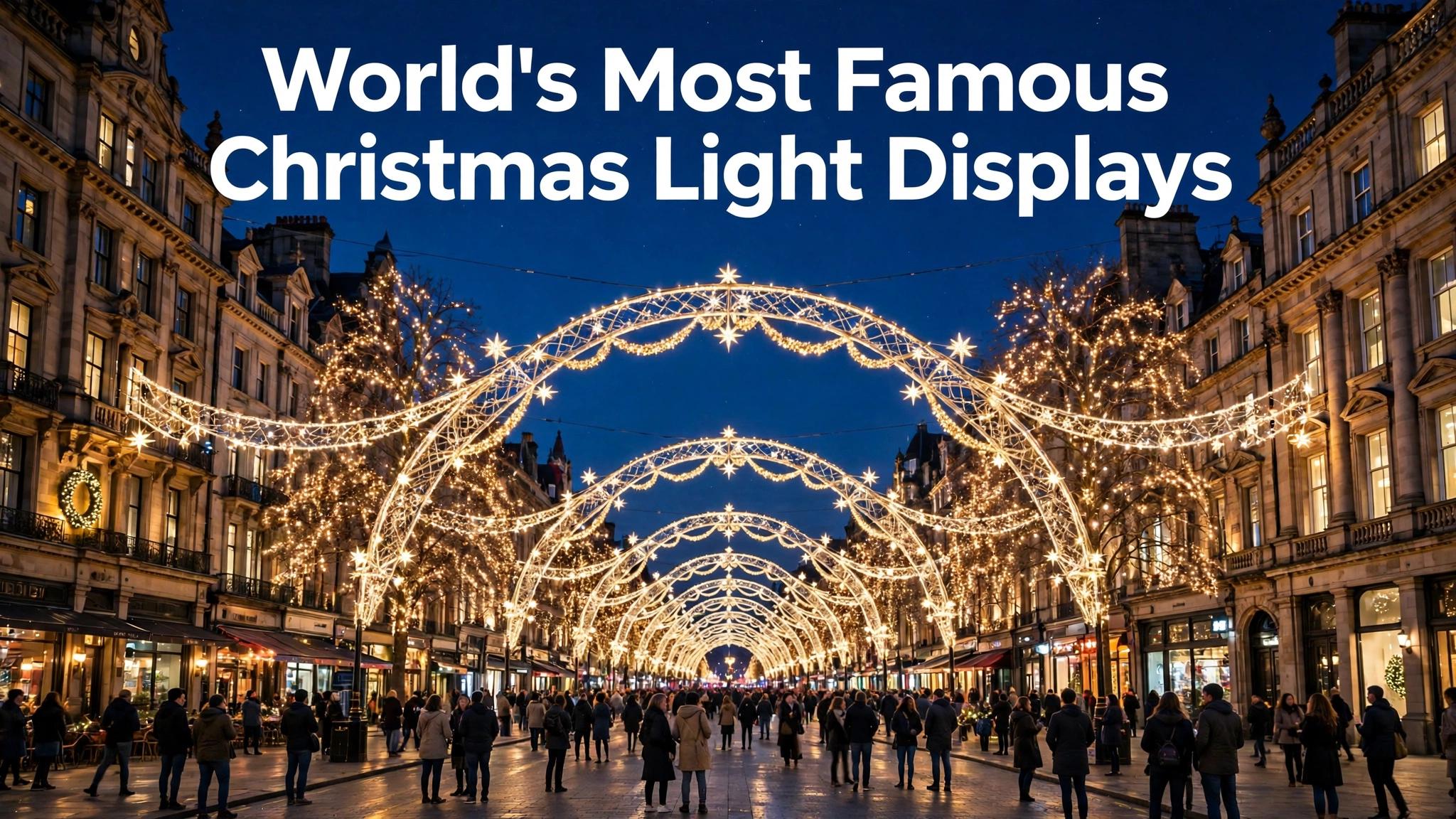
Some of the world’s most famous Christmas lights are not in a single attraction but spread across whole shopping streets, turning a city centre into a glowing walk. In London, Oxford Street, Regent Street, and Carnaby Street are renowned for their annual displays, with large-scale overhead decorations, themed designs that change each year, and switch-on events that draw crowds. Regent Street’s famous “Spirit of Christmas” arches, for example, have become an iconic image of London at Christmas, photographed millions of times and recognised worldwide. Walking these streets in December, with shop windows decorated and crowds enjoying the atmosphere, is a free and accessible way to experience Christmas lights, although evenings can be very busy and visitors should allow extra time.
Paris, often called the City of Light, lives up to its name at Christmas, when the Champs-Élysées is lined with illuminated trees and lights, and department stores create elaborate window displays that are attractions in themselves. The combination of Parisian architecture, wide boulevards, and festive lighting creates a particularly elegant display, less about sheer quantity of lights and more about style and atmosphere. In New York, the Rockefeller Center Christmas tree, with its huge Norway spruce and thousands of lights, is one of the most famous single Christmas sights in the world, drawing visitors who queue to see it and skate on the rink below. Nearby, Fifth Avenue and the Saks Fifth Avenue light show add to the spectacle, while neighbourhood displays in Brooklyn, discussed below, offer a different, more personal kind of fame.
Other cities also deserve mention for their street displays. In Tokyo, areas such as Shibuya and Roppongi Hills create modern, colourful illuminations that blend technology with festive design, often featuring blue lights, tunnels, and interactive elements. In Vienna, with its imperial architecture and Christmas markets, lights complement traditional markets rather than competing with them, creating a warm, old-world festive atmosphere. In Sydney, where Christmas falls in summer, light displays take a different form, with harbour-side illuminations and outdoor events that suit warm evenings. The lesson from city displays is that the best ones work with their city: London’s streets suit grand arches, Paris suits elegance, New York suits spectacle, and Tokyo suits innovation. A display that fits its place will always feel more memorable than one that could be anywhere.
Neighbourhoods That Glow: Dyker Heights and Community Displays
If city streets show Christmas lights at their grandest, neighbourhoods show them at their most personal and, for many visitors, most delightful. The most famous neighbourhood display in the world is probably Dyker Heights in Brooklyn, New York, where residents of a few streets decorate their homes with extraordinary enthusiasm, covering houses, gardens, and trees with lights, inflatable figures, nutcrackers, and animated scenes. The displays began with individual homeowners and grew, over decades, into a destination that attracts tour buses and thousands of visitors each December. Walking Dyker Heights on a December evening feels like entering a competition where everyone is trying to be the most festive, and the result is joyful, chaotic, and unforgettable.
What makes Dyker Heights special is not professional design but community spirit and personal expression. Each house reflects its owner’s taste, humour, and family traditions, so no two houses look alike, and the overall effect is a patchwork of styles rather than a uniform theme. Visitors should remember that Dyker Heights is a residential neighbourhood, not a theme park. Residents welcome respectful visitors who walk on pavements, keep noise down, do not block driveways, and do not trespass on private property to take photographs. Guided walking tours are available and can be a good option, because they manage crowds and share the history of the displays. The best time to visit is usually on weekday evenings, when crowds are smaller than at weekends.
Community displays exist in many countries, often on a smaller scale but with the same spirit. In the United States, neighbourhoods in cities such as Los Angeles, Chicago, and San Antonio are known for coordinated street decorations, while in the United Kingdom, villages and small towns often compete in “best dressed house” or “best street” contests. In Australia and Canada, suburban streets also develop reputations for festive lights, with residents coordinating colours and themes. These displays rarely appear in glossy travel guides, but they are often the displays that families love most, because they are free, local, and personal. Finding a local display, whether through community pages, local news, or word of mouth, is one of the best ways to enjoy Christmas lights without travelling far or spending much.
Gardens, Parks and Light Trails
Botanical gardens and parks offer a different kind of light display: a walk through illuminated nature, where lights highlight trees, lakes, and pathways rather than buildings. Kew Gardens in London, with its annual “Christmas at Kew” trail, is one of the most famous examples, featuring a winding route through illuminated gardens, light tunnels, projections on trees and glasshouses, and seasonal food stalls. The trail is ticketed and timed in recent years, which manages crowds and ensures a pleasant walk, and visitors should book in advance because popular evenings sell out. The combination of nature, art, and light makes garden trails feel more immersive than street displays, because visitors walk through the display rather than past it.
In the United States, Longwood Gardens in Pennsylvania and the Missouri Botanical Garden’s “Garden Glow” are renowned for their winter light displays, combining horticultural beauty with festive lighting, fountains, and conservatory displays. In Germany, many Christmas markets are complemented by illuminated parks and palace gardens, where lights enhance historic settings. In Singapore, Gardens by the Bay creates a spectacular festive display with its Supertrees, huge vertical gardens that light up in synchronised shows, blending futuristic design with Christmas themes. These garden displays show that Christmas lights are not only for cities and houses. They can transform natural and designed landscapes into evening wonderlands, and they suit visitors who prefer a calmer, more contemplative light experience.
Light trails in parks also suit families with children, because the walk itself is an adventure, with surprises around each bend: a tunnel of lights, a field of glowing flowers, a tree that changes colour with music. Many trails include food stalls, fairground rides, and Santa’s grottos, turning the walk into a full evening out. For visitors with mobility needs, it is worth checking trail surfaces, distances, and accessibility information in advance, because garden trails can be long and uneven, especially in wet or icy weather. Warm clothing, comfortable shoes, and a charged phone for photographs are essential, and arriving at the start of a timed slot, rather than at peak times, usually gives a more relaxed experience.
Light Festivals, Projections and Modern Spectacles
Beyond traditional displays, a new generation of light festivals uses projection, animation, and interactive technology to create spectacles that would have been impossible a generation ago. In Lyon, France, the Fête des Lumières, or Festival of Lights, held in early December, transforms buildings, squares, and bridges with large-scale light projections and installations by international artists. Although it is not strictly a Christmas event, it falls in the festive season and draws millions of visitors, showing how light itself, rather than Christmas themes alone, can be the attraction. Similar festivals in Amsterdam, Berlin, and other cities use light art to reimagine urban spaces in winter, when nights are long and cities need celebration.
Projection mapping, where images are projected onto buildings to make them appear to move, change, or tell a story, has become a highlight of many Christmas displays. Department stores, cathedrals, and civic buildings become canvases for animated shows, often set to music and repeated several times each evening. These shows are free to watch from the street, which makes them accessible, but they also draw large crowds, so arriving early and choosing a viewing spot with a clear sightline matters. For photographers, projection shows offer dramatic images, but they are best enjoyed first with the eyes rather than through a phone screen. Watching a whole show, rather than filming fragments, gives a fuller sense of the artistry involved.
Interactive displays, where visitors can change colours, trigger sounds, or walk through responsive light fields, are increasingly popular, especially with children and younger visitors. These displays blur the line between art and play, inviting visitors to become part of the light rather than merely observers. In some cities, light festivals also have a sustainability focus, using energy-efficient LED lights, solar power, and recycled materials, which is an important development as displays grow larger. Visitors who care about sustainability can look for festivals that publish their energy information and that use LEDs, which consume far less electricity than older incandescent bulbs. The future of Christmas lights is likely to be more creative, more interactive, and more efficient, and the festivals leading that change are worth watching.
Planning Your Visit: Timing, Crowds, Cold and Cameras
Enjoying a famous light display requires a little planning, especially for the most popular ones. Timing is the first consideration. Weekday evenings are usually quieter than weekends, and early December evenings are often less crowded than the week before Christmas, when everyone rushes to see displays before the holiday. Arriving just after dark, rather than late in the evening, often gives better photographs, because the sky retains a little blue light that contrasts beautifully with warm lights, a period photographers call blue hour. For ticketed displays, booking in advance is essential, and checking the official website for timed entry, last admission, and refund policies prevents disappointment.
Crowds are the second consideration. Famous displays attract large numbers, and visitors should be prepared for queues, slow walking, and busy transport. Comfortable shoes, warm layers, and patience are essential, and families with small children should plan shorter visits, with breaks for warm drinks and toilets, rather than attempting a long trail in one go. Visitors with accessibility needs should check information about step-free routes, seating, and accessible facilities before travelling, because historic streets and gardens are not always fully accessible. Keeping valuables secure in crowded areas is also wise, as busy festive streets attract pickpockets in some cities.
Cold and cameras are the final practical points. Winter evenings at light displays can be very cold, especially when standing still to watch a show or queue for entry, so warm coats, hats, gloves, and insulated footwear matter more than fashionable outfits. A thermos of hot drink, or a stop at a nearby café, makes the evening more comfortable. For photography, a phone camera is usually sufficient, but night photography benefits from steady hands, a small tripod or a stable surface, and avoiding flash, which washes out lights. Taking a few photographs and then putting the phone away to enjoy the display with your eyes is the best approach. The most famous displays are famous because they create wonder in person, and no photograph, however good, fully captures the feeling of standing under thousands of lights on a cold, clear night.
Lights at Home: Bringing the Magic to Your Own Street
You do not need to travel to a famous display to enjoy Christmas lights, and some of the most satisfying displays are the ones you create or support close to home. Hanging lights on your own house, helping a neighbour with theirs, or joining a street decoration effort brings the festive feeling to your daily walk, and it costs far less than a trip to a famous city. Simple, well-chosen lights, such as warm-white strings along a roofline, a lit wreath on a door, or candles in windows, often look more elegant than a house covered in every colour at once. Energy-efficient LEDs keep running costs low, timers prevent lights from burning all night, and outdoor-rated lights and connections, used as instructed, keep the display safe in rain and snow.
Community efforts multiply that pleasure. Streets that agree on a colour theme, villages that organise a lights trail with maps and refreshment stops, and charities that run “light up a life” events all turn private decoration into shared celebration. If your street has no tradition, starting one is easier than it sounds: a conversation with two or three neighbours, a shared switch-on evening with warm drinks, and a simple agreement on timing can be enough. Local displays also give children a sense of pride in their own area, and they create evening walks that families look forward to throughout December. Famous displays are wonderful to visit, but a glowing street at home, seen every night on the way back from school or work, may be the display you love most of all.
My Take:
My opinion on Christmas light displays is that they are one of the few festive traditions that have genuinely improved with scale, and that the best displays remind us why winter, despite its darkness, is worth celebrating. I love the moment when a street or garden lights up, not because the lights themselves are extraordinary, but because of what they do to people: strangers smile at each other, families walk more slowly, children point and gasp, and a cold night feels communal rather than lonely. That transformation is the real magic of light displays, and it cannot be measured in bulb counts or visitor numbers. A display with a million lights that leaves visitors indifferent has failed, while a small street with a hundred lights that makes a child laugh has succeeded.
I have a particular affection for neighbourhood displays such as Dyker Heights, because they represent festive spirit at its most democratic and personal. No corporation designed those houses. Ordinary residents, with their own tastes, budgets, and senses of humour, decided to decorate, and over time their individual efforts became a world-famous destination. That story matters, because it shows that festive culture is not only created by professionals, cities, or brands. It is created by people who care enough to put lights on their own house, to compete good-naturedly with neighbours, and to welcome strangers to look. I think we should celebrate that kind of creativity more, and support it by visiting respectfully, rather than treating residents’ homes as a free theme park.
On the other hand, I am wary of light displays becoming purely commercial spectacles, where the experience is dominated by ticket prices, merchandise, and queues, and where the lights themselves feel secondary to the business around them. Ticketed garden trails and festivals can be wonderful, and I understand that they cost money to create and maintain, but when a family must spend a large amount to see lights that were once free on a city street, something has been lost. I believe cities should protect at least some free, public light displays, on streets and in parks, so that Christmas lights remain accessible to everyone, not only to those who can afford tickets. Light, by its nature, is meant to be shared, and a city that lights only its paid attractions has misunderstood the point.
I also think garden light trails deserve special praise, because they offer a calmer, more immersive experience than crowded streets. Walking through illuminated trees, with music, scent, and light changing around each bend, feels like entering a story, and it suits visitors who want wonder without noise and crowds. Kew’s Christmas trail, and others like it, show that lights can enhance nature rather than overwhelm it, highlighting the shape of a tree, the curve of a lake, or the architecture of a glasshouse. That restraint is a form of artistry, and I wish more displays practised it. The brightest display is not always the best. Often, the best display is the one that knows when to leave darkness alone, so that light can shine more beautifully against it.
On photography, my advice is simple and perhaps unfashionable: look first, photograph second. I have watched visitors spend an entire light show staring at their phones, filming shaky videos they will rarely watch again, while missing the show itself. A few photographs, taken thoughtfully, are a wonderful keepsake. A whole evening spent filming is a missed experience. The same applies to social media pressure to visit the most famous display, take the perfect photograph, and move on. A light display is not a checklist item. It is an evening to be savoured, with warm drinks, good company, and time to stand still and look up. If you leave a display with only photographs and no memory of how it felt to be there, you have not really visited it.
I am also optimistic about the future of light displays, especially as they become more sustainable and more creative. LED lights have already reduced energy use dramatically, and interactive, projection-based displays show that light art can be more imaginative than simply hanging more bulbs. Festivals that commission artists, involve local communities, and publish their sustainability efforts point the way forward: displays that are beautiful, responsible, and rooted in place. I hope future displays will continue that trend, using light to tell local stories, to celebrate local architecture and nature, and to bring communities together in winter, rather than simply importing the same generic display to every city.
Finally, I believe Christmas light displays teach a simple, hopeful lesson that is easy to miss in the rush of December: darkness is not the end of the story. Winter nights are long, cold, and often difficult, especially for people who feel lonely or low at this time of year. A street full of lights does not solve those difficulties, but it offers a visible reminder that people have chosen to create beauty in the dark, to gather, and to celebrate together despite the cold. That choice, repeated in cities, neighbourhoods, and gardens around the world, is a quiet act of hope, and it is why I will keep visiting light displays, year after year, even when I have seen them before. The lights may be familiar, but the feeling they create, of warmth in winter and community in darkness, never gets old.
One last suggestion I would make to every reader: visit your own local display first, before travelling to a famous one, and give it the same attention you would give a world-renowned show. Walk slowly, notice which house tried hardest, which garden used light most cleverly, and which street feels most welcoming, and tell the people behind it that you enjoyed it. Local decorators rarely receive praise, yet they give their neighbourhood a gift every December for little reward. A kind word, a photograph shared with permission, or a small donation to a charity display costs nothing and encourages the very community spirit that makes famous displays possible in the first place. Fame begins at home, with a single string of lights and someone who cared enough to hang it.
Frequently Asked Questions
What is the most famous Christmas light display in the world?
There is no single winner, but commonly cited favourites include New York’s Rockefeller Center tree, London’s Oxford and Regent Street lights, Paris’s Champs-Élysées, Brooklyn’s Dyker Heights neighbourhood, and garden trails such as Christmas at Kew in London. Each is famous for a different reason.
Do I need tickets for famous Christmas light displays?
It depends. City street displays are usually free to walk through, while garden trails, light festivals and some special events are ticketed and timed in recent years. Always check official event pages for current ticket, timing and booking information before travelling.
When is the best time to visit Christmas light displays?
Weekday evenings in early December are usually quieter than weekends and the week before Christmas. Arriving just after dark often gives good photographs and a more relaxed walk, while late evenings can be colder and more crowded.
Are neighbourhood displays like Dyker Heights free to visit?
Yes, walking through residential neighbourhood displays is generally free, but visitors should respect residents by staying on pavements, keeping noise down, not blocking driveways, and not trespassing for photographs. Guided walking tours are also available in some areas.
What should I wear to a Christmas light display?
Warm layers, a waterproof coat, hat, gloves and comfortable, insulated footwear are essential, because visits involve standing and walking outdoors in cold weather. Bring a warm drink or plan a café stop, and carry a charged phone for maps and photographs.
Are Christmas light displays sustainable?
Many modern displays use energy-efficient LED lights, which consume far less electricity than older bulbs, and some festivals publish sustainability information. Visitors can favour displays that use LEDs and efficient design, and support events that explain their energy use.