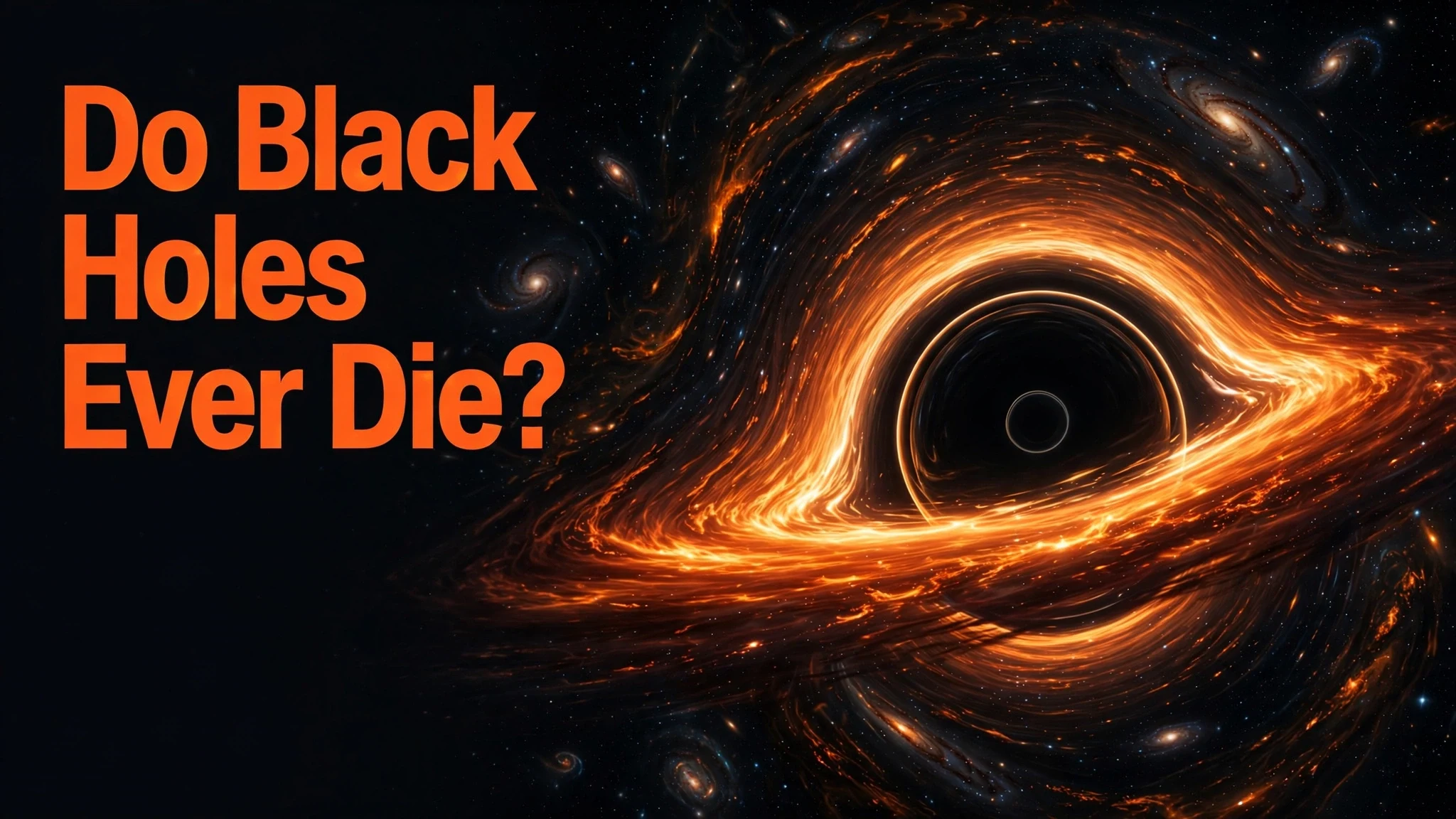
Do Black Holes Ever Die? Explained Simply
In this post
- The Simple Answer: Yes, But Incredibly Slowly
- Hawking Radiation: How Something Escapes a Black Hole
- How Long Do Different Black Holes Live?
- The Final Moments: A Black Hole’s Last Flash
- Black Holes Are Not Vacuum Cleaners: The Myths
- What Happens to a Black Hole That Keeps Eating?
- The Fate of the Universe and the Last Black Holes
- My Take:
Black holes have a reputation for being eternal. Nothing escapes them, they swallow stars and light, and they seem to sit at the centre of galaxies forever, growing larger with every meal. It is natural to assume they last forever. The surprising answer, discovered by Stephen Hawking in the 1970s, is that they do not. Black holes slowly leak energy, shrink, and eventually disappear — a process so slow that for most black holes it would take far longer than the current age of the universe, but a real process nonetheless, and one that changes how we think about the fate of everything.
The idea is strange because it contradicts the simple picture of a black hole as a perfect trap. If nothing can escape, how can a black hole lose anything? The answer lies in quantum physics, in the strange behaviour of empty space at the smallest scales, and in a process called Hawking radiation. It is one of the most beautiful ideas in modern physics, and also one of the hardest to explain without mathematics, because it depends on effects that have no everyday equivalent.
This article explains, in plain language, whether black holes die, how Hawking radiation works, how long different black holes would take to evaporate, what would happen in their final moments, and what the biggest unanswered questions are. It also clears up the common misunderstandings — that black holes are cosmic vacuum cleaners, that they will swallow the universe, or that one could suddenly appear and eat the Earth — because the real story, slow and strange as it is, is more interesting than the myths.
The Simple Answer: Yes, But Incredibly Slowly
Black holes do die, in the sense that they lose mass over time and eventually vanish, but the timescale is so long that the word “eventually” needs to be understood on a cosmic scale. A black hole with the mass of the Sun would take far longer than the current age of the universe to evaporate — a number with so many zeroes that it is effectively forever by any human standard. A supermassive black hole at the centre of a galaxy would take vastly longer still. The only black holes that would evaporate in a time we could meaningfully imagine are tiny ones, far smaller than any that have been observed.
That slowness is important, because it means the death of black holes is not something we will ever observe directly for the black holes we know about. It is a prediction of physics, not an observed event, and it is based on combining two theories — general relativity, which describes gravity and black holes, and quantum mechanics, which describes the very small — in a way that is still not fully understood. The prediction is widely accepted by physicists, but the details, especially what happens at the very end, are still debated.
For practical purposes, then, black holes are effectively eternal. They will outlast the stars, the galaxies, and probably most of the structures in the universe. They are among the last things that will remain, long after the last star has burned out. The fact that they eventually disappear does not make them less awesome; it makes them more so, because it means that even the most permanent-seeming objects in the universe are, on a long enough timescale, temporary.
Hawking Radiation: How Something Escapes a Black Hole
The mechanism behind a black hole’s death is Hawking radiation, named after Stephen Hawking, who predicted it in 1974. The idea is often explained with a picture of pairs of particles appearing out of empty space near the black hole’s edge, one falling in and one escaping. That picture is a helpful analogy, but it is not quite what the mathematics says, and physicists caution against taking it too literally. The real explanation involves quantum fields and the way energy behaves near a strong gravitational field, and it is genuinely difficult to put into ordinary words.
What matters is the result: a black hole is not perfectly black. It glows, very faintly, with radiation, and that radiation carries energy away. Because energy and mass are related, as Einstein showed, losing energy means losing mass. The black hole therefore shrinks, very slowly. The smaller it gets, the hotter it glows and the faster it shrinks, so the process accelerates towards the end — but the beginning is so slow that for a large black hole, the acceleration is irrelevant for an unimaginably long time.
It is worth noting that Hawking radiation has never been directly observed from a real black hole, because the glow is far too faint to detect against the background of the universe. It has been tested in laboratory analogues, where similar effects have been seen in systems that mimic a black hole’s edge, and the theory is widely accepted, but a direct observation remains out of reach. That is a reminder that some of the most important ideas in physics are predictions waiting for the technology to catch up.
How Long Do Different Black Holes Live?
The lifetime of a black hole depends strongly on its mass: bigger black holes live much longer, because their Hawking radiation is weaker. A black hole with the mass of the Sun would take around 10 to the power of 67 years to evaporate — a one followed by 67 zeroes — while the universe is currently about 13.8 billion years old, which is 10 to the power of 10 years. A supermassive black hole, millions or billions of times the mass of the Sun, would take far longer still, with a lifetime measured in numbers that are difficult to write down, let alone to imagine.
Small black holes would evaporate faster. A black hole with the mass of a mountain would evaporate in a time comparable to the age of the universe, and a black hole with the mass of a large asteroid would evaporate in a human lifetime or less. No such small black holes have been observed; if they were made in the early universe, as some theories suggest, the smallest ones would already have evaporated, and their final explosions might have been detectable. The fact that we have not seen them is itself a clue, though not a conclusive one.
The comparison that helps most is with stars. A star like the Sun lives about ten billion years. A black hole made from such a star lives vastly longer — so long that the number is meaningless in human terms. When astronomers say black holes die, they mean it in the sense that nothing in the universe lasts forever, not in the sense that we should expect to see one die. The universe is young, and its black holes are younger still.
The Final Moments: A Black Hole’s Last Flash
As a black hole shrinks, its Hawking radiation gets hotter and brighter, and the process speeds up. In its final moments, a black hole would be small, hot, and radiating furiously, producing a burst of high-energy particles and light. For a black hole that started with the mass of the Sun, that final burst is unimaginably far in the future, but for a tiny black hole, it would be a real, observable event: a sudden flash of energy, and then nothing.
What exactly happens at the very end is one of the great open questions in physics. The theories we have break down when the black hole becomes extremely small, because gravity and quantum mechanics, which are normally separate, both matter at once, and we do not have a complete theory that combines them. Some physicists think the black hole disappears completely, leaving only radiation. Others think it might leave behind a tiny remnant, or that something else entirely happens. We simply do not know, and that not-knowing is itself an important part of the story.
There is also the famous information paradox: if a black hole evaporates, what happens to the information about the things that fell into it? Quantum mechanics says information cannot be destroyed, but a black hole that vanishes seems to destroy it. This puzzle has driven decades of research, and while there are promising ideas — that the information is encoded in the Hawking radiation, or that it escapes in subtle ways — there is no settled answer. The death of a black hole is therefore not only a question about the future of the universe; it is a question about the deepest laws of physics.
Black Holes Are Not Vacuum Cleaners: The Myths
Much of what people believe about black holes is wrong, and the myths make the question of their death harder to understand. A black hole is not a cosmic vacuum cleaner that sucks in everything around it. Its gravity is the same as that of any object of the same mass: if the Sun were replaced by a black hole of the same mass, the Earth would continue orbiting it exactly as before, in the dark and the cold, but not pulled in. A black hole only captures things that come very close to it, within a region called the event horizon, and most things never do.
Black holes also do not grow without limit in a way that threatens the universe. They grow by swallowing matter that happens to fall in, and there is only so much matter nearby. A supermassive black hole at the centre of a galaxy is large, but the galaxy is far larger, and the black hole’s influence is limited to its immediate surroundings. The idea that a black hole will one day swallow the universe is a misunderstanding of how gravity works on large scales.
And no, a black hole is not going to appear and eat the Earth. Black holes form from dying stars or from the collapse of matter in the early universe, and there is no known way for one to appear suddenly near us. The nearest known black hole is hundreds of light-years away, and it poses no danger. The fear of black holes is understandable — they are strange and powerful — but it is not based on how they actually behave.
What Happens to a Black Hole That Keeps Eating?
A black hole that is actively feeding — pulling in gas from a companion star, or swallowing the material around it — gains mass faster than it loses it through Hawking radiation, so it grows rather than shrinks. For the black holes we observe, the feeding far outweighs the evaporation, by an enormous factor. A black hole in a galaxy with plenty of gas around it will keep growing for as long as the gas lasts, which can be billions of years. Evaporation only wins when the food runs out, which happens on timescales far longer than the current age of the universe.
This is why the supermassive black holes at the centres of galaxies are still growing, and why they will continue to grow for a very long time. They sit at the bottom of a deep gravitational well, and matter keeps falling in. Only when the universe has expanded and cooled, and the supply of gas has dwindled, will evaporation begin to dominate. That is a future so distant that the stars themselves will have died out first, and the universe will be a dark place lit only by the faint glow of evaporating black holes.
There is a poetic side to this. The last light in the universe may come not from stars but from black holes, slowly evaporating, giving back the energy they swallowed over trillions of years. It is a strange and beautiful image, and it is a reminder that the universe has a long future ahead of it, far longer than its past, and that the objects we think of as destroyers may turn out to be the last sources of light.
The Fate of the Universe and the Last Black Holes
Cosmologists who think about the far future of the universe describe an era, trillions of years from now, when the stars have burned out, the galaxies have dispersed, and the only remaining sources of energy are black holes, slowly evaporating. In that dark, cold future, a black hole’s faint glow would be one of the few things still happening. Eventually, even those would vanish, leaving a universe of cold, thin radiation, expanding forever. That is one possible fate, though it depends on assumptions about dark energy and the expansion of the universe that are still uncertain.
It is a humbling picture, and it is worth remembering that it is based on extrapolating our current theories far beyond anything we can test. The universe has surprised us before, and it may surprise us again. New physics — a better theory of quantum gravity, a different understanding of dark energy — could change the story completely. The evaporation of black holes is a prediction of our best current ideas, not a certainty, and the history of science suggests that predictions about the far future are the ones most likely to be revised.
For now, the useful answer is this: yes, black holes die, but so slowly that for any black hole we know, the answer is effectively no, not in any time that matters to us. They are the longest-lived objects in the universe, and they will be among the last things to go. That they go at all is a profound fact about the universe — that nothing, not even a black hole, lasts forever — and it is a fact that comes from one of the most remarkable ideas in modern physics.
My Take:
My honest reaction to the question of whether black holes die is a mixture of wonder and humility. Wonder, because the answer — yes, they slowly evaporate by leaking a faint glow predicted by Stephen Hawking — is one of the most beautiful ideas in science, and it connects two theories that seem to have nothing to do with each other: the physics of the very large and the physics of the very small. Humility, because the timescale is so vast that the answer is, for any practical purpose, no. A black hole with the mass of the Sun will outlive everything we know, and the fact that it eventually dies is a truth about the far future, not about our lives. I think that combination — a profound truth that changes nothing in practice — is characteristic of the best science. It changes how we understand the world, even when it does not change what we do in it.
What I find most moving is the image of the last light in the universe coming from evaporating black holes. Long after the stars have gone out, the objects we think of as the darkest things in existence would be the only things still glowing, giving back the energy they swallowed over trillions of years. There is a kind of justice in that, and a kind of poetry, and it reminds me that the universe is stranger and more generous than our fears suggest. We imagine black holes as destroyers, and they are, but they are also, in the very long run, givers. That is not a moral. It is physics. But it feels like a moral anyway, and I think that is part of why the idea stays with people.
I am also struck by how honest the science is about what it does not know. The information paradox — what happens to the information about things that fell into a black hole when it evaporates — has no settled answer, and physicists will tell you so plainly. The final moments of a black hole are unknown, because our theories break down there. I respect that honesty, and I think it is a model for how to talk about difficult subjects generally: say what is known, say how it is known, and say plainly where the knowledge stops. The alternative — pretending to know — is worse, because it closes the question instead of leaving it open for the next person to answer.
On the myths, I think the vacuum cleaner image has done real harm, because it makes black holes seem like a threat and hides what they actually are: objects whose gravity is the same as any object of the same mass, dangerous only up close, and profoundly informative about how the universe works. If the Sun became a black hole tomorrow, the Earth would keep orbiting. That single fact, once understood, removes most of the fear, and what is left is curiosity. I would rather people were curious about black holes than afraid of them, because curiosity leads to learning and fear leads to misunderstanding.
In the end, the question of whether black holes die is a question about whether anything lasts forever, and the answer — no, not even a black hole — is both sobering and comforting. Sobering, because it means the universe itself is temporary, in the longest sense. Comforting, because it means that even the most permanent-seeming things are part of a larger story that changes and ends. I do not think we need to be sad about that. The stars will burn out, the black holes will evaporate, and the universe will grow cold and dark, but that is trillions of years away, and in the meantime there is a great deal to learn, to see and to understand. The death of a black hole is not something to fear. It is something to wonder at, from a safe distance, while we still have light to see by.
I also think the information paradox deserves a word, because it is the kind of puzzle that shows science at its best. Two well-tested theories disagree, and rather than pretending the disagreement does not exist, physicists have spent fifty years arguing about it, proposing ideas, testing them, and discarding the ones that do not work. That is not a sign of failure. It is a sign that the field is alive, and that the next great idea is likely to come from exactly this kind of honest disagreement. I would rather have a science that admits its puzzles than one that hides them.
There is a practical lesson here too, about how to think about very long timescales. Human beings are bad at thinking about millions of years, let alone numbers with sixty-seven zeroes, and our intuitions fail completely at that scale. The fact that a black hole’s lifetime is effectively forever, and also finite, is a good exercise in holding two truths at once. It teaches a kind of humility: that our sense of forever is very short, and that the universe operates on timescales that dwarf us. That humility is not depressing. It is clarifying, because it puts our own brief, bright lives in perspective without diminishing them.
If I were explaining this to a child, I would start with the simplest image: a black hole is like a drain that is so strong nothing can climb out, but even a drain, given enough time, runs dry. The child would ask how long, and I would say: longer than anything you can imagine, longer than the stars will live, longer than the universe has existed so far. And the child would probably say: so it never really dies, then. And I would say: not for us, no. But it does, eventually, and that is one of the most remarkable things we know about the universe.
One final thought: the death of black holes is a reminder that the universe is not static. Stars are born and die, galaxies form and disperse, and even black holes, the most permanent objects we know, eventually fade. That impermanence is not a flaw in the universe. It is the universe. And understanding it — really understanding it, not just repeating the words — is one of the finest things a mind can do with its brief time in the light.
Frequently Asked Questions
Do black holes ever die?
Yes, according to current physics, black holes slowly lose mass through Hawking radiation and eventually evaporate. But the process is incredibly slow: a black hole with the mass of the Sun would take far longer than the age of the universe to disappear, so for practical purposes black holes are effectively eternal.
What is Hawking radiation?
Hawking radiation is a faint glow predicted by Stephen Hawking in 1974, by which black holes slowly lose energy and mass. It arises from quantum effects near the event horizon. It has not been directly observed from a real black hole because it is far too faint, but the theory is widely accepted.
How long does it take a black hole to evaporate?
It depends on mass: bigger black holes live much longer. A Sun-mass black hole would take around 10 to the power of 67 years, while the universe is about 13.8 billion years old. Supermassive black holes would take far longer still. Only tiny black holes would evaporate quickly.
What happens in a black hole’s final moments?
As it shrinks, a black hole gets hotter and radiates faster, ending in a burst of high-energy particles and light. What exactly happens at the very end is unknown, because our theories of gravity and quantum mechanics break down at that scale, and it is an open question in physics.
Can a black hole swallow the Earth?
No. Black holes only capture things that come very close to them, and the nearest known black hole is hundreds of light-years away. If the Sun were replaced by a black hole of the same mass, Earth would keep orbiting it. Black holes are not cosmic vacuum cleaners.
What is the black hole information paradox?
It is the puzzle of what happens to information about things that fell into a black hole when the black hole evaporates. Quantum mechanics says information cannot be destroyed, but an evaporating black hole seems to destroy it. There is no settled answer yet, and it is a major open question in physics.