What Is a Neutron Star? Explained Simply
In this post
- How a Neutron Star Is Born: The Death of a Big Star
- How Dense Is Dense? A Teaspoon That Weighs a Billion Tonnes
- Why Neutron Stars Spin So Fast
- Pulsars, Magnetars and the Neutron Star Family
- When Neutron Stars Collide: Gold, Gravity and Light
- What Neutron Stars Teach Us About Physics
- Could a Neutron Star Ever Affect Earth?
- My Take:
Imagine taking a star much bigger than the Sun, crushing it until it is only as wide as a city, and packing more mass than the Sun into that tiny ball. The result is a neutron star: one of the strangest objects in the universe, so dense that a single teaspoon of its material would weigh about a billion tonnes, so magnetic that it can bend the atoms around it, and spinning so fast that it can rotate hundreds of times a second. It is the leftover core of a dead star, and it is also a natural laboratory for physics that cannot be reproduced anywhere on Earth.
Neutron stars are not rare in the cosmic sense — astronomers estimate there are hundreds of millions of them in our galaxy alone — but they are small, dark and hard to find, so most people have never heard of them, or know them only as the word behind “pulsar”, the regular radio heartbeat that some of them produce. Yet they are among the most important objects in astronomy, because they test our understanding of matter, gravity and the forces that hold atoms together, in conditions far beyond anything a laboratory can create.
This article explains neutron stars in plain language: how they form when a massive star dies, what they are actually made of, why they spin so fast and shine so strangely, what pulsars and magnetars are, and why scientists care so much about objects that are, by cosmic standards, almost invisibly small. You do not need any physics background to follow it — only curiosity about what happens when a star dies and refuses, quite, to disappear.
How a Neutron Star Is Born: The Death of a Big Star
A neutron star begins with a massive star, at least eight times the mass of the Sun, living a short and brilliant life. For millions of years, the star balances two forces: gravity pulling its material inward, and the pressure from nuclear fusion in its core pushing outward. The star burns hydrogen into helium, helium into carbon, and so on, building up layers of heavier elements like an onion. Each stage burns faster than the last, until the core is iron — and iron cannot be fused to release energy. At that point, the balance breaks.
When the core can no longer support itself, it collapses in less than a second. The outer layers of the star are thrown outward in a supernova, an explosion so bright it can outshine a whole galaxy for weeks. The core, meanwhile, is crushed by gravity to an extraordinary density. Protons and electrons are forced together until they merge into neutrons, and the core becomes a ball of neutrons about twenty kilometres across, holding more mass than the Sun. That ball is the neutron star.
The supernova that creates it also scatters the heavy elements forged in the star — carbon, oxygen, iron, gold — into space, where they will one day become part of new stars, planets and, eventually, living things. The iron in your blood and the calcium in your bones were made in stars like this one. A neutron star is therefore not only a strange object; it is the leftover heart of a star that helped build the material of the world we live in.
How Dense Is Dense? A Teaspoon That Weighs a Billion Tonnes
The density of a neutron star is almost impossible to picture, because nothing on Earth is remotely like it. A neutron star packs roughly one and a half times the mass of the Sun into a sphere about the size of a city. The often-quoted comparison — that a teaspoon of neutron star material would weigh about a billion tonnes — is a way of making that number feel real, though it is worth noting that such a teaspoon could not exist outside the star: without the star’s immense gravity holding it together, the material would expand violently. The figure is an illustration, not a thing you could ever hold.
What makes this density possible is that the atoms themselves have been destroyed. In ordinary matter, atoms are mostly empty space: a tiny nucleus surrounded by electrons at a relatively vast distance. In a neutron star, gravity has crushed that empty space away. The protons and electrons have merged into neutrons, and the neutrons are packed together as tightly as physics allows. The result is matter in a state that does not exist anywhere else in the universe, and that scientists are still trying to understand.
The surface of a neutron star is also extraordinary. Its gravity is so strong that a mountain on its surface could be no more than a few millimetres high — gravity would flatten anything taller. Its crust, a thin layer of iron-like material over the neutron interior, is thought to be the strongest material in the universe, far stronger than steel or diamond. And because the gravity is so intense, time itself runs slightly slower on the surface of a neutron star than it does far away, an effect predicted by Einstein and confirmed by observations of these objects.
Why Neutron Stars Spin So Fast
Most neutron stars spin, and they spin fast — often many times a second, and in some cases more than seven hundred times a second. The reason is the conservation of angular momentum, the same effect that makes an ice skater spin faster when she pulls her arms in. The original star was already rotating slowly, like the Sun. When its core collapsed from thousands of kilometres across to about twenty, that slow rotation was concentrated into a tiny ball, and the spin rate shot up enormously.
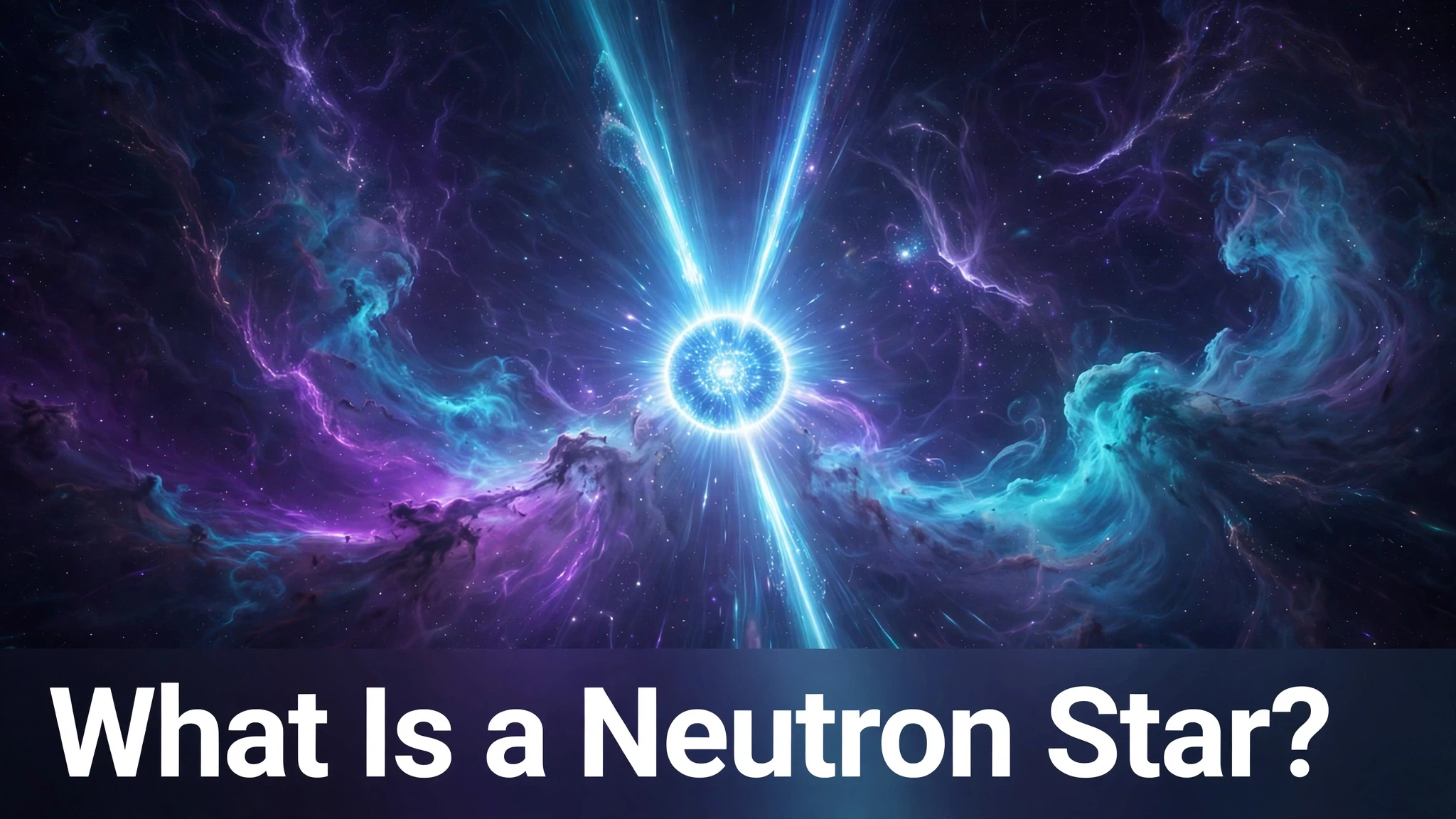
This rapid spin has a visible consequence. A neutron star’s magnetic field, already strong, is concentrated by the same collapse, becoming trillions of times stronger than Earth’s. Charged particles are funnelled along the magnetic field lines to the star’s magnetic poles, where they produce beams of radiation — radio waves, X-rays, light — that shoot out into space like a lighthouse beam. As the star spins, the beam sweeps around, and if Earth happens to lie in its path, we see a regular pulse of radiation each time the beam points at us. That is a pulsar.
Pulsars are so regular that the best of them keep time more accurately than atomic clocks, and astronomers use them as cosmic lighthouses: to test Einstein’s theory of gravity, to detect the faint ripples of gravitational waves passing through the galaxy, and to navigate spacecraft. A dead star, spinning hundreds of times a second, has become one of the most precise clocks in the universe. That is a strange and wonderful fact, and it is one of the reasons neutron stars are so valued by scientists.
Pulsars, Magnetars and the Neutron Star Family
Not all neutron stars are the same. The most common kind we observe are pulsars: neutron stars whose beams of radiation sweep past Earth as they spin, producing regular pulses. Some pulsars are young and spin relatively slowly; others, called millisecond pulsars, spin hundreds of times a second and are thought to have been spun up by stealing material from a companion star. These old, fast pulsars are the most precise timekeepers known.
Magnetars are the extreme members of the family. Their magnetic fields are a thousand times stronger than an ordinary neutron star’s, so strong that they can distort atoms and produce violent outbursts of X-rays and gamma rays. A magnetar can, in a fraction of a second, release more energy than the Sun produces in a hundred thousand years. A magnetar flare in 2004 was so powerful that it affected Earth’s upper atmosphere from halfway across the galaxy. Fortunately, magnetars are rare and far away.
There are also neutron stars we cannot see as pulsars, either because their beams do not point at Earth or because they are too old and quiet. Astronomers find these by other means: by their X-ray glow, by their effect on a companion star, or by the gravitational waves they produce when two neutron stars collide. Each kind tells us something different, and together they are teaching us about matter under the most extreme conditions in the universe.
When Neutron Stars Collide: Gold, Gravity and Light
In 2017, astronomers observed something extraordinary: two neutron stars spiralling into each other and merging, an event detected both as gravitational waves — ripples in space itself — and as light across the spectrum, from gamma rays to radio. It was the first time the same event had been seen in both gravitational waves and light, and it confirmed a long-standing idea: that the collision of neutron stars is where much of the universe’s gold, platinum and other heavy elements are made.
The physics is dramatic. As the two stars merge, they are torn apart by gravity, and the neutron-rich material they throw off is so hot and dense that neutrons are captured by atomic nuclei, building up heavy elements in seconds. The glow from that newly made material — a kilonova — can be seen for days. The gold in a wedding ring, the platinum in a car, and the rare elements in a phone were likely made in an event like this, billions of years ago, before the solar system existed.
The collision also gave scientists a new way to measure the universe: by comparing the gravitational wave signal with the light, they could work out how far away the event was and how fast the universe is expanding. It was a landmark in astronomy, and it happened because neutron stars, small and dark as they are, can produce the most violent and informative events in the cosmos when they meet.
What Neutron Stars Teach Us About Physics
Neutron stars matter to physicists because they are the only place in the universe where matter is squeezed to such densities. The interior of a neutron star is a mystery: some scientists think it is mostly neutrons, others think the centre may contain stranger forms of matter, perhaps a soup of quarks, the particles that make up protons and neutrons. No laboratory on Earth can reproduce those conditions, so the only way to learn about them is to observe neutron stars and work backwards from what they do.
Their extreme gravity also makes them a test of Einstein’s theory of general relativity. The theory predicts how time and space behave near a very massive object, and neutron stars — especially pulsars in orbit around another star — provide the most precise tests available. So far, Einstein’s predictions have held up, even in these extreme conditions, which is both reassuring and, for physicists hoping for new physics, a little frustrating. Every test that confirms the theory narrows the room for the new ideas that might one day replace it.
There is also a practical side. The precise timing of pulsars is being used to detect gravitational waves from pairs of supermassive black holes, and it may one day help navigate spacecraft far from Earth, where GPS does not reach. A network of pulsars could serve as a galactic positioning system, letting a spacecraft work out where it is by the timing of pulses from known pulsars. It is a fitting use for dead stars: guiding the living as they travel between the stars.
Could a Neutron Star Ever Affect Earth?
For all their violence, neutron stars are not a danger to Earth. The nearest known neutron star is hundreds of light-years away, and their radiation, while intense up close, fades with distance. A magnetar flare powerful enough to affect Earth would have to be very close, and none is. The real risk from space to Earth comes from asteroids and from our own Sun, not from neutron stars.
What neutron stars do affect is our understanding. They show us that matter can exist in states we never imagined, that a star can die and leave behind something smaller than a city that still shapes the universe around it, and that the elements we are made of were forged in violence on a scale that is hard to comprehend. They are a reminder that the universe is stranger than our everyday experience suggests, and that the strangeness is not decoration: it is the physics that made us possible.
The next time you look at the night sky, it is worth remembering that among the stars you can see, there are also stars you cannot — tiny, dense, spinning remnants of giants that died long ago, sweeping their lighthouse beams through the dark. They are not visible to the eye, but they are there, and they are among the most extraordinary things the universe has made.
My Take:
I find neutron stars quietly awe-inspiring in a way that black holes, for all their drama, are not. A black hole is an ending: a place where our understanding stops. A neutron star is a survivor: a star that died violently and left behind something that still spins, still shines, still keeps time more accurately than anything we can build. There is something moving about that — a heart that keeps beating after the body is gone, a clock that keeps ticking in the dark. It is the kind of fact that makes the universe feel less like a collection of objects and more like a story, and I think that is why people who learn about neutron stars tend to remember them.
What impresses me most is the density, not as a number but as an idea. We live in a world where atoms are mostly empty space, where a solid table is, at the level of its particles, almost entirely nothing. A neutron star is what happens when that nothing is squeezed out, when gravity wins completely and matter is packed as tightly as it can be packed. It is a reminder that the solid world we take for granted is a special case, a low-density arrangement that exists only because gravity here is weak. Somewhere out there, the same material that makes up you and me is packed a billion times more densely, and it is still the same universe, obeying the same rules. That is a humbling thought, and a thrilling one.
The pulsar story is the part I love telling people, because it turns an abstract object into something you can almost hear. A lighthouse beam sweeping through space, hundreds of times a second, so regular that it keeps better time than an atomic clock — that is an image that stays with you. And the fact that astronomers use those beams to detect gravitational waves, to test Einstein, and perhaps one day to navigate spacecraft, shows how a curiosity can become a tool. Science often works that way: you study something because it is strange, and years later you discover that the strangeness is exactly what makes it useful.
I am also struck by the gold. The idea that the gold in a ring, or the platinum in a piece of jewellery, was made in the collision of two dead stars billions of years ago, is one of those facts that changes how you look at an ordinary object. It connects the everyday to the cosmic in a way that few facts do. It also reminds us that we are, quite literally, made of star stuff — not in a vague poetic sense, but in the specific sense that the heavy elements in our bodies were forged in stellar deaths. A neutron star collision is not a distant abstraction. It is part of our own history.
If I have a reservation, it is only that these objects are so strange that they are easy to sensationalise, and the sensational version — a teaspoon weighing a billion tonnes, a magnetar that could wipe out the Earth — can crowd out the quieter, more interesting truth. The truth is that neutron stars are valuable not because they are dangerous but because they are informative: they are the only place where we can study matter at such densities, and they are teaching us physics we could not learn any other way. The danger stories are fun, but the science story is better, and it is the one I would rather people remembered.
For a reader who is new to this, my advice is to let the strangeness sink in slowly. You do not need to understand the physics to appreciate the picture: a star dies, its core collapses to the size of a city, it spins hundreds of times a second, and it keeps time better than anything humans have built. That picture is enough. The details — the quarks, the relativity, the gravitational waves — can come later, if you want them. The wonder is available at once, and it is free, and it is one of the best things about learning how the universe works.
I also think about the scientists who study these objects, because their work is a particular kind of patience. A pulsar’s signal is faint, the data is noisy, and the conclusions take years of careful observation. There is no drama in it, no sudden breakthrough every week, only a slow accumulation of evidence that gradually reveals something extraordinary. I admire that patience, and I think it is a model for how to learn about anything difficult: not by demanding a quick answer, but by paying attention, over a long time, to something that does not shout.
The question of what is inside a neutron star is the part that stays with me longest, because it is a reminder of how much we do not know. We can measure the mass, the spin, the magnetic field, and the timing of the pulses, and still not know whether the centre is neutrons, or quarks, or something we have not yet imagined. That gap between what we can measure and what we can know is not a failure. It is the frontier, and it is where the next discovery will come from. I find that exciting rather than frustrating, because it means the universe still has secrets, and the secrets are the reason to keep looking.
For a reader who wants to go further, I would suggest starting with pulsars, because they are the most accessible part of the story. There are recordings of pulsar signals, turned into sound, that you can listen to online, and hearing the regular heartbeat of a dead star is a strange and moving experience. It makes the abstraction real in a way that a paragraph cannot. Science is often taught as a set of facts, but it is also a set of experiences, and listening to a pulsar is one of the most remarkable experiences the universe offers.
One more thought: the neutron star story is a reminder that size is not the same as importance. A neutron star is tiny by cosmic standards — a city-sized ball in a galaxy of billions of stars — and yet it can produce the gold in a ring, test the laws of physics, and keep time better than anything we can build. The universe does not reward size. It rewards density, spin, and the strange physics that happens when matter is pushed to its limits. That is a useful lesson, and not only for astronomy.
Frequently Asked Questions
What is a neutron star in simple terms?
A neutron star is the tiny, extremely dense leftover core of a massive star that exploded as a supernova. It packs more mass than the Sun into a ball about 20 kilometres across, and it is made mostly of neutrons, the particles that normally sit inside atoms.
How dense is a neutron star?
Extraordinarily dense. A commonly used illustration is that a teaspoon of neutron star material would weigh about a billion tonnes, though such a teaspoon could never exist outside the star, because the material would expand without the star’s gravity holding it together.
What is a pulsar?
A pulsar is a neutron star whose beams of radiation sweep past Earth as it spins, so we see regular pulses of radio waves or light, like a lighthouse beam. Pulsars spin very fast and keep time with extraordinary precision.
What is a magnetar?
A magnetar is a neutron star with an exceptionally strong magnetic field, far stronger than an ordinary neutron star’s. Magnetars can produce violent outbursts of X-rays and gamma rays, and a single flare can briefly release enormous amounts of energy.
How do neutron stars form?
They form when a massive star, at least eight times the mass of the Sun, runs out of fuel and its core collapses in a supernova explosion. The outer layers are thrown into space, while the core is crushed into a ball of neutrons about 20 kilometres wide.
Can a neutron star become a black hole?
Yes, in some cases. If a neutron star gains enough extra mass, for example by pulling material from a companion star or by merging with another neutron star, gravity can overcome the pressure holding it up and it can collapse further into a black hole.