How Do Astronauts Sleep in Space? Explained Simply
In this post
- No Bed, No Up or Down: The Sleeping Bag on the Wall
- Sixteen Sunrises a Day: The Problem of Light
- The Schedule: Why Astronauts Sleep by the Clock
- What Goes Wrong: Insomnia, Snoring and Strange Dreams
- The Tools That Help: Earplugs, Eye Masks and Melatonin
- What Space Sleep Teaches Us About Sleep on Earth
- Sleeping on the Way to Mars: The Next Challenge
- My Take:
Sleep is one of the most ordinary things a person does, and in space it becomes one of the strangest. There is no up or down, no bed to lie on, no night that lasts eight hours, and no quiet. The Sun rises and sets sixteen times a day on the International Space Station, the hum of machines never stops, and your body floats. Yet astronauts sleep, night after night, for months at a time, and they do it well enough to work, to think clearly, and to stay safe. How they manage it is a story about clever design, strict routine, and the adaptability of the human body.
The problem is not only the lack of gravity. On Earth, sleep is anchored by a cycle of light and dark, by the weight of a blanket, by the feeling of lying down, and by a quiet, dark room. In orbit, all of those anchors are gone or weakened. The station circles the Earth every ninety minutes, so an astronaut sees a sunrise every forty-five minutes. The body, which expects a twenty-four-hour day, is confused. Add to that the noise of fans and pumps, the need to stay strapped in so you do not float into equipment, and the strange feeling of fluid shifting to your head, and it is easy to see why sleep in space was once one of the hardest parts of the job.
This article explains how astronauts sleep in space, from the sleeping bags strapped to the walls to the schedules that protect their rest, the problems they face, and the tricks they use to sleep well. It also looks at what scientists have learned about sleep from studying astronauts, and what that tells us about sleep on Earth. You do not need to know anything about spaceflight to follow it — only to have wondered, as most people do, what it feels like to fall asleep while floating above the world.
No Bed, No Up or Down: The Sleeping Bag on the Wall
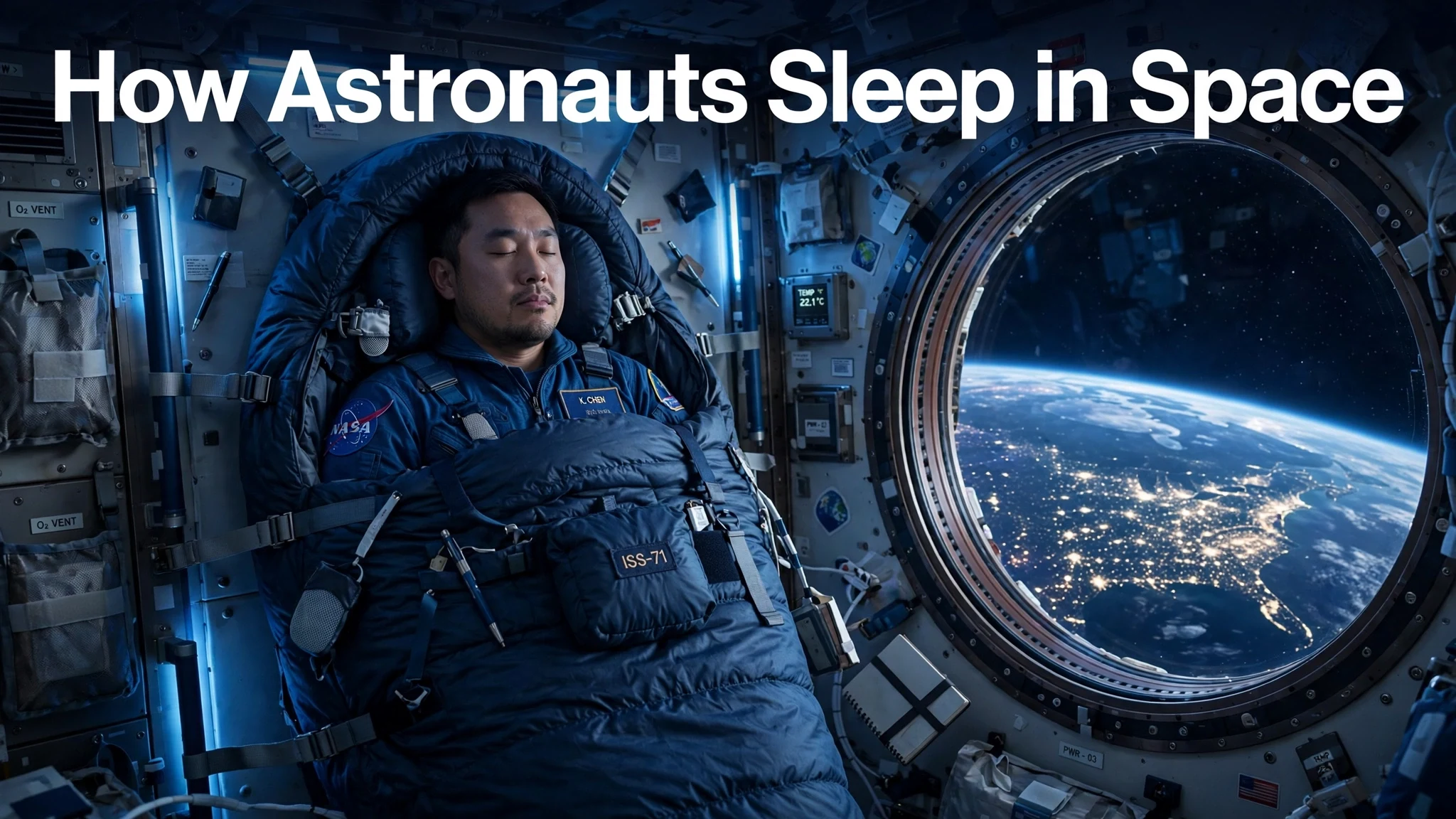
Astronauts on the International Space Station sleep in sleeping bags, but not the kind you use on a camping trip. The bag is strapped to a wall, a ceiling or a floor — the words barely mean anything in orbit, since there is no up or down — and the astronaut floats inside it, held in place by straps so they do not drift away and bump into equipment. Some crew members sleep in small private cabins, about the size of a phone booth, with a sleeping bag, a laptop, and a few personal items. Others sleep in a shared module, in a bag attached to a wall. Either way, the bag is the bed, the blanket and the anchor.
The position inside the bag is different from sleeping on Earth. Without gravity pulling the body down, the arms tend to float up in front of the chest, and the spine stretches slightly — astronauts grow a few centimetres taller in space as the discs between their vertebrae expand. The sleeping bag keeps the body contained and gives a sense of pressure and enclosure that helps the brain understand that it is time to sleep. Some astronauts say they sleep better in space than on Earth, because there are no pressure points, no mattress digging into a hip or a shoulder. Others find the floating sensation strange and take weeks to get used to it.
The cabins are also designed for darkness and quiet, as far as that is possible. Each cabin has a door, a light that can be dimmed, and ventilation that provides fresh air — essential, because in weightlessness, the carbon dioxide you breathe out does not rise away from your face; it forms a bubble around your head, and without a fan, you could wake up with a headache from breathing your own exhaled air. The small details of the sleeping arrangements — the straps, the fan, the light — are not luxuries. They are the difference between sleeping and not sleeping, and between a crew that works well and one that does not.
Sixteen Sunrises a Day: The Problem of Light
The biggest challenge to sleep in space is light. The station orbits the Earth every ninety minutes, which means an astronaut sees a sunrise and a sunset roughly every forty-five minutes — sixteen of each in a twenty-four-hour day. The human body clock, the circadian rhythm, is built for a single sunrise and a single sunset, and it uses light as its main signal for when to be awake and when to sleep. Sixteen sunrises is not a signal; it is noise, and the body clock struggles to make sense of it.
The solution is artificial: the crew follows a strict schedule based on Greenwich Mean Time, with lights dimmed in the evening and brightened in the morning, and with window covers closed at night. The station’s lighting system has been upgraded to use different colours at different times — bright, blue-rich light in the morning to promote alertness, and warmer, dimmer light in the evening to encourage sleep. It is a way of rebuilding, inside a metal tube, the pattern of light and dark that the body expects from a day on Earth.
Even with that, the body clock can drift. Some astronauts find their sleep shifts earlier or later, or that they wake in the middle of the scheduled night. The crew are given sleep guidelines, and their sleep is monitored — in some missions with wrist-worn devices that track movement and light exposure. When a crew member’s sleep is poor, the schedule can be adjusted, or a light therapy session can be used to reset the clock. The lesson is that sleep in space is not left to chance. It is managed, like food, exercise and work, because a tired astronaut is a risk to the mission and to themselves.
The Schedule: Why Astronauts Sleep by the Clock
Life on the space station runs on a timetable. The crew typically sleep for about eight and a half hours, work for about eight hours, and spend the rest of the time on exercise, meals, maintenance and free time. The schedule is planned in advance and displayed on screens around the station, and it is followed closely, because in an environment where the Sun rises sixteen times a day, the only thing that tells the body when to sleep is the clock and the routine.
The schedule also protects sleep. Work is not supposed to intrude on the sleep period except in an emergency, and the crew are encouraged to wind down before bed — to read, to listen to music, to talk to family on a video call, or to look out of the window at the Earth below. That wind-down matters, because the transition from work to sleep is harder when work and sleep happen in the same small space, a few metres apart. On Earth, you leave the office and go home. On the station, you float from your workstation to your sleeping bag, and the boundary between the two has to be created by habit rather than by distance.
Exercise is part of the schedule too, and it helps sleep. Astronauts exercise for about two hours a day, on a treadmill with a harness, on a cycle machine, or with resistance equipment, mainly to counteract the loss of muscle and bone in weightlessness. But exercise also tires the body in a healthy way, and it helps the sleep that follows. The crew who exercise regularly generally sleep better than those who do not, which is another reason the exercise schedule is taken seriously, even on days when the crew are busy or tired.
What Goes Wrong: Insomnia, Snoring and Strange Dreams
Despite all the planning, sleep in space is often worse than sleep on Earth. Studies of astronauts have found that they sleep less in orbit — often around six hours a night instead of eight — and that their sleep is more fragmented, with more waking during the night. Some of that is the environment: noise, light, discomfort, and the strangeness of floating. Some of it is the work: the pressure, the excitement, and the knowledge that a mistake could be serious. And some of it is the body itself, adapting to weightlessness in ways that affect sleep.
Snoring is a good example of how the body changes. On Earth, snoring is caused partly by gravity pulling the tissues of the throat down. In weightlessness, that pull is gone, and many astronauts who snore on Earth stop snoring in space. But other problems appear: fluid shifts to the head, which can cause a stuffy nose and a feeling of congestion, and the lack of gravity means that mucus does not drain as it does on Earth. Some astronauts wake with a blocked nose or a headache, and that affects their sleep.
Dreams in space are another curiosity. Astronauts report dreams that are often about Earth — about home, about family, about ordinary life — and some report dreams in which they are floating or falling. There is no evidence that dreams in space are fundamentally different from dreams on Earth, but the experience of dreaming about home while floating above it is a poignant one, and astronauts have written about it movingly. Sleep, even in orbit, remains a deeply human experience, tied to memory, to home, and to the people left behind.
The Tools That Help: Earplugs, Eye Masks and Melatonin
Astronauts use a range of simple tools to help them sleep. Earplugs or noise-cancelling headphones reduce the constant hum of the station’s fans and pumps, which runs at a level comparable to a noisy office. Eye masks block the light that leaks around window covers or from a neighbour’s laptop. Some astronauts use a sleep mask and earplugs every night, and they become as much a part of the bedtime routine as brushing teeth.
Light is also used as a tool, not only as a problem. Bright light in the morning helps reset the body clock, and some astronauts use light therapy — sitting in front of a bright lamp for a period — to shift their sleep pattern when it drifts. The station’s lighting system is designed to support this, with lights that change colour and intensity through the day. It is a simple idea, but it is one of the most effective sleep interventions available, in space or on Earth.
Sleeping pills are used sometimes, but cautiously. Some astronauts take a mild sleep aid, such as melatonin, which is a hormone the body produces naturally to signal sleep, or a prescription sleep medication for a short period, especially in the first days of a mission when the body is still adapting. But medication is not a long-term solution, and the preference is for good habits: a regular schedule, a dark and quiet sleeping place, exercise, and a wind-down routine. The tools help, but the routine is what makes sleep work in space.
What Space Sleep Teaches Us About Sleep on Earth
The study of sleep in space has taught scientists a great deal about sleep in general. It has shown how important light is to the body clock, and how quickly the clock can drift when light is irregular — a finding that applies to shift workers, to people who travel across time zones, and to anyone who stares at a bright screen late at night. The lighting systems developed for the space station are now being used in hospitals, offices and homes on Earth, to help people sleep better and work better.
It has also shown how resilient the human body is. Astronauts sleep less and worse in space, yet they function, they work, they make decisions, and they stay safe for months. That does not mean poor sleep is harmless — it is not, and the risks of fatigue are taken seriously — but it does show that the body can adapt to extraordinary conditions, and that sleep, even when it is imperfect, is enough to keep a person going. That resilience is reassuring, and it is also a reminder not to take sleep for granted.
Perhaps the most important lesson is the simplest: sleep needs a routine, a dark and quiet place, and a body that is tired in a healthy way. Astronauts, who have every reason to sleep badly, sleep as well as they do because those basics are protected by a schedule and by design. On Earth, where the basics are often neglected — where light, noise, work and screens intrude on the night — the space station is a reminder of what sleep needs, and of how much better it can be when those needs are taken seriously.
Sleeping on the Way to Mars: The Next Challenge
Future missions will make sleep harder. A journey to Mars takes months, and a stay on Mars will have a day that is about forty minutes longer than an Earth day, which will confuse the body clock in a new way. The crew will be further from Earth than anyone has ever been, with no quick return, and with a communication delay that makes support from home slower. Sleep will matter even more, because a tired crew on a Mars mission cannot be replaced or rescued quickly.
Designers are already thinking about this. Future spacecraft may have better sleeping quarters, with more privacy, better soundproofing, and lighting that mimics the Martian day. They may use individual light therapy, better monitoring, and schedules that are adapted to each crew member’s body clock. They may also use artificial gravity, by rotating part of the spacecraft, which would restore the feeling of up and down and might make sleep more natural. None of these is certain, but all of them are being studied.
The lesson of sleep in space so far is that it is solvable, but only if it is treated as a serious part of mission design, not as an afterthought. A spacecraft that is designed for work but not for sleep is a spacecraft that will fail, because its crew will fail first. The engineers who design the next generation of spacecraft know this, and the sleeping bag strapped to a wall, humble as it looks, is one of the most important pieces of equipment on the station. It is where the mission rests, and where the people who carry it out recover enough to do it again tomorrow.
My Take:
My honest reaction to learning how astronauts sleep is a mixture of admiration and recognition. Admiration, because the solution — a sleeping bag strapped to a wall, a strict schedule, lights that change colour to fake a day — is so simple and so human, and it works well enough to keep people alive and working in the most hostile environment we have ever lived in. Recognition, because the problems are the same ones many of us face on Earth: too much light at night, too much noise, a schedule that does not respect the body’s clock, and work that follows us into the bedroom. The space station is an extreme version of a modern bedroom, and the lessons it teaches apply to both.
What strikes me most is the discipline of it. On Earth, sleep is often treated as something that happens if there is time left over, after work, after screens, after everything else. On the station, sleep is scheduled, protected and designed for, because a tired astronaut is a danger to the mission. I think that is the right attitude, and I wish more of us adopted it. Sleep is not a luxury or a sign of laziness. It is a basic need, like food and water, and the people who treat it that way — in space or on Earth — function better than those who do not. The astronauts are not being pampered. They are being sensible.
I am also moved by the small, human details: the astronaut who reads before bed, the one who listens to music, the one who looks out of the window at the Earth and thinks of home. Those are not technical details. They are the ways people make an alien place feel human, and they matter as much as the engineering. A sleeping bag is a piece of equipment, but the routine around it — the book, the call home, the view — is what makes it possible to sleep. That is a reminder that technology alone never solves a human problem. It is the habits and the meanings around the technology that do.
The light problem is the part I think about most, because it is the clearest example of how the body is built for a world we no longer live in. Our body clock expects one sunrise and one sunset, and modern life — with its screens, its shift work, its late nights — gives it something else entirely. The space station, with its sixteen sunrises, is the extreme case, but the rest of us live in a milder version of the same problem. The solution the station uses — bright light in the morning, dim warm light in the evening, a regular schedule — is available to anyone, and it is one of the simplest and most effective things a person can do for their sleep. I find that encouraging: the best sleep advice from space is also the best sleep advice on Earth.
On the dreams, I have a softer thought. Astronauts dream of home, of ordinary life, of the people they love, while floating above the planet where those people are. There is something poignant about that, and it reminds me that sleep is not only a biological process. It is where the mind goes home, where it processes the day, where it keeps us connected to the life we have left behind. A person can be further from home than any human has ever been, and their dreams will still take them back there. That is a beautiful fact, and it is a reminder that no amount of distance changes what matters to us.
If I had to take one practical lesson from all of this, it would be this: protect your sleep the way astronauts protect theirs. Keep a regular time for bed and for waking. Make the bedroom dark and quiet. Get bright light in the morning and dim light in the evening. Exercise during the day. Wind down before bed, and keep work out of the bedroom if you can. None of that is new advice, and none of it requires a space station. But knowing that the same rules keep people alive in orbit makes them easier to take seriously. If it is important enough for a mission to Mars, it is important enough for a Tuesday night.
Finally, I think the story of sleep in space is a story about adaptability. The human body, given time, learns to sleep while floating, to sleep through noise, to sleep with the Sun rising every forty-five minutes. That adaptability is remarkable, and it is also a reason for hope: if we can learn to sleep in space, we can learn to sleep better on Earth, and we can learn to live in places and conditions that seem impossible now. The sleeping bag on the wall is a small thing, but it is proof of a large one — that people can adapt to almost anything, if they are given the right tools, the right routine, and enough time.
I also think about the astronauts who say they sleep better in space than on Earth, because there are no pressure points and no mattress digging into a hip. That is a small, surprising detail, and it reminds me that the body is adaptable in ways we do not expect. We assume that the natural way — lying in a bed, under gravity — is the best way, but the body does not care about natural. It cares about comfort, about darkness, about quiet, and about a routine it can trust. A sleeping bag on a wall, if it provides those things, can be a better bed than a mattress that does not. That is a useful reminder not to confuse the familiar with the best.
The noise problem is one I recognise from ordinary life. The station hums constantly, and the crew learn to sleep through it, or they use earplugs. On Earth, the noise is different — traffic, a neighbour, a phone buzzing — but the principle is the same: the sleeping environment matters, and a small change, like earplugs or a white noise machine, can make a real difference. I think we underestimate how much of poor sleep is environmental, and how much of it can be fixed by changing the room rather than by changing ourselves. The astronauts, who cannot change their room, change what they can, and that is a practical attitude worth copying.
One more thought: the way sleep is scheduled and protected on the station is a model for how any high-stakes work should treat rest. The crew are not expected to work through the night, or to prove their dedication by sleeping less. They are expected to sleep, because a tired crew is a danger. I wish more workplaces on Earth understood that. The idea that rest is a sign of weakness, or that sleeping less is a sign of commitment, is not only wrong but dangerous, in space and on Earth. The astronauts sleep because their lives depend on it. Our lives depend on it too, in quieter ways, and we would do well to remember that.
Frequently Asked Questions
How do astronauts sleep in space?
They sleep in sleeping bags strapped to a wall, ceiling or floor of the space station, in small private cabins or shared modules. The bag holds them in place so they do not float away, and a fan provides fresh air. They typically sleep for about eight and a half hours on a strict schedule.
Do astronauts float while they sleep?
Yes, they float inside their sleeping bags, with their arms often drifting up in front of their chest. The bag and straps keep them in place so they do not drift into equipment. Many astronauts say the floating sensation is comfortable once they get used to it, because there are no pressure points.
How do astronauts deal with 16 sunrises a day?
The crew follows a strict schedule based on Greenwich Mean Time, with lights dimmed in the evening and brightened in the morning, and window covers closed at night. The station’s lighting changes colour through the day to mimic a normal pattern of light and dark and help the body clock stay on schedule.
Do astronauts snore in space?
Many who snore on Earth stop snoring in space, because gravity no longer pulls the tissues of the throat down. However, fluid shifts to the head in weightlessness, which can cause a stuffy nose and congestion that affects sleep in other ways.
Do astronauts dream in space?
Yes. Astronauts report dreams that are often about Earth, home and family, and some dream of floating or falling. There is no evidence that dreaming in space is fundamentally different from dreaming on Earth, though the experience of dreaming about home while orbiting above it is often described as poignant.
How much sleep do astronauts get in space?
They are scheduled for about eight and a half hours, but studies have found they often sleep less, around six hours a night, and that their sleep is more fragmented than on Earth. Sleep is monitored and the schedule is adjusted when needed, because fatigue is a safety risk.