How Do Astronauts Eat in Space? Explained Simply
In this post
- What Space Food Actually Is: Pouches, Cans and Tortillas
- How a Meal Is Made: Hot Water, a Warmer and a Straw
- Why Food Tastes Different in Space
- Drinks, Coffee and the Famous Space Espresso
- Crumbs, Spills and the Rules of Eating in Orbit
- Growing Food in Space: Lettuce, Chillies and the Future
- Why Shared Meals Matter More Than the Food
- My Take:
Food is one of the most human things there is, and in space it becomes one of the most complicated. There is no kitchen as we know it, no fridge full of fresh food, no plate you can set down, and no gravity to keep your dinner where you put it. A crumb that floats away can get into an astronaut’s eye or into a piece of equipment. A drop of coffee can drift across a module and short a circuit. And yet, astronauts eat three meals a day, they share them together, they celebrate birthdays with cake, and they say that a good meal is one of the best parts of life in orbit. How they do it is a story about ingenuity, chemistry, and the stubborn human need to eat well even in the strangest place imaginable.
The challenge starts with the food itself. Fresh food lasts only a few days, and a resupply ship may not arrive for months, so most space food has to last for a year or more without refrigeration. It has to be light, because every kilogram sent to orbit costs a great deal, and it has to be safe, because a food poisoning outbreak in space would be a serious emergency. It also has to be food that people actually want to eat, day after day, for months, in a place where their sense of taste is dulled and their appetite is often low.
This article explains how astronauts eat in space: what the food is, how it is prepared and packaged, how they eat it without gravity, what they drink, what happens to the crumbs, and why shared meals matter so much. It also looks at what the food teaches us about nutrition, about the psychology of eating, and about the future, when astronauts will travel to Mars and need to grow their own food. You do not need to know anything about spaceflight — only to have wondered what dinner looks like when dinner floats.
What Space Food Actually Is: Pouches, Cans and Tortillas
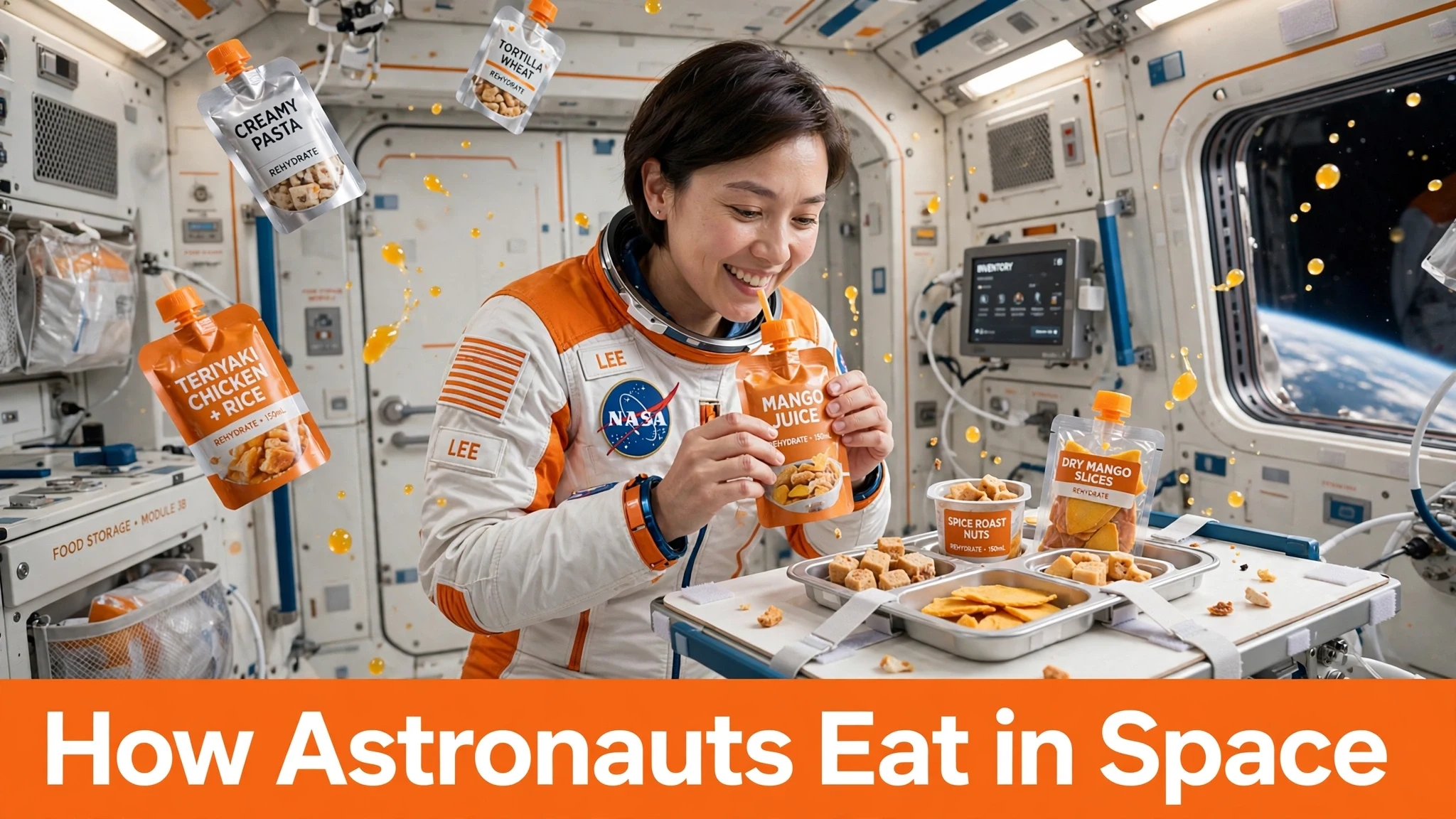
Most food on the International Space Station comes in pouches, cans or sealed packets, and it falls into a few categories. Thermostabilised food is food that has been heated to kill bacteria and then sealed in a pouch or a can, much like the food in a tin at home, and it can be eaten at room temperature or warmed. Freeze-dried food has had its water removed, so it is light and lasts a long time, and it is rehydrated with hot water before eating — soups, casseroles, vegetables and even scrambled eggs are prepared this way. Irradiated food has been treated with radiation to kill bacteria, and it includes meats such as beef steak. And there is a small amount of fresh food — fruit, vegetables, bread — delivered by resupply ships, which is eaten quickly, usually within a few days, and is always a cause for celebration.
There is no bread in the usual sense, because bread makes crumbs, and crumbs in weightlessness are a hazard: they float into eyes, into equipment, and into air filters. Instead, astronauts eat tortillas, which do not crumble, and which have become the most popular food in space. A tortilla can be wrapped around almost anything — eggs, meat, vegetables — and it can be eaten with one hand while floating. The tortilla is a small, practical solution to a real problem, and it is a good example of how space food is designed around the environment, not around tradition.
Condiments come in liquid form, in small bottles or pouches: ketchup, mustard, mayonnaise, hot sauce. Salt and pepper are dissolved in water and squirted from a bottle, because a grain of salt or pepper in weightlessness would float away and could get into someone’s eye or nose. The details sound funny, but they are serious: in a closed environment where the air is recirculated, anything that floats is a potential problem, and food is designed so that nothing floats that does not have to.
How a Meal Is Made: Hot Water, a Warmer and a Straw
Preparing a meal in space is a small ritual. The astronaut chooses a pouch from the pantry, attaches it to a water dispenser, and adds hot or cold water through a needle-like valve. The pouch is then kneaded to mix the water and the food, and left for a few minutes to rehydrate. Thermostabilised food is heated in a small food warmer, a box with slots that holds several pouches at once. The food is then eaten directly from the pouch, usually with a spoon or a fork, and sometimes by squeezing the pouch. There is no cooking in the usual sense — no frying, no baking, no stove — because an open flame in a spacecraft full of oxygen would be extremely dangerous.
Eating from a pouch takes practice. The astronaut holds the pouch, opens it, and eats with a spoon, taking care not to let food escape. Liquids are drunk through a straw from a sealed pouch, because a cup of coffee would float away as a ball of liquid. Coffee itself is a special case: it comes as instant coffee in a pouch, to which hot water is added, and it is drunk through a straw. Astronauts have said that the coffee is not as good as fresh coffee on Earth, but that the ritual of a morning coffee matters, and that the smell, even in a pouch, is comforting.
The galley, the area where food is prepared and eaten, is a social space. The crew gather there for meals, floating around a table that is really a frame with restraints for pouches and utensils. They eat together, they talk, and they share food from each other’s supplies — a Russian cosmonaut’s soup, an American astronaut’s dessert, a Japanese astronaut’s curry. The meal is one of the few times in the day when the crew are not working, and it is protected as a social time, because a crew that eats together works better together.
Why Food Tastes Different in Space
Many astronauts report that food tastes blander in space, and there are two reasons. The first is physical: in weightlessness, fluid shifts to the head, the nose becomes congested, and the sense of smell — which is a large part of taste — is reduced. It is like eating with a cold. The second is psychological: the food is the same, day after day, the variety is limited, and the environment is strange. Appetite often drops in the first days of a mission, and some astronauts lose weight, which is a concern because they also lose muscle and bone in weightlessness.
The response has been to make food spicier and more strongly flavoured. Hot sauce is one of the most popular items on the station, and astronauts ask for extra spices, for strong flavours, for food that can cut through the congestion. The space agencies also work hard on variety: the menu on the station includes more than two hundred items, from different countries and cuisines, and astronauts can choose their own menus before a mission, so they eat food they like. That choice matters, because a person who enjoys their food eats more of it, and eating enough is essential for health in space.
There is also a psychological side. Food is comfort, and in a stressful, isolated environment, a familiar taste can be a powerful thing. Astronauts have favourite foods sent from home, and they save them for difficult days. A birthday cake, a holiday meal, a packet of a favourite snack — these are not luxuries. They are a connection to home, and to normal life, and they help a crew stay healthy in mind as well as in body. The people who plan space food understand this, and they treat morale as seriously as nutrition.
Drinks, Coffee and the Famous Space Espresso
Drinks in space are all pouches and straws. Water is the most important drink, and it is recycled on the station from urine, sweat and condensation — a fact that surprises people, but the water is purified to a very high standard and is cleaner than most tap water on Earth. Juice, tea and coffee are available as powders to which water is added. There are no fizzy drinks in the usual sense, because the bubbles do not rise in weightlessness; the gas stays mixed in the liquid, and drinking it can cause discomfort.
Coffee deserves a special mention, because it is one of the most requested items and one of the most missed. For years, astronauts drank instant coffee from a pouch, which was acceptable but not satisfying. Then, in 2015, an espresso machine called ISSpresso was sent to the station, and astronauts could drink real espresso — though still from a pouch, and still through a straw. The machine was a feat of engineering, because it had to work in weightlessness, with no gravity to pull the water through the coffee, and it had to be safe. The fact that so much effort went into a cup of coffee says something about how important small comforts are in space.
Alcohol is not allowed on the station, for reasons of safety and health. That surprises some people, but it is a sensible rule: in an environment where a mistake can be serious, and where the body is already under stress, alcohol is an unnecessary risk. The crew celebrate with other things — a special meal, a video call home, a view of the Earth — and they do not seem to miss alcohol as much as they miss fresh food and good coffee.
Crumbs, Spills and the Rules of Eating in Orbit
Eating in weightlessness has rules, and they exist for good reasons. Food must be contained, crumbs must be avoided, and anything that floats must be caught. Astronauts eat slowly and carefully, and they clean up after every meal, wiping surfaces and collecting any food that has escaped. A crumb in an eye is painful; a crumb in a piece of equipment can cause a fault; a drop of liquid in the wrong place can short a circuit. The rules are not about tidiness. They are about safety.
Spills do happen, and they are handled calmly. A ball of liquid floating in the air is caught with a towel or a cloth, and the surface is wiped down. An astronaut who has been in space for a while learns to eat without spilling, to open a pouch without letting food escape, and to drink without letting a bubble of liquid drift away. It becomes second nature, like learning to eat in a moving car, except that the car is moving at twenty-eight thousand kilometres an hour and there is no road.
The waste is also managed carefully. Food packaging is collected, compacted and stored, and it is eventually sent back to Earth or burned up in the atmosphere with other waste. Nothing is thrown out of the station into space. The system is a reminder that in a closed environment, everything has to be accounted for, and that eating — the most ordinary human activity — becomes, in space, a small exercise in engineering and discipline.
Growing Food in Space: Lettuce, Chillies and the Future
One of the most exciting developments in space food is growing it. The station has a small garden, a system called Veggie, in which astronauts grow lettuce, cabbage, mustard greens and even chillies, using LED lights and a controlled environment. The plants grow in weightlessness, their roots in a special material, and they are harvested and eaten fresh — the first fresh food grown and eaten in space. The lettuce is not a large meal, but it is a symbol: food that was not brought from Earth, but grown where it was eaten.
The chillies are particularly interesting, because they were the first fruit grown in space, and they took months to grow, requiring pollination by hand, with a small fan and a brush. The astronauts who grew them described the harvest as a celebration, and the chillies were shared among the crew. It was a small thing — a few red chillies — but it was also a proof of concept: that food can be grown in space, and that future crews will not have to rely entirely on supplies from Earth.
Growing food will be essential for a mission to Mars. A journey there takes months, and a stay on Mars will last longer still, and it will not be possible to carry all the food needed for the whole mission. Future crews will have to grow a significant part of their diet, in greenhouses on Mars or in transit, and that will require not only technology but knowledge: how to grow plants in low gravity, how to pollinate them, how to keep them healthy, and how to make a diet from what can be grown. The lettuce on the station is the first step on that road, and it is a step that matters more than its size suggests.
Why Shared Meals Matter More Than the Food
Ask astronauts what they miss most about Earth, and food is often near the top of the list — not the food itself, but the experience of eating it: a meal cooked at home, a table with family, a restaurant with friends. In space, the meal is one of the few times the crew come together as people rather than as workers, and the agencies that run the station protect that time deliberately. Meals are scheduled, the crew eat together, and they are encouraged to share food from their own supplies.
The sharing is also cultural. A crew on the station is often international, and the food reflects that: Russian soups, American desserts, Japanese curries, European cheeses. Sharing food is sharing culture, and it is one of the ways a diverse crew becomes a team. An astronaut who has eaten a colleague’s food, and who has shared their own, has a bond that goes beyond work, and that bond matters when the crew face a difficult day or an emergency.
In the end, the story of eating in space is not only about pouches and tortillas. It is about the human need to eat well, to eat together, and to find comfort in food even in the strangest place imaginable. The engineers who design space food understand that, and the astronauts who eat it live it every day. A meal in orbit is a small, daily act of normal life in an abnormal place, and that normality is part of what makes the mission possible.
My Take:
My view on eating in space is that it is one of the most human stories in spaceflight, because it is about a need that does not change, however far you travel. You can be floating above the Earth, travelling at twenty-eight thousand kilometres an hour, doing work that no one has ever done before, and you still need dinner, and you still want it to taste good, and you still want to eat it with other people. That continuity — that the most ordinary human need survives the most extraordinary human journey — is both comforting and profound, and it is why I think the food story matters more than the technical details.
What I love most is the tortilla. It is a small, practical, unglamorous solution to a real problem — bread makes crumbs, crumbs are dangerous, so use a flatbread that does not crumble — and it has become the most popular food in space. That is engineering at its best: not a grand invention, but a sensible adaptation, a willingness to let go of tradition and to use what works. I think there is a lesson in that for all of us: the best solution is often not the most impressive one, but the one that fits the environment you are actually in.
The taste problem is the part I think about most, because it is a reminder that eating is not only about nutrition. It is about smell, about memory, about comfort, and about the pleasure of a flavour. When astronauts say food tastes bland in space, they are not complaining about the cooking. They are describing a real physiological change — fluid in the head, a blocked nose, a dulled sense of smell — and the response, more spice and more flavour, is a sensible one. It is also a reminder that the people who plan space food are thinking about the person, not only the calorie count, and that is the right way to think about food anywhere.
I am also struck by the social side. The meal is protected time, the crew eat together, they share food from different countries, and that sharing builds a team. That is true on Earth as well, and it is easy to forget in a busy life: that a shared meal is not a waste of time, but a way of building the relationships that make work possible. The space station, where time is precious and every minute is scheduled, still protects the meal, and that tells me something about what matters. If a crew in orbit makes time to eat together, the rest of us can probably make time too.
The growing food story is the part that gives me hope for the future. A lettuce grown on the station, a chilli pollinated by hand in weightlessness, is a small thing, but it is proof that we can grow food where we go, not only carry it with us. That matters for Mars, and it matters for Earth, because the same techniques — growing food in a controlled environment, with little water and no soil — could help feed people in places where farming is hard. Space has a habit of giving back, and the garden on the station is a good example of that.
If I had to take one practical lesson from eating in space, it would be this: eat together, eat food you enjoy, and pay attention to flavour. Those are simple things, and they are easy to neglect, but they are the things that keep a crew healthy and happy in orbit, and they will keep the rest of us healthy and happy on Earth. The pouch and the straw are specific to space. The need for a good meal, shared with good people, is universal, and it is one of the few things that does not change, however far we travel.
Finally, I think the coffee story is worth remembering, because it shows how much small comforts matter. A great deal of engineering went into making a cup of espresso in weightlessness, and the reason was not that espresso is essential. It was that the ritual of a morning coffee — the smell, the warmth, the moment of calm before work — is essential, and that a crew that has its small comforts works better than a crew that does not. That is a lesson for any workplace, any home, and any life: the small things are not small. They are the things that make the big things possible.
I also think about the waste, because it is a reminder that in a closed system, nothing disappears. Every pouch, every wrapper, every crumb has to be accounted for, collected, and dealt with, and that is a discipline that Earth could learn from. On Earth, we throw things away and forget about them, but there is no away — there is only somewhere else, a landfill, an ocean, a place we do not see. The station, where there is no away, forces a honesty about waste that the rest of us avoid. Eating in space is a lesson in taking responsibility for what you consume, and I think that lesson is worth carrying home.
The fresh food deliveries are the part that moves me most. A resupply ship arrives with apples, oranges, vegetables, and the crew gather to eat them, not because an apple is a remarkable thing, but because it is fresh, and it is from Earth, and it is a reminder of home. That hunger for fresh food, for something that grew in soil and sun, is deeply human, and it tells me that no amount of technology will replace the simple pleasure of a fresh apple. The pouch food is clever and necessary, but the apple is what the crew really want, and that is a good thing to know about ourselves.
Finally, I think about the future, when astronauts will grow most of their food on Mars, and I wonder what that will feel like. A greenhouse on another planet, with plants growing in red soil under artificial light, tended by people who are further from home than anyone has ever been — that is a strange and hopeful image. It is also a reminder that food is not only fuel. It is a connection to Earth, to life, to the green things that grow, and carrying that connection with us, to another world, is one of the most human things we could do. The lettuce on the station is small, but it is the beginning of that, and beginnings matter.
Frequently Asked Questions
What do astronauts eat in space?
Mostly food in pouches, cans and sealed packets: thermostabilised meals, freeze-dried food rehydrated with hot water, and irradiated meats. Fresh fruit and vegetables arrive on resupply ships and are eaten quickly. Tortillas replace bread because they do not make crumbs.
How do astronauts eat without gravity?
They eat directly from pouches with a spoon or fork, taking care not to let food escape, and they drink through a straw from a sealed pouch. Salt and pepper are dissolved in water and squirted from a bottle, and crumbs are avoided because they can float into eyes or equipment.
Why does food taste different in space?
In weightlessness, fluid shifts to the head, the nose becomes congested and the sense of smell is reduced, which dulls taste. Food is therefore made spicier and more strongly flavoured, and hot sauce is one of the most popular items on the station.
Can astronauts grow food in space?
Yes. The station has a small garden system where astronauts have grown lettuce, cabbage, mustard greens and chillies, using LED lights. The food is eaten fresh, and growing food will be essential for future missions to Mars, where carrying all supplies is not practical.
Do astronauts drink coffee in space?
Yes. They drink instant coffee from a pouch through a straw, and since 2015 the station has had an espresso machine, ISSpresso, that makes real espresso in weightlessness. The ritual of a morning coffee is considered important for morale.
Is there a kitchen on the space station?
There is a galley area for preparing and eating food, with a water dispenser, a food warmer and a table, but there is no stove or oven, because an open flame would be dangerous. Meals are prepared by adding hot water to pouches and warming them, then eaten together by the crew.