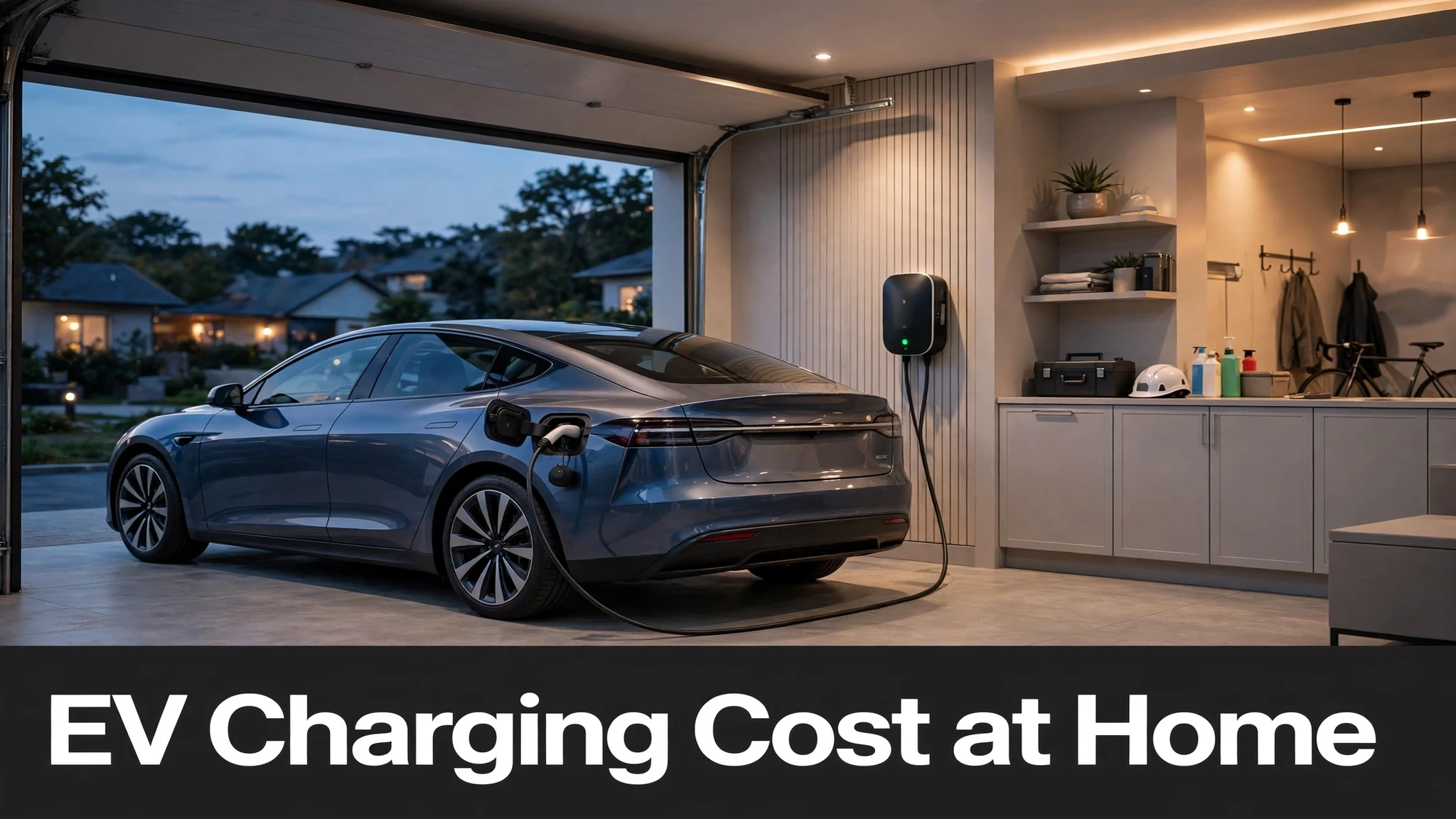
Electric Car Charging Cost at Home 2026
In this post
- The Simple Formula: Battery Size Times Price per kWh
- UK Home Charging Costs in 2026: Off-Peak Changes Everything
- US and India: The Same Formula, Very Different Rates
- Level 1, Level 2, and Why Home Fast Charging Is Not Level 3
- Cutting Your Home Charging Bill Further
- Worked Monthly Examples: Three Drivers, Three Bills
- How Renters and Flat Dwellers Can Charge Cheaper
- Solar, Batteries, and Vehicle-to-Home: Do They Change the Maths?
- My Take:
Home charging is the cheapest way to run most electric cars, but the actual bill depends on only two numbers: your battery size in kilowatt-hours and the price you pay per kilowatt-hour. Everything else — off-peak tariffs, charger levels, charging losses, and your driving distance — modifies those two numbers, and once you can do the simple multiplication, no charging claim can confuse you. This guide gives you that formula, worked examples from the UK, the US, and India, the difference between slow and fast home chargers, and the hidden costs, such as installation and standing charges, that turn a cheap per-mile figure into a real monthly bill. Rates vary by region, supplier, and time of day, so use your own electricity bill rate for a personal figure, and treat every number here as an example from published 2026 guides, not a promise for your tariff.
The headline finding is consistent across countries: charging at home, especially overnight on a dedicated electric-vehicle tariff, costs far less per mile than public rapid charging or petrol, but charging at home on a standard daytime rate is much less dramatic. That gap is the whole story. A driver who can charge overnight on a cheap tariff may pay only a few pence or cents per mile; a driver stuck on a standard rate, or forced to use public chargers, pays several times more. Before buying an electric car, therefore, the most valuable check is not the car’s headline range, but your home electricity situation: your tariff, your overnight rate, and whether you can install a faster charger.
The Simple Formula: Battery Size Times Price per kWh
A kilowatt-hour, written kWh, is a unit of energy, like a litre of fuel for a petrol car. Your car’s battery size tells you how many kWh it can hold — a typical mid-size electric car holds around 60 kWh, a small city car may hold 40 kWh, and a large long-range car may hold 75 to 100 kWh. Your electricity price tells you what each kWh costs on your tariff. Multiply them, and you get the cost of a full charge from empty: battery size in kWh multiplied by price per kWh equals full-charge cost.
Take a worked example using UK figures published for late 2026. A 60 kWh battery charged at the standard price-cap rate of about 26p per kWh costs about £15.60 for a full charge from empty. The same battery charged overnight on a dedicated EV tariff at about 7p per kWh costs about £4.20. The car did not change; the tariff changed the bill by more than three times. That is why two neighbours with identical cars can report completely different charging costs, and why any article that quotes a single “cost to charge an EV” without stating the tariff is incomplete.
Two adjustments make the formula realistic. First, you rarely charge from completely empty to completely full, so a daily top-up costs proportionally less: adding 20 kWh costs 20 times your rate, whatever that rate is. Second, charging loses some energy as heat, so the meter may record roughly 10% more energy than the battery receives; published UK cost-per-mile figures often divide by 0.9 to allow for that loss. Add about a tenth to your simple calculation if you want a conservative estimate, and remember that taxes, standing charges, and your supplier’s day rate also affect your total electricity bill, even if they are not part of the per-kWh charging figure itself.
UK Home Charging Costs in 2026: Off-Peak Changes Everything
In the UK, the gap between a standard rate and an off-peak EV tariff is the largest single factor in home charging cost. Published guides for September to November 2026 put the standard price-cap rate at around 26p per kWh for a typical direct-debit customer, while dedicated EV tariffs offered overnight windows, typically between about 11pm and 6am, at roughly 7p to 8.8p per kWh, depending on supplier and region. You usually need a smart meter, and for most such tariffs, a smart charger that can be scheduled to charge only in the cheap window.
Translated into cost per mile, using a typical efficiency of about 3.5 miles per kWh, home charging at the standard rate costs roughly 7.5p per mile before allowing for losses, while overnight EV-tariff charging costs roughly 2p per mile. A driver covering 10,000 miles a year would therefore pay roughly £750 a year on the standard rate versus roughly £200 a year overnight, before losses and standing charges — a difference large enough to affect the whole economics of owning the car. Public charging, by contrast, averaged around 54p per kWh on slower public chargers and around 77p to 80p on rapid chargers in published August to November 2026 averages, making a full 60 kWh charge roughly £32 to £48, several times the overnight home cost.
The practical lesson is to check EV tariffs before you assume home charging is cheap, and to check the whole tariff, not just the overnight rate. Some EV tariffs charge a higher day rate or standing charge, which can offset the overnight saving if your household uses a lot of daytime electricity. Use a comparison based on your total usage, not just the headline overnight figure, and set your car’s or charger’s schedule so charging actually happens in the cheap window; a smart charger left on an unscheduled setting can silently charge at the expensive rate and erase the saving.
US and India: The Same Formula, Very Different Rates
In the United States, average residential electricity was reported at roughly 18 cents per kWh in 2026 guides, with wide state variation — from about 12 cents in some states to over 50 cents in Hawaii in one reported May 2026 range. At 18 cents, a 60 kWh full charge costs about $10.80 before losses, and at an off-peak time-of-use rate of 8 to 12 cents, the same charge costs about $4.80 to $7.20. Public Level 2 charging in the US was commonly reported at 25 to 40 cents per kWh, and DC fast charging at 40 cents or more, so home charging remains the cheapest option for most American drivers, but the saving is smaller in high-rate states than in low-rate ones. Always use your state’s and utility’s actual rate, not a national average, for a personal estimate.
In India, published 2026 guides put home charging at roughly ₹6 to ₹10 per unit, which is the Indian term for a kWh, giving a full-charge cost of roughly ₹144 to ₹550 depending on battery size and tariff. A commonly cited example is a 45 kWh car charged at ₹8 per unit, costing ₹360 for a full charge, or about ₹396 allowing roughly 10% charging loss, and working out at roughly ₹1 per kilometre at typical efficiency. Driving 1,000 kilometres a month at that rate costs roughly ₹1,000 to ₹1,200 in electricity in such guides, compared with roughly ₹6,800 for a comparable petrol car in Delhi in the same comparison — but Indian tariffs vary by state, slab, and supplier, and public DC fast charging, reported at roughly ₹15 to ₹25 per unit plus tax, costs two to three times home charging. The formula is identical everywhere; only the rate and the currency change.
Level 1, Level 2, and Why Home Fast Charging Is Not Level 3
Charging speed at home depends on the charger level, and confusing the levels leads to expensive mistakes. Level 1 charging uses a standard household outlet, typically 120 volts in the US, and adds only a few miles of range per hour — enough for a low-mileage driver who plugs in every night, but slow for a long commute. Level 2 charging uses a 240-volt circuit, like an electric cooker circuit, and can deliver up to about 19.2 kW, adding roughly 12 to 70 miles per hour depending on the car and charger, which is enough to fully charge most cars overnight. That is the level most home installations aim for.
True Level 3, or DC fast charging, at 50 kW to 400 kW or more, is not a home option for ordinary houses: the hardware alone is reported to cost tens of thousands of dollars, requires commercial three-phase power, and draws more current than most neighbourhood transformers can supply. Anyone selling you a “home Level 3 charger” for a normal house price is misdescribing a Level 2 unit. For home use, the realistic choice is between a standard outlet, which costs nothing to install but charges slowly, and a dedicated Level 2 wall charger, which charges overnight but requires professional installation and possibly an electrical panel upgrade.
Installation cost is the hidden part of the home-charging bill. It varies widely by country, house wiring, distance from the panel to the parking space, and whether an upgrade is needed, so get at least two local quotes before budgeting, and check whether your utility, government, or carmaker offers a grant, rebate, or discounted installation in your area, because such schemes change frequently and differ by region. Also consider a smart charger that can schedule charging, track energy use, and respond to off-peak tariffs, because a dumb charger that charges at whatever rate applies when you plug in can cost more over a year than the price difference between chargers.
Cutting Your Home Charging Bill Further
The cheapest saving is timing: schedule charging for your off-peak window, and avoid charging at peak rates unless you need the range urgently. Most cars and smart chargers let you set a departure time, so the car charges overnight and is ready in the morning, and some can also limit charging to, for example, 80% for daily use, which can be gentler on battery health for many models, though you should follow your carmaker’s guidance for your specific battery. Preconditioning — heating or cooling the car while it is still plugged in — can also save battery range on cold mornings, because the energy comes from the wall rather than the battery.
Second, reduce wasted energy: keep tyres at the recommended pressure, remove unnecessary roof boxes and weight, and drive smoothly, because efficiency directly determines cost per mile. A car achieving 4 miles per kWh costs 25% less per mile than the same car achieving 3.2 miles per kWh at the same electricity rate. Third, review your tariff annually: electricity prices, EV tariffs, and your own driving pattern all change, and a tariff that was cheapest when you bought the car may not be cheapest a year later. Finally, if you have solar panels, charging during sunny hours can reduce grid electricity use, but the saving depends on your export rate, your panel output, and whether your charger can use surplus solar power, so calculate it from your own generation and tariff rather than assuming solar charging is free.
Worked Monthly Examples: Three Drivers, Three Bills
Concrete monthly figures show why tariff matters more than car choice. Driver A drives 800 miles a month at 3.5 miles per kWh, needing about 229 kWh, plus about 10% losses, roughly 252 kWh from the meter. Overnight at 7p, that costs about £17.60 a month; at a standard 26p, about £65.50; on public rapid charging at 80p, about £201. Driver B drives only 300 miles a month, needing roughly 94 kWh including losses: about £6.60 overnight, £24.40 standard, £75 rapid. Driver C drives 1,500 miles a month, needing roughly 472 kWh including losses: about £33 overnight, £123 standard, £378 rapid. These are arithmetic examples from the rates above, not bills, because standing charges, day-rate use, and actual efficiency vary, but the ratios hold: overnight home charging is roughly a quarter of standard-rate cost and roughly a tenth of rapid-charging cost.
The same arithmetic exposes a common error: comparing an EV’s overnight cost with a petrol car’s fuel cost while ignoring the EV’s purchase premium, insurance, and charger installation. A driver saving £50 a month on fuel but paying £200 a month more in finance for the car is not saving money overall, even though the per-mile figure looks impressive. Calculate total monthly cost — finance or depreciation, insurance, charging, and maintenance — before claiming a saving, and be sceptical of any comparison that quotes only fuel. Home charging makes the fuel line cheap; it does not by itself make the car cheap.
How Renters and Flat Dwellers Can Charge Cheaper
Drivers without a driveway face the hardest charging economics, because they cannot access cheap overnight home rates and must rely on public charging, workplace charging, or shared residential chargers. If you rent, ask your landlord and local council about on-street residential charging schemes, shared chargers in your building, or workplace charging, because schemes vary widely by city and change frequently. Workplace charging, where available, is often the best substitute for home charging: it uses daytime electricity at a negotiated rate and covers the working day, which suits a commuter who drives home and back. Some employers offer it free or subsidised as a benefit, so ask before assuming public rapid charging is your only option.
Also check slower public charging near home, such as lamppost or destination chargers, which are usually far cheaper per kWh than rapid chargers, even if they take hours. A slow charger you can use overnight near home, or while shopping or at a gym, can approach home-charging economics without a driveway, provided the parking and connection fees do not erase the saving. Compare the full cost per kWh, including any session, parking, or membership fee, not just the headline energy rate, because a cheap rate with a high session fee is expensive for a small top-up. For flat dwellers, the charging strategy is location planning, not tariff planning: find two or three reliable slow chargers near home and work, learn their real total cost, and build your routine around them.
Solar, Batteries, and Vehicle-to-Home: Do They Change the Maths?
Solar panels change home charging only if you calculate with your real export and import rates, not with the slogan “free sunshine”. If your supplier pays you little for exported solar electricity but charges a high rate for imported electricity, using surplus solar to charge your car during the day can beat exporting it, provided you are home, the sun is shining, and your charger can use surplus power rather than drawing from the grid at full rate. If you are at work during peak solar hours, that surplus is exported anyway, and overnight grid charging on a cheap tariff may still be cheaper. A home battery complicates the maths further: it can store daytime solar for overnight car charging, but batteries cost thousands, lose energy in conversion, and degrade, so the payback depends on your tariff spread, your driving, and your total household use, not on the car alone. Get a whole-house calculation from a qualified installer before assuming solar plus battery makes charging free.
Vehicle-to-home and vehicle-to-grid systems, where a car battery powers the house or sells electricity back to the grid, are promising but, for most drivers in 2026, still niche: they require compatible cars, chargers, tariffs, and permissions that vary by country and supplier, and frequent cycling can affect battery warranty and life, so check your carmaker’s terms carefully. Do not buy a car or charger for vehicle-to-grid income until a scheme in your area offers a concrete, written rate and your carmaker confirms warranty coverage. The core maths remains battery times rate; solar and storage only change which rate applies, and when.
My Take:
My judgement is that home charging is genuinely cheap, but the way it is usually sold is misleading, because sellers quote the overnight rate and hide the standard rate, the installation cost, and the standing charge. A buyer who hears “£4 a charge” and then charges at 26p during the day will feel cheated, not because the car is bad, but because the headline was incomplete. The honest sales sentence would be: “Overnight on the right tariff, about £4; on a standard tariff, about £15; on a public rapid charger, about £45 — check which one applies to you.” That sentence is longer, but it is the sentence that lets a buyer decide correctly, and any dealer or article that will not say it should be treated with suspicion.
I also think the tariff check should come before the car choice, not after it. People spend weeks comparing range, acceleration, and infotainment, and ten minutes, if that, on their electricity tariff, yet the tariff can change the running cost more than the choice between two similar cars. Before ordering, do three things: read your electricity bill for your actual per-kWh rate, ask your supplier what EV or time-of-use tariff you qualify for and what day rate it charges, and get a charger installation quote for your house. If you rent, if you park on the street, or if your panel needs an upgrade, those answers may change the economics completely, and it is better to learn that before signing than after delivery.
There is a fairness point here too. Home charging rewards people who own a house with a driveway and a modern electrical panel, and penalises people in flats, rented homes, or older buildings who must rely on public charging at several times the price. That gap is not a technical detail; it is the difference between electric driving being cheap and being a luxury. Until street charging, workplace charging, and fair public rates improve, the claim “EVs are cheap to run” will be true for some drivers and false for others, through no fault of the drivers themselves. Policymakers and landlords need to hear that, because a transition that only works for homeowners will stall.
Finally, do not let a cheap per-mile figure make you drive more without thinking. Electricity is cheaper than petrol per mile, but it is not free, and the car, the battery, the charger, and the electricity all have environmental and financial costs. The best saving is still the journey you do not need to take, the car you share, or the smaller battery that suits your real driving instead of the largest battery you can afford. Choose the car for the miles you actually drive, charge it overnight on the cheapest tariff you can genuinely use, and keep the formula — battery times rate, plus about a tenth for losses — on your phone. With that formula, no headline, dealer, or forum post can mislead you again, because you can check any claim in ten seconds.
There is a broader judgement I have not yet made, about what cheap home charging does to how we think about travel itself. When a mile costs two pence, the marginal cost of an extra journey feels negligible, and that feeling encourages driving for trips that walking, cycling, or public transport would have covered, or that did not need to happen at all. The result can be more traffic, more congestion, and more demand on the electricity grid at peak times, even as each individual mile becomes cleaner and cheaper. That rebound effect does not cancel the benefit of electric driving, especially where electricity is low-carbon, but it means cheapness alone is not a transport policy: cities still need safe walking routes, reliable buses, and charging that does not reward unnecessary peak-time demand. For an individual driver, the practical version of that point is simpler: do not let a cheap per-mile figure justify a larger car, a longer commute, or a habit of driving everywhere, because the cheapest and cleanest mile is still the one you do not drive, and the second cheapest is the one you share. An electric car charged overnight on a cheap tariff is a genuine improvement over a petrol car for the same journey, and it is still worth asking, journey by journey, whether the journey itself is necessary, whether it could be combined with another errand, or whether a bus or bicycle would do. That question costs nothing, saves more than any tariff switch for short urban trips, and keeps the benefit of electric driving honest rather than turning it into an excuse for more driving. The formula tells you what a mile costs; it does not tell you whether the mile was worth taking, and that second question is the one that determines whether cheap charging makes your life better or simply makes you drive more.
I would add one more judgement about battery size, because bigger is often sold as better without asking how you drive. A 100 kWh battery that you charge overnight is convenient for long trips, but it costs more to buy, more to charge per full charge, and more to carry every day in weight and efficiency loss, while a 60 kWh battery that covers your daily driving with margin is cheaper in every line. Buy range for the trips you actually take monthly, not for the one annual holiday you could cover with a single rapid-charging stop. That discipline — matching battery to real use, tariff to real schedule, and charger to real parking — is what turns electric driving from an expensive gesture into a genuinely cheaper habit. The formula is simple, but the discipline of applying it to your own bill, your own house, and your own mileage is where the saving actually lives.
Keep one number on your phone: your own price per kWh, your car’s miles per kWh, and the resulting cost per mile. Update it when your tariff changes, and you will never again need to trust a headline about charging costs, because every claim can be checked against your own three numbers in seconds.
Frequently Asked Questions
How much does it cost to charge an electric car at home in 2026? It depends on your battery size and your electricity rate: multiply battery kWh by price per kWh. As examples from published 2026 guides, a 60 kWh battery costs about £15.60 at a UK standard rate of 26p per kWh, about £4.20 overnight on a UK EV tariff at 7p, and about $10.80 at a US average of 18 cents, before roughly 10% charging losses — use your own bill rate for a personal figure.
What is the cheapest way to charge an electric car at home? Charge overnight on a dedicated EV or time-of-use tariff, using a scheduled smart charger or your car’s departure timer so charging happens only in the cheap window, typically late at night. Check the tariff’s day rate and standing charge too, because a cheap overnight rate paired with an expensive day rate can offset the saving if your household uses much daytime electricity.
How do I calculate my electric car home charging cost per mile? Divide your price per kWh by your car’s efficiency in miles per kWh. At 26p per kWh and 3.5 miles per kWh, the cost is about 7.5p per mile; at 7p overnight, it is about 2p per mile, before allowing roughly 10% for charging losses. Use your own efficiency, which varies with driving style, weather, and speed, rather than a headline figure.
Is a Level 2 home charger worth installing for an electric car? For most drivers who commute or drive daily, yes, because Level 2 charging on a 240-volt circuit can fully charge most cars overnight, while a standard outlet adds only a few miles per hour. Get at least two local installation quotes, check for grants or rebates in your area, and confirm whether your electrical panel needs an upgrade, because installation cost varies widely by house.
Can I install a Level 3 fast charger at home? No, not as an ordinary home installation. True DC fast charging at 50 kW or more requires commercial power and hardware reported to cost tens of thousands of dollars, beyond what a normal house supply can provide. What you can install at home is a Level 2 charger, delivering up to about 19.2 kW, which is enough for overnight charging.
Why is public charging so much more expensive than home charging? Public chargers carry higher electricity costs, network fees, and, in many countries, higher tax than home electricity — for example, published UK averages for 2026 put public rapid charging at around 77p to 80p per kWh against about 7p overnight at home. That is why home charging is usually cheapest, and why drivers without home charging face a real cost disadvantage.