Horsepower Explained In Simple Words
In this post
Car adverts love horsepower. A hatchback has 120 of them, a sports car has 500, a lorry has more still, and the numbers are treated as a simple score: more is faster, more is better, more is more. But almost nobody who reads those numbers could say what one horsepower actually is. It sounds like the power of one horse, and that is roughly where the idea began — but the real story is stranger, older, and more useful than the adverts suggest, because horsepower is not about strength at all. It is about speed of work.
Horsepower measures a rate: how fast work gets done. A strong person and a weak person can both lift the same box onto the same shelf, and both do the same amount of work. The strong person does it faster, and that speed is power. Horsepower is the unit engineers invented to measure that speed, and it has survived for over two hundred years because it answers the one question every buyer actually asks: how quickly can this machine do its job?
The horse that started it all
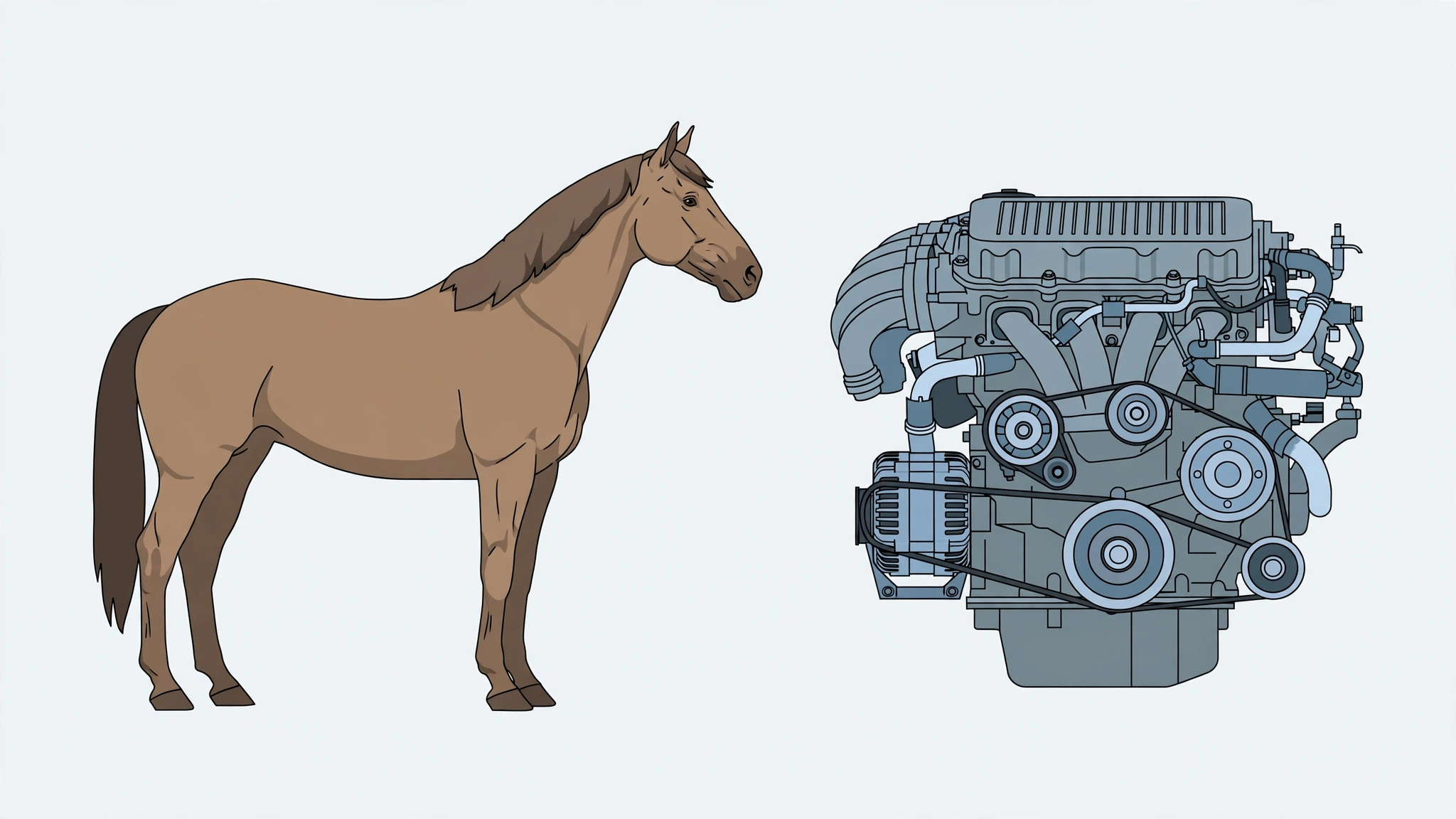
The story begins in the late eighteenth century with James Watt, the Scottish engineer who improved the steam engine. Watt needed to sell his engines to mine owners and mill owners who understood horses, not physics. So he measured his engines in the language his customers already spoke: how many horses would this engine replace?
Britannica records that Watt adopted the value after experiments with strong dray horses, and that the figure he chose was about 50 percent more than the power an average horse could sustain across a working day. Watt was not describing a typical horse. He was describing a strong horse working hard, and then rounding the number into something tidy for selling engines. The marketing worked so well that the unit never died.
The tidy number Watt settled on defines the unit to this day. One horsepower is the power needed to lift 33,000 pounds by one foot in one minute — 33,000 foot-pounds per minute, as the Haynes motoring guide explains it. Picture a horse hauling a heavy weight out of a mine shaft, steadily, for a full minute. The rate of that work is one horsepower. It is a vivid image, and it has outlived every machine Watt ever sold.
Horsepower is a rate, not a force
The distinction matters, because people confuse power with force all the time. Force is a push. Work is a push applied over a distance — lifting a weight, dragging a load, turning a wheel. Power is how fast the work happens. Two engines can do the same work while one takes twice as long, and the faster one has twice the power, even though the work is identical.
A simple picture helps. Imagine carrying twenty bags of shopping up two flights of stairs. Doing it in one trip or five trips moves the same bags the same distance, so the work is the same. Doing it in one fast trip takes more power than five slow ones, because the same work happens in less time. Horsepower measures exactly that: the rate of the work, not the size of the load.
That is why a high-horsepower car accelerates faster rather than simply pulling harder. Given the same weight, the car that does the work of speeding up more quickly has more power. Given more weight — a trailer, a hill, a full load — power decides how quickly the car can still move it. Strength moves the load. Power decides the pace.
One horsepower in watts
The old horse unit survives, but engineers also measure power in watts, the unit named after Watt himself. Britannica gives the conversion plainly: one horsepower equals 746 watts. A 100-horsepower car therefore makes about 74,600 watts, roughly the power of a thousand old-fashioned light bulbs, or about seventy-five electric kettles running at once. The numbers sound absurd because they are: engines are ferociously powerful machines, and the horse unit hides that fact behind a friendly farm animal.
Other countries kept their own version. Metric horsepower, used in much of Europe, is defined as 4,500 kilogram-metres per minute, which works out to 0.9863 of a British horsepower — very close, but not identical. A German car rated at 150 PS (Pferdestärke, literally “horse strength”) makes slightly less power than a British car rated at 150 hp. The difference is tiny, about 1.4 percent, but it is real, and it explains why the same car sometimes wears different numbers in different markets.
For everyday purposes the conversion is simple: one horsepower is about three-quarters of a kilowatt, and one kilowatt is about 1.34 horsepower. Either unit describes the same thing — the rate of work — and neither is more correct. Horsepower survives because two centuries of drivers learned to feel it.
Torque turns, horsepower hurries
Every car conversation eventually reaches torque, and the two are often confused. Torque is twisting force: the force that turns the wheels, felt as the push in your back when the car pulls away. Horsepower is how fast that twisting can be kept up as the engine spins faster. Haynes gives the relationship as a formula: horsepower equals engine speed in revolutions per minute, multiplied by torque, divided by 5,252.
The formula explains why engines feel different. A diesel engine makes huge torque at low speed, so it pulls strongly from rest and tows happily, but it runs out of breath at high revs, so its horsepower number is modest. A small petrol engine in a sports car makes modest torque but spins very fast, so the multiplication by high revs gives a big horsepower number, and the car flies at speed. Torque is the muscle. Horsepower is the muscle kept working at speed.
A useful rule follows: torque decides how the car feels pulling away, and horsepower decides how it feels gaining speed. A tractor has enormous torque and little horsepower, because it pulls slowly. A racing motorcycle has modest torque and huge horsepower, because it spins fast. Cars live between the two, tuned for the job they were built to do.
Gross horsepower versus net horsepower
Old car books quote power figures that sound impossibly large for their time, and there is a reason: the way power was measured changed. Haynes explains the two methods. Gross horsepower was measured with the engine on a test bench, in ideal conditions, stripped of the parts that drain power in real life. Net horsepower is measured with the engine installed as it runs in the car, driving the alternator, the cooling fan, the air conditioning, and the power steering.
The difference is not small. A 1970s muscle car rated at 300 gross horsepower might make closer to 220 net horsepower in the car, because the accessories and the exhaust system eat the rest. The industry switched to net ratings in the early 1970s, which is why power figures appear to fall overnight in old catalogues even though the engines barely changed. The engines did not get weaker. The ruler got honest.
Modern ratings are net ratings, measured the way the engine actually runs, and they are comparable across brands in a way the old numbers never were. When a modern car claims 150 horsepower, that is the power the car has on the road, accessories and all, not a laboratory fantasy.
Brake horsepower and indicated horsepower
Two more terms appear in car books, and both describe where the measuring happens. Britannica explains that brake horsepower is the power measured at the engine’s output shaft — the power available to drive the car, after the engine’s own internal friction has taken its share. It is called “brake” horsepower because early tests measured it with a brake device absorbing the shaft’s power.
Indicated horsepower is the power developed inside the cylinders, before friction steals its share. The gap between the two is the friction of pistons, bearings, and pumps — typically ten percent or more, according to Britannica. Indicated horsepower is what the burning fuel produces. Brake horsepower is what the driver gets to use. The difference is the engine’s own running cost, paid in power before the wheels see any of it.
For buyers, brake horsepower is the number that matters, and it is the number modern ratings use. The other terms survive in engineering books and in old arguments about whose car was really fastest in 1969. Knowing the difference at least stops the arguments from being entirely confused.
What horsepower means for a driver
For a driver, horsepower answers three practical questions. The first is acceleration: all else equal, more horsepower means the car gains speed faster, because it does the work of speeding up at a higher rate. The second is cruising ease: a car with generous power does not strain on hills or when overtaking, because it has rate to spare. The third is top speed: pushing through air resistance at speed takes power, and the faster the car must go, the more power the air demands.
Weight decides how much the numbers mean. A light car with 120 horsepower feels livelier than a heavy car with 150, because the power has less mass to move. That is why the power-to-weight ratio — horsepower per tonne — is a better guide than horsepower alone. A motorcycle with 100 horsepower and a weight of 200 kilograms accelerates like a supercar, while a lorry with 400 horsepower and a weight of 40 tonnes accelerates like a lorry. The horses matter, but so does the cart.
Horsepower also decides nothing about fuel economy on its own. A powerful engine driven gently can be economical, and a weak engine driven flat out can be thirsty. The driver’s foot matters as much as the engineer’s numbers, which is why two owners of the same car report very different fuel bills.
Why the old horse still runs
Horsepower should have died with the horse-drawn age. It survived because it is human-sized. Watts are precise and abstract; 746 of them means nothing to a person standing in a showroom. One horse is something anyone can picture, and 150 horses is a herd anyone can feel. Watt chose his unit to sell engines to people who knew horses, and two centuries later the unit still sells cars to people who have never ridden one.
The next time an advert boasts of horsepower, the picture is simple. Forget the herd. Think of work done fast: a weight lifted, a hill climbed, a car gaining speed, all measured by how quickly the job gets done. That rate — not the force, not the size, not the noise — is what the number has meant since a Scottish engineer watched strong horses hauling in a mine, and decided to measure his engines against them.
Frequently Asked Questions
What is horsepower in simple words?
Horsepower measures how fast work gets done, not how much force is applied. One horsepower is the power needed to lift 33,000 pounds by one foot in one minute, a rate James Watt adopted after experiments with strong dray horses. A car with more horsepower can gain speed faster, because it does the work of accelerating at a higher rate.
How many watts is one horsepower?
One horsepower equals 746 watts, so a 100-horsepower car makes about 74,600 watts. Metric horsepower, used in much of Europe, is slightly different: it is defined as 4,500 kilogram-metres per minute and equals 0.9863 of a British horsepower. One kilowatt equals about 1.34 horsepower, and one horsepower is about three-quarters of a kilowatt.
What is the difference between horsepower and torque?
Torque is the twisting force that turns the wheels and pushes you back in the seat when the car pulls away, while horsepower is how fast that twisting can be kept up as the engine spins faster. Haynes gives the formula: horsepower equals rpm multiplied by torque, divided by 5,252. Torque decides how the car feels pulling away, and horsepower decides how it feels gaining speed.
What is the difference between gross and net horsepower?
Gross horsepower was measured on a test bench in ideal conditions, with the engine stripped of the accessories that drain power, while net horsepower is measured with the engine installed as it runs in the car, driving the alternator, fan, air conditioning, and power steering. The industry switched to net ratings in the early 1970s, which is why old power figures look larger than modern ones for similar engines. Modern ratings are net ratings and are comparable across brands.
Does more horsepower always mean a faster car?
Not always, because weight decides how much the numbers mean: a light car with 120 horsepower can feel livelier than a heavy car with 150. The power-to-weight ratio is a better guide than horsepower alone. Horsepower also says nothing about fuel economy by itself, since a powerful engine driven gently can be economical and a weak engine driven hard can be thirsty.
Sources
- Haynes — What Is Horsepower and What Does It Measure? (fetched 2026-10-28)
- Encyclopaedia Britannica — Horsepower (fetched 2026-10-28)