Winter Driving Safety: First Snow Tips
In this post
- Why the First Snow Is More Dangerous Than Later Snow
- Prepare the Car Before You Need It
- Clear the Car Properly and See Clearly
- Slow Down and Multiply Your Following Distance
- Read the Road: Black Ice, Bridges and Shaded Corners
- If You Skid, Steer Gently and Do Less
- If You Get Stuck, Stay Calm and Avoid Wheelspin
- When Not to Drive, and How to Judge a Journey
- First-Snow Driving by Vehicle Type and Road Type
- After the First Snow: Learning From Each Journey
- My Take:
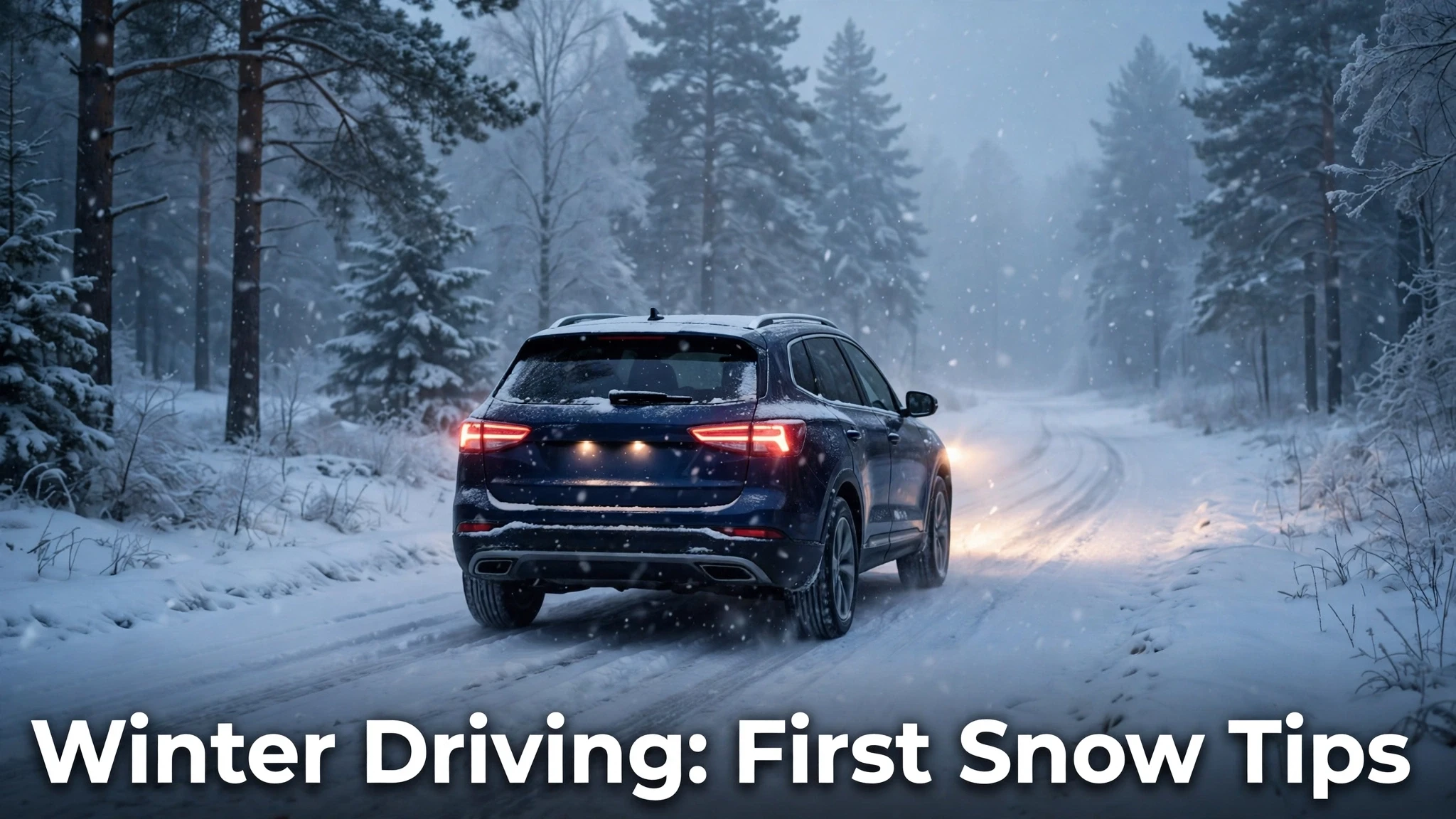
The first snow changes driving in ways that surprise even confident drivers. A road that felt safe yesterday can hide ice today, a turn that needed light braking can send a car sliding, and a short trip can take twice as long. The danger is not snow itself. It is the false belief that normal speed, normal braking and normal following distance still work. On snow and ice, grip falls sharply, stopping distance grows, and small mistakes become hard to correct. This guide gives first-snow drivers a practical system: prepare the car before the storm, change speed and distance on the road, handle skids without panic, and know when staying home is the safest choice.
Why the First Snow Is More Dangerous Than Later Snow
First snow is risky for three reasons. First, drivers are out of practice. After months of dry roads, muscle memory favours firm braking and quick steering, both of which cause slides on ice. Second, road crews and drivers are still adjusting: untreated side roads, bridges and shaded corners freeze before main roads. Third, the first snow often arrives with wet, heavy flakes that melt and refreeze, creating a thin, invisible ice layer under fresh snow. A driver who assumes the road is only snowy may actually be driving on ice.
Temperature matters more than the amount of snow. Around freezing point, snow melts under tyres and refreezes as ice. Just below freezing, packed snow becomes polished and slippery. Well below freezing, snow can be drier and grip can improve slightly, but ice patches remain. Wind adds another risk: drifting snow can cover lane markings and create sudden whiteouts on open roads. Check the forecast for temperature, wind, freezing rain and snow timing, not only for whether snow will fall.
First-snow crashes often happen at low speed in towns, not only on motorways. Junctions, roundabouts, car parks and downhill approaches to traffic lights are high-risk because drivers brake late, turn while braking, or follow too closely. Treat every first-snow journey as a new skill session, even if the distance is short and the road looks familiar.
Prepare the Car Before You Need It
Preparation starts before the first forecast, not on a freezing morning. Check tyre tread depth and pressure, because cold air lowers pressure and worn tyres lose grip faster on wet snow. Winter tyres stay flexible in cold weather and grip better than summer tyres below about 7°C, while good all-season tyres are a compromise for mild winters. Whatever tyre you use, replace a tyre that is cracked, bulged or below the legal tread limit, and never mix very different tyre types on the same axle.
Check the battery, because cold starts strain older batteries. Test lights, wipers and washer fluid, using winter washer fluid that will not freeze in the reservoir. Top up coolant to the correct mixture and check that the heater and demister work, since a misted windscreen is a safety failure, not a comfort problem. Clear all snow from the roof, bonnet, lights, mirrors and number plates before driving; snow falling from the roof can blind you or the driver behind you, and a small cleared peephole on the windscreen is dangerous and, in many places, illegal.
Pack a winter kit: ice scraper, de-icer, torch, warm blanket, gloves, hat, water, snacks, phone charger, jump leads, a small shovel, a bag of sand or non-clumping cat litter for traction, and a high-visibility vest. Keep the fuel tank at least half full in snow season so you can run the heater if delayed and so you are not forced into a risky fuel stop in a storm. Tell someone your route and expected arrival time on longer journeys, and keep your phone charged before you leave.
Clear the Car Properly and See Clearly
Do not rush this step. Start the car, switch on the demister, and clear every window fully, not just the driver’s side. Scrape ice rather than pouring hot water on a frozen windscreen, which can crack glass. Lift wipers only if they are not frozen to the screen; forcing a frozen wiper can damage the motor or blade. Switch off automatic wipers before starting the car in frost, so they do not try to move while stuck.
Clean headlights and rear lights, because snow and road salt dim them quickly and other drivers need to see your brake lights early. Clean mirrors and side indicators. Remove snow from the roof so it does not slide forward when you brake. If snow is heavy, clear the exhaust pipe before sitting with the engine running, to reduce carbon monoxide risk. These five minutes feel slow on a cold morning, but they decide whether you can see a pedestrian, a junction or a stopped car in time.
Slow Down and Multiply Your Following Distance
Speed is the main control you have on snow. Drive below the posted limit when grip is low, and choose a speed that lets you stop within the distance you can see ahead. On ice, stopping distance can be about ten times longer than on dry roads, according to UK motoring guidance; at 50 mph that can mean hundreds of metres, not a few car lengths. Even on packed snow, allow far more room than usual. A practical rule for snow is a gap of at least five to six seconds behind the vehicle ahead, and considerably more on ice, downhill, or in poor visibility. Pick a fixed roadside object, count when the vehicle ahead passes it, and do not reach it before six seconds have passed.
Brake earlier and more gently. Begin slowing well before junctions, bends, traffic lights and pedestrian crossings. Avoid braking hard while turning, because that combination often breaks grip. If your car has anti-lock brakes, press firmly and steadily in an emergency and steer around the hazard; do not pump the pedal, because the system pumps for you. If your car lacks anti-lock brakes, use gentle, repeated braking, but the safer plan is to avoid needing emergency braking at all by keeping speed low and distance large.
Stay in the highest gear that still gives control on level snow, and move off in second gear where possible to reduce wheelspin. Avoid sudden acceleration, which spins the wheels and polishes snow into ice. On hills, build steady momentum before the slope, keep a constant speed, and avoid stopping halfway up if possible. Going downhill, use a low gear, leave a large gap, and brake gently before the slope, not during it. If you must stop on a hill, leave extra room and restart gently, without spinning the wheels.
Read the Road: Black Ice, Bridges and Shaded Corners
Black ice is a thin, transparent ice layer that looks like wet tarmac. It forms when rain or melted snow freezes, especially overnight. Watch for it on bridges, which freeze first and thaw last because cold air flows underneath them; on shaded stretches under trees or buildings; in dips where cold air collects; and on untreated side roads. A road that looks merely wet at dawn may be icy. If the temperature is near or below freezing and the surface looks glossy, assume ice.
Other clues help. If spray from other vehicles stops and the road suddenly looks dry and shiny, ice is possible. If your steering feels unusually light, grip may be falling. If ice forms on your mirrors or wiper blades, the road may be freezing too. Listen for the change from noisy wet tyres to quieter running on ice, but do not rely on sound alone. Reduce speed before a bridge or shaded bend, not after you feel a slide.
Keep to main, treated roads after snowfall where possible, because they are more likely to have been gritted and cleared. Avoid overtaking on snow unless you have a clear view, a large gap and no oncoming risk; a snowplough’s spray and a slower vehicle’s snow cloud can blind you mid-manoeuvre. Keep headlights on in falling snow and fog, and use fog lights only when visibility is seriously reduced, switching them off when it improves so you do not dazzle drivers behind you.
If You Skid, Steer Gently and Do Less
A skid feels alarming, but the correct response is calm and small. Ease off the accelerator, do not stamp on the brake, and steer gently in the direction you want the front of the car to go. If the rear slides left, steer left; if it slides right, steer right. This is called steering into the skid. Avoid large, jerky steering movements, which can cause a second slide in the opposite direction. Once grip returns, straighten the wheel smoothly and slow down further.
Front-wheel skids feel different: the car keeps going straight despite steering input. In that case, ease off the accelerator, do not add more steering lock, and wait for the front tyres to regain grip before steering again. Four-wheel-drive helps you move off and climb, but it does not shorten braking distance on ice; every car, whatever its drive system, must brake on the same slippery surface. Electronic stability control helps, but it cannot create grip that is not there, and it should stay switched on in snow.
Practise in a safe, empty car park after the first light snow, at very low speed, to learn how your car feels when it slides and how gently you must steer and brake. That ten-minute lesson is worth more than any article, because it replaces panic with a known movement. Never practise on a public road, near pedestrians, or at normal traffic speed.
If You Get Stuck, Stay Calm and Avoid Wheelspin
If wheels spin in deep snow, stop accelerating hard. Spinning digs the car deeper and polishes ice under the tyres. Straighten the steering wheel, clear snow from around the tyres and from under the car if safe, and place sand, cat litter, floor mats or branches under the driven wheels for grip. Rock the car gently: a short forward movement, then reverse, building a small path, without revving hard. If your car has a traction-control off switch or a snow mode, check the handbook; sometimes briefly reducing traction control helps in deep snow, but return it to normal once moving.
If you cannot free the car, stay with it in severe weather unless help is very close and safe to reach on foot. Keep the engine running in short bursts for heat, with a window slightly open for fresh air and the exhaust clear of snow. Put hazard lights on, wear the high-visibility vest if you step out, and call for help with your exact location. Do not walk along a fast road in a whiteout to find help; visibility for other drivers may be near zero.
When Not to Drive, and How to Judge a Journey
The safest first-snow decision is sometimes no journey. Postpone non-essential travel during freezing rain, heavy snow, high winds or official severe-weather warnings. Ask three questions: is the trip essential, is there a safer time or route, and can I do it by public transport or delay it by a day? If you are a new driver, have summer tyres in a cold snap, or feel anxious about the forecast, that anxiety is useful information, not weakness. A delayed arrival is better than a crash.
If you must travel, choose main roads, allow double the normal time, and plan fuel, food and rest stops. Avoid night driving in snow if you can, because visibility, fatigue and ice risk all rise together. Watch for snowploughs and gritters, give them room, and never overtake a working plough on a narrow road. If conditions worsen during the journey, pull over safely in a car park or service area, not on a hard shoulder in poor visibility unless there is no alternative, and wait for conditions to improve.
Teach passengers, especially children, to stay calm and belted, and to avoid distracting the driver during snow. Keep the radio or phone navigation volume low enough to hear hazards, and set navigation before moving off. A calm cabin helps a driver make the gentle inputs that snow driving requires.
First-Snow Driving by Vehicle Type and Road Type
Different vehicles fail in different ways on snow, so a single rule does not fit all drivers. Small front-wheel-drive cars are often easier to control at low speed because the driven wheels also steer, but they still slide when braking hard, and their light rear can swing on ice. Rear-wheel-drive cars can lose traction more easily when moving off, especially on hills, because weight shifts away from the driven wheels; gentle throttle, winter tyres and added care on slopes matter more. Four-wheel-drive vehicles move off and climb better, yet their braking distance on ice is essentially the same as any other car, a fact that causes many four-wheel-drive crashes when drivers confuse traction with stopping power. Electric vehicles add another factor: instant torque can spin wheels on ice if the driver accelerates firmly, while regenerative braking can feel different from engine braking, so drivers should learn their car’s snow mode and gentlest acceleration setting before a storm.
Road type changes risk as well. Motorways in snow demand large gaps, steady speed, lane discipline and early exits, because a crash at motorway speed, even in snow, is severe. Urban roads demand attention to pedestrians, cyclists, buses and side streets where snow is untreated and visibility is blocked by parked cars and snowbanks. Rural roads demand the most caution of all: they freeze earlier, are gritted later, have fewer lights, and a slide can end in a ditch or field with no immediate help. Single-track rural roads also require reversing to passing places, a manoeuvre that is hard on ice and should be practised only at very low speed. Van and lorry drivers face longer stopping distances, higher centres of gravity, and load shifts when braking, so they need even larger gaps and slower cornering. Motorcyclists and cyclists should generally avoid first-snow riding unless they have specialist tyres, training and protective clothing, because two wheels offer almost no recovery from an ice slide. Matching your technique to your vehicle and road, rather than copying another driver’s speed, is a core first-snow skill.
After the First Snow: Learning From Each Journey
After a first-snow journey, a short review improves the next one more than any general advice. Note which roads were icy, where you braked too late, whether your tyres gripped on hills, and whether your windscreen stayed clear. Check tyre pressure again after a cold week, because pressure falls as temperature falls, and refill washer fluid before it runs out on a salty motorway. If you skidded, ask what you did just before: too much speed, braking while turning, or a sudden steering input. That specific cause, not a vague “be careful,” is what you should change next time. Keep a simple winter note on your phone — date, road, temperature, problem, fix — and review it before the next forecast. Over one winter, that note becomes personal, local knowledge that no national guide can provide, because it records your car, your roads and your mistakes.
My Take:
First snow exposes a habit I think many drivers share: we judge safety by how the journey felt last week, not by how the road feels today. Dry-road confidence is a poor guide on ice. I have seen the same pattern in other areas of life, where people keep using a method that worked in easy conditions and only notice the change when it fails. Winter driving rewards the opposite habit. Slow down before you feel danger, leave room before you need it, and prepare before the storm arrives. That discipline feels boring, and that is exactly why it works. Safe snow driving is not dramatic. It is early braking, gentle steering, a cleared windscreen, and a decision to wait an hour if the forecast is bad.
I also think first-snow advice often focuses too much on equipment and too little on judgement. Winter tyres help, four-wheel drive helps you move, and stability control helps in a slide, but none of them changes the physics of stopping on ice. A driver with winter tyres who follows at two seconds and brakes late is still unsafe. A driver with ordinary tyres who leaves six seconds, drives slowly, and avoids the journey in freezing rain is safer. Equipment should support good judgement, not replace it. If you can only afford one change this winter, choose the change in behaviour first: more time, more distance, less speed.
The most useful lesson from a skid is how little input a car needs on snow. On dry roads, a firm correction feels effective. On ice, the same correction becomes a second problem. That applies beyond driving. When a situation is already unstable, a large, sudden reaction often makes it worse. Gentle, early, repeated corrections give a system time to recover. I think new drivers should learn this in a car park, at walking speed, before they learn it at traffic speed. A small, controlled slide teaches respect for ice in a way that reading about stopping distances never will. It also teaches humility. You realise quickly that you are not in full control, and that real control means preventing the slide, not recovering from it.
I am also struck by how much winter safety depends on unglamorous preparation. Clearing the roof, checking washer fluid, packing a blanket, keeping half a tank of fuel: none of these makes a good story, but together they decide whether a delay becomes a danger. People often prepare for the journey they expect, not the delay they might face. A first-snow trip that takes twenty minutes in summer can take an hour in snow, and a minor breakdown in freezing weather can become a health risk if you have no warm clothing or phone charge. Preparation is not pessimism. It is respect for weather that does not care about your schedule.
There is a social side too. Following distance is not only personal safety; it protects the driver behind you. When you brake gently and early, you give the car behind time to react. When you clear your roof, you protect the driver behind from falling snow. When you stay off the road in a storm, you leave room for gritters, ambulances and snowploughs. Winter driving is a shared task, and selfish driving in snow harms strangers quickly. I think that point deserves more emphasis, because it turns safety from a private rule into a public responsibility.
Finally, I think the best first-snow rule is the simplest: if you are unsure, slow down, increase distance, or stop. Uncertainty is data. A glossy road, a temperature near freezing, a forecast of freezing rain, or a feeling of nervousness all mean grip may be lower than it looks. Acting on uncertainty early costs minutes. Ignoring it can cost a car, an injury, or worse. That trade is never worth it. Drive the first snow as if you are learning again, because in an important sense, you are. The road has changed, and the driver must change with it.
There is also a pedestrian angle that drivers often overlook. In snow, pedestrians wear dark, hooded clothing, walk on roads when pavements are icy, and may step out from behind snowbanks without seeing a car. Children are shorter than snowbanks and harder to see at junctions. Older pedestrians move slowly and may slip on untreated crossings. A driver who slows near schools, bus stops and shopping streets, and who expects a pedestrian at every obscured corner, is not being overcautious. They are adjusting to a winter reality in which the most vulnerable road users are also the least visible. The same logic applies to cyclists, who may wobble on ice and need far more overtaking room than in summer.
Insurance and legal consequences add another practical reason to drive conservatively. A crash in snow does not automatically excuse a driver, and insurers and police will ask whether speed, tyres, visibility and following distance were appropriate for conditions. Driving with a windscreen cleared only in a small peephole, with snow on the roof, or on bald tyres, weakens any claim that conditions alone caused a crash. Keeping records — a dated photo of tyre tread, a service receipt, a forecast screenshot — is not bureaucratic excess. It is evidence that you prepared and adapted. More importantly, it forces the preparation itself: a driver who checks tyres for a record is a driver who actually checks tyres.
A final judgement concerns new drivers and winter confidence. A new driver who has only driven in summer may feel that winter driving is a separate, advanced skill, and therefore avoid it entirely, which leaves them unprepared when snow arrives unexpectedly. A better approach is graduated exposure: first, a short, daylight journey on a treated main road in light snow, with an experienced passenger, at low speed, with a large gap. Then, a car-park practice session for skids and moving off. Then, a longer journey in heavier snow only when the first two felt controlled. That progression builds real confidence, not false confidence, because each step adds a specific skill — distance, gentle inputs, skid recovery — rather than a general feeling of bravery. Parents and instructors should support that progression, rather than either forbidding all winter driving or pushing a new driver into a storm unprepared.
Frequently Asked Questions
How much longer is the stopping distance on ice during first snow driving? On ice, stopping distance can be about ten times longer than on dry roads, according to UK motoring guidance, so at higher speeds the distance can reach hundreds of metres. That is why first-snow driving needs much lower speed and a gap of at least five to six seconds, and more on ice or downhill.
What should a beginner do first when driving in snow for the first time? Clear every window, light and mirror fully, check tyres and washer fluid, choose main treated roads, allow double the normal time, drive below the limit, leave a five-to-six-second gap, brake gently and early, and avoid sudden steering or acceleration. If freezing rain or a severe warning is in place, postponing a non-essential trip is the safer choice.
How do I spot black ice while winter driving in the first snow? Black ice looks like a glossy wet patch rather than white snow. It is most likely on bridges, shaded corners, dips and untreated roads when the temperature is near or below freezing. If the surface looks shiny, spray from other vehicles stops, or your steering feels unusually light, slow down before the patch, not after you slide.
What is the correct way to recover from a skid on snow or ice? Ease off the accelerator, do not stamp on the brake, and steer gently in the direction you want the front of the car to go, which is steering into the skid. Avoid large steering movements, wait for grip to return, straighten smoothly, and then slow down further. With anti-lock brakes, press firmly and steadily in an emergency rather than pumping the pedal.
Are winter tyres necessary for first snow driving, or are all-season tyres enough? Winter tyres stay flexible in cold weather and grip better below about 7°C, so they are the strongest choice for regular cold winters. Good all-season tyres are a reasonable compromise in mild winters, but they do not replace careful speed, distance and braking. Worn, cracked or mismatched tyres are unsafe in snow whatever the label says.
What should I keep in a car for winter driving emergencies in snow? Pack an ice scraper, de-icer, torch, warm blanket, gloves, hat, water, snacks, phone charger, jump leads, a small shovel, sand or non-clumping cat litter for traction, and a high-visibility vest. Keep at least half a tank of fuel, a charged phone, and someone informed of your route on longer snowy journeys.
When should I cancel a journey because of first snow conditions? Cancel or delay non-essential travel during freezing rain, heavy snow, high winds, whiteouts or official severe-weather warnings, especially if you are a new driver, have summer tyres, or feel unsure about the route. A delayed arrival is safer than driving through conditions where you cannot see, stop or steer reliably.
Sources
- https://www.ageas.co.uk/solved/road-safety/winter-driving/
- https://www.churchill.com/car-insurance/magazine/driving-in-snow-ice
- https://www.rac.co.uk/drive/advice/winter-driving/driving-in-snow/
- https://www.otozen.com/blogs/blog/first-time-driving-in-snow
- https://www.tireagent.com/blog/winter-driving-tips