Fake Medicine That Still Works
In this post
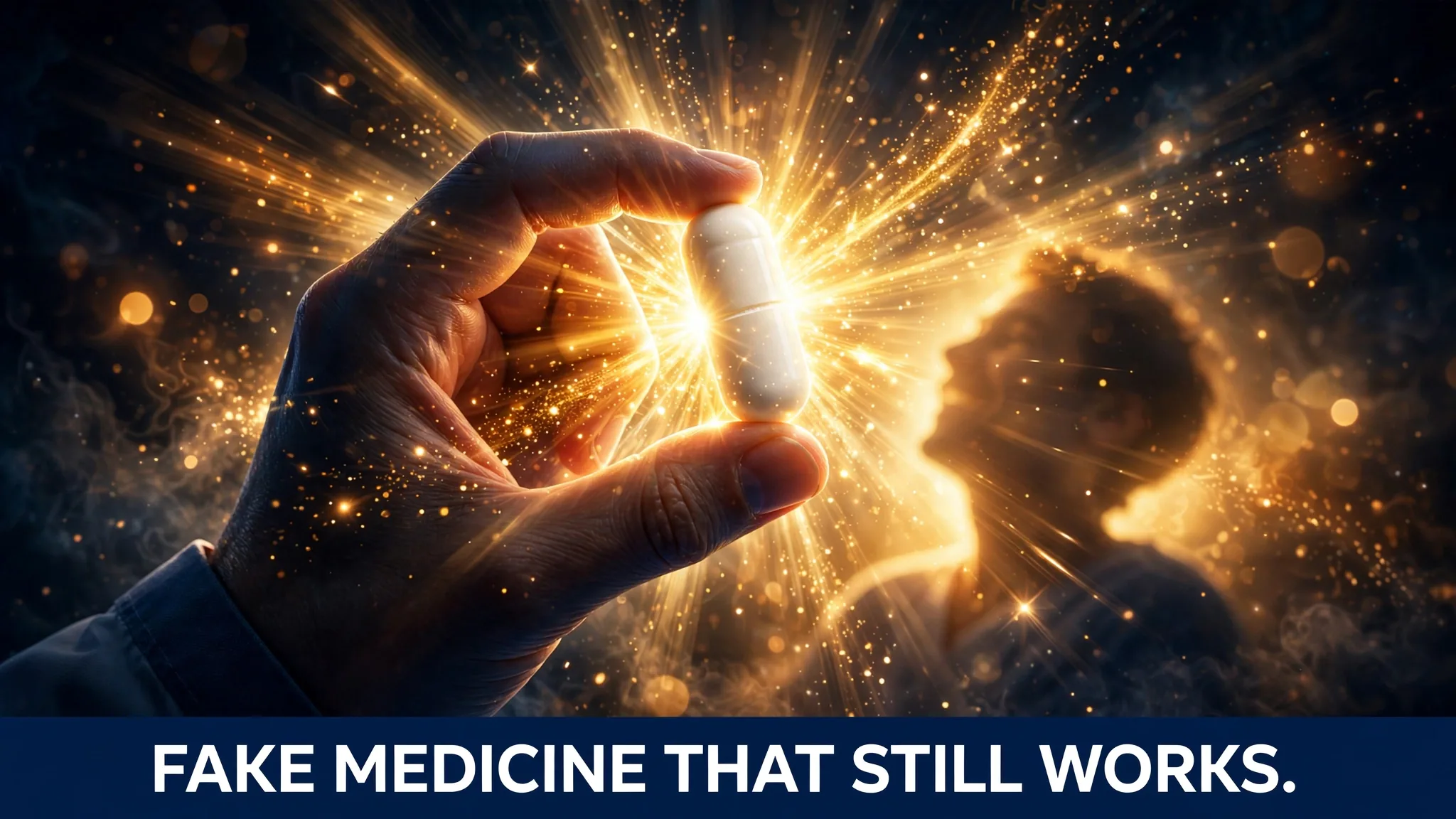
Imagine two patients with the same pain. Both are handed a white pill and told it is a strong painkiller. Both swallow it, and both feel real relief. But one of the pills was a lie: it contained nothing but sugar. No medicine, no active ingredient at all — and yet the pain genuinely eased.
This is no trick or fairy tale. It is one of the best-studied puzzles in medicine: the placebo effect. Here we look at what a placebo really is, why your brain can turn a fake treatment into real relief, why every new medicine must prove itself against a sugar pill — and where the effect honestly stops, because a placebo cannot cure serious disease.
Please note: this article is general information only. It is not medical advice. Never stop, skip or replace medicine your doctor has prescribed, and always talk to a doctor about your own treatment.
What Exactly Is A Placebo?
A placebo is a dummy treatment — something made to look exactly like real medicine but with nothing active inside it. It might be a sugar pill, an injection of plain salt water, or even a fake procedure. The patient receives it just like a real treatment, but the pill itself does nothing to the body directly.
The improvement that follows is called the placebo effect. The U.S. National Center for Complementary and Integrative Health (NCCIH) describes it as a real, beneficial health outcome that grows out of a person’s expectation — the belief that the treatment is going to help. The relief is not faked by the patient, and it is not imaginary. The pain drops. The nausea fades. Something genuine happens — it just does not come from the pill.
Two engines drive the effect. The first is expectation: if you truly believe a treatment will help, your brain prepares for relief, and relief often follows. The second is conditioning, the learning of the body: if swallowing a pill has eased your pain many times before, then swallowing a pill can start the same process again, the way the smell of food can make your mouth water before you eat. A third ingredient matters too — the care around the treatment. Research shows the effect grows when a patient feels listened to and looked after by someone they trust.
A Famous Story From The War
There is a famous story often told about the Second World War, and it is usually told like this. An American doctor named Henry Beecher was working in a military hospital where wounded soldiers were being treated — and the morphine, the powerful painkiller, ran out. In desperation, a salt-water injection was given to a suffering soldier in place of morphine, without telling him. Believing he had received the real drug, the soldier calmed down, and his pain eased enough for treatment to go ahead.
The details of this story have shifted over the years of retelling, and it should be heard as a story rather than a proven record. But its heart — that belief alone eased a man’s pain — captured something doctors had noticed for a long time, and after the war Beecher devoted himself to studying it. In 1955 he published a landmark paper, “The Powerful Placebo”, which pushed the whole of medicine to take the sugar pill seriously.
Why Every New Medicine Must Beat A Fake One
Here is a surprising fact: the humble sugar pill is the toughest examiner in medicine. According to the NCCIH, the “gold standard” for testing any new treatment is the randomized, placebo-controlled trial. Volunteers are divided by chance into two groups. One group receives the real new drug. The other receives a placebo that looks identical. Neither the patients nor, usually, the doctors know who got what.
Why go to all this trouble? Because people in trials often improve for reasons that have nothing to do with the drug: the illness fades on its own, hope lifts the spirits, and the placebo effect does its quiet work. Only by comparing the two groups can scientists see whether the new medicine adds anything beyond all that. If the real drug cannot beat the fake one, the drug has failed — no matter how impressive it looks.
What Is Happening Inside The Brain
For years, the placebo effect was brushed aside with the words “it is all in your head” — as if that made it unreal. Modern brain research has shown how wrong that dismissal was. It begins in the head, yes — but it does not stay there.
Harvard Health reports that in pain studies, when volunteers are given placebos, the brain releases endorphins — the body’s own natural pain-relieving chemicals, the same family of chemistry that strong painkillers imitate. In studies of Parkinson’s disease, placebos have been shown to increase the brain’s production of dopamine, a chemical that Parkinson’s patients lack. These are measurable physical changes, seen on brain scans and in chemical tests. Expectation is the switch, but real chemistry does the work.
How strong can it be? In one study described by Harvard Health, people with irritable bowel syndrome — a condition of stomach pain and discomfort — were treated with sham acupuncture, fake needles that secretly fold away instead of entering the skin. Even so, 44 percent of them reported real relief. Then the researchers added one thing: a warm, attentive, caring practitioner who listened. Relief jumped to 62 percent. Same fake needles. The difference was kindness and attention — part of the treatment nobody can put in a bottle.
Feeling Better Is Not The Same As Being Cured
Now comes the honest limit, and it is the most important part of this whole story.
The placebo effect works mainly on how a person feels: pain, nausea, tiredness, low mood, and other symptoms that the brain itself helps to shape and judge. Where a condition is measured by feeling, the effect can be large. But where a condition is measured by the body itself, the story changes completely.
Harvard Health describes a study of asthma patients that makes this beautifully clear. Given a real asthma drug, a placebo inhaler, or fake acupuncture, the patients reported feeling about equally better with all three. But when doctors measured their actual lung function with a breathing test, only the real drug had improved it. The placebo had comforted the feeling of breathlessness without opening the airways at all.
So let us say it plainly: a placebo cannot kill bacteria, so it cannot cure an infection. It cannot shrink a tumour. It cannot mend a broken bone, clear a blocked artery, or replace insulin. Anyone who claims a sugar pill — or any fake treatment — can cure serious disease is misleading you, and the danger is real: people who trust fake cures may delay the real treatment that could save them. The placebo effect is a genuine power of the mind, but it is a power over symptoms and feelings, not over disease itself.
The Surprise: It Can Work Even When You Know
Common sense says the trick should die the moment it is revealed. If a patient knows the pill is fake, surely nothing should happen?
Surprisingly, research says otherwise. Scientists at Harvard, led by Ted Kaptchuk, ran “open-label” placebo studies, in which patients were plainly told: this is a placebo, it contains no medicine — and placebos can be powerful. In one small study of irritable bowel syndrome patients, the honest placebo still produced a real effect, performing noticeably better than no treatment at all. The NCCIH notes the same finding: placebos may help even when patients know what they are taking.
Why would a known fake work? Researchers suggest the ritual itself matters — taking a pill, following a routine, being cared for — and that the body’s learned responses can fire without conscious belief. The effect in these honest studies is modest, not magical. But it is real, and it has changed how scientists think about the whole subject: deception, it turns out, was never the main ingredient.
The Dark Twin: The Nocebo Effect
If belief can heal, it can also harm. The placebo effect has a dark twin called the nocebo effect — from a Latin word meaning “I shall harm”, while placebo means “I shall please”. When people expect a treatment to hurt them, they often genuinely feel worse: headaches, aches, nausea and tiredness that the treatment itself did not cause.
Harvard Health describes a striking study of people who had stopped taking statins — cholesterol-lowering drugs — because of side effects such as muscle pain. Sixty volunteers, average age 66, rotated month by month between a statin, a placebo, and no pill at all, without knowing which was which, and recorded their symptoms daily for a year. The result: 90 percent of the symptoms they felt while taking the statin were also present in the months they took the placebo. The aches were real — the volunteers were not inventing them — but the drug was not causing most of them. Expectation was. And when the participants were shown their own results, about half felt confident enough to restart their statins and stayed on them.
The lesson cuts both ways. It does not mean side effects are imaginary, and real side effects must always be taken seriously and discussed with a doctor. It means the mind watches the body so closely that fear itself can turn the volume up on every small ache — and knowing this can sometimes help people stay on medicines they truly need.
What This Means For You
So what should an ordinary person do with all this? Three honest takeaways. First, respect the effect without worshipping it: your expectations, your habits, and a doctor who listens can genuinely support your recovery — alongside real medicine, never instead of it. Second, be suspicious of anyone selling a “miracle” treatment whose only proof is that people feel better after taking it; feeling better is exactly what a placebo does, which is why real drugs must beat one in trials. Third, if you ever struggle with a medicine’s side effects, talk to your doctor rather than quietly stopping — sometimes, as the statin study showed, the full picture is more hopeful than it feels.
The sugar pill teaches a humbling lesson. The mind is not separate from the body; it is one of the body’s own medicines — powerful for pain and feelings, useless against germs and tumours, and always deserving of honesty. That is why the fake medicine that still works remains one of the most important tools in science: it keeps medicine honest.
Frequently Asked Questions
Is the placebo effect real, or is it just imagination? It is real. Brain studies show measurable changes — such as the release of endorphins, the body’s natural painkillers — when people respond to a placebo. The relief is genuine, even though the pill itself was inactive.
Can a placebo cure diseases like cancer or infections? No. Placebos can ease symptoms such as pain, nausea and tiredness, but they cannot kill germs, shrink tumours or repair damage in the body. Serious diseases always need real treatment from a doctor.
Why do drug trials give some patients fake pills? Because many people improve anyway — through natural recovery, hope and the placebo effect. By comparing a real drug against an identical-looking placebo, scientists can tell whether the drug itself truly works.
Can a placebo work if I know it is fake? It seems so, at least sometimes. In Harvard’s open-label studies, patients told honestly that their pills were placebos still improved more than patients given no treatment — though the effect is modest.
What is the nocebo effect? It is the opposite of the placebo effect: expecting harm makes people feel real symptoms. In one study, 90 percent of the side effects people blamed on a statin also appeared when they unknowingly took a placebo.
Should I stop my medicine and rely on the placebo effect? No — never. Stopping prescribed medicine can be dangerous. The placebo effect works alongside real treatment, not instead of it. If you have concerns about your medicine, talk to your doctor.
Sources
- National Center for Complementary and Integrative Health (NCCIH), “Placebo Effect”: https://nccam.nih.gov/health/placebo-effect
- Harvard Health, “Putting the placebo effect to work”: http://www.health.harvard.edu/mind-and-mood/putting-the-placebo-effect-to-work/
- Harvard Health, “Statin side effect could be due to the ‘nocebo’ effect”: https://www.health.harvard.edu/staying-healthy/statin-side-effect-could-be-due-to-the-nocebo-effect
- The picture on this page is an original illustration made for Talha M Blog.