The Gardner Museum Heist: The Story Explained
In this post
- The Museum and the Night of the Theft
- What Was Stolen: Thirteen Works, Including Masterpieces
- The Investigation: A Mystery With No Arrests
- The Theories: Who Did It, and Why
- The Empty Frames and the Museum Today
- Why the Heist Matters, and What It Teaches Us
- The Art That Was Taken: Why These Paintings Matter
- The Museum Today: Empty Frames and Open Doors
- The Stolen Paintings: The Art Itself and Why It Matters
- My Take:
In the early hours of 18 March 1990, two men dressed as police officers entered the Isabella Stewart Gardner Museum in Boston, tied up the guards, and stole thirteen works of art, including paintings by Vermeer, Rembrandt, and Degas. The value of the stolen art is estimated at $500 million, making it the largest art theft in American history, and one of the largest in the world. More than thirty years later, none of the works has been recovered, and the empty frames still hang on the museum’s walls, a reminder of what was lost. The Gardner Museum heist is a mystery that has never been solved.
This guide explains the story of the Gardner Museum heist, from the night of the theft to the investigation, the theories, and the empty frames. It is based on the historical record, and it is told in a neutral tone, without glorifying the crime. The heist was a serious offence, and it deprived the public of works of art that belonged to everyone. The story is fascinating, but it should be remembered that the paintings are still missing, and that their recovery is the goal.
The Museum and the Night of the Theft
The Isabella Stewart Gardner Museum, in Boston, is a museum built around the collection of Isabella Stewart Gardner, a wealthy art collector who opened her home as a museum in 1903. Her will stipulated that the collection should not be changed, and that if any work were removed, the museum would lose its endowment. That is why the empty frames still hang on the walls: they are a condition of the will, and a visible reminder of the theft. The museum’s collection includes works by Rembrandt, Vermeer, Degas, and Manet, and it is one of the most important private collections in America.
On the night of 17-18 March 1990, two men, dressed as Boston police officers, knocked on the museum’s side door and told the night guard that they were responding to a disturbance. The guard, breaking museum policy, let them in. Once inside, the men tied up the guard and a second guard, and spent 81 minutes in the museum, cutting paintings from their frames and taking them, along with other works. They left at about 2:45am, and the guards were found by police in the morning. The theft was discovered quickly, but the thieves were gone, and the paintings have never been found.
What Was Stolen: Thirteen Works, Including Masterpieces
Thirteen works were stolen, and they include some of the most important paintings in the museum. The most valuable is Vermeer’s The Concert, a painting from about 1664, and one of only 34 known Vermeers in the world. It is estimated to be worth over $200 million, and it is considered one of the most important missing paintings in the world. Rembrandt’s The Storm on the Sea of Galilee, from 1633, is another masterpiece, and it is the only seascape Rembrandt ever painted. It was cut from its frame, and its loss is a major blow to art history.
Other stolen works include Rembrandt’s A Lady and Gentleman in Black, and a small self-portrait, Degas’s La Sortie de Pesage, and five drawings, Manet’s Chez Tortoni, and a Chinese bronze beaker, a Shang dynasty vessel. The thieves also took a finial, a decorative top, from a Napoleonic flag. The total value is estimated at $500 million, though the true value is incalculable, because these are unique works that cannot be replaced. The empty frames, which still hang in the museum, are a powerful symbol of the loss, and they are visited by thousands of people each year.
The Investigation: A Mystery With No Arrests
The investigation into the Gardner heist has been one of the longest and most complex in FBI history, and it has produced no arrests and no recoveries. The FBI has investigated hundreds of leads, including theories involving the Boston mafia, Irish republicans, and art thieves, but none has led to the paintings. The museum has offered a $10 million reward for information leading to the recovery of the works, the largest reward ever offered by a private institution, and it has not been claimed. The FBI has said that it believes it knows who was involved, but it has not named them publicly, and it has not recovered the art.
The investigation has been hampered by the lack of physical evidence: the thieves left few traces, the museum’s security was poor, and the guards were tied up, so they could provide only a limited description. The paintings are also difficult to sell, because they are so famous that any attempt to sell them would be detected, which suggests that they were stolen for a private collector, or as collateral in a criminal deal, rather than for sale on the open market. The FBI continues to investigate, and the museum continues to appeal for information, but after more than thirty years, the case remains open and unsolved.
The Theories: Who Did It, and Why
There are several theories about who carried out the Gardner heist, and why. One theory involves the Boston mafia, particularly the Winter Hill Gang, and a figure named Bobby Donati, a mob associate who is believed by some investigators to have been involved. Another theory involves Irish republican groups, who may have stolen the art to raise funds or to use as leverage. A third theory is that the heist was carried out by a small group of art thieves, who planned it carefully and who have kept the paintings hidden. Each theory has supporters, and each has gaps, and none has been proven.
The motive is also debated. The paintings are too famous to sell, so the thieves must have had another reason: to hold them for ransom, to use them as collateral, to give them to a private collector, or to trade them for the release of a prisoner. The FBI has suggested that the paintings may have been moved through criminal networks, and that they may have changed hands several times. The truth is that we do not know who did it, or why, and the theories are based on incomplete evidence. The heist remains a mystery, and the theories are a reflection of that mystery, rather than a solution to it.
The Empty Frames and the Museum Today
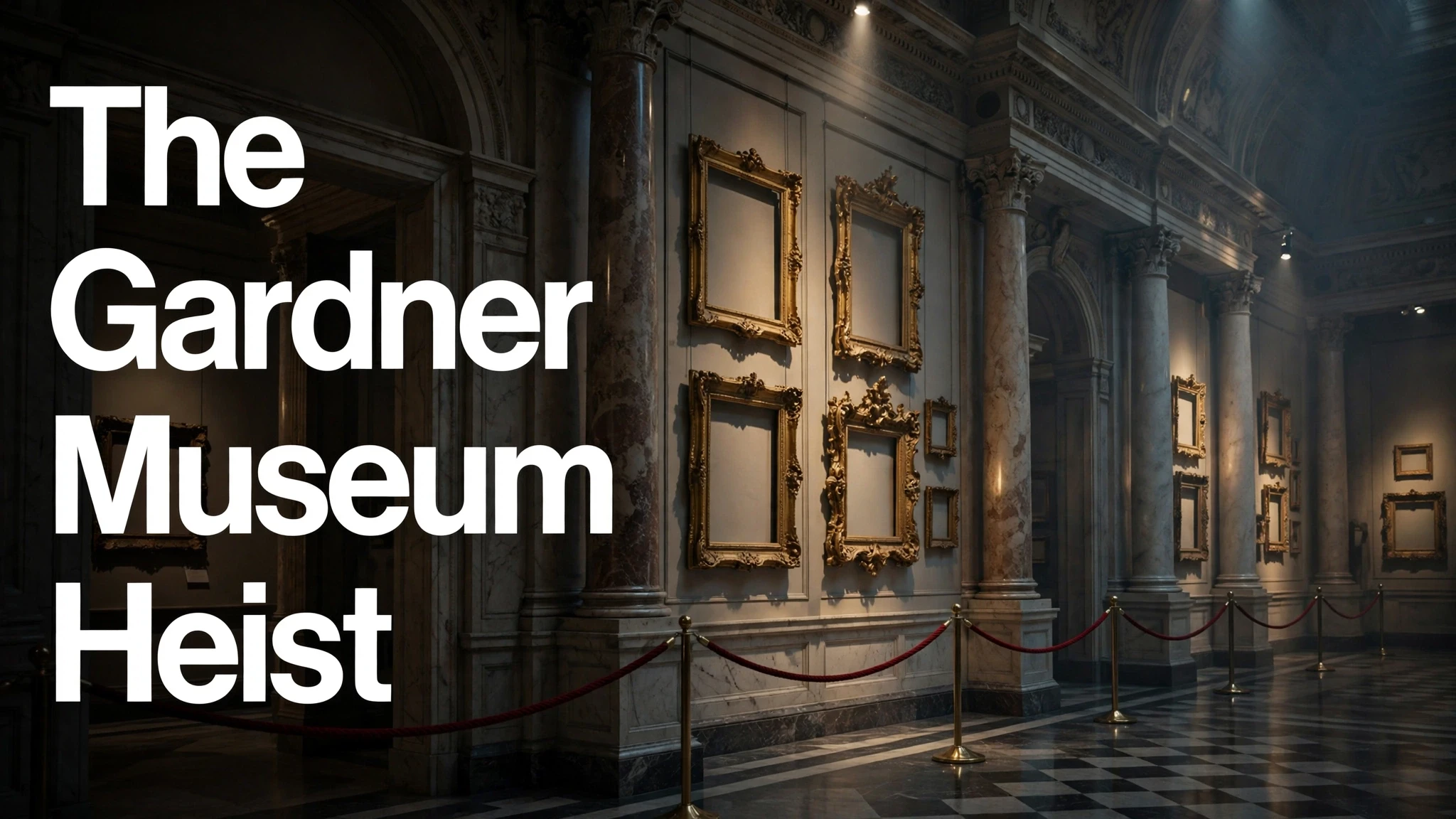
The empty frames are the most visible legacy of the heist, and they are a deliberate choice. Isabella Stewart Gardner’s will stated that if any work were removed from the museum, the museum would lose its collection, and the trustees have interpreted that to mean that the frames must remain, as placeholders, until the works are recovered. The frames hang on the walls, empty, in the Dutch Room, where The Concert and The Storm on the Sea of Galilee once hung, and they are a powerful and poignant sight. Visitors come to see them, and to imagine the paintings that are missing.
The museum today is a working museum, with a collection that is still remarkable, and with exhibitions, concerts, and educational programmes. It has improved its security significantly since the heist, and it continues to appeal for information about the stolen works. The empty frames are not only a reminder of loss. They are a statement of hope: that the paintings will one day be recovered, and that the frames will be filled again. That hope has lasted for more than thirty years, and it is a testament to the museum’s commitment to its collection, and to the public’s love of the art that was taken.
Why the Heist Matters, and What It Teaches Us
The Gardner Museum heist matters because it is the largest art theft in American history, and because the works that were stolen are irreplaceable. A painting by Vermeer, of which only 34 exist, cannot be replaced, and its loss is a loss to everyone, not only to the museum. The heist also matters because it exposed the vulnerability of museums, and it led to improved security across the museum world. It is a reminder that art is fragile, and that its protection requires constant vigilance.
What the heist teaches us is that some crimes are not about money in the usual sense. The thieves did not steal cash, which could be spent, but art, which cannot be sold openly, and which must be hidden. That suggests a different kind of motive, and a different kind of criminal, and it is why the case has fascinated investigators and the public for so long. The heist is a mystery, but it is also a warning: that great works of art, which belong to everyone, can be taken in a single night, and that their recovery is never guaranteed. The empty frames are a reminder of that, and they will remain, until the paintings come home.
The Art That Was Taken: Why These Paintings Matter
Before moving on, it helps to slow down on the art that was taken: why these paintings matter, because this is the stage where small choices in the Gardner Museum heist quietly decide whether the experience succeeds.
What makes the Isabella Stewart Gardner Museum in Boston, robbed in 1990 worth studying inside the Gardner Museum heist is the way it balances simplicity and depth, because beginners can use it at once while experienced readers still find something new. Sharing the Isabella Stewart Gardner Museum in Boston, robbed in 1990 with a friend or reading what others noticed about it can open up angles that were missed, and discussion is one of the fastest ways to deepen a grasp of the Gardner Museum heist. Choosing the Isabella Stewart Gardner Museum in Boston, robbed in 1990 over a flashier option is often the wiser move, because substance lasts longer than novelty, and the Gardner Museum heist is best enjoyed when quality comes before hype.
The smartest approach to two men who entered posing as police officers is to set a small, clear goal first, such as understanding one step or one idea, because the Gardner Museum heist becomes far less overwhelming in small pieces. Compared with a random choice in the same area, two men who entered posing as police officers stands out because it has a clear purpose, and that clarity is what makes the Gardner Museum heist feel rewarding instead of confusing. Two men who entered posing as police officers often comes up first when people discuss the Gardner Museum heist, and the reason is simple: it is easy to understand, easy to try, and easy to explain to someone else.
What finally matters about the night guards who were tied up during the theft is not how popular it is but how well it fits a person’s own taste, time, and mood, since the Gardner Museum heist works best when it is personal. One idea worth understanding early in the Gardner Museum heist is the night guards who were tied up during the theft, which captures a central part of the subject without demanding specialist knowledge first. What makes the night guards who were tied up during the theft worth studying inside the Gardner Museum heist is the way it balances simplicity and depth, because beginners can use it at once while experienced readers still find something new.
Taken together, these examples show that the art that was taken: why these paintings matter is less about perfection and more about paying attention, which is a theme that runs through all of the Gardner Museum heist.
The Museum Today: Empty Frames and Open Doors
There is more to the museum today: empty frames and open doors than first appears, and a little patience here reveals patterns in the Gardner Museum heist that keep showing up in later sections of this guide.
The smartest approach to the Vermeer painting known as The Concert, taken that night is to set a small, clear goal first, such as understanding one step or one idea, because the Gardner Museum heist becomes far less overwhelming in small pieces. Compared with a random choice in the same area, the Vermeer painting known as The Concert, taken that night stands out because it has a clear purpose, and that clarity is what makes the Gardner Museum heist feel rewarding instead of confusing. The Vermeer painting known as The Concert, taken that night often comes up first when people discuss the Gardner Museum heist, and the reason is simple: it is easy to understand, easy to try, and easy to explain to someone else.
What finally matters about the Rembrandt works, including The Storm on the Sea of Galilee is not how popular it is but how well it fits a person’s own taste, time, and mood, since the Gardner Museum heist works best when it is personal. One idea worth understanding early in the Gardner Museum heist is the Rembrandt works, including The Storm on the Sea of Galilee, which captures a central part of the subject without demanding specialist knowledge first. What makes the Rembrandt works, including The Storm on the Sea of Galilee worth studying inside the Gardner Museum heist is the way it balances simplicity and depth, because beginners can use it at once while experienced readers still find something new.
What stays with me about the museum today is the empty frames, left on the walls as a reminder, and the open question they represent: thirteen works of art, still missing, still wanted.
The Stolen Paintings: The Art Itself and Why It Matters
The thirteen works stolen from the Gardner Museum are not only valuable. They are masterpieces, and understanding what they are, and why they matter, is essential to understanding why the heist is so significant. The most famous is Vermeer’s The Concert, which is one of only about thirty-four paintings by Vermeer in the world, and which is considered one of his finest works. It shows three people making music, in a quiet, intimate scene, and it is a masterpiece of light, colour, and composition. Its loss is not only a financial loss, but a cultural one, because it is a work that can never be replaced, and that the public can no longer see. That is why the museum keeps its empty frame on the wall, as a reminder, and as a hope that it will return.
Another stolen work is Rembrandt’s The Storm on the Sea of Galilee, which is his only seascape, and which shows Christ calming the storm, with the disciples in a boat, tossed by waves. It is a dramatic, powerful painting, and it is also a personal one, because Rembrandt is said to have painted himself into the scene, among the disciples. Its theft removed a unique work from public view, and it is a loss to art history, not only to the museum. The other Rembrandt, A Lady and Gentleman in Black, is a portrait of a couple, and it is a quiet, dignified work, which shows Rembrandt’s skill as a portraitist. Together, the two Rembrandts represent a significant part of the museum’s collection, and their loss is deeply felt.
The other stolen works include a Manet, a Degas, and a Chinese bronze beaker, among others, and each one is significant, in its own way. The Manet, Chez Tortoni, is a portrait of a man at a cafe table, and it is a small, intimate work, which shows Manet’s modernity, and his interest in everyday life. The Degas works are sketches, and studies, which show the artist’s process, and which are valuable to scholars, as well as to the public. The bronze beaker is an ancient Chinese ritual vessel, which is a reminder that the Gardner’s collection is not only European, but global, and that the heist affected many cultures, not only one. Each work matters, and each loss is felt.
The value of the stolen art is often given as a figure, reportedly around five hundred million dollars, but that figure is misleading, because these works are, in a sense, priceless. They cannot be bought, or sold, on the open market, because they are too well known, and any attempt to sell them would be detected. Their value is cultural, historical, and artistic, not only financial, and their loss is a loss to everyone who cares about art, whether or not they ever visited the museum. That is why the museum offers a reward, and why the FBI continues to investigate, decades later, because the works are not only property. They are heritage, and they belong to the public, in a way that goes beyond ownership.
Finally, remember that the empty frames are not only a symbol of loss. They are also a symbol of hope, and of the museum’s commitment to recovering the works, and to keeping their memory alive. The museum has said that it will keep the frames empty, until the paintings return, and that promise is a powerful one, because it says that the loss is not accepted, and that the search continues. Visit the museum, see the frames, and remember the paintings, because that memory is part of what keeps the hope alive, and what may one day lead to their return. Art matters, and these works matter, and they should not be forgotten.
My Take:
The image I can’t get out of my head is the empty frames. Not the theft itself, not the men dressed as police officers, but the frames, still hanging on the wall, more than thirty years later, because a will said they must stay. That’s the part of this story that stays with me. A museum that refuses to fill the gap, that leaves the absence visible, so that everyone who visits understands what was taken. It’s a quiet, stubborn act of hope, and it’s more powerful than any reward or investigation. The frames say: these paintings belong here, and we’re waiting.
Here’s what I think is most often missed. The thieves stole thirteen works, but they stole something else too: the public’s access to them. Vermeer’s The Concert is one of only 34 Vermeers in the world. Rembrandt’s Storm on the Sea of Galilee is the only seascape he ever painted. These aren’t just valuable objects. They’re part of our shared culture, and they were available to anyone who walked into that museum. Whoever took them took them away from everyone, and put them somewhere nobody can see them. That’s the real loss, and it’s larger than the $500 million figure that gets quoted. The money is an estimate. The loss is permanent, until they’re found.
I’ll be honest about the investigation, because it’s easy to assume the FBI must know more than it says, and that a solution is just around the corner. After thirty years, with no arrests and no recoveries, the honest assessment is that the case is cold, even if it’s technically open. The museum’s $10 million reward has not been claimed. The leads have not produced the paintings. That doesn’t mean the paintings are gone forever, and I hope they’re recovered, but it does mean we should be realistic. Hope is not evidence, and the frames may hang empty for a long time yet.
What I find most frustrating is the way the heist is romanticised, as if it were a clever caper from a film. It wasn’t. It was a violation of a public trust, carried out by men who tied up two guards and cut paintings from their frames with a blade. The cutting is the detail that bothers me most. A painting cut from its frame is damaged, perhaps irreparably, and that damage is part of the crime. These weren’t careful collectors. They were thieves who damaged what they took, and the damage matters, because even if the paintings are found, they may never be the same.
So my view is simple, and it’s the view the museum itself takes. The frames stay empty. The reward stays open. The appeal for information stays active. And the rest of us should remember what was taken, and why it matters, without turning the theft into entertainment. The Gardner heist is a mystery, yes, but it’s also a loss, and the loss is the point. If the paintings are ever found, the frames will be filled, and that will be a day worth celebrating. Until then, the empty frames are the story, and they tell it better than any theory.
The reward is the part of the Gardner story that tells you how seriously it is still taken. The museum offers ten million dollars for information leading to the return of the paintings, and that reward has been available for years, and nobody has claimed it, which tells you that the paintings are not being offered for sale, and that the people who have them either do not know what they have, or are afraid to come forward. The FBI has a theory, and it has changed over the years, but the basic idea is that the paintings were taken by people who thought they could sell them, and who discovered, too late, that famous stolen art is almost impossible to sell, because every dealer, and every collector, knows what it is, and will not touch it.
That is the irony of art theft: the most valuable paintings are the hardest to sell, because they are too famous, and the thieves are left with works they cannot use, and cannot sell, and cannot display. Some stolen paintings are held for ransom, and some are used as collateral in criminal deals, and some are simply hidden, and forgotten, and the Gardner paintings may be any of those things. The empty frames, left on the walls, are a deliberate choice by the museum, and they are a powerful one, because they remind every visitor of what is missing, and they keep the story alive, in a way that a blank wall would not. The frames are a promise, that the paintings will come back, and a question, that has not been answered, in more than thirty years. The museum waits, and the world waits with it, and the frames wait, empty, on the wall.
The art is what matters most, and that is the point I would leave you with, because it is easy to focus on the heist, on the thieves, and on the mystery, and to forget what was actually stolen: thirteen works of art, including masterpieces by Vermeer and Rembrandt, that the public can no longer see. Those works are not only valuable. They are irreplaceable, and their loss is a cultural loss, felt by everyone who cares about art, whether or not they ever visited the Gardner. I would urge you to learn about the paintings, to look at reproductions, and to understand why they matter, because that understanding will make the heist more than a mystery. It will make it a tragedy, and a reminder of what is at stake, when art is stolen.
I also think we should be honest about the empty frames, and about what they represent. They are not only a memorial. They are a promise, that the museum will not forget, and will not give up, and that the paintings are still wanted, and still missed. That promise is powerful, and it is a sign of the museum’s commitment, and of the public’s love for the works. If you visit the Gardner, take a moment to look at the frames, and to think about the paintings that once hung there, and about the people who made them, and the people who loved them. That moment of attention is a form of respect, and it keeps the memory alive.
Another point I would make is about the value, and the way it is reported, because the figure of five hundred million dollars is often quoted, but it is misleading, and it distracts from the real loss. These paintings cannot be bought or sold, because they are too famous, and their value is not financial, but cultural, and historical. They are part of our shared heritage, and their loss is a loss to everyone, not only to the museum, or to an insurer. Do not think of them as expensive objects. Think of them as works of art, made by human hands, that can never be replaced, and that deserve to be seen, and loved, by the public, for generations to come. That is their true value.
And the final thing I would say is to hope, because the paintings may still be recovered, and the museum, the FBI, and the public have not given up. Art is sometimes recovered, decades after it is stolen, and the Gardner works may yet return, to the frames that wait for them. That hope is not naive. It is a commitment, and it is worth holding, because the return of even one painting would be a triumph, and a reminder that art endures, and that the search for it is worthwhile. Keep the hope alive, remember the paintings, and visit the museum, to see the frames, and to be part of the story. The art matters, and it is worth waiting for.
Frequently Asked Questions
What was stolen in the Gardner Museum heist?
Thirteen works were stolen, including Vermeer’s The Concert, Rembrandt’s The Storm on the Sea of Galilee, and works by Degas and Manet. The total value is estimated at $500 million, making it the largest art theft in American history.
When did the Gardner Museum heist happen?
The heist happened in the early hours of 18 March 1990. Two men dressed as police officers entered the museum, tied up the guards, and spent 81 minutes stealing the art before leaving.
Have the Gardner Museum paintings been found?
No, none of the thirteen works has been recovered, more than 30 years later. The museum offers a $10 million reward for information leading to their recovery, and the FBI investigation remains open.
Why do the empty frames still hang in the museum?
Isabella Stewart Gardner’s will stipulated that the collection should not be changed, and the trustees keep the empty frames as placeholders until the paintings are recovered. They are a visible reminder of the loss.
Who stole the Gardner Museum paintings?
No one has been arrested or charged. Theories involve the Boston mafia, Irish republican groups, and art thieves, but none has been proven, and the FBI has not publicly named those it believes were involved.
What is the most valuable painting stolen?
Vermeer’s The Concert, from about 1664, is the most valuable, estimated at over $200 million. It is one of only 34 known Vermeers, and its loss is considered one of the greatest in art history.