How Do Forensic Scientists Work? Explained Simply
In this post
- The Crime Scene: Securing, Searching, and Collecting
- DNA: The Most Powerful Tool in Forensic Science
- Fingerprints, Footprints, and Trace Evidence
- The Laboratory: Analysis, Testing, and Quality Control
- Digital Forensics: Phones, Computers, and Online Evidence
- In Court: Presenting Evidence and the Limits of Science
- Fingerprinting, Blood and the First Forensic Tools
- A Career in Forensics: Training and Daily Work
- The History of Forensic Science: From Fingerprints to DNA
- My Take:
Forensic science is the application of science to the law, and it is one of the most important tools in modern criminal investigation. When a crime is committed, forensic scientists examine the scene, collect evidence, analyse it in a laboratory, and present their findings in court. Their work can identify a suspect, exonerate an innocent person, or prove what happened when there are no witnesses. It is a field that combines biology, chemistry, physics, and careful observation, and it is far more methodical, and far less glamorous, than television suggests.
This guide explains how forensic scientists work, simply, from the crime scene to the laboratory to the courtroom. It covers the main types of evidence, DNA, fingerprints, fibres, and digital evidence, and it explains what forensic science can and cannot do. Whether you are interested in the science, or simply curious about how crimes are solved, this is how the work is actually done, step by step, by real scientists, in real laboratories.
The Crime Scene: Securing, Searching, and Collecting
The work of a forensic scientist begins at the crime scene, and the first rule is to protect it. The scene is cordoned off, so that no one can enter and contaminate the evidence, and a record is made: photographs, sketches, and notes, showing where everything was found. The scene is then searched systematically, often in a grid pattern, so that nothing is missed. Every item that might be evidence, a fingerprint, a hair, a fibre, a bloodstain, a weapon, is photographed in place, then collected, labelled, and packaged, so that it can be tracked from the scene to the laboratory to the courtroom. That tracking, called the chain of custody, is essential, because evidence that cannot be accounted for may not be accepted in court.
Collection is careful and methodical. A scientist wears gloves, a mask, and protective clothing, to avoid adding their own DNA or fingerprints to the scene. They use tweezers, swabs, and bags, and they label each item with a number, a description, and the location where it was found. They do not move anything until it has been recorded, and they do not guess. A crime scene is a puzzle, and the evidence is the pieces, and the scientist’s job is to collect the pieces without damaging them, so that the laboratory can analyse them. Television often shows a single scientist doing everything, but in reality, a team works together, each with a role, and the process takes hours, not minutes.
DNA: The Most Powerful Tool in Forensic Science
DNA is the most powerful tool in forensic science, because it is unique to each person, except for identical twins, and it can be found in blood, saliva, hair, skin, and other bodily fluids. A DNA profile is made by analysing specific regions of the DNA, and comparing the profile from a crime scene sample with a profile from a suspect, or with a database of profiles from convicted offenders. If the profiles match, it is strong evidence that the sample came from that person. If they do not match, the person is excluded. DNA has solved cold cases decades old, it has exonerated innocent people, and it has identified victims.
DNA analysis is careful and precise, but it has limits. A sample must be collected properly, stored correctly, and analysed without contamination, or the result may be unreliable. A DNA match does not prove guilt on its own: it proves that a person’s DNA was at a scene, but not how it got there, or when. A person could have visited a place earlier, or their DNA could have been transferred by someone else. DNA is a powerful tool, but it is one piece of evidence, and it must be considered alongside other evidence. It is also a tool that raises ethical questions, about databases, privacy, and consent, which are debated by scientists, lawyers, and the public.
Fingerprints, Footprints, and Trace Evidence
Fingerprints have been used in criminal investigation for more than a century, and they remain a valuable tool. Each person’s fingerprints are unique, and they do not change over a lifetime. At a crime scene, fingerprints are found by dusting a surface with powder, or by using chemicals that react with the oils in a print, and they are photographed and compared with prints from a suspect, or with a database. A match can identify a person, and a lack of a match can exclude them. Fingerprints are useful, but they are not perfect: a print may be partial, smudged, or distorted, and the comparison requires skill and judgement.
Trace evidence is the small, often invisible material that is transferred when people and objects come into contact: fibres from clothing, hairs, glass fragments, paint, and soil. A fibre from a suspect’s jacket, found on a victim, can link them. A soil sample from a shoe can link a person to a place. Trace evidence is analysed in a laboratory, using microscopes and chemical tests, and it is often the evidence that solves a case when DNA and fingerprints are not available. Footprints, tyre marks, and tool marks are also analysed, by comparing the pattern with a suspect’s shoe, tyre, or tool. Each type of evidence is a piece of the puzzle, and together, they can build a picture of what happened.
The Laboratory: Analysis, Testing, and Quality Control
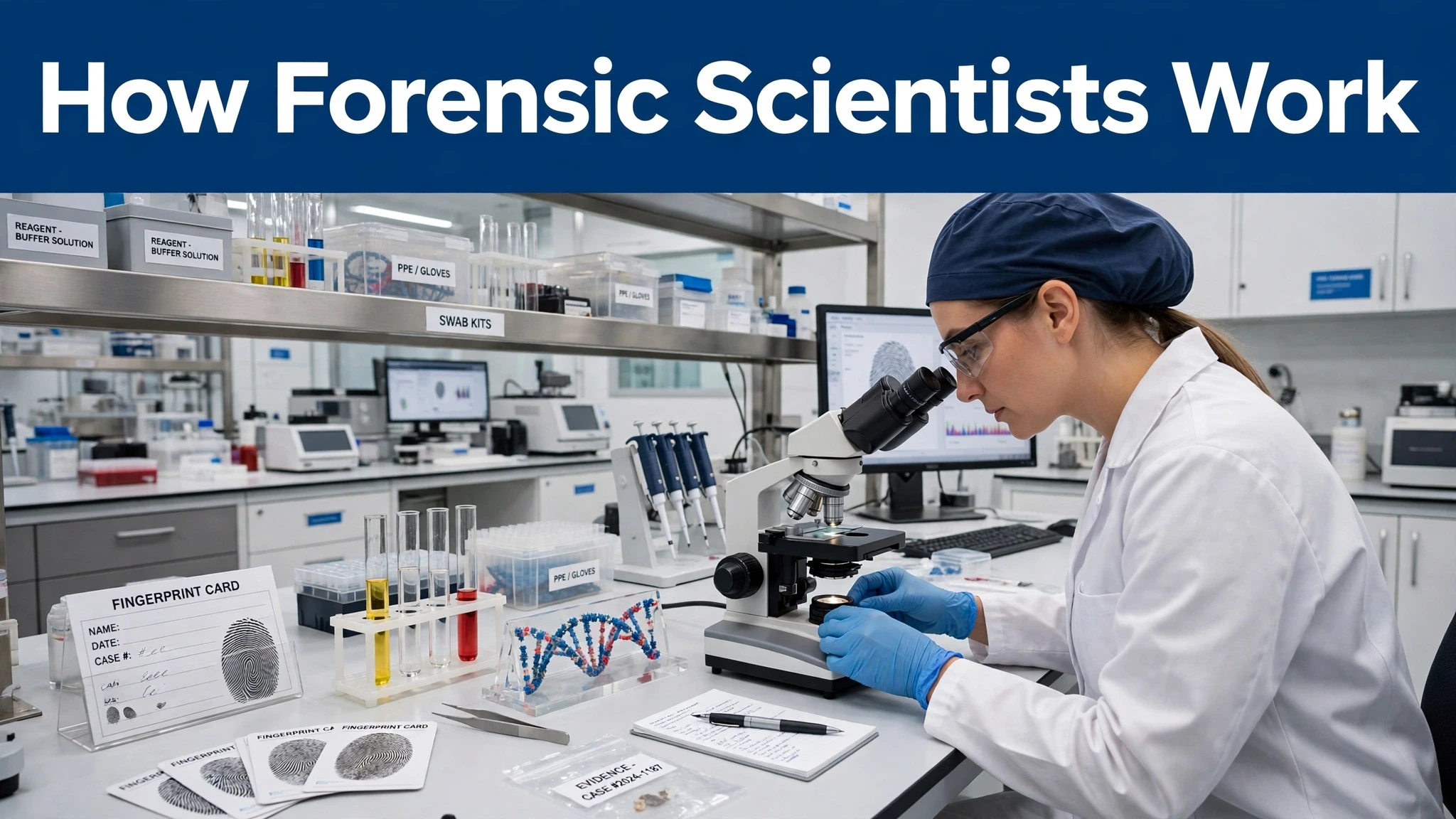
In the laboratory, forensic scientists analyse the evidence collected at the scene, using a range of techniques. A biologist analyses DNA and bodily fluids. A chemist analyses drugs, poisons, and explosives. A physicist analyses ballistics, the study of bullets and firearms, and the trajectory of a shot. A digital forensic scientist analyses phones, computers, and other devices, recovering deleted files, messages, and location data. Each scientist specialises, and each follows strict procedures, so that the results are reliable and can be defended in court.
Quality control is essential. Laboratories follow standards, they test their methods, they use controls, and they document every step. A result that cannot be repeated, or that was obtained by a flawed method, is not useful, and it may be challenged in court. Forensic scientists also have to be honest about uncertainty: a test may show that a substance is likely to be a drug, but not certainly, or that a DNA match is strong, but not absolute. That honesty is part of the science, and it is why forensic evidence is presented with probabilities and with caveats, rather than as absolute certainty. A good laboratory is a careful, methodical place, and its work is slow, precise, and unglamorous.
Digital Forensics: Phones, Computers, and Online Evidence
Digital forensics is one of the fastest-growing areas of forensic science, because so much of life is now digital. A phone, a computer, or a tablet can contain messages, photographs, location data, browsing history, and financial records, all of which can be evidence. A digital forensic scientist recovers data, including deleted files, analyses it, and presents it in a way that can be used in court. They must be careful not to alter the data, so they work on a copy, not on the original device, and they document every step, so that the chain of custody is preserved.
Digital evidence can be powerful: a message can show intent, a location can place a person at a scene, and a photograph can show what happened. But it also has limits: data can be faked, a device can be used by someone else, and a location can be misleading. Digital forensic scientists must understand both the technology and the law, because the evidence must be collected legally, with a warrant or with consent, or it may not be admissible. As more of life moves online, digital forensics becomes more important, and it is now a central part of most investigations, from fraud to violent crime.
In Court: Presenting Evidence and the Limits of Science
The final stage of forensic work is the courtroom, where a scientist presents their findings as an expert witness. They explain what they did, what they found, and what it means, in language that a jury can understand, and they are questioned by both sides. A good expert witness is clear, honest, and impartial: they are not there to prove guilt or innocence, but to present the science, and to explain its limits. They must be prepared for cross-examination, in which the other side will challenge their methods, their conclusions, and their qualifications.
Forensic science has limits, and it is important to be honest about them. A DNA match is strong evidence, but it is not proof of guilt. A fingerprint match is useful, but it depends on the quality of the print. Some techniques, such as bite mark analysis and hair comparison, have been criticised for being unreliable, and they are now used more cautiously. The history of forensic science includes mistakes, and those mistakes have led to reforms, to better standards, and to a greater awareness of uncertainty. Forensic science is a powerful tool, but it is a human tool, and it must be used with care, with honesty, and with an understanding of its limits.
Fingerprinting, Blood and the First Forensic Tools
Fingerprinting was one of the first forensic tools, and it remains one of the most important, because fingerprints are unique, to each person, and they do not change, over a lifetime. The idea that fingerprints could identify a person was proposed in the nineteenth century, and it was first used, in criminal cases, in the early twentieth century, when police began to collect, and to compare, prints, from crime scenes, and from suspects. A fingerprint, left on a surface, can be lifted, with powder, or with chemicals, and compared, to a database, or to a suspect’s prints, and a match can be powerful evidence, though it is not, on its own, proof of guilt.
Blood was another early tool, because blood typing could exclude, or include, a suspect, and because blood spatter could reveal how a crime happened, and where a person was standing. The study of blood, and of other bodily fluids, grew, over the twentieth century, into a science, with laboratories, and with standards, and it became a central part of forensic work. Those early tools, fingerprinting, and blood, were the foundation of modern forensics, and they showed that science could help the law, and that evidence, carefully collected, and analysed, could reveal the truth, in a way that witness statements, alone, could not. They were simple tools, but they were revolutionary, and they changed how crimes were investigated, forever.
A Career in Forensics: Training and Daily Work
A career in forensics is a combination of science, and detective work, and it requires training, in biology, or chemistry, or a related field, and then specialised training, in forensic techniques. Most forensic scientists have a degree, in science, and many have a master’s degree, in forensic science, or a related subject, and they work in laboratories, or in the field, collecting, and analysing, evidence. The daily work is varied: one day, a scientist might be examining DNA, from a crime scene, and the next, they might be testifying, in court, explaining their findings, to a judge, and a jury.
The work is not like television, where cases are solved, in an hour, and where the evidence is always clear. In reality, forensic work is slow, careful, and often inconclusive, and it requires patience, and attention to detail, and the ability to work, under pressure, and to explain complex science, in simple terms. It also requires a strong sense of ethics, because the evidence must be handled, correctly, and the results must be reported, honestly, even when they do not support the theory, that the police, or the prosecution, favour. A career in forensics is rewarding, for people, who love science, and who want to help the law, and who are prepared, to do careful, painstaking work, day after day, in the service of the truth.
The History of Forensic Science: From Fingerprints to DNA
Forensic science is often thought of as modern, but its history goes back centuries, and it is a story of slow, careful progress, from simple observation, to sophisticated science. The first forensic technique to be widely used was fingerprinting, which was developed in the late nineteenth century, when it was discovered that every person’s fingerprints are unique, and that they do not change over time. That discovery transformed criminal investigation, because it gave police a way to identify a person from a mark left at a scene, and it was first used in a murder case in Argentina, in 1892, and then in Britain, and around the world. Fingerprints are still used today, and they remain one of the most reliable forms of identification, even in the age of DNA.
The early twentieth century brought other advances: the study of blood, the analysis of hair, and the use of microscopes to compare bullets, and fibres. Each new technique added a tool to the investigator’s kit, and each one made it harder for a criminal to escape detection. But forensic science was still, in those years, more art than science, relying on the skill, and experience, of individual experts, rather than on standardised methods, and on rigorous testing. That began to change in the mid-twentieth century, as laboratories were established, as methods were standardised, and as forensic science became a profession, with training, qualifications, and quality control.
The most important breakthrough came in the 1980s, with the discovery of DNA profiling, by Alec Jeffreys, in Britain. DNA profiling showed that every person, except identical twins, has a unique genetic code, and that it could be recovered from blood, saliva, hair, or skin, even in tiny amounts. That discovery revolutionised forensic science, because it provided a level of certainty that no previous method could match, and it was first used to solve a murder case in 1986, and to exonerate an innocent man. Since then, DNA has become the gold standard, and it has solved cold cases, identified victims, and freed people who were wrongly convicted. It is, without doubt, the most powerful tool in forensic science, and its impact cannot be overstated.
The history of forensic science is also a history of mistakes, and of lessons learned, because early methods were sometimes unreliable, and they led to wrongful convictions, when they were used without proper care. Bite mark analysis, hair comparison, and some forms of blood analysis have all been shown to be less reliable than once believed, and their use has been restricted, or abandoned. Those mistakes are important, because they remind us that forensic science is not infallible, and that it must be tested, validated, and used with caution. The best forensic scientists are the ones who understand the limits of their methods, and who are honest about uncertainty, rather than overstating what the evidence can prove.
Today, forensic science continues to advance, with new techniques for analysing digital evidence, for recovering DNA from tiny samples, and for using artificial intelligence to analyse patterns. But the principles remain the same: collect carefully, analyse rigorously, and present honestly, with an awareness of what the evidence can, and cannot, prove. That is the legacy of a century of progress, from fingerprints to DNA, and it is a legacy that should be respected, and protected, because forensic science, used well, is one of the most powerful tools for justice, and for truth, that we have.
My Take:
I want to start by clearing up the biggest misunderstanding about forensic science, because television has done it a real disservice. On TV, a scientist finds a single hair, runs it through a machine, and names the killer before the adverts. In reality, the work is slow, methodical, and often inconclusive. A sample takes days to analyse, not minutes. A result is a probability, not a certainty. And a DNA match, however strong, doesn’t prove guilt on its own. It proves a person’s DNA was somewhere, not how it got there or when. The real science is more careful than the fiction, and I think it’s more interesting for being careful.
Here’s the part I think matters most, and it’s the part TV never shows: the chain of custody. Every item of evidence has to be tracked, from the scene to the lab to the courtroom, with a record of everyone who handled it. If that chain breaks, the evidence may be useless, however good the science is. That paperwork, those labels, those photographs of where something was found, they’re not bureaucracy. They’re the foundation of the whole process. A brilliant analysis of a contaminated sample is worthless. A careful collection of a clean sample is everything. The unglamorous work is the work that matters.
I’ll be honest about the limits, because they’re important and they’re often ignored. Some forensic techniques are strong: DNA, when done properly, is powerful. Fingerprints, when the print is clear, are useful. But other techniques have been oversold. Bite mark analysis and hair comparison, which were once presented as certain, have been shown to be unreliable, and they’ve contributed to wrongful convictions. That’s a serious failure, and it’s why the field has reformed, with better standards and more honesty about uncertainty. A science that admits its limits is a stronger science, not a weaker one, and I think the public should know that.
What I find most impressive is the laboratory itself, and how different it is from the image. It’s not a room full of flashing machines and dramatic revelations. It’s a quiet, careful place, where scientists follow procedures, run controls, document every step, and check each other’s work. The quality control is the point. A result that can’t be repeated isn’t a result. A method that isn’t validated isn’t a method. That discipline is what makes forensic evidence trustworthy in court, and it’s what separates science from guesswork. It’s slow, it’s precise, and it’s unglamorous, and that’s exactly why it works.
So my view is this. Forensic science is one of the most important tools in the justice system, because it can identify the guilty and exonerate the innocent, and it has done both, many times. But it’s a tool, not a magic answer, and it must be used with care, with honesty, and with an understanding of its limits. The next time you watch a crime drama, enjoy it, but remember that the real work is slower, more careful, and more honest than the fiction. And that’s a good thing, because justice depends on it. The scientists who do this work deserve respect, not for drama, but for discipline.
The courtroom is where forensic science meets its hardest test, because a scientist must explain complex evidence to people who are not scientists, and must do so honestly, without overstating what the evidence can prove. A DNA match can be powerful, but it does not, on its own, prove guilt, because it shows only that a person was present, or that their DNA was found, and the jury must decide what that means, in the context of the whole case. A fingerprint can identify a person, but it cannot say when the print was made, or why. Those limits matter, and a good forensic scientist will state them clearly, and will not pretend that the science can answer questions it cannot.
That honesty is important, because forensic science has made mistakes, and those mistakes have sent innocent people to prison. In the past, some techniques were presented as certain, when they were not, and bite marks, and hair analysis, were treated as proof, when they were only opinion. DNA testing has since freed many people who were wrongly convicted, and those exonerations are a reminder that science must be careful, and that the law must be careful with science. A forensic scientist is not an advocate for the prosecution, or for the defence. They are a witness for the evidence, and their duty is to the truth, even when the truth is uncertain, or inconvenient, or when it does not help the side that called them. That duty is what makes the work honourable, and it is what makes it hard.
The history is what I would emphasise, because it shows that forensic science is not a television invention, but a discipline that has developed over more than a century, through careful work, through mistakes, and through breakthroughs, from fingerprints to DNA. I would urge anyone who is interested in forensics to learn that history, because it will make you a better viewer, and a better thinker, and it will help you understand why some methods are trusted, and others are not. A technique that has been tested, validated, and used for decades is more reliable than one that is new, and unproven, however impressive it seems on screen. Trust the history, and trust the science, not the drama.
I also think we should be honest about the limits, because forensic science is powerful, but it is not infallible, and it has led to wrongful convictions, when it was used carelessly, or when its limits were ignored. Bite marks, hair comparison, and other methods were once presented as certain, and they were later shown to be unreliable, and innocent people suffered as a result. That is a sobering lesson, and it is a reminder that science must be humble, and honest, and that experts must acknowledge uncertainty, rather than overstating their conclusions. The best forensic science is the science that knows its limits, and that is careful, rigorous, and transparent. Demand that, and justice will be better served.
Another point I would make is about DNA, and how it has changed everything, because it is the most powerful tool we have, and it has solved cases that were thought unsolvable, and freed people who were wrongly imprisoned. That is a triumph, and it is worth celebrating, but DNA is also a responsibility, because it raises questions about privacy, about databases, and about who has access to genetic information. Those questions are important, and they should be discussed, openly, and honestly, because a powerful tool needs clear rules, and public trust. Support DNA testing, but also support the safeguards that protect privacy, and ensure that it is used fairly, and justly.
And the final thing I would say is to be sceptical of television, and to remember that real forensic science is slower, more careful, and less dramatic than what you see on screen. A DNA test takes weeks, not minutes, a fingerprint is not always found, and a case is not solved in an hour. That slowness is not a flaw. It is the nature of good science, and it is what makes the results reliable. Watch the shows, enjoy them, but do not confuse them with reality, and do not expect real investigations to work like fiction. Real forensic science is patient, methodical, and honest, and it is worth respecting, for what it is, and for what it can do, when it is done well.
Frequently Asked Questions
How do forensic scientists work?
Forensic scientists secure the crime scene, collect and label evidence, analyse it in a laboratory, and present findings in court. They use DNA, fingerprints, trace evidence, and digital analysis, following strict procedures so results are reliable.
What is DNA evidence?
DNA is a unique profile found in blood, saliva, hair, and skin. A match between a crime scene sample and a suspect is strong evidence, though it proves presence, not guilt on its own, and it must be considered with other evidence.
How are fingerprints used in forensics?
Fingerprints are unique and do not change. They are found by dusting or chemicals, photographed, and compared with a suspect’s prints or a database. A clear match can identify a person, but partial or smudged prints are less reliable.
What is trace evidence?
Trace evidence is small material transferred by contact, such as fibres, hairs, glass, paint, and soil. Analysed in a laboratory, it can link a suspect to a victim or a place, and it often solves cases when DNA is not available.
What is digital forensics?
Digital forensics recovers and analyses data from phones, computers, and tablets, including messages, location data, and deleted files. Scientists work on a copy, not the original, to preserve evidence for court.
Can forensic science prove someone is guilty?
No single test proves guilt. Forensic evidence provides probabilities and pieces of a picture, and it must be considered with other evidence. Some techniques are strong, such as DNA, while others have limits and must be used cautiously.