The Zodiac Killer Case, Explained Simply
In this post
- The Murders: What Happened in 1968 and 1969
- The Letters: Taunting the Police and the Press
- The Ciphers: Codes That Took Decades to Solve
- The Investigation and the Main Suspect
- Why the Case Was Never Solved
- The Victims, the Families, and the Legacy
- The Letters in Detail: Tone, Clues and False Leads
- Amateur Sleuths and the Search for Answers
- The Zodiac in Culture: Films, Books, and the Public Fascination
- My Take:
The Zodiac Killer is one of the most famous unsolved criminal cases in American history. In the late 1960s, a person who called himself the Zodiac murdered at least five people in Northern California, taunted the police and the press with letters and ciphers, and then vanished, never identified, never caught. The case has been the subject of books, films, and endless speculation, and it remains open, more than fifty years later. It is a story that is fascinating, and also deeply sad, because the victims were real people, and their families never received justice.
This guide explains the Zodiac Killer case simply: the murders, the letters, the ciphers, and the investigation. It is based on the historical record, and it is told in a neutral tone, without graphic detail, and without glorifying the killer. The focus is on what happened, what is known, and why the case remains unsolved. It is a difficult subject, and it should be read with care, but it is an important part of criminal history, and it is worth understanding.
The Murders: What Happened in 1968 and 1969
The Zodiac Killer is linked to at least five murders in Northern California, between December 1968 and October 1969, and to two attempted murders in which the victims survived. The first known attack was on 20 December 1968, when two teenagers, David Faraday and Betty Lou Jensen, were shot on a lovers’ lane in Benicia. The second was on 4 July 1969, when Darlene Ferrin was shot and Michael Mageau was wounded, in Vallejo. The third was on 27 September 1969, when Bryan Hartnell and Cecelia Shepard were attacked at Lake Berryessa, and Shepard later died. The fourth was on 11 October 1969, when taxi driver Paul Stine was shot in San Francisco.
The killer also claimed, in letters, to have murdered more people, but those claims have not been verified, and the confirmed victim count is five. The attacks were different in method and in location, which made the investigation difficult, and the killer’s identity was never established. The victims were young, ordinary people, and their deaths were a tragedy for their families and for their communities. The case is remembered for the killer’s letters, but it should also be remembered for the victims, whose lives were cut short, and whose families have waited for answers for more than fifty years.
The Letters: Taunting the Police and the Press
What made the Zodiac case unique was the letters. Beginning in August 1969, the killer sent letters to newspapers in the San Francisco area, claiming responsibility for the murders, taunting the police, and threatening further violence. The letters were signed with a symbol, a circle with a cross through it, and the writer called himself the Zodiac. The letters included details about the murders that only the killer would know, which confirmed that they were genuine, and they included ciphers, coded messages that the writer challenged the public to solve.
The letters were a form of communication, and also a form of control: by writing to the newspapers, the killer ensured that the case remained in the public eye, and that the police were under pressure. The letters were also cruel, because they caused fear in the community, and they prolonged the suffering of the victims’ families. The tone of the letters was boastful and threatening, and they have been studied by linguists and psychologists, who have tried to learn about the writer from the language, the spelling, and the handwriting. The letters are a central part of the case, and they are the reason the killer is known as the Zodiac.
The Ciphers: Codes That Took Decades to Solve
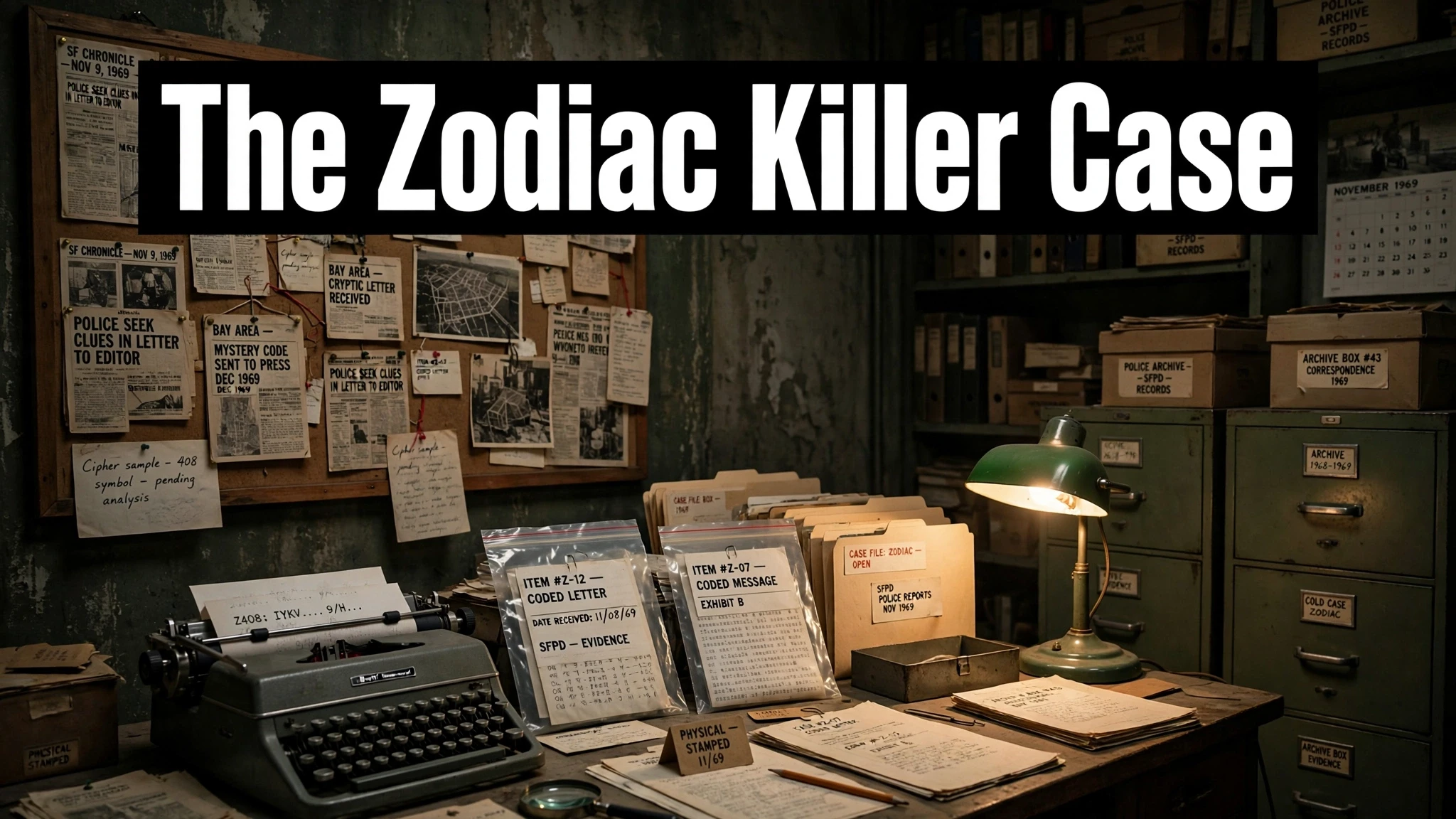
The Zodiac sent four ciphers, coded messages, to the newspapers, and they have been a focus of the case ever since. The first cipher, known as Z408, was 408 characters long, and it was solved within a week by a schoolteacher and his wife, Donald and Bettye Harden, who worked it out at home. The solution was a message in which the killer said that killing was a game, and that he was collecting slaves for the afterlife. The second cipher, Z340, was 340 characters long, and it remained unsolved for more than fifty years, until it was cracked in December 2020 by a team of codebreakers, using computer analysis. The solution was a message in which the killer denied being the person the police suspected, and said that he was not afraid of being caught.
The other two ciphers, known as Z13 and Z32, are very short, and they have not been solved, partly because they contain too little information to work with. The ciphers are important because they show that the killer was intelligent, that he enjoyed puzzles, and that he wanted attention. They are also important because they have not led to his identity: even the solved ciphers contain no name, no address, and no clue that identifies the writer. The ciphers are a puzzle, but they are not a solution to the case, and their solution, while a remarkable achievement, did not bring the investigation closer to an arrest.
The Investigation and the Main Suspect
The investigation into the Zodiac Killer involved multiple police departments, the FBI, and thousands of hours of work, and it produced a large number of suspects, but no arrest. The most famous suspect was Arthur Leigh Allen, a former teacher who lived in Vallejo, and who was investigated for many years. Allen matched some of the descriptions, he owned a typewriter similar to one used for a letter, and he had a history that made him a person of interest. However, his fingerprints did not match those found at a crime scene, his handwriting did not match the letters, and DNA evidence, tested years later, did not link him to the case. Allen died in 1992, without being charged, and the case remains open.
Other suspects have been proposed, including several men who have been named in books and in documentaries, but none has been proven to be the Zodiac. The investigation was hampered by the fact that the murders took place in different jurisdictions, by the lack of forensic technology in the 1960s, and by the killer’s care in leaving little evidence. Modern DNA testing has been applied to the case, and it has produced some leads, but it has not identified the killer. The case remains one of the most famous unsolved mysteries in American criminal history, and it is a reminder of the limits of investigation, even with modern science.
Why the Case Was Never Solved
There are several reasons why the Zodiac case was never solved. The first is that the killer left very little physical evidence, and what he left, fingerprints, a footprint, and a few items, was not enough to identify him with the technology of the time. The second is that the murders were spread across different police departments, which made coordination difficult, and which allowed the killer to operate in different areas. The third is that the killer stopped, or at least stopped writing, after 1974, and the trail went cold. Without new murders, new letters, or new evidence, the investigation had little to work with.
A fourth reason is that the case became a media sensation, which generated thousands of tips, many of them false, and which made the investigation harder, not easier. The public’s fascination with the Zodiac, and the many books and films about the case, have also created a problem: the line between fact and speculation has blurred, and many claims about the killer’s identity are based on weak evidence. The case may still be solved, through DNA, or through a new lead, and the police have said that it remains open. But after more than fifty years, the most honest answer is that we do not know who the Zodiac was, and we may never know.
The Victims, the Families, and the Legacy
The legacy of the Zodiac case is not only the mystery, but the impact on the victims’ families, who have lived for decades without answers. The families of David Faraday, Betty Lou Jensen, Darlene Ferrin, Cecelia Shepard, and Paul Stine have waited for justice, and they have had to live with the public’s fascination with the killer, which can feel like a second injury. The case is a reminder that behind every famous crime are real people, whose lives were ended, and whose families were left to cope. That is the part of the story that should not be forgotten, even as the mystery continues to fascinate.
The case has also had a lasting impact on criminal investigation, on forensic science, and on popular culture. It led to improvements in how police departments share information, it showed the value of forensic evidence, and it inspired books and films, most famously David Fincher’s Zodiac, which is a careful and respectful telling of the story. The case remains open, and the hope is that new technology, particularly DNA, will one day identify the killer, and bring some closure to the families. Until then, the Zodiac Killer remains a mystery, and a reminder that some crimes, however famous, remain unsolved, and that the victims deserve to be remembered, not only the killer.
The Letters in Detail: Tone, Clues and False Leads
The Zodiac’s letters are remarkable, not only for their content, but for their tone, which is a mixture of boasting, taunting, and strange, almost playful, cruelty. The killer wrote as if he were enjoying the attention, and as if he were in control, and his letters were designed to frighten, and to frustrate, the police, and the public. He claimed responsibility for murders, he threatened more, and he included ciphers, and diagrams, that he said would reveal his identity, if they were solved. That tone, of arrogance, and amusement, is part of what makes the case so unsettling, because it suggests a person, who saw murder, as a game, and who enjoyed playing it.
The letters also contained clues, and false leads, and it is often difficult to tell them apart. Some ciphers were solved, and they revealed rambling messages, with no clear identity, while others remain unsolved, and may never be solved. Some details in the letters matched the crimes, while others did not, and some may have been invented, to mislead, or to claim credit, for crimes he did not commit. The letters are a puzzle, and they have been studied, for decades, by police, by cryptographers, and by the public, and they remain, in part, a mystery. They are also a reminder that a criminal can use the media, and the public, as a tool, and that the search for attention can be as important, to a killer, as the crime itself.
Amateur Sleuths and the Search for Answers
Amateur sleuths have been drawn to the Zodiac case for decades, because it is unsolved, and because the letters, and the ciphers, invite anyone to try to solve it. Some amateurs are serious researchers, who study the evidence, and who contribute useful ideas, and who help to keep the case alive, when the police have moved on. Others are less careful, and they propose theories, that are based on speculation, rather than evidence, and they name suspects, who may be innocent, and who suffer, as a result. The line between helpful, and harmful, is thin, and it is important to remember that the case is real, and that the victims were real people, with families, who are still living.
The internet has made amateur sleuthing easier, and more widespread, because it allows people to share information, and to collaborate, from anywhere in the world. That collaboration has produced some useful work, including new analyses of the ciphers, and new examinations of the evidence, but it has also produced a great deal of noise, and speculation, and it is often difficult to separate the two. The best amateur work is careful, and evidence-based, and it respects the victims, and their families, and it does not claim to have solved the case, unless it has proof. The search for answers is understandable, and it is human, but it must be done with care, and with respect, for the people, who were harmed.
The Zodiac in Culture: Films, Books, and the Public Fascination
The Zodiac Killer has become a cultural icon, appearing in films, books, television, and music, and that fascination says as much about us as it does about the case. The most famous film is David Fincher’s Zodiac, from 2007, which tells the story of the investigation, and of the journalists and detectives who pursued the killer, and which is praised for its accuracy, and its atmosphere. It does not solve the case, and it does not sensationalise it, but it captures the obsession, the frustration, and the fear, that the case created, and it is a powerful, thoughtful film, that is worth watching, if you are interested in the case, and in how it affected the people who lived through it.
Books have also told the story, most famously Robert Graysmith’s Zodiac, which was written by a cartoonist at the San Francisco Chronicle, who became obsessed with the case, and who named a suspect, Arthur Leigh Allen. Graysmith’s book is influential, and it shaped public understanding, but it is also controversial, because some of its claims have been questioned, and because it presents a theory as if it were proven, when it is not. That is a reminder that books, like films, are interpretations, and that they should be read critically, with an awareness of what is evidence, and what is speculation. The best books about Zodiac are honest about the limits of what is known, and they do not claim to have solved the case, when they have not.
Television has also been fascinated, with documentaries, dramas, and true crime series, all retelling the story, and all adding to the legend. Some are careful, and accurate, and some are sensational, and misleading, and the viewer should be able to tell the difference. A documentary that interviews detectives, that shows the evidence, and that acknowledges uncertainty, is more valuable than one that presents a new suspect, or a new theory, as if it were the answer. The public fascination is understandable, because the case is unsolved, and because the killer taunted the police, and the press, but that fascination should not obscure the fact that real people were murdered, and that their families still grieve. Entertainment should not come at the expense of respect.
The fascination also raises a question: why are we so drawn to an unsolved case, and to a killer who was never caught? Part of it is the mystery, the idea that a puzzle remains, and that it might be solved. Part of it is the fear, the idea that a killer could be among us, and never be found. And part of it is the story itself, with its ciphers, its letters, and its taunts, which make it feel like a thriller, rather than a real crime. That feeling is dangerous, because it can make us forget that the victims were real, and that their deaths were not entertainment. The best cultural works about Zodiac remember that, and they keep the victims at the centre, even as they explore the mystery. The worst forget it, and they should be avoided.
Finally, remember that the Zodiac case is not only a cultural phenomenon. It is a real investigation, which continues, with new technology, and new leads, and which may one day be solved. DNA, and other forensic methods, have advanced since the 1960s, and they offer hope, even after so many years. Whether the case is solved or not, it will remain a part of our culture, because it is a story about fear, about obsession, and about the limits of justice, and those themes are timeless. Watch the films, read the books, but remember the victims, and respect the investigation, because the case is real, and the people in it are real, and they deserve more than fascination. They deserve justice, and remembrance.
My Take:
The part of the Zodiac case I think about most isn’t the ciphers or the letters. It’s the families. Five people were murdered, and their families have waited more than fifty years for an answer that may never come. The killer wrote letters to newspapers, and those letters made him famous. The victims didn’t choose fame. They were teenagers on a date, a young woman in a car, a couple at a lake, a taxi driver doing his job. Their names are in the record, but the public remembers the symbol, the circle with a cross, more than it remembers them. I think that’s wrong, and I think any telling of this case should start with the people who were lost, not with the puzzle.
Here’s what I want to be clear about. The ciphers are fascinating, and the codebreaking is a genuine achievement, but solving a cipher didn’t solve the case. The Z408 solution told us the killer thought killing was a game. The Z340 solution, cracked after fifty years, told us he denied being the suspect the police had in mind. Neither named him. Neither brought the families closer to justice. I think the public’s focus on the codes has distorted the case, turning it into a puzzle to be solved rather than a crime to be investigated. Puzzles are satisfying. Murders are not, and the distinction matters.
I’ll be honest about Arthur Leigh Allen, because his name comes up in every discussion, and the record is often misrepresented. Allen was investigated for years, and he matched some descriptions, but his fingerprints didn’t match, his handwriting didn’t match, and DNA testing didn’t link him to the case. He died without being charged. That doesn’t mean he was innocent, and it doesn’t mean he was guilty. It means the evidence wasn’t enough, and that’s the honest position. Naming a suspect as the killer without proof is unfair to the suspect and to the victims, because it creates a false sense of closure. The case is unsolved. Saying so is more respectful than pretending otherwise.
What I find most troubling is how the case became entertainment, and how that entertainment sometimes forgets the victims. Books, films, documentaries, and online theories keep the Zodiac famous, and that fame is part of why the case endures. But fame is not justice, and a killer who is remembered for his letters is still a killer who was never caught. I think we should enjoy a good mystery, and still be clear about what it is: five murders, two survivors, and families who never got answers. The mystery is interesting. The loss is real, and the loss is more important.
So my view is this. The Zodiac case is worth understanding, because it shows how investigation works, how forensic science has changed, and how a killer can exploit the media. But it’s worth understanding fully, with the victims at the centre, not the symbol. Remember David Faraday, Betty Lou Jensen, Darlene Ferrin, Cecelia Shepard, and Paul Stine. Remember that the case is open, and that DNA may one day identify the killer. And remember that until that day, the honest answer is that we don’t know who he was. That’s not a satisfying ending, but it’s the true one, and the families deserve the truth more than they deserve a theory.
The victims are the part of the Zodiac story that is most often lost, and they are the part that should be remembered first. They were young people, with lives, and families, and plans, and their deaths were not a puzzle, or a game, but a loss that their families have carried for more than fifty years. When the case is discussed as a mystery, with ciphers, and letters, and suspects, it is easy to forget that real people died, and that their families are still living with the question of who did it, and why. A respectful account of the case starts with the victims, and it returns to them, and it does not treat them as clues, or as background, to a more interesting story about a killer.
There is still hope, and it comes from DNA, which was not available when the crimes happened, and which has solved other cold cases in recent years. Investigators have worked on DNA from the Zodiac’s letters, and from evidence at the scenes, and the hope is that a profile can be built, and matched, to a person, or to a family, through the same kind of genealogy that has identified other criminals. That hope is real, but it is not a promise, and the evidence is old, and fragile, and it may not yield an answer. Still, the possibility matters, because it means the case is not closed, and it means the families may one day have an answer. Until then, the best we can do is to remember the victims, and to be careful with the theories, and to understand that a mystery is not a game, when real lives are at stake.
The fascination is what I would question most, because it is easy to be drawn to the Zodiac case, to the ciphers, the letters, and the mystery, and to forget that real people were murdered, and that their families still live with that loss. I would urge anyone who is fascinated by the case to remember the victims, to learn their names, and to think about them, not only about the killer. The killer wanted attention, and he got it, and that attention is part of his legacy. The victims deserve attention too, and they deserve to be remembered as people, not as part of a puzzle. That shift in focus, from the killer to the victims, is the most important thing a viewer, or a reader, can do.
I also think we should be honest about the books and films, and about how they shape our understanding, because a film can make a theory seem true, and a book can make a suspect seem guilty, even when the evidence is weak. Robert Graysmith’s book, and David Fincher’s film, are both powerful, but they are also interpretations, and they should be read, and watched, critically. Do not accept a suspect because a book names him. Do not accept a theory because a film presents it well. Check the evidence, read other sources, and remember that an unsolved case is unsolved for a reason: because the evidence is not enough, and because certainty is not available, however much we want it. That uncertainty is uncomfortable, but it is honest.
Another point I would make is about the danger of amateur sleuthing, because the internet has made it easy for anyone to investigate, to propose a suspect, and to accuse a person, often without evidence, and often with harmful consequences. A person named online as the Zodiac may be innocent, and the accusation can ruin their life, and their family’s life, even if it is baseless. Be careful about what you believe, and what you share, and do not accuse someone without strong evidence. The police, and the FBI, are the ones who should investigate, and the public’s role is to provide information, not to conduct a trial online. That restraint is a form of respect, for the victims, for the investigation, and for the truth.
And the final thing I would say is to hope for a solution, but to accept that it may never come, and to find value in the case, even without a solution. The Zodiac case has taught us about forensic science, about investigation, and about the limits of what we can know, and those lessons are valuable, whether or not the killer is ever identified. The victims deserve justice, and we should hope for it, but we should also remember them, and honour them, regardless of the outcome. That remembrance is the most important thing, and it is available to anyone, without solving the case. Remember the victims, respect the investigation, and let the fascination be tempered by compassion. That is the right way to approach this case.
Frequently Asked Questions
Who was the Zodiac Killer?
The Zodiac Killer was never identified. He murdered at least five people in Northern California in 1968 and 1969, sent taunting letters and ciphers to newspapers, and then vanished. The case remains open more than 50 years later.
How many people did the Zodiac Killer murder?
The Zodiac is linked to five confirmed murders and two attempted murders in which the victims survived. He claimed more victims in his letters, but those claims have not been verified.
Were the Zodiac Killer ciphers solved?
The first cipher, Z408, was solved within a week in 1969. The second, Z340, was solved in December 2020 after more than 50 years. The two short ciphers, Z13 and Z32, remain unsolved, and none of the solutions identified the killer.
Was Arthur Leigh Allen the Zodiac Killer?
Arthur Leigh Allen was the main suspect for many years, but his fingerprints and handwriting did not match, and DNA testing did not link him to the case. He died in 1992 without being charged, and the case remains unsolved.
Why was the Zodiac Killer never caught?
He left little physical evidence, the murders spanned different police jurisdictions, and he stopped writing after 1974, so the trail went cold. The case generated many false tips, and the forensic technology of the 1960s was limited.
Is the Zodiac Killer case still open?
Yes, the case remains open, and police have said that modern DNA testing may one day identify the killer. The hope is that new technology will bring closure to the victims’ families.