The Great Train Robbery: The Story Explained
In this post
- The Plan: A Gang, a Train, and £2.6 Million
- The Night: 8 August 1963
- The Investigation: Fingerprints, a Farm, and Arrests
- The Escapes: Ronnie Biggs and the Long Aftermath
- The Driver, the Money, and the Human Cost
- Why the Story Endures, and What It Means
- The Money Trail: What Happened to the Cash
- The Robbery on Screen: Films, Books and Memory
- The Money: What Happened to the £2.6 Million
- My Take:
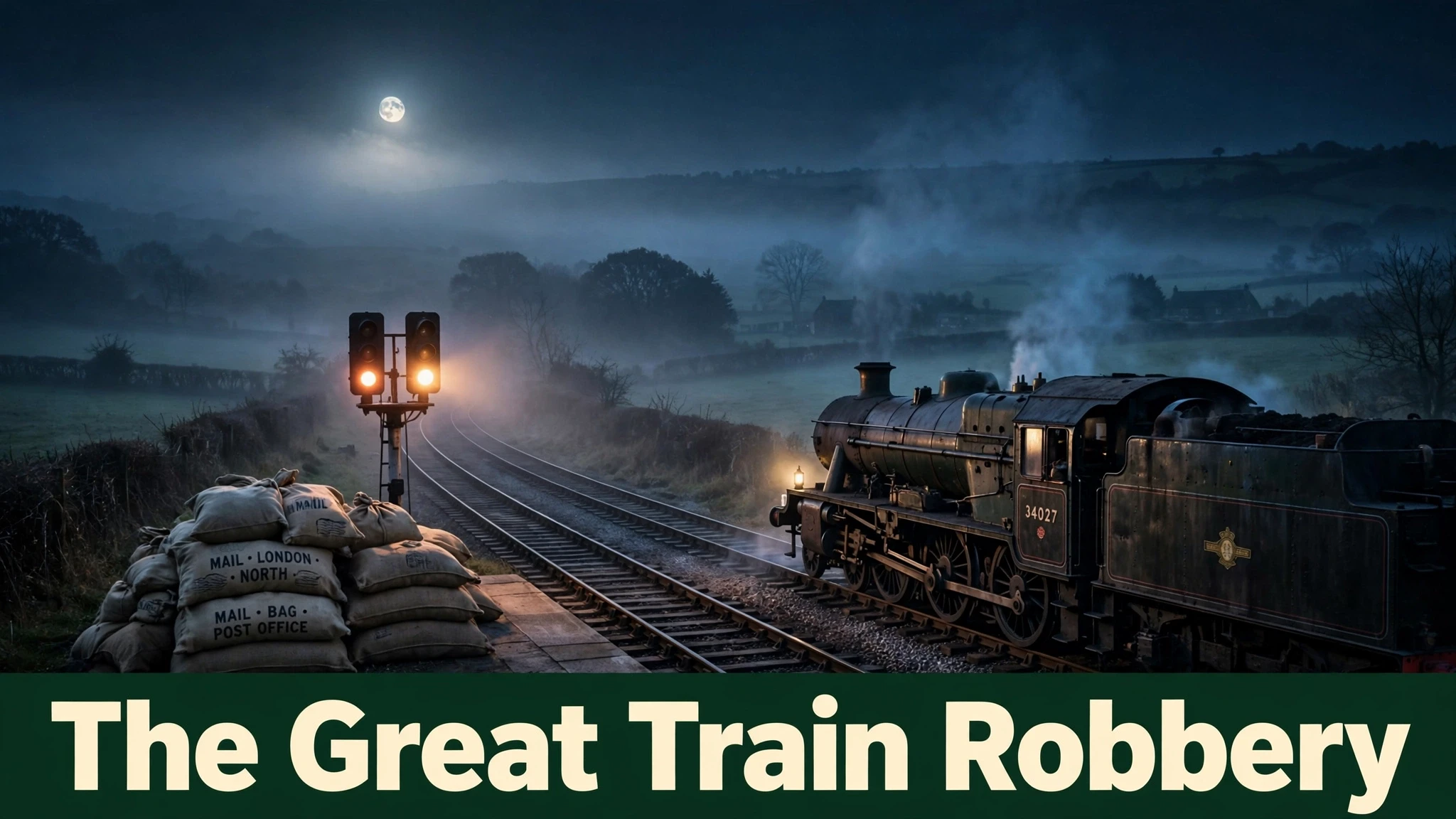
On the night of 8 August 1963, a gang of thieves stopped a Royal Mail train in Buckinghamshire, England, and stole £2.6 million, an enormous sum at the time. It was one of the largest robberies in British history, and it became a legend, not only because of the money, but because of the planning, the characters involved, and the long aftermath, including escapes, recaptures, and a fugitive who lived abroad for decades. The Great Train Robbery is a story that has been told in books, films, and television, and it remains one of the most famous crimes in British history.
This guide explains the story of the Great Train Robbery, from the planning to the night itself, the investigation, and what happened to the gang. It is based on the historical record, and it is honest about what is known and what is disputed. It is told in a neutral tone, without glorifying the crime, because the robbery, however famous, was a serious offence, and it had real consequences for the people involved, including the train driver, who was injured and never fully recovered.
The Plan: A Gang, a Train, and £2.6 Million
The Great Train Robbery was planned over months, by a gang of about fifteen men, led by Bruce Reynolds, a London criminal who had been involved in robberies before. The target was the Royal Mail train from Glasgow to London, which carried mail, including registered mail with banknotes, on a regular schedule. The gang learned the train’s timetable, its route, and its security, and they planned to stop it at a remote location, in Buckinghamshire, where they could unload the money without being seen. The plan was detailed: they would tamper with a signal to stop the train, uncouple the locomotive and the first carriages, and drive them to a nearby bridge, where the money would be loaded into vehicles.
The gang included men with different skills: some were experienced thieves, some were drivers, and one, Roger Cordrey, was an electrician who knew how to tamper with the signal. They rented a farmhouse, Leatherslade Farm, as a hideout, and they prepared vehicles, including a lorry and cars, to carry the money. The total amount they expected to steal was large, but the actual amount, £2.6 million, was far more than they had anticipated, because the train was carrying more money than usual. The plan was ambitious, and it required precision, timing, and secrecy, and on the night, it worked, though not without violence, and not without mistakes that would lead to their capture.
The Night: 8 August 1963
On the night of 8 August 1963, the gang put their plan into action. They tampered with a signal at Sears Crossing, near Cheddington in Buckinghamshire, covering the green light and wiring a battery to the red light, so that the train would stop. When the Royal Mail train, hauled by a diesel locomotive, stopped at the signal, the gang, wearing helmets and gloves, boarded the locomotive and overpowered the driver, Jack Mills, and his secondman, David Whitby. Mills was struck on the head with an iron bar, an injury from which he never fully recovered, and which contributed to his early death. That violence is an important part of the story, and it should not be overlooked in the retelling.
The gang uncoupled the locomotive and the first two carriages, which contained the high-value mail, and drove them to Bridego Bridge, about a mile away, where they had positioned vehicles. There, they unloaded 120 mailbags, containing £2.6 million in banknotes, into a lorry and cars, in about fifteen minutes. They then drove to Leatherslade Farm, where they divided the money, and where they stayed for a short time before dispersing. The whole operation, from stopping the train to leaving the farm, took only a few hours, and it was, in terms of planning, remarkably efficient. But the gang had left evidence behind, and that evidence would lead the police to them.
The Investigation: Fingerprints, a Farm, and Arrests
The police investigation was one of the largest in British history, involving hundreds of officers, and it moved quickly. The gang had left fingerprints at Leatherslade Farm, on a ketchup bottle, on a Monopoly board, and on other items, because they had not worn gloves while playing games and eating at the farm. Those fingerprints identified several members of the gang, and within weeks, arrests began. The farm itself was found after a tip-off, and the police discovered evidence that linked the gang to the robbery. The investigation was methodical, and it relied on forensic evidence, on informants, and on the mistakes the gang had made.
By the end of 1963, most of the gang had been arrested, and in early 1964, they were tried at Aylesbury Crown Court. The trial was a major public event, and the sentences were severe: most of the gang received thirty years in prison, which was unusually long at the time, and which reflected the seriousness of the crime and the public attention it had received. The money was mostly never recovered: only a small fraction, about £400,000, was found, and the rest was never traced, though some of it was likely spent, hidden, or lost. The investigation showed that even a well-planned robbery leaves traces, and that forensic science, even in 1963, could identify those responsible.
The Escapes: Ronnie Biggs and the Long Aftermath
The most famous part of the aftermath is the escape of Ronnie Biggs, a member of the gang who had been recruited as a driver. Biggs was sentenced to thirty years, but in 1965, he escaped from Wandsworth Prison, by climbing over a wall and being driven away in a furniture van. He fled to Australia, then to Brazil, where he lived for decades, because Brazil had no extradition treaty with Britain for his crime. Biggs became a celebrity, giving interviews, selling his story, and living openly in Rio de Janeiro, where he fathered a child, which gave him further protection from extradition. He returned to Britain in 2001, when he was ill, and he was imprisoned, before being released on compassionate grounds in 2009. He died in 2013.
Other members of the gang also escaped, or were released, and their lives after the robbery varied. Bruce Reynolds, the leader, was arrested in 1968, served ten years, and later wrote a memoir. Some members lived quietly, others were involved in further crime, and some died in prison or shortly after release. The story of the escapes, particularly Biggs’s long exile in Brazil, captured the public imagination, and it turned the robbery into a legend, though it should be remembered that the escapes were not a happy ending. They were the consequences of a crime, and they involved decades of separation from family, and of living as a fugitive.
The Driver, the Money, and the Human Cost
The human cost of the Great Train Robbery is often overlooked in the retelling, and it deserves attention. Jack Mills, the train driver, was struck on the head during the robbery, and he suffered from headaches, dizziness, and trauma for the rest of his life. He never returned to work, and he died in 1970, at the age of 57, and his family believed that the injury contributed to his early death. David Whitby, the secondman, was also affected, though less seriously. The robbery was not a victimless crime, and the violence, though brief, had lasting consequences for the men who were attacked, and for their families.
The money, £2.6 million in 1963, would be worth tens of millions today, and most of it was never recovered. Some of it was spent, some was hidden, and some was likely lost. The gang members who were caught served long sentences, and their families suffered. The story is often told as a daring adventure, but it was a serious crime, with real victims, and the fascination it holds should not obscure that. A balanced telling of the Great Train Robbery acknowledges the planning and the drama, but it also acknowledges the harm, and the fact that the people who carried it out were punished, and that the money was, for the most part, never found.
Why the Story Endures, and What It Means
The Great Train Robbery endures because it is a remarkable story: a large sum, a clever plan, a dramatic night, and a long aftermath of escapes and recaptures. It has been retold in books, in films, and in television dramas, and it has become part of British cultural history. It endures also because it happened at a time when Britain was changing, and the robbery seemed to capture something about that moment: a sense of daring, of anti-authoritarianism, and of a criminal underworld that was both feared and romanticised. That romanticisation is part of the problem, because it can make a serious crime seem like an adventure, and it can obscure the harm that was done.
What the story means, in the end, is that a well-planned crime can succeed in the short term, but it rarely succeeds in the long term. The gang stole a fortune, but most of them were caught, they served long sentences, and the money was mostly lost. The driver was injured, and his life was shortened. The legend is more appealing than the reality, and the reality is that crime, however clever, has consequences. The Great Train Robbery is a fascinating story, and it is worth knowing, but it is worth knowing fully, including the cost, and not only the drama.
The Money Trail: What Happened to the Cash
The Money Trail: What Happened to the Cash is where many people form their lasting opinion of the Great Train Robbery, so it pays to understand what is really going on here instead of guessing.
The Glasgow to London mail train stopped in the night in 1963 often comes up first when people discuss the Great Train Robbery, and the reason is simple: it is easy to understand, easy to try, and easy to explain to someone else. A good way to judge the Glasgow to London mail train stopped in the night in 1963 is to ask what it does well and what it leaves out, since every part of the Great Train Robbery makes trade-offs and naming them sharpens judgement. A common mistake is rushing past the Glasgow to London mail train stopped in the night in 1963, so slowing down and giving it a fair try usually leads to a better judgement about the Great Train Robbery than a quick first impression.
What makes the gang who tampered with a railway signal to halt the train worth studying inside the Great Train Robbery is the way it balances simplicity and depth, because beginners can use it at once while experienced readers still find something new. Sharing the gang who tampered with a railway signal to halt the train with a friend or reading what others noticed about it can open up angles that were missed, and discussion is one of the fastest ways to deepen a grasp of the Great Train Robbery. Choosing the gang who tampered with a railway signal to halt the train over a flashier option is often the wiser move, because substance lasts longer than novelty, and the Great Train Robbery is best enjoyed when quality comes before hype.
With the money trail: what happened to the cash understood, the next part of the Great Train Robbery becomes easier, because you now have a reference point to compare new ideas against.
The Robbery on Screen: Films, Books and Memory
Before moving on, it helps to slow down on the robbery on screen: films, books and memory, because this is the stage where small choices in the Great Train Robbery quietly decide whether the experience succeeds.
What makes the driver who was injured during the robbery worth studying inside the Great Train Robbery is the way it balances simplicity and depth, because beginners can use it at once while experienced readers still find something new. Sharing the driver who was injured during the robbery with a friend or reading what others noticed about it can open up angles that were missed, and discussion is one of the fastest ways to deepen a grasp of the Great Train Robbery. Choosing the driver who was injured during the robbery over a flashier option is often the wiser move, because substance lasts longer than novelty, and the Great Train Robbery is best enjoyed when quality comes before hype.
The smartest approach to the farmhouse hideout where the gang counted the money is to set a small, clear goal first, such as understanding one step or one idea, because the Great Train Robbery becomes far less overwhelming in small pieces. Compared with a random choice in the same area, the farmhouse hideout where the gang counted the money stands out because it has a clear purpose, and that clarity is what makes the Great Train Robbery feel rewarding instead of confusing. The farmhouse hideout where the gang counted the money often comes up first when people discuss the Great Train Robbery, and the reason is simple: it is easy to understand, easy to try, and easy to explain to someone else.
Taken together, these examples show that the robbery on screen: films, books and memory is less about perfection and more about paying attention, which is a theme that runs through all of the Great Train Robbery.
The Money: What Happened to the £2.6 Million
The £2.6 million stolen in the Great Train Robbery was an enormous sum in 1963, worth many millions today, and what happened to it is one of the most enduring parts of the story. Most of the money was never recovered, and its fate has been the subject of speculation, rumour, and legend, ever since. Some of it was found at the gang’s hideout, a farm, where the police discovered a large amount, but the majority disappeared, and it has never been found. That missing money is a reminder that the robbery, for all its planning, and its success, did not make the gang rich, in the way they had hoped, because stolen money is difficult to spend, difficult to hide, and difficult to keep.
The gang members who were caught spent years in prison, and many of them died without ever enjoying the money, or without ever revealing where it was. Some of it was said to have been spent on legal fees, on supporting families, and on living expenses, while on the run. Some was said to have been hidden, and lost, or buried, and never found. Some was said to have been invested, or given away, or stolen by others. The truth is that no one knows, for certain, what happened to most of it, and that uncertainty is part of the legend. The money became a myth, a treasure that was never found, and that myth has kept the story alive, long after the robbery itself.
Ronnie Biggs, who escaped from prison, and lived in Brazil for decades, became the most famous member of the gang, in part because of the money, and the life he lived. He claimed to have little money, and to have lived modestly, but he also became a celebrity, and he profited from his fame, through books, interviews, and appearances. His story shows that the robbery made him famous, but not rich, and that fame, like stolen money, is a complicated thing, and not always a blessing. He returned to Britain, years later, ill, and old, and he died in prison, a reminder that crime, however glamorous it may seem, has consequences, that last a lifetime.
The money that was recovered was returned to the banks, and to the Post Office, but the loss was not only financial. The robbery cost the life of the train driver, who was injured, and who never fully recovered, and it cost the gang members their freedom, their families, and their futures. The money, whatever happened to it, was not worth that cost, and the story is a cautionary tale, not a celebration, however often it is told as an adventure. The glamour of the robbery fades, when you look at the human cost, and at the lives that were damaged, and that is the part of the story that should not be forgotten.
Finally, remember that the missing money is a mystery, but it is not the most important mystery of the Great Train Robbery. The most important questions are about the people: why they did it, what they hoped for, and what it cost them, and those questions have answers, in the lives they lived, and in the consequences they faced. The money is a detail, and a distraction, and it should not obscure the human story, which is one of ambition, of risk, and of loss. The robbery is remembered because it was daring, but it should also be remembered because it was tragic, and because it shows that crime, however clever, rarely pays, in the way its perpetrators hope.
My Take:
The first thing I want to say about the Great Train Robbery is that the popular version leaves out the part that matters most. Jack Mills, the driver, was hit on the head with an iron bar, and he never recovered. He never worked again. He died at 57, and his family believed the injury shortened his life. That’s not a footnote. That’s the human cost, and it’s the part that gets lost when the story is told as a daring adventure. I think any honest telling has to start there, not with the money, because the money is the least important part of what happened that night.
Here’s what I think the planning reveals, and it’s less glamorous than the legend suggests. The gang was organised, yes, and the plan was detailed, but they made basic mistakes that undid them within weeks. They left fingerprints on a ketchup bottle and a Monopoly board at the farmhouse. They played games without gloves, in a hideout they’d rented for the job. That’s not criminal genius. That’s carelessness, and it’s why forensic evidence caught them so quickly. The robbery worked for a night. The investigation worked for years. That’s the balance the legend usually misses.
I’ll be honest about Ronnie Biggs, because his story is the one everyone remembers, and it’s the one that distorts the rest. Biggs escaped, lived in Brazil for decades, and became a celebrity, and that story is entertaining. But it’s also misleading, because it makes the robbery look like a game with a happy ending. For most of the gang, there was no happy ending. There were thirty-year sentences, families left behind, and money that was mostly lost. Biggs was the exception, not the rule, and treating him as the story is like treating a lottery winner as the typical player. The typical outcome was prison.
What I find most interesting is why the story endures, and I think it’s because it happened at a moment when Britain was changing, and the robbery seemed to capture something about that change. It was daring, it was anti-authoritarian, and it was against a system that many people felt was stuffy and old. That context matters, but it doesn’t excuse the crime, and it doesn’t erase the harm. I think we can understand why people were fascinated, and still be clear that fascination is not approval. A story can be interesting and wrong at the same time.
So my view is this. The Great Train Robbery is worth knowing, because it’s a remarkable piece of history, and because it shows how planning, forensic science, and the law interact. But it’s worth knowing fully, with the driver, the sentences, and the lost money included, not only the daring night and the escape to Brazil. The legend is appealing. The reality is more complicated, and more honest. Remember Mills, remember the thirty years, and remember that most of the money was never found. That’s the whole story, and it’s the one worth telling.
The aftermath of the robbery is where the story becomes a tragedy, and then a legend, because the money was never fully recovered, and the men who took it paid a heavy price. Most of the gang were caught within months, and they were given long sentences, thirty years in some cases, which were severe for the time, and which shocked the public. A few escaped, and the most famous, Ronnie Biggs, fled abroad, and lived for decades as a fugitive, and his story became a kind of folk tale, about a man who outran the law, and who could never come home. The money itself mostly vanished, spent, or hidden, or lost, and only a small part was ever found.
What made the robbery famous was not only the money, but the way the public reacted to it. There was no violence, or almost none, and the gang were seen, by some, as daring, and even romantic, and that view has lasted, in films, and in books, and in songs, that treat the robbery as an adventure, rather than a crime. That view is worth questioning, because a crime is still a crime, even when it is clever, and the driver of the train was badly hurt, and his life was changed by what happened that night. The robbery is a good story, and it is told well, but it is also a reminder that the people we admire in stories are often people who caused real harm, and that the line between a legend and a criminal is thinner than we like to think. Remember the driver, as well as the gang, and the story becomes a different one.
The money is the part that captures the imagination, but it is not the part that matters most, and that is the point I would leave you with. A missing fortune is a romantic idea, a treasure that was never found, and it has kept the story alive for decades. But the money was not worth the cost, and the gang members who stole it did not become rich, or happy, or free. They became prisoners, fugitives, and legends, and their lives were damaged, in ways that money could not repair. I would urge you to look beyond the money, and to see the human cost, because that cost is the real story, and it is a cautionary tale, not a celebration.
I also think we should be honest about the way the robbery is romanticised, in films, in books, and in popular culture, because that romanticisation hides the harm. The train driver was injured, and he never recovered, and his family suffered, and that suffering is often forgotten, in the telling of a daring heist. A robbery is not a victimless crime, and the Great Train Robbery was not an adventure. It was a violent act, with real consequences, for real people, and it should be remembered as such. Enjoy the story, but do not forget the victims, and do not let the glamour obscure the harm. That is a matter of respect, and of truth.
Another point I would make is about the legend, and how it grows, because the missing money has become a myth, and myths are powerful, and they can distort history. People claim to know where the money is, or to have found it, or to have spent it, and those claims are rarely true, but they are repeated, and they become part of the story. Be sceptical of those claims, and ask for evidence, because a good story is not the same as a true one, and the truth, in this case, is that most of the money was never found, and probably never will be. That uncertainty is part of the mystery, and it is fine to enjoy it, as a mystery, without believing every claim.
And the final thing I would say is to remember the driver, and the other ordinary people who were affected, because they are the ones who are often forgotten, in the focus on the gang, and the money. The driver, the postal workers, and their families lived with the consequences, long after the headlines faded, and their story deserves to be told, and remembered. A crime story is not only about the criminals. It is also about the victims, and about the cost, and that cost is the most important part. Remember them, and the story becomes not only exciting, but honest, and that honesty is what makes it worth telling.
Frequently Asked Questions
What was the Great Train Robbery?
On 8 August 1963, a gang stopped a Royal Mail train in Buckinghamshire and stole £2.6 million, one of the largest robberies in British history. The gang was mostly caught within weeks, though most of the money was never recovered.
How much money was stolen in the Great Train Robbery?
£2.6 million was stolen, an enormous sum in 1963, worth tens of millions today. Only about £400,000 was ever recovered, and the rest was never traced.
Who was Ronnie Biggs?
Ronnie Biggs was a member of the gang who escaped from prison in 1965 and lived in Brazil for decades, because Brazil had no extradition treaty for his crime. He returned to Britain in 2001 and died in 2013.
What happened to the train driver?
Jack Mills, the driver, was struck on the head during the robbery and never fully recovered. He never returned to work and died in 1970 at 57, and his family believed the injury contributed to his early death.
How were the robbers caught?
The gang left fingerprints at their hideout, Leatherslade Farm, on items including a ketchup bottle and a Monopoly board. Police identified them from the prints, and most were arrested within weeks and sentenced to 30 years.
Was the Great Train Robbery money ever found?
Most of the money was never recovered. Only a small fraction was found, and the rest was likely spent, hidden, or lost. The gang members served long prison sentences.