How A Turbocharger Works Simply
In this post
Press the accelerator in a small modern car, and something surprising happens. The car pulls harder than its little engine seems entitled to pull, surging forward with a faint whistle from under the bonnet. The secret is a device about the size of a grapefruit, bolted to the side of the engine, doing a clever piece of recycling. It takes energy the engine was about to throw away — the hot exhaust rushing out — and uses it to cram more air into the engine, so the engine can burn more fuel and make more power.
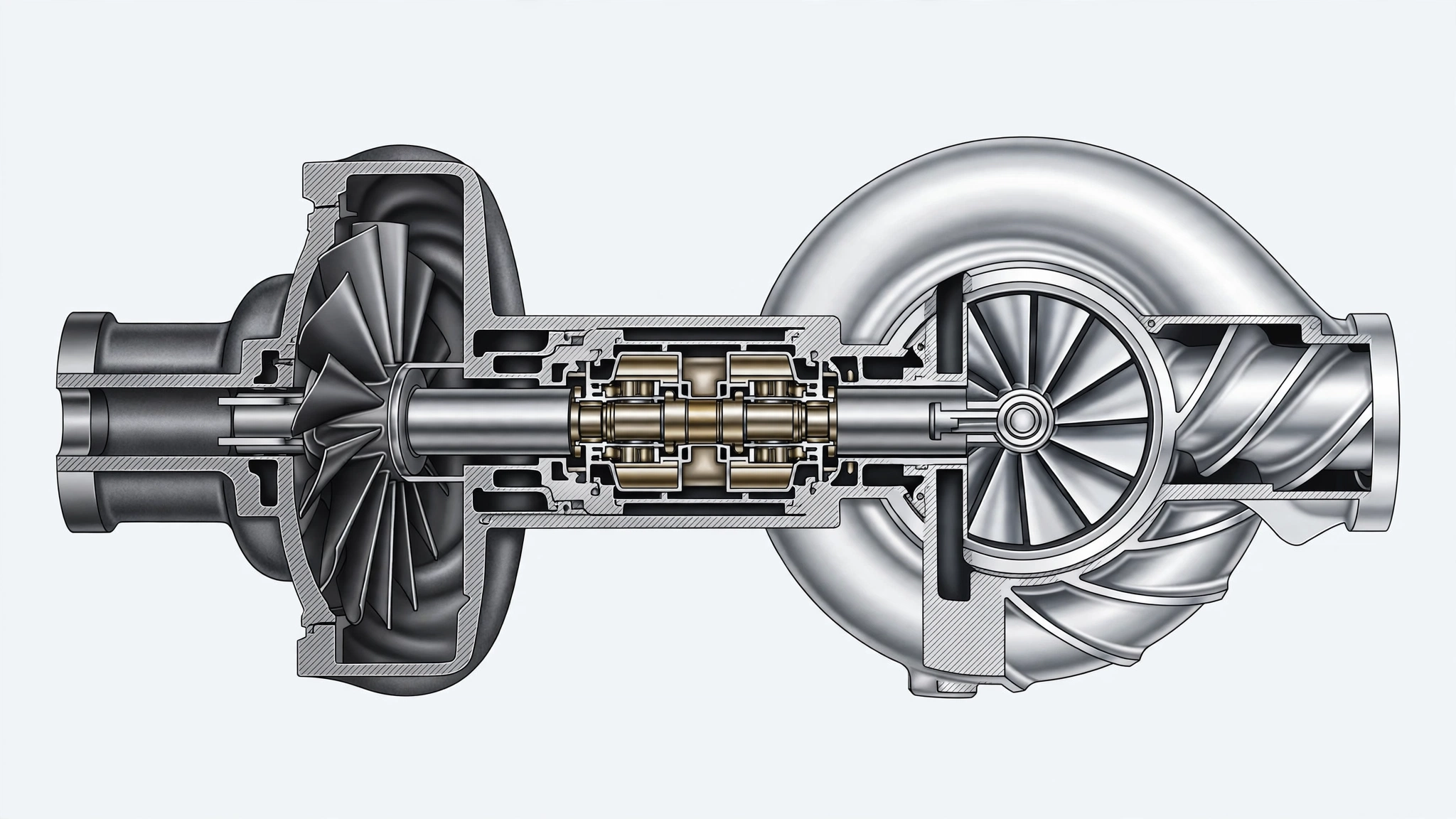
That device is the turbocharger, and its idea is beautifully simple. Explain That Stuff, the science explainer, describes it as a pair of fans that harness waste exhaust to force extra air into the engine. Two fan wheels sit on the ends of a single shaft: one in the exhaust stream, one in the intake air. The exhaust spins the first wheel, the shaft spins the second, and the second wheel pushes extra air into the cylinders. One fan drives the other, and the engine breathes deeper than it ever could on its own.
An engine is an air pump
To understand a turbocharger, start with what an engine does. A petrol or diesel engine is, at heart, an air pump that burns fuel. Each cylinder draws in air, squeezes it, adds fuel, burns the mixture, and pushes the burnt gases out. The power comes from the burning, and the burning needs oxygen from the air. More air in the cylinder means more fuel can be burned, and more fuel burned each second means more power.
A normal engine breathes at the mercy of the atmosphere. The piston moving down draws air in, but the air arrives at ordinary pressure, and only so much fits in the cylinder. That limit caps the power. Engineers call the engine “naturally aspirated” when it breathes this way — no help, just the atmosphere pushing air in as the piston drops.
A turbocharger breaks the cap. Instead of waiting for air to wander in, it forces air in under pressure, packing more oxygen into the same cylinder. The same small engine, given more air, burns more fuel per second and produces more power. The engine does not get bigger. Its lungs get stronger.
Two fans on one shaft
The turbocharger itself has two main parts, joined by a shaft. On one end sits the turbine, a fan wheel placed in the path of the hot exhaust gases leaving the engine. On the other end sits the compressor, a fan wheel placed in the intake, where fresh air enters. The shaft between them runs through a central housing, and the whole spinning assembly is called the CHRA — the centre housing rotating assembly, in engineer-speak.
When the engine runs, exhaust gases rush out under pressure and blast the turbine wheel, spinning it very fast — tens of thousands of revolutions per minute, and in some cases far more. Because the turbine and the compressor share one shaft, the compressor spins at the same speed, and its blades scoop fresh air and fling it outward, packing it into the intake at higher than atmospheric pressure. The exhaust, which was waste a moment ago, is now doing useful work.
Nothing else drives it. There is no belt, no motor, no extra power source. The turbocharger is powered entirely by energy the engine was discarding anyway, which is why engineers love it: it recovers waste and turns it into power, for the price of some extra plumbing and heat.
More air means more fuel and more power
The compressor’s extra air does not make power by itself. Air alone does not burn. The power comes from the extra fuel the engine can now burn, because the extra oxygen allows a bigger, richer charge in each cylinder. Explain That Stuff is careful on this point: the extra power comes from burning more fuel per second, not directly from the exhaust energy. The exhaust spins the fan; the fan supplies the air; the air allows the fuel; the fuel makes the power.
That chain also explains why turbocharged engines can be smaller. A small engine with a turbocharger can make the power of a much larger engine, because it breathes like a larger one whenever the turbo is spinning. Car makers use this to fit smaller, lighter engines that sip fuel gently in town, then deliver strong power when the driver asks for it. The engine is two engines in one: economical when cruising, powerful when pushed.
There is a limit, though. Forcing in air compresses it, and compressed air gets hot. Hot air is thinner, holding less oxygen, and too-hot air can cause the fuel to ignite too early, which damages engines. That is why the next part of the system matters so much.
The intercooler cools the squeezed air
Between the compressor and the engine sits a heat exchanger, usually called an intercooler. Its job is simple: cool the hot compressed air before it reaches the cylinders. Cooler air is denser, packing more oxygen into each cylinder, and it behaves better when the fuel ignites. The intercooler is the quiet partner of the turbocharger, and without it much of the turbo’s benefit would melt away as heat.
You can often spot an intercooler at the front of a car, low behind the bumper, looking like a small radiator. Air flows through it as the car moves, carrying heat away from the compressed charge. It has no moving parts and asks for nothing, but it earns its place on every hard acceleration, keeping the squeezed air cool, dense, and safe to burn.
The whole system is a loop of trade-offs managed well: exhaust heat spins the turbine, the turbine drives the compressor, the compressor heats the air by squeezing it, and the intercooler removes that heat so the engine gets cool, dense air. Waste becomes power, and heat becomes a problem solved on the way in.
Turbo lag: the pause before the push
Every turbocharged car has a characteristic pause. You press the accelerator, and for a heartbeat — sometimes a full second — little happens. Then the push arrives, suddenly and strongly. That pause is turbo lag, and it is the turbocharger’s most famous weakness.
Lag happens because the turbine needs exhaust flow to spin up. At low engine speed, little exhaust flows, the turbine turns slowly, and the compressor pushes little extra air. Press the accelerator and the engine must first speed up, make more exhaust, spin the turbine faster, and only then does the extra air arrive. The chain takes time, and the driver feels the wait.
Engineers fight lag in several ways: smaller, lighter turbine wheels that spin up faster; twin turbos, where a small turbo works at low speed and a larger one takes over; and variable-geometry turbines that adjust their shape to catch exhaust better at different speeds. Modern cars have far less lag than the turbo cars of the 1980s, but the physics never fully disappears. A small pause before the surge is the signature of a turbo doing its work.
Turbocharger versus supercharger
The turbocharger has a close cousin, the supercharger, and the difference is what drives the fan. A turbocharger is driven by waste exhaust, as described. A supercharger is driven by the engine itself, usually by a belt from the crankshaft, so it spins whenever the engine spins and gives instant response with no lag.
That instant response costs power. Because the supercharger steals some engine power to drive itself, part of its gain is spent running the device. The turbocharger steals nothing from the crankshaft, but waits for exhaust flow, so it lags. Explain That Stuff draws the contrast plainly: the supercharger is driven by the engine and takes power to run, while the turbocharger lives off waste energy and answers a moment later. Car makers choose between them — or use both — based on the character they want the car to have.
Who invented the turbocharger
The turbocharger is older than most people guess. It was invented by Alfred J. Büchi, a Swiss engineer working for the Sulzer company, who patented the idea in Germany in 1905. Büchi lived from 1879 to 1959, and his idea waited decades for materials and engines strong enough to use it. Early turbos went to ships and aircraft, where the power gain mattered most, and only later shrank into cars.
The long wait makes sense. A turbine spinning at enormous speed in a stream of exhaust hot enough to glow needs bearings, metals, and oils that the early twentieth century could barely provide. Büchi’s idea was right; the world needed time to catch up with it. When it did, the turbocharger spread everywhere, from trucks to racing cars to the small hatchback in the supermarket car park.
The benefits and the costs
The advantages are clear. A turbocharger gives more power from the same size of engine, allows a smaller and lighter engine to do a bigger engine’s job, can improve fuel economy by roughly up to 10 percent in the right conditions, and helps the fuel burn more completely, which can mean cleaner exhaust. That combination — power plus economy — is why so many modern cars, from city cars to lorries, now carry one.
The costs are real too. Turbo lag dulls the response. The system is more complex, with more parts to fail and higher maintenance costs. The engine endures higher pressures and temperatures, which can shorten its life if the turbo is abused or the oil is neglected. And the turbo itself spins at extreme speed in extreme heat, so it demands good oil, sensible warm-up, and care. Consumer Reports warned as early as 2013 that turbocharged engines do not always deliver the fuel savings their makers promise in real driving, because a driver who uses the extra power often pays for it at the pump.
The honest summary is that a turbocharger is a brilliant bargain with conditions attached. Treat it well — good oil, gentle warm-up, cool-down after hard driving — and it repays the care with years of strong, economical service. Ignore it, and the small device that gave the engine its strength becomes the engine’s most expensive repair.
Frequently Asked Questions
How does a turbocharger work in simple words?
A turbocharger is two fan wheels on one shaft: hot exhaust gases spin the turbine wheel, and the shaft spins the compressor wheel, which forces extra air into the engine. More air lets the engine burn more fuel per second, and burning more fuel makes more power. The energy comes from exhaust the engine was throwing away, and an intercooler cools the squeezed air before it reaches the cylinders.
What is turbo lag and why does it happen?
Turbo lag is the short pause between pressing the accelerator and feeling the extra push, and it happens because the turbine needs exhaust flow to spin up. At low engine speed little exhaust flows, so the compressor pushes little extra air until the engine speeds up and makes more exhaust. Smaller turbine wheels, twin turbos, and variable-geometry turbines all reduce lag, but the physics of waiting for exhaust flow never fully disappears.
What is the difference between a turbocharger and a supercharger?
A turbocharger is driven by waste exhaust gases, so it costs the engine no power but responds with a delay, while a supercharger is driven by a belt from the engine’s crankshaft, so it responds instantly but steals some engine power to run itself. The turbocharger recovers energy that would be wasted, and the supercharger trades a little power for immediate response.
Who invented the turbocharger?
The turbocharger was invented by Alfred J. Büchi, a Swiss engineer working for the Sulzer company, who patented the idea in Germany in 1905. Early turbochargers were used in ships and aircraft, and the idea waited decades for materials and engines strong enough to use it in cars. Büchi lived from 1879 to 1959.
Does a turbocharger save fuel?
It can, by roughly up to 10 percent in the right conditions, because a smaller turbocharged engine can do the work of a larger engine and sip fuel gently when cruising. But the saving depends on driving style: a driver who uses the extra power often will pay for it at the pump, and Consumer Reports warned in 2013 that turbocharged engines do not always deliver their promised savings in real driving. The economy is real when the car is driven gently, and the power is there when it is needed.
Sources
- Explain That Stuff — How Turbochargers Work (fetched 2026-10-28)