Why Ocean Water Tastes Salty
In this post
- Rain, Rocks, And The Long Journey To The Sea
- Rivers Flow Through, Oceans Keep
- The Second Source: Openings In The Seafloor
- Two Sources Together Explain The Salt
- What Salt Actually Is: Mostly Two Elements
- Salinity: 35 Parts Per Thousand
- Why The Sea Does Not Get Saltier Forever
- A Dynamic Balance, Not Endless Build-Up
- Why Salinity Varies From Place To Place
- Drinking Seawater: Why It Makes Thirst Worse
- You may also like
Dip your hand in the sea and taste a drop, and you will not do it twice. The water is bitter, sharp, and unmistakably salty, so salty that drinking it makes you thirstier, not less thirsty. It seems strange, because the water that fills the ocean comes from rain, and rain is fresh. Rivers, too, are fresh enough to drink, and they pour into the sea every day, in enormous volumes. So where does all the salt come from, and why does the sea never become fresh, no matter how much rain falls or how many rivers flow into it? The answer is a story that begins on land, continues deep under the sea, and has been running for hundreds of millions of years.
The sea is salty because of two main sources, and both have been at work for as long as there have been oceans. The first source is runoff from the land, carried by rivers. The second is openings in the seafloor, deep underwater vents, that release minerals directly into the sea. Together, they have filled the oceans with dissolved salts, and because the water that evaporates from the sea leaves its salt behind, the salt stays, accumulating over geological time, with no way out except the slow processes that remove it.
Rain, Rocks, And The Long Journey To The Sea
It starts with rain, and rain is not quite pure water. Rain contains some dissolved carbon dioxide from the surrounding air, and the carbon dioxide in the air and in rainwater creates a very weak acid, carbonic acid, in the rain. Slightly acidic rain falls on rocks, and as it runs over them, it erodes the rocks, in the same way that slightly acidic rain erodes a limestone statue over decades, or dissolves the minerals in soil. This process is slow, almost invisible in a single lifetime, but over millions of years, it moves an astonishing amount of material.
As rainwater runs over land, it picks up dissolved minerals from the rocks and soil it touches, including salts, and carries them into streams. The streams join rivers, and the rivers carry the dissolved salts to the sea. If you taste river water, it will not taste salty, because the concentration of dissolved salts in a river is very low, far below the level your tongue can detect. But the volume is enormous, and the flow never stops. Every river, every day, delivers a small load of salt to the sea, and the sea, unlike a river, has no outlet to carry that salt away.
Rivers Flow Through, Oceans Keep
This is the key difference between a river and an ocean. A river is a passage: water flows through it, and whatever it carries flows through too, onward to the sea. An ocean is a basin: water flows in, and the only way out is evaporation, upward, into the air. The water that evaporates is fresh, because evaporation leaves dissolved salts behind. The salt that arrived stays. Over hundreds of millions of years, the steady delivery of small loads, with no exit, has built the sea’s saltiness to its present level, and the process continues today, grain by grain, river by river.
The Second Source: Openings In The Seafloor
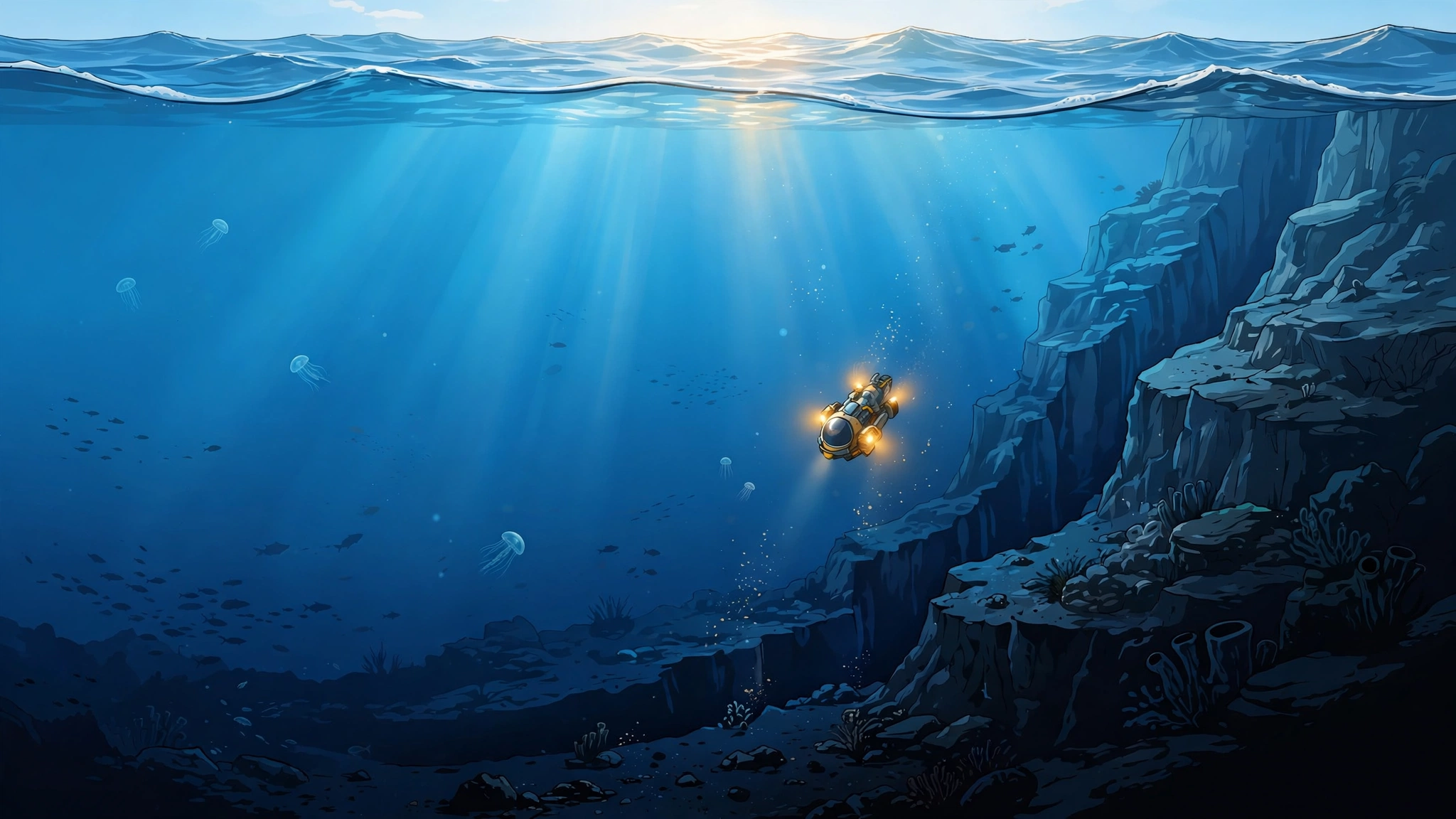
Rivers are not the only source. The second source of salt in the ocean is openings in the seafloor, known as hydrothermal vents, deep underwater, where seawater seeps into cracks in the ocean crust, is heated by hot rock below, and returns to the sea carrying dissolved minerals. The water that emerges from these vents is rich in minerals leached from the rocks it passed through, and it pours those minerals directly into the deep ocean, far from any river mouth.
These vents are found along the mid-ocean ridges, the long underwater mountain chains where new seafloor is born, and they release water that can be extremely hot, laden with dissolved chemicals. Some vents build tall chimneys of mineral deposits, black smokers and white smokers, named for the colour of the mineral-rich water they release. The minerals they carry include the same salts that rivers deliver, and over geological time, their contribution has been large. The ocean’s salt is therefore not only washed off the land. It is also cooked out of the Earth’s crust, from below, in a process that has run for as long as there has been seafloor to heat.
Two Sources Together Explain The Salt
The two sources together explain a puzzle that rivers alone cannot: the sea is far saltier than rivers could make it in the time available, if rivers were the only source, and the proportions of different salts in seawater do not exactly match the proportions in river water. The seafloor vents supply the missing part, and the combination of the two sources, land runoff and seafloor openings, accounts for the sea’s chemistry as we find it today.
What Salt Actually Is: Mostly Two Elements
When people say “salt,” they usually mean table salt, sodium chloride, and in the sea, that is indeed the main ingredient. The two most common ions in seawater, the charged particles that dissolved salts break into, are chloride and sodium. Together, chloride and sodium make up about 85 percent of the dissolved material in seawater. That is why seawater tastes like table salt: it largely is table salt, dissolved, at a concentration far higher than any cook would use.
But seawater is not only sodium chloride. Other dissolved ions include magnesium and sulfate, which together make up about another 10 percent, along with smaller amounts of calcium, potassium, bicarbonate, and many other elements in trace quantities. In fact, nearly every naturally occurring element is present in seawater in some amount, dissolved from rocks, carried by rivers, released by vents, or delivered by other processes. The ocean is, in chemical terms, a very dilute soup of almost everything the Earth contains, with sodium and chloride dominant, and everything else present in smaller, varying amounts.
Salinity: 35 Parts Per Thousand
The total amount is measured as salinity, the concentration of dissolved salts, and the average salinity of the ocean is about 35 parts per thousand. In other words, in every thousand grams of seawater, about 35 grams are dissolved salts, and the rest is water. That is about 3.5 percent salt by weight. It does not sound like much, until you consider the volume: the oceans hold about 1.3 billion cubic kilometres of water, and at 3.5 percent, the salt in them would cover the Earth’s land surface, if it were spread out, in a layer many metres thick. The salt is invisible, dissolved, but it is there, in almost unimaginable quantity.
Why The Sea Does Not Get Saltier Forever
If rivers keep delivering salt, and evaporation keeps leaving it behind, why does the sea not become saltier and saltier, without limit, until it is too salty for life? The answer is that salt also leaves the sea, through slow processes that balance the inputs, and the sea’s salinity has been roughly stable for a very long time. The balance is not exact, year by year, but over geological time, the ocean finds an equilibrium, in which salt in equals salt out.
Salt leaves the sea in several ways. Some is buried in sediments on the seafloor, as minerals settle and are trapped. Some is removed by sea spray, which carries tiny droplets of seawater into the air, where the salt is deposited on land when the droplets fall as rain or settle as dry particles, returning some salt to the land it came from. Some is taken up by marine organisms, which use calcium and other minerals to build shells and skeletons, and those shells, when the organisms die, sink and become sediment, locking minerals away. And some is trapped in the pores of seafloor rocks, as seawater circulates through the crust and exchanges minerals with it.
A Dynamic Balance, Not Endless Build-Up
The result is a dynamic balance: salt arrives from rivers and vents, and salt departs through burial, spray, organisms, and crustal exchange. The ocean’s salinity today, about 35 parts per thousand on average, reflects that balance, not a one-way accumulation. If the balance shifted, the sea would slowly become saltier or fresher, and over millions of years, it has shifted, as continents moved, climates changed, and the rates of erosion and venting varied. But for the world we live in, the sea’s saltiness is stable enough to be treated as a constant, and life in the sea has evolved to live within it.
Why Salinity Varies From Place To Place
The average salinity is about 35 parts per thousand, but the sea is not uniform, and salinity varies from place to place, depending on local conditions. Salinity varies with temperature, evaporation, and precipitation: where evaporation is high and rainfall is low, as in the subtropics, the sea is saltier, because more fresh water leaves and the salt stays. Where rainfall is high, or where large rivers pour fresh water into the sea, the sea is fresher, because the fresh water dilutes it. Near the mouth of a great river, the sea can be noticeably less salty, and in enclosed seas with high evaporation and little river input, it can be noticeably saltier.
Temperature matters too, because warm water evaporates faster, concentrating salt, while cold water, especially near melting ice, is diluted by freshwater from ice melt. The result is a map of salinity that mirrors the world’s climate: salty bands in the warm, dry subtropics, fresher water near the equator, where rain is heavy, and fresher water near the poles, where ice melts. These differences are small compared with the average, a few parts per thousand, but they matter for ocean currents, because saltier water is denser and sinks, driving the slow, deep circulation that carries heat and nutrients around the planet. Salt is not only a taste. It is an engine of ocean movement.
For swimmers, the differences are felt more directly. Floating is easier in saltier water, because the denser water provides more buoyancy, which is why it is famously easy to float in very salty enclosed seas, and slightly harder in fresher coastal water near a river mouth. The difference is subtle, a matter of a few percent, but it is real, and it is the same physics that drives the ocean’s great currents: salt changes density, and density moves water.
Drinking Seawater: Why It Makes Thirst Worse
It is tempting to think that any water will quench thirst, and that seawater, being mostly water, should help a thirsty person. It does the opposite, and the reason is salt. Your kidneys can only produce urine that is less salty than seawater, so to excrete the salt in a litre of seawater, your body must use more water than that litre contains, drawing on water already in your tissues. Drinking seawater therefore causes a net loss of water, and makes dehydration worse, not better. The more you drink, the thirstier and more dehydrated you become.
This is why survival guides warn against drinking seawater, however thirsty you are, and why the saltiness of the sea matters practically, not only scientifically. Your body can handle the salt in food, in moderation, because food provides water and other substances along with it, and your kidneys can manage the load over time. But a large volume of seawater, taken at once, overwhelms the kidneys’ ability to concentrate urine, and the body pays for the salt with its own water. The sea’s salt, which took hundreds of millions of years to accumulate, is too much for a human body to process in a single drink.
The same principle explains why freshwater is precious, and why the desalination of seawater, removing its salt to make it drinkable, requires energy and equipment. The salt is dissolved at the level of individual ions, intimately mixed with the water, and separating it is not like filtering out sand. It requires forcing water through membranes, or boiling it and condensing the vapour, leaving the salt behind, in both cases reversing, at human scale and human cost, the natural process that put the salt there in the first place.
The sea tastes salty because the Earth has been salting it, slowly and steadily, for hundreds of millions of years, through rain on rocks, rivers carrying dissolved minerals, and vents in the seafloor releasing minerals from below, while evaporation leaves the salt behind. The salt is mostly sodium chloride, about 85 percent of the dissolved material, at an average concentration of 35 parts per thousand, balanced by slow processes that remove it. It varies with climate, drives ocean currents, and makes seawater undrinkable. The next time you taste it, you are tasting the accumulated chemistry of the planet, dissolved, drop by drop, over geological time.
You may also like
Frequently Asked Questions
Why is the ocean salty? The ocean is salty because of two main sources: runoff from the land, carried by rivers, and openings in the seafloor that release minerals directly into the sea. Slightly acidic rain erodes rocks on land, picking up dissolved salts that rivers carry to the sea, while deep hydrothermal vents release minerals leached from hot rock below. Because evaporation removes only fresh water and leaves salt behind, the salt accumulates, and over hundreds of millions of years the two sources have built the sea’s present saltiness.
How salty is seawater? The average salinity of the ocean is about 35 parts per thousand, meaning about 35 grams of dissolved salts in every thousand grams of seawater, or about 3.5 percent by weight. The two most common ions are chloride and sodium, which together make up about 85 percent of the dissolved material, with magnesium and sulfate making up about another 10 percent. Salinity varies from place to place with temperature, evaporation, and precipitation, being higher where evaporation is high and rainfall is low, and lower near river mouths and melting ice.
Why does drinking seawater make you more thirsty? Because your kidneys can only produce urine that is less salty than seawater, so to excrete the salt in a litre of seawater your body must use more water than that litre contains, drawing on water already in your tissues. Drinking seawater therefore causes a net loss of water and makes dehydration worse, not better. That is why survival guides warn against drinking seawater however thirsty you are: the more you drink, the more dehydrated you become.
Does rain make the ocean less salty? Rain adds fresh water, which dilutes the sea locally and temporarily, especially in regions of heavy rainfall, but it does not make the ocean fresh overall. Rain also carries dissolved carbon dioxide, forming a weak acid that erodes rocks and picks up salts, which rivers then deliver to the sea, so rain is both a diluter and, indirectly, a source of salt. Over the long term, evaporation removes the fresh water and leaves the salt behind, keeping the ocean’s average salinity near 35 parts per thousand.
Why are some seas saltier than others? Salinity varies with temperature, evaporation, and precipitation. Where evaporation is high and rainfall is low, as in the warm subtropics, the sea is saltier, because more fresh water leaves and the salt stays behind. Where rainfall is heavy, large rivers pour in fresh water, or ice melts, the sea is fresher, because the fresh water dilutes it. Saltier water is also denser and sinks, so these differences help drive the ocean’s deep circulation, which carries heat and nutrients around the planet.
Sources
- National Oceanic and Atmospheric Administration, Ocean Service, “Why is the ocean salty?”: https://oceanservice.noaa.gov/facts/whysalty.html