How Do Pandas Survive on Bamboo? Explained Simply
In this post
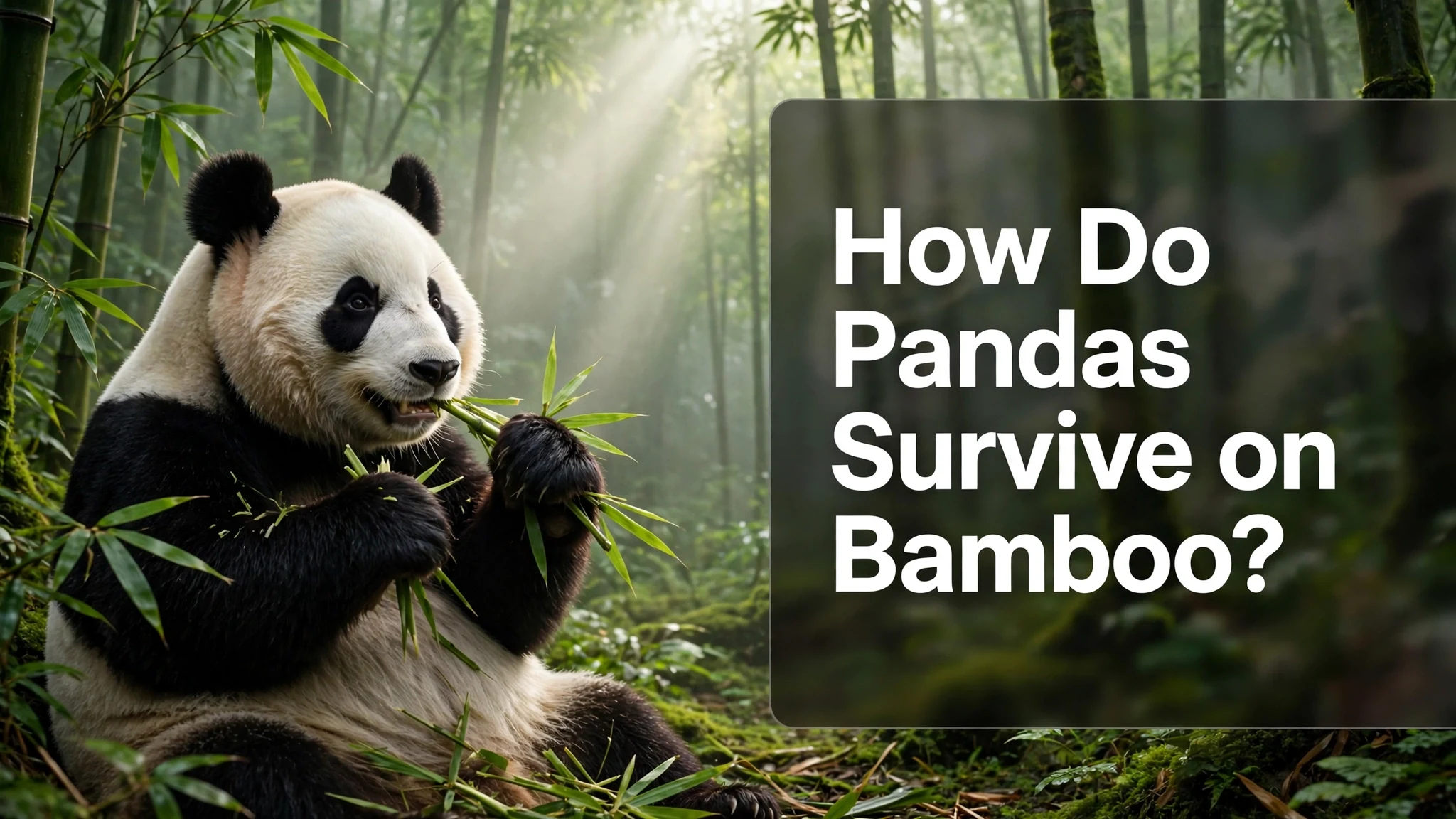
A giant panda is a bear, yet it eats almost nothing but bamboo. Bamboo is low in nutrients, hard to digest, and it gives the panda very little energy. A panda must eat for most of the day, sit for hours chewing, and still it gets so little fuel that it moves slowly and sleeps a lot. It looks like a bad diet, yet pandas have survived on it for millions of years. The answer is a set of special adaptations, from a false thumb to a gut full of bacteria, that let the panda make a living from a poor food.
This guide explains why pandas eat bamboo, how they digest it, how they pick and eat it, and why their slow life is a success. It also explains what pandas ate before bamboo, and why they are still bears underneath.
Why Bamboo? A Food No One Else Wants
Pandas eat bamboo because it is plentiful, it grows all year, and almost no other animal eats it.
In practice, Bamboo grows in dense forests in China, and it is available all year, even in winter. That reliability matters, because a panda does not need to migrate or hunt for food. It can stay in one forest and eat the same food every day. So bamboo is a dependable food, even if it is a poor one, and dependability is valuable in a hard place. The false thumb is the panda’s makeshift tool, and once I saw a wrist bone doing a thumb’s job, the bear’s clumsy eating stopped looking like a mistake and started looking like improvisation.
Look closer and Almost no other large animal eats bamboo, so pandas face little competition for it. That is the same trade the koala makes with eucalyptus: a poor food, but plenty of it, and no rivals. By specialising in bamboo, pandas avoid competing with other bears and animals. So the panda’s diet is a niche, and that niche has allowed it to survive, even though the food itself is low in energy. A panda’s bamboo diet is not one adaptation; the thumb, the teeth, the gut, and the slow life work together, and the way a baby weighing a hundred grams depends entirely on its mother proves every part is doing a job.
The key point is that Pandas did not always eat bamboo. Their ancestors were meat eaters, like other bears. Over millions of years, they changed to a bamboo diet, as bamboo forests spread and other foods became scarce. That change is a remarkable example of evolution, because it turned a carnivore into a bamboo specialist. So the panda is a bear that changed its diet, and its body changed with it, in ways we can still see today. Up close, eating bamboo all day looks less like a poor choice and more like a practical one, because bamboo is everywhere, nobody else wants it, and the panda has the whole forest to itself.
A Bear’s Gut on a Bamboo Diet
Pandas have the gut of a carnivore, not a herbivore, which makes digesting bamboo hard.
What makes this work is that A panda’s digestive system is short, like a meat eater’s, not long like a cow’s. That short gut means bamboo passes through quickly, and the panda digests only a small part of it. Scientists estimate that a panda digests only about 17 percent of the bamboo it eats. So the panda is inefficient, and it must eat a lot to get enough energy, because most of the bamboo passes through undigested. People laugh at pandas for eating a food they barely digest, yet that inefficiency is the point: the panda chose abundance over nutrition, and made abundance work.
Step back for a moment and Pandas also have gut bacteria that help break down bamboo, although those bacteria are not as good as a cow’s. The bacteria help a little, but they cannot turn bamboo into a rich food. That is why a panda must eat for 10 to 16 hours a day, to make up for the low efficiency. So the panda’s gut is a compromise, and it is the reason the panda’s life is spent mostly eating. One panda day packs chewing, stripping, and digesting into hours of steady work, and the animal spends its energy so carefully that a slow life is the only life that fits the food.
The surprising part is that A panda eats 12 to 38 kilograms of bamboo a day, depending on the season and the bamboo. That is a huge amount, and it is why pandas spend so much time sitting and chewing. In spring, they eat shoots, which are softer and more nutritious, while in other seasons they eat leaves and stems. So the panda’s diet changes with the seasons, and it chooses the best bamboo available at each time of year. Follow the bamboo from the false thumb to the jaws to the gut, and the separate parts of the panda join into one story about making a poor choice work, day after day.
The False Thumb: A Tool for Holding Bamboo
Pandas have a special wrist bone that works like a thumb, and it lets them grip bamboo.
In practice, A panda’s false thumb is an enlarged wrist bone, not a real thumb. It works with the panda’s fingers to grip bamboo stems, like a thumb and fingers holding a stick. That grip lets the panda strip leaves, break stems, and hold bamboo while it eats. So the false thumb is a tool, and it is one of the panda’s most famous adaptations. The false thumb is the panda’s makeshift tool, and once I saw a wrist bone doing a thumb’s job, the bear’s clumsy eating stopped looking like a mistake and started looking like improvisation.
Look closer and The false thumb is not as flexible as a human thumb, but it is good enough for bamboo. It helps the panda handle bamboo efficiently, which matters when it must eat for hours each day. Without it, the panda would struggle to hold bamboo steady. So the false thumb is a small bone with a big job, and it is a key part of the panda’s bamboo life. A panda’s bamboo diet is not one adaptation; the thumb, the teeth, the gut, and the slow life work together, and the way a baby weighing a hundred grams depends entirely on its mother proves every part is doing a job.
The key point is that Other animals that eat bamboo, such as red pandas, also have a false thumb. That is a case of convergent evolution, where different animals evolve a similar solution to the same problem. It shows how useful the false thumb is, and how bamboo eating pushes animals towards the same design. So the false thumb is not unique to giant pandas, but it is a sign of a shared challenge, and a shared answer. Up close, eating bamboo all day looks less like a poor choice and more like a practical one, because bamboo is everywhere, nobody else wants it, and the panda has the whole forest to itself.
Teeth, Jaws, and Chewing All Day
Pandas have strong teeth and jaws for crushing bamboo, and they spend hours chewing.
What makes this work is that A panda’s teeth are large and flat, built for crushing bamboo stems and leaves. Its jaws are strong, and the muscles that close them are large. That strength is needed because bamboo is tough and fibrous. So the panda’s head is built like a crushing machine, and it is designed for a lifetime of chewing. People laugh at pandas for eating a food they barely digest, yet that inefficiency is the point: the panda chose abundance over nutrition, and made abundance work.
Step back for a moment and Pandas chew bamboo thoroughly, which helps break it down and makes it easier to digest. They sit and chew for hours, taking their time, because rushing would waste food. That slow chewing is part of their slow life, and it is why they appear calm and unhurried. So the panda’s eating is not fast food; it is slow food, and the chewing is as important as the swallowing. One panda day packs chewing, stripping, and digesting into hours of steady work, and the animal spends its energy so carefully that a slow life is the only life that fits the food.
The surprising part is that Pandas also have a thick, tough lining in their throat and gut, which protects them from bamboo splinters. Bamboo can splinter into sharp pieces, yet the panda’s gut is protected. That protection is another adaptation to a difficult food. So the panda’s body is armoured inside as well as outside, and it is built to handle a food that would hurt other animals. Follow the bamboo from the false thumb to the jaws to the gut, and the separate parts of the panda join into one story about making a poor choice work, day after day.
A Slow Life on Low Energy
Like koalas, pandas live slowly because their food gives them little energy.
In practice, Pandas move slowly, sleep a lot, and avoid unnecessary activity. They may sleep for 10 hours a day, and they spend most of their waking hours eating. That slow life saves energy, which is essential on a bamboo diet. So the panda’s calm, sleepy image is not laziness; it is energy saving, and it is the same strategy as the koala’s. The false thumb is the panda’s makeshift tool, and once I saw a wrist bone doing a thumb’s job, the bear’s clumsy eating stopped looking like a mistake and started looking like improvisation.
Look closer and Pandas are solitary animals, and they avoid each other except for mating. That solitude reduces competition for bamboo, and it saves energy that would be spent on social life. A panda’s home range is a patch of bamboo forest, and it marks it with scent. So the panda’s social life is minimal, and that minimalism is part of its energy saving. A panda’s bamboo diet is not one adaptation; the thumb, the teeth, the gut, and the slow life work together, and the way a baby weighing a hundred grams depends entirely on its mother proves every part is doing a job.
The key point is that Pandas are good climbers and swimmers, but they do not use those skills often. They climb trees to rest or escape, and they swim if they need to cross a river. Most of the time, they stay on the ground, eating bamboo. So the panda has abilities it rarely uses, because using them would cost energy it cannot afford to waste. Up close, eating bamboo all day looks less like a poor choice and more like a practical one, because bamboo is everywhere, nobody else wants it, and the panda has the whole forest to itself.
Baby Pandas: Tiny, Helpless, and Dependent
Baby pandas are born tiny and helpless, and they depend on their mothers for months.
What makes this work is that A baby panda is born weighing only about 100 grams, which is one of the smallest babies relative to its mother’s size of any mammal. It is blind, pink, and helpless, and it cannot regulate its own temperature. Its mother holds it close, keeps it warm, and feeds it with milk. So the panda’s start in life is fragile, and it depends entirely on its mother. People laugh at pandas for eating a food they barely digest, yet that inefficiency is the point: the panda chose abundance over nutrition, and made abundance work.
Step back for a moment and The mother panda cares for her cub for 18 months or more, teaching it to eat bamboo and to climb. The cub starts by drinking milk, then it starts to eat bamboo as it grows. That long care is needed because the cub must learn a difficult diet and a slow life. So the panda’s childhood is long, and it is a time of learning, not just growing. One panda day packs chewing, stripping, and digesting into hours of steady work, and the animal spends its energy so carefully that a slow life is the only life that fits the food.
The surprising part is that In the wild, a mother panda usually raises only one cub at a time, even if twins are born. That is because she cannot produce enough milk for two cubs on a bamboo diet. In zoos, twins are often raised with help from keepers. So the panda’s low-energy diet affects even its family life, and it is a reminder of how much the diet shapes everything. Follow the bamboo from the false thumb to the jaws to the gut, and the separate parts of the panda join into one story about making a poor choice work, day after day.
Pandas, Bamboo Forests, and Conservation
Pandas depend on bamboo forests, and those forests are under threat, which is why pandas need protection.
In practice, Pandas live in mountain forests in China, where bamboo grows in dense stands. They need large forests, because bamboo dies back periodically and pandas must move to find new bamboo. When forests are broken up by roads and farms, pandas cannot move easily. So protecting pandas means protecting large, connected forests, not just small patches. The false thumb is the panda’s makeshift tool, and once I saw a wrist bone doing a thumb’s job, the bear’s clumsy eating stopped looking like a mistake and started looking like improvisation.
Look closer and Bamboo itself is a strange plant, because it flowers and dies at the same time across a whole area. When that happens, pandas must move to another area with different bamboo. That movement is harder now, because forests are fragmented. So the panda’s food has its own cycle, and the panda’s survival depends on being able to follow that cycle. A panda’s bamboo diet is not one adaptation; the thumb, the teeth, the gut, and the slow life work together, and the way a baby weighing a hundred grams depends entirely on its mother proves every part is doing a job.
The key point is that Conservation work has helped pandas, and their status has improved from endangered to vulnerable. That improvement came from protecting forests, creating reserves, and breeding pandas in zoos. But pandas still need large forests and plenty of bamboo, and their future depends on continued protection. So the panda’s story is a hopeful one, but it is not finished, and it still needs care. Up close, eating bamboo all day looks less like a poor choice and more like a practical one, because bamboo is everywhere, nobody else wants it, and the panda has the whole forest to itself.
My Take:
I like pandas, not because they are cute, although they are, but because they are a puzzle. A bear that eats bamboo, a carnivore’s gut on a herbivore’s diet, a thumb that is not a thumb, and a life spent eating for most of the day. It should not work, yet it does, and it has worked for millions of years. That is the part about a panda surviving on bamboo that stays with me. Nature does not always choose the best food. Sometimes it chooses the food no one else wants, and it makes that choice work.
I think the false thumb is the most charming detail. A wrist bone that works like a thumb is a clever, makeshift solution. It reminds me that evolution does not always invent a new part; sometimes it reuses an old part for a new job, and that is enough. The false thumb is the detail I keep coming back to, because a wrist bone that works like a thumb is a clever, makeshift solution, and it reminds me that evolution reuses what it has. Pandas are no longer just cute animals for me; they are a puzzle about trade-offs, and I find myself thinking about that puzzle whenever a choice looks bad on paper but works in practice.
The gut problem is the part I respect most. A panda has a carnivore’s gut, yet it eats bamboo, and it digests only a small part of it. That inefficiency is a flaw, yet the panda lives with it by eating for hours, which is a patient, stubborn way to solve a problem. For me, the honest test for a panda surviving on bamboo is simple. Panda talk that sounds clever without predicting anything gets set aside, and I watch the bear eat instead. I trust a panda explanation when it lets me predict the animal, like knowing it will spend most of its day chewing, and this piece kept making that prediction come true. That is the kind of panda detail I would tell a friend at a zoo, so the bear stripping bamboo becomes a story about a tool, not just a meal.
I also like the parallel with koalas. Both animals eat a poor, toxic food that no one else wants, and both live slowly because of it. That parallel shows a pattern in nature, and it makes both animals easier to understand, because they are solving the same problem in different forests. Understanding pandas took me longer than a cute photograph, because the gut problem, the thumb, and the baby’s fragility all have to be held in mind at once. For me, learning about a panda surviving on bamboo was not one dramatic moment. A thumb here, a jaw there, a baby panda no bigger than a mouse, and the separate facts gradually added up to an animal I could finally understand. I no longer feel silly asking simple panda questions, because wondering why a bear eats bamboo took me to the forest, the gut, and the whole slow life.
The baby panda story is the one that moved me. A baby weighing 100 grams, blind and helpless, depending entirely on its mother, is a fragile start. It is a reminder that even a large, strong animal can begin life as something tiny and vulnerable, and that care matters more than size. If a friend asked about pandas, I would tell them to watch it eat, because the eating shows you the thumb, the teeth, and the patience all at once. Ask what bamboo gives the panda, who gains from a food nobody else eats, and what the slow life costs, and the panda’s diet turns into a careful bargain. My old view of pandas was a cute bear that made a silly food choice, and the resourceful animal that replaced it is steadier and far more impressive to me.
If I could watch a panda, I would watch it eat. I would want to see how it holds bamboo, how it strips leaves, and how it chews. That ordinary act, repeated for hours, is the panda’s whole life, and watching it would teach me more than a photo. Learning about pandas has made me slower to call a choice foolish, because a food that looks terrible on paper can be the right choice when it is abundant and uncontested. The more I learn about pandas, the less I trust a quick judgement about what is smart, and that caution feels like a useful habit. Looking again at a panda pays off, because the first look sees cuteness and the second sees a thumb at work. One image stays with me: a baby panda weighing a hundred grams, blind and helpless, and the mother’s care that turns that fragile start into a bear.
The lesson I take from pandas is about making a poor choice work. A panda did not choose the best food. It chose the food that was available, and it adapted to it. I think we all face that choice sometimes: the best option is not available, so we must make the available option work, and do it well. If I could keep one panda lesson, it would be making a poor choice work, because the panda did not choose the best food, it chose the food that was available, and made it enough. Retelling the panda story without the guide open showed me where I was still vague, above all about how little of the bamboo the panda actually digests.
Going back to the opening section about a food no one else wants, I noticed how much of the panda’s story depends on abundance, not on quality. Cuteness, the thing everyone notices first, is less revealing than the jaws, chewing all day, which is where the panda’s real life happens. The panda’s steady chewing steadies me, because it shows a hard life can be managed with unglamorous, repeated effort.
The gut section changed how I talk about pandas, because it gave me a problem to describe, a carnivore’s gut on a herbivore’s diet, instead of just a cute face. I start now by asking how a bear’s gut copes with bamboo, then I describe the thumb, and only afterwards do I draw a wider lesson. Starting with the gut lets the listener feel the panda’s problem first, and that seems a fairer way to present it than starting with my conclusion. It also lets the listener hold a second view, and a panda discussion that welcomes that view beats one that simply admires the bear.
Coming back to the false thumb at the end tied the piece together for me in a way the earlier sections had not. Thumb, gut, and the baby’s slow start all pointed the same way: improvise with what you have, keep chewing, and let new facts change your mind. Those habits reach beyond pandas into my own choices, so I will keep this piece and come back to it after some time has passed. I will watch the next panda I see eat with new attention, looking at the thumb first, and expecting that second look to teach me more.
Frequently Asked Questions
Why do pandas only eat bamboo?
Pandas eat bamboo because it is plentiful, available all year, and almost no other animal eats it. Their ancestors changed to a bamboo diet over millions of years, and their bodies adapted to it.
Can pandas eat meat?
Pandas are bears and their gut is like a carnivore’s, so they can digest meat, and they occasionally eat small animals or carrion in the wild. But bamboo makes up about 99 percent of their diet.
How much bamboo does a panda eat a day?
A panda eats 12 to 38 kilograms of bamboo a day, depending on the season. It spends 10 to 16 hours a day eating, because bamboo is low in energy and hard to digest.
What is a panda’s false thumb?
A panda’s false thumb is an enlarged wrist bone that works like a thumb. It helps the panda grip bamboo stems, strip leaves, and hold bamboo while it eats.
Why do pandas sleep so much?
Pandas sleep a lot because bamboo gives them very little energy. Sleeping and moving slowly save energy, which lets them survive on a low-energy diet, like koalas.
Are pandas still endangered?
Giant pandas were listed as endangered for many years, but their status improved to vulnerable after conservation work protected forests and increased their numbers. They still need large, connected bamboo forests to survive.