How Do Undercover Police Work? Explained Simply
In this post
- What Undercover Work Actually Is
- The Cover Story: Building a Second Life
- Surveillance, Back-Up, and Staying Safe
- What Undercover Officers Can and Cannot Do
- How Evidence From Undercover Work Is Used in Court
- Famous Cases and What They Teach Us
- Undercover Work in 2027: Phones, Crypto, and the Internet
- My Take:
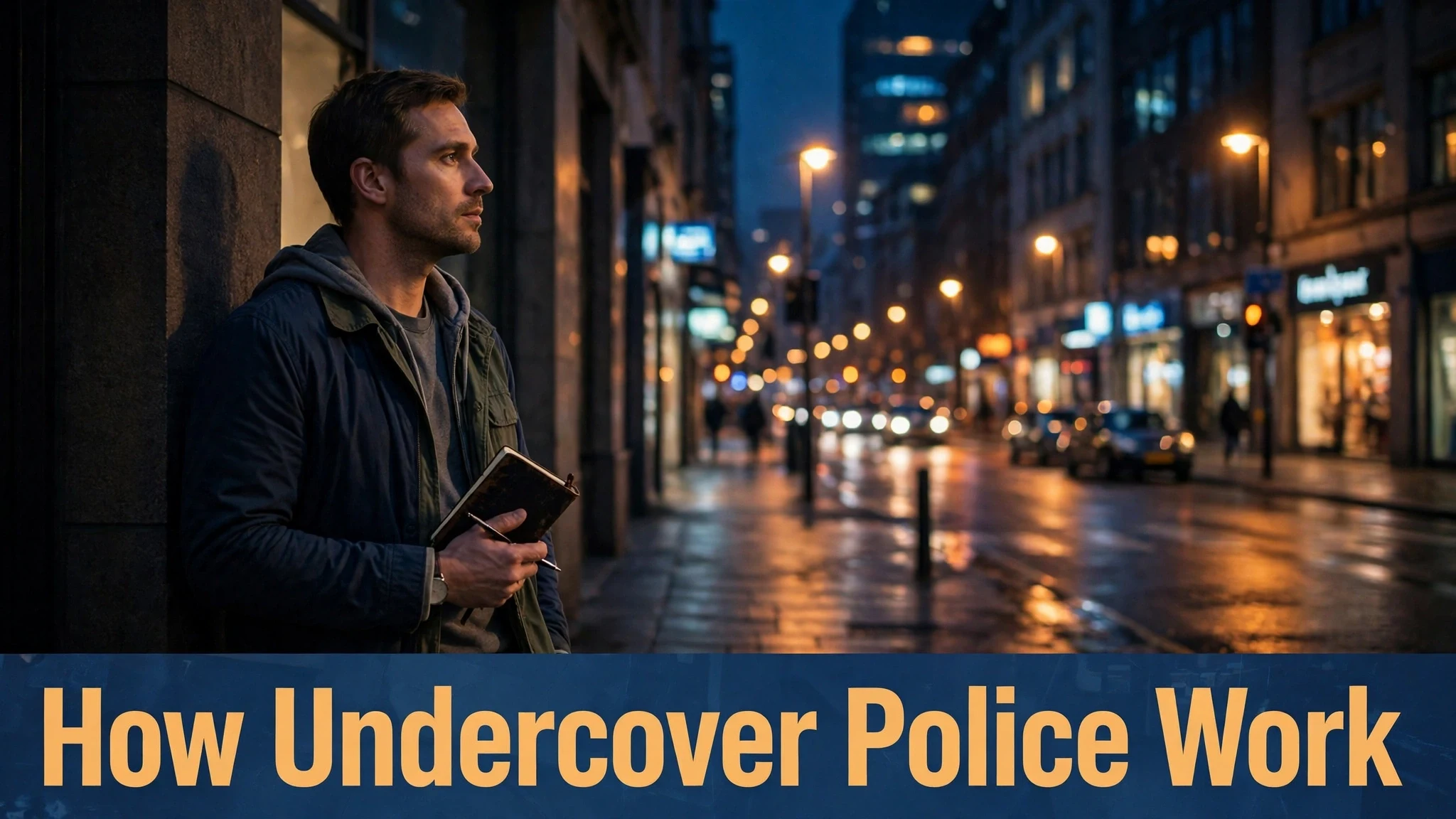
Television makes undercover police work look like a life of fast cars, false names, and dangerous meetings in dark car parks. The reality is slower, more careful, and much more bound by rules. An undercover officer is a police officer who pretends to be someone else — a buyer, a seller, a worker, or a friend — in order to gather evidence about a crime that cannot be investigated openly. The work is used most often against drug dealing, organised crime, human trafficking, and corruption, where the criminals will not talk to a uniformed officer and where a normal investigation would be noticed immediately.
The reason undercover work exists is simple: some crimes happen behind closed doors, among people who trust only each other. A drug dealer will not sell to a stranger in uniform. A trafficking network will not advertise its routes. A corrupt official will not take a bribe from someone who looks like a police officer. To get inside that closed world, the police need someone who can be accepted as part of it, at least for a while, without giving away that they are gathering evidence for a court.
That does not mean an undercover officer can do anything they like. In most countries, undercover work is tightly controlled by law, by senior officers, and by prosecutors. The officer must have a clear purpose, a written plan, a supervisor who checks on them, and a limit on how far they can go. They cannot encourage someone to commit a crime they would not otherwise commit, they cannot use illegal drugs themselves as part of the act, and they cannot break the law in ways that would make the evidence unusable in court. The balance between getting close enough to see the crime and staying within the law is the hardest part of the job.
What Undercover Work Actually Is
Undercover work is a form of covert investigation, which means it is done in secret, without the people being investigated knowing that the police are watching. It is different from surveillance, where officers watch from a distance, and it is different from an informant, who is usually a member of the criminal group giving information to the police. An undercover officer is a trained police officer who takes on a false identity and enters the group or the situation directly.
There are different levels of undercover work. At the simplest level, an officer may pretend to be a customer for a single meeting — for example, buying a small amount of drugs from a dealer in order to prove that the dealer is selling. This is sometimes called a “test purchase”, and it is short, planned, and closely supervised. At a deeper level, an officer may live a false life for months or even years, working in a job, renting a flat, and building friendships with people they are investigating. This is called a long-term infiltration, and it is rare, expensive, and emotionally demanding.
Most undercover work falls between these two extremes. An officer may use a false name and a cover story for a few weeks, meeting the same people repeatedly, gathering information about who is in charge, where the money goes, and how the crime is organised. The goal is not to arrest one person on the street, but to understand the whole network, so that when arrests are made, they are made at the right time and against the right people.
The Cover Story: Building a Second Life
The heart of undercover work is the cover story, also called a legend. This is the false identity the officer will use: a name, a background, a job, a family, and a reason for being in the place where the crime happens. A good cover story is simple, believable, and hard to check. It explains why the officer has money, why they are available at odd hours, and why they are interested in the criminal activity, without raising suspicion.
Building a cover story takes time. The officer may be given false documents, a false driving licence, a false bank account, and a false address, all created with the help of the police department. They may be given a car, a phone, and clothes that fit the role. They will practise the story until they can answer questions about their past without hesitating, because a single inconsistent answer can end the operation — or put the officer in danger.
The officer also needs a reason to be in the criminal world that makes sense. A common cover is a buyer: someone who wants to purchase drugs, stolen goods, or illegal weapons. Another is a worker: someone who needs a job in a warehouse, a bar, or a transport company that is being used by criminals. A third is a friend or associate: someone who was introduced by a trusted person and who slowly becomes part of the group. The cover must match the officer’s age, appearance, and skills, because a person who looks out of place will be noticed quickly.
Surveillance, Back-Up, and Staying Safe
An undercover officer is never truly alone, even when they appear to be. Behind every meeting there is usually a team: officers watching from a distance, listening through a hidden microphone, following the officer’s car, and ready to intervene if something goes wrong. The officer may wear a listening device, carry a tracking device, or use a code word that signals danger. The team will have a plan for what to do if the officer is discovered, if a meeting turns violent, or if the officer needs to leave quickly.
Safety is the first rule of undercover work, and it shapes every decision. The officer is trained to avoid situations that cannot be controlled, to leave if they feel threatened, and to never carry a weapon in a way that would give them away. They are also trained to handle the stress of living a lie: remembering a false name, a false past, and a false opinion, while staying alert to danger. The psychological pressure is one of the reasons long-term undercover work is rare, and why officers who do it receive regular checks from a supervisor and from a welfare officer.
The supervisor, sometimes called a handler or controller, is the officer’s link to the police department. The handler does not go undercover themselves, but they meet the officer regularly, receive the evidence, check that the officer is staying within the rules, and decide when the operation should end. The handler also keeps a record of every meeting, every conversation, and every item of evidence, because that record will be needed in court. Without a careful record, the evidence may be challenged by a defence lawyer, and the whole case may fail.
What Undercover Officers Can and Cannot Do
The law places clear limits on undercover work, and those limits vary by country, but some principles are common. An undercover officer can pretend to be a criminal, can listen to conversations, can buy illegal goods, and can gather information. They cannot commit serious crimes themselves, they cannot use violence, and they cannot supply the drugs or weapons that are being sold. They also cannot encourage, or “entrap”, a person into committing a crime they would not otherwise have committed. If the police create the crime, rather than discovering it, the court may rule that the evidence is unfair and should not be used.
This rule against entrapment is often misunderstood. An undercover officer can offer to buy drugs from a dealer who is already selling drugs, because the dealer was already committing the crime. What the officer cannot do is persuade an ordinary person who has never sold drugs to start selling them, by offering a large sum of money or by pressuring them repeatedly. The line between a fair test and an unfair trap is decided by a judge, and it is one of the reasons undercover operations are planned carefully and recorded in detail.
Undercover officers are also bound by rules about their personal life. They cannot form a romantic relationship as part of the cover, they cannot use the operation to settle a personal score, and they cannot keep evidence or money for themselves. In the past, some operations in different countries were criticised when these rules were broken, and the criticism led to tighter oversight, better training, and clearer rules about what is and is not allowed. Modern undercover work is supposed to be accountable, with a paper trail that can be checked by a senior officer, a prosecutor, and, if necessary, a court.
How Evidence From Undercover Work Is Used in Court
Evidence gathered by an undercover officer is used in court in the same way as other police evidence, but it is often challenged more strongly by defence lawyers. The defence may argue that the officer’s identity was not properly authorised, that the officer went beyond what was allowed, or that the evidence was obtained by entrapment. For that reason, the police must be able to show that the operation was approved, that the officer was supervised, and that the evidence was recorded accurately.
The officer will usually give evidence in court, sometimes in person and sometimes with their identity protected. They will describe the meetings, the conversations, and the items they bought or saw. Audio and video recordings, photographs, and seized items will be shown to support their account. The defence will have the chance to question the officer, to ask about the cover story, and to test whether the officer’s memory is reliable. This is one of the reasons undercover officers are trained to keep detailed notes: a clear, honest record is the best defence against a challenge.
Not every undercover operation ends in an arrest. Some operations are closed because the officer’s cover is at risk, because the information is no longer useful, or because a more serious crime has been discovered that needs a different approach. When an operation ends, the officer must be “extracted” safely, which means removing them from the false life without alerting the people they were investigating. This can be difficult, especially after a long operation, because the officer may have built real friendships and may feel guilt about deceiving people. Support after an operation is an important part of the job, and it is taken more seriously now than it was in the past.
Famous Cases and What They Teach Us
Undercover work has been part of some of the most famous criminal cases of the last hundred years. In the United States, undercover officers helped to investigate organised crime families, drug cartels, and corrupt officials. In the United Kingdom, undercover officers were used against drug dealers, football hooligans, and environmental protest groups, and some of those operations were later criticised for going too far. In Australia and other countries, undercover officers have been used against drug importation and human trafficking networks.
One lesson from these cases is that undercover work is most effective when it is targeted, time-limited, and focused on a specific crime. Operations that drift, that last too long, or that target people who are not actually committing serious crimes are more likely to fail, to be criticised, and to cause harm to the officers involved. Another lesson is that the evidence must be gathered in a way that a court will accept. An operation that gathers dramatic information but breaks the rules may win headlines and lose the trial.
A third lesson is about the human cost. Officers who spend months pretending to be someone else often find it hard to return to normal life. They may struggle to trust people, to talk about their work, or to feel at home with their own family. Police departments now recognise this, and they offer counselling, rest periods, and a gradual return to normal duties. The image of the undercover officer as a lone hero who needs no help is a film invention; the reality is a team effort, with support before, during, and after the operation.
Undercover Work in 2027: Phones, Crypto, and the Internet
In 2027, much of the criminal world has moved online, and undercover work has moved with it. An officer may now pretend to be a buyer on a dark-web marketplace, a contact in an encrypted chat group, or a person offering to launder cryptocurrency. The cover story is still important, but the skills are different: the officer must understand how the platform works, how payments are made, and how to avoid leaving a digital trail that would reveal their real identity.
Online undercover work has its own risks. A criminal group may ask the officer to prove their identity by sending a photograph, a video, or a document. They may check the officer’s online history, looking for gaps that suggest a false identity. They may use software to trace an IP address or to check whether a photograph has been used before. The police must therefore build a digital cover story that is as careful as the physical one, with social media accounts, messages, and a history that looks real.
At the same time, the internet has made some undercover work easier, because officers can gather evidence without meeting a criminal in person. A chat log, a payment record, and a delivery address can be enough to identify a suspect and to build a case. The challenge is to do this without breaking the law, without entrapping an innocent person, and without putting the officer at risk. As technology changes, the rules and the training must change with it, and that is an ongoing process in police forces around the world.
My Take:
My honest view is that undercover police work is both necessary and dangerous, and it deserves to be understood in its full complexity, not as a film plot. It is necessary because some crimes cannot be investigated openly: a drug network, a trafficking ring, or a corrupt group will not invite a uniformed officer to watch them work. Without someone inside, those crimes would continue unseen, and the people they harm would have no protection. I think that point is often lost when undercover work is criticised, because the criticism focuses on the deception, and forgets the victims who would otherwise be ignored. Deception by the police is a serious matter, but so is allowing a trafficking network to operate because no one was willing to go inside it.
At the same time, I believe the limits on undercover work are not a bureaucratic obstacle; they are the reason the work can be trusted. An officer who can do anything, who can encourage a crime, who can form a false relationship, or who can break the law without consequence, is not a police officer; they are a criminal with a badge. The rules against entrapment, the requirement for authorisation, the role of the handler, and the need for a court to accept the evidence are what separate lawful investigation from abuse. I would rather see an operation fail because it stayed within the rules than see it succeed by breaking them, because a conviction obtained by breaking the rules damages trust in the police, and that trust is harder to rebuild than a single case is to win.
I also think we should talk more about the officers themselves. The image of the undercover officer as a fearless lone hero hides the reality of stress, loneliness, and moral confusion. Living a lie for months, befriending people you intend to arrest, and remembering a false past while staying alert to danger is a heavy burden, and it does not end when the operation ends. I believe police forces should be judged not only by the arrests they make, but by how they look after the officers who make them — the counselling, the rest, the gradual return to normal work, and the respect for the fact that the officer gave up a part of their normal life for the job. If we want good people to do this work, we need to look after them when it is over.
Another point I keep returning to is the question of who gets targeted. Undercover work should be used against serious crime, where there is clear evidence that a crime is happening and where no other method will work. It should not be used to spy on people because of their opinions, their protests, or their politics. History shows that when undercover powers are used too widely, they are used against the wrong people, and the damage to public trust lasts for years. I think every undercover operation should have to answer a simple question before it starts: is this crime serious enough, and is this the only way to stop it? If the answer is not a clear yes, the operation should not go ahead.
On the subject of technology, my view is that the move online has made undercover work both more powerful and more in need of oversight. An officer can now gather evidence from a chat group without ever meeting a criminal, which is safer, but the same technology makes it easier to collect large amounts of personal information about people who are not suspected of any crime. I believe the rules need to keep pace with that change, so that online undercover work is authorised, recorded, and limited in the same way as physical undercover work. The internet should not become a place where the old rules no longer apply, simply because the meeting happens on a screen rather than in a room.
Finally, I think the public should be more honest about what they expect from the police. We want the police to stop serious crime, but we also want them to respect privacy, to be fair, and to follow the law. Those two demands are in tension, and undercover work sits exactly on that tension. There is no perfect answer, only a careful balance, and that balance has to be checked by senior officers, by prosecutors, by courts, and by the public. My hope is that undercover work continues, because it is needed, but that it continues with clear rules, with proper oversight, and with respect for the officers who do it and the people they investigate. That is a harder story to tell than a film about a lone hero, but it is a truer one, and it is the one that protects both safety and freedom.
I also want to say something about the way undercover work is shown in films and on television, because those portrayals shape what the public expects, and what they will accept. A film that shows an undercover officer breaking the law, lying to a judge, or forming a false relationship, and then being praised as a hero, teaches the audience that the ends justify the means. That is a dangerous lesson, because it makes real abuse harder to recognise and harder to criticise. I would like to see more honest portrayals, where the officer follows the rules, where the handler checks the work, and where the evidence is gathered carefully and lawfully. That may be less dramatic, but it is more truthful, and it helps the public to understand why the rules exist in the first place.
One more point stays with me, and it is about the people who are investigated. A person who is the target of an undercover operation is still a person, with rights, and with a family, and the investigation should be proportionate to the crime. An operation that targets a serious drug network is very different from an operation that targets a small group of protesters, and the public should be able to tell the difference. I believe that every undercover operation should be judged not only by whether it catches a criminal, but by whether it was necessary, whether it was fair, and whether it respected the rights of the people involved. That is a high standard, but it is the standard that a lawful police force should meet.
Frequently Asked Questions
Is undercover police work legal?
Yes, in most countries it is legal when it is authorised by a senior officer, supervised, and carried out within the law. The officer cannot commit serious crimes or entrap an innocent person into committing a crime they would not otherwise commit.
How long can an undercover operation last?
It can last from a single meeting to several months or, in rare cases, years. Most operations are short and targeted. Long-term infiltrations are rare because they are expensive, stressful, and risky for the officer.
Can an undercover officer break the law?
An undercover officer may pretend to be a criminal and may buy illegal goods as part of an authorised operation, but they cannot commit serious crimes, use violence, or supply drugs or weapons. The exact limits depend on the law of the country concerned.
What is entrapment?
Entrapment is when the police persuade or pressure a person into committing a crime they would not otherwise have committed. If a court finds that entrapment happened, the evidence may be ruled unfair and the case may fail.
Do undercover officers work alone?
No. An undercover officer is usually supported by a team that watches, listens, and is ready to help, and by a handler who supervises the operation, keeps records, and decides when it should end.
How is undercover evidence used in court?
The officer gives evidence about the meetings and conversations, supported by recordings, photographs, and seized items. The defence can challenge the evidence, so the operation must be authorised, recorded, and carried out within the rules.