How to Spot a Romance Scam in 2027
In this post
A romance scam begins the way a love story is supposed to begin. Someone kind, funny, and attentive appears in your messages. They remember the small things you tell them. They ask about your day, they send good-morning texts, and they make you feel chosen. The difference is that the person on the other side is not falling in love with you. They are running a script, and the script has one goal: to get you to send money, or to hand over information that lets them steal it later.
In 2027, these scams are harder to spot than they used to be, because the tools have improved. A scammer can now use stolen photographs that look completely real, write fluent messages in your language, and even hold a short video call using borrowed footage or a generated face. They can build a profile that matches your interests, your faith, your age group, and your taste in music. The old advice — “look for bad grammar” — no longer protects anyone on its own, because the messages are often polished and patient.
That patience is part of the trap. A romance scammer may talk to you for weeks or months before money is ever mentioned. They are not in a hurry, because trust is the product they are building. Once you believe they are real, the requests begin slowly: a small favour, a parcel fee, a medical bill, a plane ticket that is almost booked. Each request is framed as an emergency, and each one is designed to make saying no feel like betraying someone you love.
This guide explains the warning signs as they actually appear in 2027, the tricks scammers use on dating apps and social media, the payment methods they prefer, and the exact steps to take if you suspect the person you are talking to is not who they claim to be. It is written for anyone who dates online, and for the family members who worry about someone they love.
The First Hello: How the Scam Usually Starts
Most romance scams in 2027 start on a dating app, on Facebook or Instagram, or in the comments of a public post. The first message is usually warm but not pushy: a compliment about a photograph, a shared interest, or a friendly question. The profile often looks too good to be true — a doctor working overseas, a soldier on deployment, an engineer on an oil rig, a successful business owner who travels constantly. The job is always one that explains why they cannot meet you in person, and why they are often offline at odd hours.
Within a few days, the scammer will try to move the conversation off the dating app and onto WhatsApp, Telegram, or email. This is a key warning sign, because dating apps have safety teams and reporting tools, while a private chat is much harder for anyone else to see. They may say the app keeps crashing, or that they prefer a more private place to talk. Once you are off the platform, you lose the protections the platform offers, and the scammer gains privacy.
The early messages follow a pattern that is worth learning to recognise. The scammer asks many questions about your life — your family, your job, your dreams, your fears — and gives back a story that matches yours. If you are lonely after a divorce, they have been through one too. If you love travel, they have travelled the world. If you are religious, they share your faith. This is called mirroring, and it is not romance; it is research. A real person has their own separate life, opinions that sometimes differ from yours, and days when they are boring, busy, or in a bad mood. A scammer is almost always available, almost always agreeable, and almost always says exactly what you want to hear.
Love Bombing and the Rush to Trust
Love bombing is the name for the flood of affection that arrives far too fast. Within a week, the scammer may be calling you their soulmate, talking about marriage, or planning a future together. They may send poems, songs, and long messages about how they have never felt this way before. For someone who has been lonely, this can feel wonderful, and that is exactly why it works. The speed is the clue: real love grows through shared experience, disagreement, and time, while a scam needs you committed before you have had time to check anything.
Another part of the rush is the way the scammer makes themselves the centre of your emotional life. They message first thing in the morning and last thing at night. They ask you to keep the relationship secret, saying their family would not understand, or that they want to surprise everyone when they arrive. Secrecy cuts you off from the friends and family who might spot the warning signs, and it makes the scammer your only source of reassurance. If a new online partner asks you to hide the relationship from everyone you trust, treat that as a serious red flag, not as a romantic secret.
The scammer will also begin to create a sense of shared destiny. They may talk about a house they want to buy, a business they want to start with you, or a life in your country. These plans are always just out of reach — blocked by one small problem that money could solve. The problem is never their fault, and the solution is always urgent. By the time the first request for money arrives, you have already imagined a future together, and refusing feels like giving up on that future.
The Money Requests: Small Favours, Then Emergencies
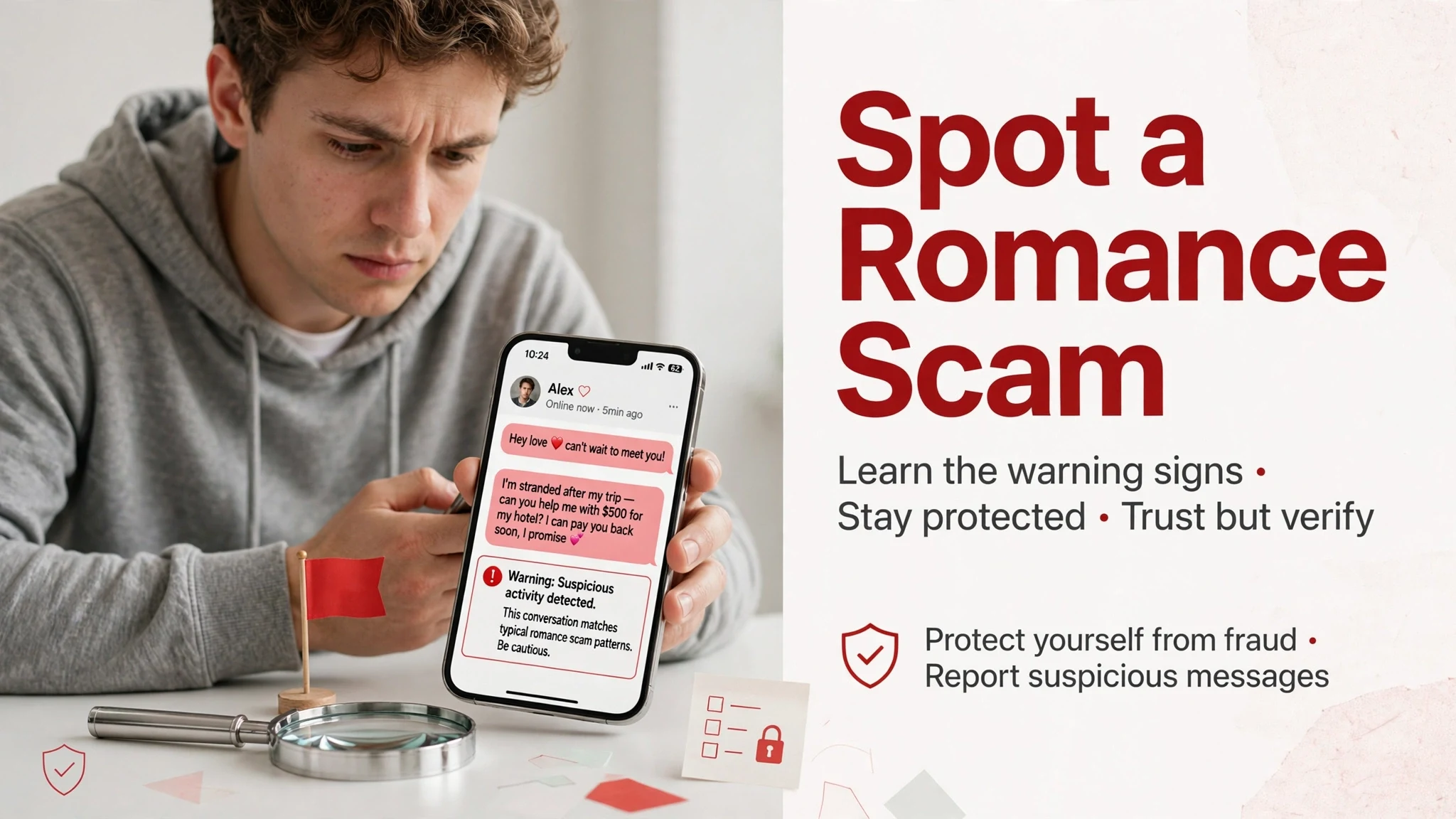
The first request for money is rarely large. It may be a gift card for a phone top-up, a small transfer to help with a parcel, or a fee to release a package that is stuck at customs. The scammer will often promise to pay you back, and they may even send you a fake receipt or a screenshot of a transfer that never arrives. The small amount is deliberate: it tests whether you will send money at all, and it makes the next request easier.
After that, the emergencies grow. A typical story is a medical crisis — a mother in hospital, a child who needs surgery, an accident on the oil rig. Another common story is a frozen bank account, a stolen wallet, or a military rule that prevents access to money while on deployment. A third is the travel trap: the scammer has bought a ticket to visit you, but there is a sudden visa fee, a baggage charge, or a quarantine cost, and without it the visit will be cancelled. Each emergency comes with pressure: pay now, or lose the visit, the treatment, or the relationship.
In 2027, many romance scams also involve cryptocurrency. The scammer may introduce you to a trading platform that looks professional, show you fake profits, and encourage you to invest a small amount. At first, you may even be able to withdraw a little money, which builds trust. Then the platform asks for a larger deposit, or charges a fee to release your profits, and the money disappears. This is sometimes called a “pig butchering” scam, because the victim is fattened with false affection and fake profits before the theft. If a romantic partner you have never met asks you to invest in crypto, that is not a relationship; it is a crime in progress.
Fake Profiles, Stolen Photos, and Video Tricks
A romance scammer’s profile is usually built from stolen material. The photographs may belong to a real model, a soldier, a doctor, or an ordinary person whose pictures were taken from social media. The name may be invented, and the life story may be copied from several different people. In 2027, some scammers also use artificial intelligence to create faces that do not belong to any real person, which makes a reverse image search less useful than it used to be.
There are still checks you can do. A reverse image search may show that the same photograph appears under different names on different sites. A search of the person’s name, along with the words “scam” or “fraud”, may show warnings from other victims. A video call is a useful test, but it is no longer a guarantee: some scammers use pre-recorded video, or software that puts a borrowed face over their own. During a call, ask them to do something unscripted, such as holding up a piece of paper with today’s date and your name, or turning their head from side to side while they speak. A real person can do that easily; a fake video often cannot.
Other details give the profile away. The account may be very new, with few friends, few posts, and a history that starts only weeks ago. The person may claim to live in your country but use a phone number from another country, or say they are on a military base that does not allow video calls. Their stories may change: the age of a child, the name of a hometown, or the date of a deployment may shift between messages. Save screenshots of the profile and the messages, because scammers delete accounts quickly once they are reported, and the screenshots are evidence if you need to report the crime.
The Payment Methods Scammers Prefer
Romance scammers prefer payment methods that are hard to reverse. Gift cards are a classic choice: the victim is asked to buy cards, scratch off the code, and send a photograph of the code. Once the code is shared, the money is gone, and the card company cannot get it back. Bank transfers to a personal account, wire transfers, and cryptocurrency are also common, because they move quickly and cross borders easily.
A scammer may also ask you to receive money and forward it to someone else, or to open a bank account in your name for them to use. This is extremely dangerous, because it can make you a “money mule” — a person who moves stolen money for criminals. Even if you did not know the money was stolen, you can be held responsible, and your bank account can be closed. Never accept money from an online partner and pass it on, and never let them use your bank account, your identity documents, or your address for parcels.
If a person you met online asks for payment in gift cards, crypto, or a wire transfer to a stranger’s account, stop the conversation. A genuine partner who is in a real emergency will have other options — family, an employer, a bank, an embassy — and will not need a stranger they have never met to buy gift cards at midnight. The urgency is manufactured, and the payment method is chosen because it cannot be undone.
What to Do If You Suspect a Romance Scam
If you suspect you are being scammed, the first step is to pause and talk to someone you trust. Tell a friend, a family member, or a colleague what is happening, and show them the messages. Scammers rely on isolation, and a second pair of eyes often sees what love has hidden. You do not need to be embarrassed: these scams are run by organised criminals, and they have fooled intelligent, careful people all over the world.
Do not send more money, and do not send personal information such as your identity card number, bank details, passwords, or photographs of documents. If you have already sent money, contact your bank immediately and ask whether the transfer can be stopped or recalled. Save every message, receipt, profile link, and phone number, and take screenshots before the account is deleted. Then report the profile to the dating app or social media platform, and report the crime to your local police and to a national fraud reporting service.
In the United States, reports can be made to the Federal Trade Commission and the FBI’s Internet Crime Complaint Center. In the United Kingdom, Action Fraud is the national reporting service. In Australia, Scamwatch collects reports. In Pakistan, the Federal Investigation Agency’s Cybercrime Wing handles online fraud reports. The exact body varies by country, but every country has a route, and reporting helps the authorities track the criminal groups behind these scams, even if your own money cannot be recovered.
Healing After a Romance Scam
Being scammed in a romance is not only a financial loss; it is a heartbreak, and it deserves to be treated as one. Many victims feel shame, anger, and grief, and they blame themselves for trusting someone. That shame is part of why so many scams go unreported. It helps to remember that the scammer spent weeks building a false relationship with professional skill, and that falling for it is not a sign of stupidity. It is a sign that you are capable of trust, which is a good quality that was abused by a criminal.
Practical recovery starts with securing your accounts: change passwords, turn on two-factor authentication, and check your bank statements for any transaction you do not recognise. If you shared identity documents, consider a credit freeze or a fraud alert with your credit agency, if one is available in your country. Emotional recovery takes longer, and talking to a trusted person, a counsellor, or a victim support group can help. Some victims find it useful to write down the timeline of the scam, so that the story becomes a fact they can look at, rather than a feeling that keeps changing.
If someone in your family has been scammed, the most helpful response is kindness, not blame. Saying “how could you fall for that?” makes the victim less likely to ask for help, and more likely to keep sending money in secret. Instead, listen, believe them, and help them gather evidence and report the crime. The goal is to stop the loss and to protect the next person, not to win an argument about who should have known better.
My Take:
My honest view is that romance scams work because they attack the most human part of us, not the most careless part. We all want to be loved, to be chosen, and to matter to someone, and a scammer who understands that can get past defences that would stop a stranger offering a prize or a lottery win. I have seen people describe these scams as if the victim was greedy or foolish, and I think that is wrong. The victim was not greedy; they were hopeful. The scammer did not offer money; they offered companionship, and that is a much more powerful lure. If we want fewer victims, we need to start by respecting the people who are targeted, rather than mocking them, because mockery is what keeps victims silent and allows the same criminal to find the next person.
I also believe the dating platforms have a larger responsibility than they currently accept. They profit from connection, and they know that romance scams happen on their services every day, yet the safety warnings are often small, the reporting process is slow, and a banned scammer can return with a new photograph in minutes. I am not saying a platform can stop every crime, but I do think it should be much harder to create a brand-new account, to move a conversation off the platform, and to target a person who has just joined. A simple warning when someone tries to share a phone number too quickly, or a check that flags profiles using photographs already reported elsewhere, would save real money and real heartbreak. Until that happens, users have to protect themselves, and guides like this one have to do the work the platform should be doing.
Another point I keep returning to is the role of family and friends. A romance scam is much harder to run when the victim has someone to talk to, because an outsider can see the pattern — the rushed love, the secret, the emergency, the gift cards — without being inside the emotion of it. The problem is that many victims hide the relationship, either because the scammer asked them to, or because they fear being judged. I think families need to make it safe to talk about online dating, including the embarrassing parts, so that a son or a mother can say “I met someone online and I am not sure” without being laughed at. That single conversation, held early, can be worth more than any list of warning signs, because it breaks the isolation the scammer depends on.
On the subject of money, my view is blunt: never send money to a person you have never met in person, no matter how convincing the story is, and no matter how long you have been talking. I know that sounds harsh, and I know there are rare cases where a genuine person needs help, but the risk is simply too high, and the scammer’s story is designed to make an exception feel reasonable. If someone you love is truly in an emergency, there are banks, embassies, hospitals, and charities that can help them without a stranger buying gift cards. I would rather be the person who said no to a real emergency once than the person who sent their savings to a criminal who had rehearsed the emergency for weeks. That rule — no money before a real meeting — should be treated as a line that does not move, even when the story is sad and the person sounds sincere.
I also think we need to talk more honestly about loneliness, because loneliness is the fuel for this crime. Many victims are widowed, divorced, living alone, or working far from home, and the scammer is often the first person in a long time who asks about their day. That is not a weakness; it is a human need, and the answer is not to tell lonely people to be more suspicious, but to make sure they have real connection in their lives. A weekly call from a child, a friend who visits, a community group that meets in person — these ordinary things are the best protection against a romance scam, because a person who feels loved is much harder to deceive with false love. I would like to see that point made more often, alongside the technical advice about reverse image searches and gift cards.
Finally, I believe that reporting matters, even when the money is gone and the scammer has vanished. Every report helps investigators see the pattern: the same photograph, the same phone number, the same crypto wallet, the same story about an oil rig or a hospital. One report may not get your money back, but a hundred reports can close a network, and a thousand can change how a platform behaves. If you have been scammed, I would urge you to report it, to tell someone you trust, and to forgive yourself for trusting. The crime was committed by the person who lied to you, not by you for believing them. The best revenge on a romance scammer is to stop the payments, to warn others, and to keep your capacity to love intact, because that is the very thing they tried to steal.
I also want to say something about the way we talk about online dating itself, because the fear of scams should not stop people from looking for love online. Millions of people have met genuine partners on dating apps, and the internet has brought together couples who would never have met otherwise. The answer is not to avoid online dating, but to date wisely: to meet in public, to tell a friend where you are going, to take time before trusting, and to keep the rule about money firmly in place. A genuine person will respect those boundaries, and will be happy to meet you, to introduce you to their friends, and to build a relationship in the real world. A scammer will resist every one of those steps, and that resistance is the clearest sign you will ever get.
One last thought is for the friends and family who worry about someone they love. If you suspect a parent, a sibling, or a friend is being scammed, do not start with an accusation, and do not take their phone away. Start with curiosity and care: ask how they met, ask what they know about the person, and ask whether you can see the messages together. Offer to help them check the profile, to search the photographs, and to talk to the bank. Your goal is not to prove them wrong; it is to give them a safe way to step back, to see the pattern, and to stop the payments without feeling humiliated. That kindness is often the difference between a victim who stops in time and a victim who keeps paying in secret for months.
Frequently Asked Questions
How can I tell if someone online is a romance scammer?
Look for a rushed declaration of love, a refusal to meet or to video call properly, a job that keeps them overseas, and any request for money, gift cards, or crypto. A real partner will have a verifiable life, will meet you in person, and will not need money from someone they have never met.
Why do romance scammers move the chat off the dating app?
They move to WhatsApp, Telegram, or email to avoid the dating app’s safety team and reporting tools. Once the conversation is private, it is harder for anyone else to see the pattern, and the scammer can delete the account if they are reported.
Can a romance scammer fake a video call?
Yes, in 2027 some scammers use pre-recorded video or software that places a borrowed face over their own. Ask the person to do something unscripted on camera, such as holding a paper with today’s date, and be suspicious if they always have an excuse not to call.
What should I do if I already sent money to a romance scammer?
Stop sending money, save all messages and receipts, contact your bank immediately, and report the crime to the police and to a national fraud reporting service. Do not let the scammer convince you that one more payment will fix the problem.
Is it safe to send a small amount just to test if they are real?
No. A small payment is a test the scammer uses to see whether you will pay at all, and it often leads to larger requests. A genuine partner does not need a payment test to prove their love.
How do I help a family member who may be in a romance scam?
Listen without blame, ask to see the messages, and point out the pattern calmly. Help them save evidence, contact the bank, and report the scam. Blame makes victims hide the relationship, while kindness makes it possible for them to stop.