How to Spot a Job Scam in 2027
In this post
- Why Job Seekers Are Easy Targets in 2027
- The Fee Trap: Training, Equipment, and Visas
- Fake Recruiters and Stolen Company Names
- The Interview That Is Not an Interview
- Work-From-Home, Crypto, and Task Scams
- The Ten-Minute Check Before You Accept Any Offer
- What to Do If You Have Already Been Targeted
- My Take:
A job scam is a cruel kind of fraud because it targets people at the moment they are most hopeful. You have applied for dozens of jobs, you are waiting for a reply, and then a message arrives: you have been selected, the salary is generous, the work is from home, and you can start on Monday. It feels like the wait is over. In reality, the person who sent that message is not an employer. They are a criminal who wants your money, your identity documents, or your unpaid labour, and they have learned exactly how a real hiring process looks.
In 2027, job scams have become more convincing, because the scammers copy real job adverts, real company logos, and real recruiter profiles. They post on job boards, on LinkedIn, on Facebook groups, and on WhatsApp, and they reply quickly, which real employers often do not. They may hold a video interview that looks professional, send a contract with a company letterhead, and even give you a start date and a manager’s name. The polish is the point: if the process feels official, you are less likely to ask the questions that would expose it.
The cost of falling for a job scam is not only money. Victims lose fees they paid for training, equipment, or visas, and they lose weeks of time they could have spent applying for real work. Some victims hand over their identity card, passport details, and bank information, and then face identity theft for years. Others are tricked into doing real work — writing, data entry, or customer service — and are never paid. Some are even asked to receive and forward money or parcels, which can make them part of a crime without them realising it.
This guide is written for job seekers, for parents helping a young person find work, and for anyone who has received an offer that feels too easy. It explains how job scams work in 2027, the different types to watch for, the checks you can run in ten minutes, and what to do if you have already been targeted.
Why Job Seekers Are Easy Targets in 2027
Job hunting in 2027 is stressful, competitive, and often lonely. Many people apply for a hundred jobs and hear back from only a few, and each rejection makes the next message feel more important. Scammers understand this, and they design their messages to arrive at the right emotional moment. They use words like “selected”, “shortlisted”, and “urgent”, and they promise a salary that is higher than the market rate, with fewer requirements than a real employer would ask for. The offer is designed to make you act before you think.
Remote work has made the problem worse. When a job is fully remote, you expect to be hired by email and video call, and you do not expect to visit an office. Scammers use that expectation to explain why you will never meet anyone in person, why the interview is only by text, and why the contract arrives as a PDF. A real remote employer will still have a verifiable office, a website, a domain email address, and colleagues you can find online. A scammer has only a chat account and a borrowed logo.
Young people looking for their first job, people who have recently lost work, and people looking for work abroad are the most targeted groups. A first-time job seeker may not know what a normal hiring process looks like, and may think that paying a fee is normal. A person hoping to work overseas may be willing to pay for a visa, a medical test, or a flight, because the job abroad feels like a life-changing chance. Scammers build their stories around those hopes, and they charge for the hope itself.
The Fee Trap: Training, Equipment, and Visas
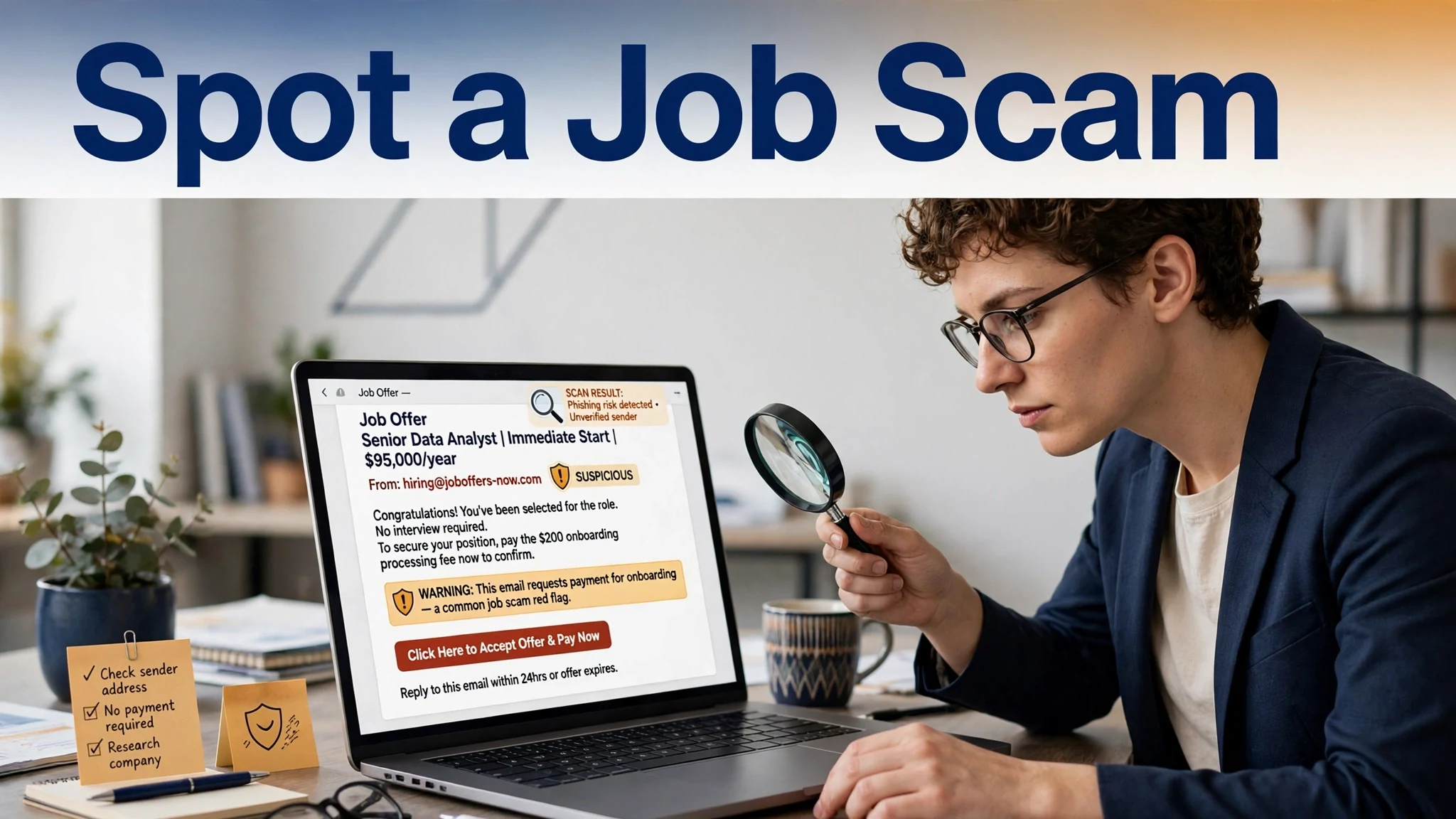
The most common job scam is the fee trap. After a short interview, you are told you have the job, but you must pay something first. It may be called a training fee, a registration fee, a background check fee, a uniform fee, or a deposit for a laptop and equipment. The amount is often small enough to feel reasonable — the price of a week of work — and you are told it will be refunded with your first salary. It will not be refunded, because there is no job and no salary.
A real employer pays for your training, your equipment, and your background check. If a company wants you to work for them, they invest in you; they do not ask you to invest in them before you have earned a single payment. There are a few honest exceptions, such as a government licence that you apply for yourself, but even then you pay the government or the licensing body directly, not a recruiter on WhatsApp. If a recruiter asks you to send money by bank transfer, mobile wallet, gift card, or cryptocurrency, stop the process immediately.
The visa version of this scam is especially harmful. A scammer promises a job in another country — often in the Gulf, Europe, Canada, or Australia — and asks for payment for a visa, a medical test, a police clearance, or a flight booking. They may show you a fake visa, a fake work permit, or a fake employment letter with stamps and signatures. A real work visa is issued by a government embassy or immigration authority, and you can check its status through official channels. No recruiter can sell you a visa over WhatsApp, and no employer will ask you to pay them for one. If you are offered work abroad, check the employer and the visa process with the embassy of that country before you pay anything.
Fake Recruiters and Stolen Company Names
A job scammer rarely invents a company from scratch. It is easier to steal a real one. They copy the name, logo, and job description of a well-known employer, create a similar email address, and post the job on a board where anyone can post. The email may come from an address that looks almost right — a company name followed by a free email service, or a domain with one letter changed. The recruiter’s LinkedIn profile may have been created a week ago, with a stock photograph and no real connections.
To check a recruiter, start with the company’s official website. Find the careers page, and see whether the job is listed there. Find the company’s official email domain, and compare it with the address that contacted you. Search the recruiter’s name and the company name together with the word “scam”, and see whether other people have reported the same message. Call the company’s public phone number — not the number in the email — and ask whether the person who contacted you works there and whether the job exists.
A genuine recruiter will not mind these checks. They expect candidates to research the company, and they will be happy to meet on a video call from a company account, to send an offer from a company domain, and to give you time to think. A scammer will rush you, will refuse a video call, will insist on text chat only, and will become angry or threatening if you ask questions. Pressure is a tactic, not a hiring style. If you feel pushed, that is your answer.
The Interview That Is Not an Interview
A real job interview is a two-way conversation. The employer asks about your experience, your skills, and how you handle problems, and you ask about the work, the team, and the pay. A scam interview is often very different. It may last only a few minutes, it may happen entirely by text on WhatsApp or Telegram, and it may ask almost nothing about your skills. Instead, it focuses on how quickly you can start, whether you have a bank account, and whether you can pay a fee.
Some scams use a fake video interview with a person who reads from a script, or a recorded video that is played back to many victims. The interviewer may have a poor connection, may refuse to turn on their camera, or may ask you to turn yours on while theirs stays off. They may ask for your identity documents, your bank details, or your passwords during the interview itself. No real employer asks for your bank account number before you have signed a contract, and no employer needs your password for anything.
Another version of the scam is the task scam. You are asked to complete a trial task — writing articles, designing a logo, entering data, or translating a document — and you are told you will be paid after the task is approved. You complete the work, the scammer uses it, and the payment never arrives. A short unpaid test is sometimes part of a real hiring process, but it should be brief, clearly limited, and never a full day of work that the company can sell. If the “test” is a real job with a deadline, it is not a test; it is unpaid labour.
Work-From-Home, Crypto, and Task Scams
Work-from-home scams are among the fastest-growing job scams in 2027, because they promise flexibility and a good income with no experience. The job may be described as liking videos, reviewing products, completing surveys, or reshipping parcels. The pay is quoted per task, and the first few tasks pay a small amount, which builds trust. Then the platform asks you to deposit money to unlock higher-paying tasks, or charges a fee to withdraw your earnings. The money you deposited disappears, and the earnings were never real.
Cryptocurrency job scams follow a similar pattern. You are hired as a trader, an analyst, or a customer service agent for a crypto company, and you are asked to buy crypto, to move crypto between wallets, or to recruit other people. The company may not exist, the trading platform may be fake, and the crypto you move may be stolen money. If a job involves moving money or crypto for strangers, it is not a job; it is a money-mule scheme, and it can lead to a closed bank account, a police investigation, and a criminal record.
Parcel reshipping scams are another version. You are hired to receive parcels at your home and forward them to another address, and you are paid per parcel. The parcels are often bought with stolen credit cards, and you become the person whose address is on the delivery. By the time the police trace the parcels, the scammer has vanished, and you are the one explaining why stolen goods were sent to your home. A real logistics company does not hire strangers to reship parcels from their living room.
The Ten-Minute Check Before You Accept Any Offer
Before you accept any job offer, spend ten minutes checking it. First, search the exact job title and company name together, and see whether the same advert appears on the company’s own careers page. Second, check the email domain: a real company uses its own domain, not a free email service. Third, look at the recruiter’s profile: a real recruiter has a history, connections, and posts that go back months or years, not days. Fourth, read the contract carefully: a real contract has a company address, a registration number, a clear salary, working hours, and a notice period, and it does not ask you to pay a fee.
Fifth, be suspicious of any offer that arrives without a proper application. If you did not apply for the job, or you applied weeks ago and were never interviewed, a sudden offer is a warning sign. Sixth, check the salary against the market: if the pay is far above what similar jobs offer, and the requirements are far below, the offer is designed to excite you, not to hire you. Seventh, never send identity documents, bank details, or passwords to a recruiter before you have verified the company through its official channels. Eighth, tell someone you trust about the offer, and ask them to look at the messages with you. A second opinion often sees what excitement has hidden.
If any check fails, do not argue with the recruiter. Simply stop replying, save screenshots of the messages, and report the advert to the job board and the platform where it appeared. You do not owe a scammer an explanation, and you do not need to prove that they are a scammer before you walk away. A real employer will still be there tomorrow; a scammer will move on to the next victim.
What to Do If You Have Already Been Targeted
If you have paid money to a job scammer, contact your bank or payment provider immediately and ask whether the payment can be stopped, recalled, or disputed. Save every message, receipt, contract, and screenshot, and do not delete the chat, because it is evidence. Report the scam to the job board, to the platform where you were contacted, and to the police and a national fraud reporting service in your country. In the United States, the Federal Trade Commission and the FBI’s Internet Crime Complaint Center accept reports. In the United Kingdom, Action Fraud is the reporting service. In Pakistan, the Federal Investigation Agency’s Cybercrime Wing handles online fraud.
If you shared identity documents, take steps to protect yourself: change your passwords, turn on two-factor authentication, check your bank statements, and consider a fraud alert or credit freeze if one is available in your country. If you shared your bank account details, ask your bank to monitor the account and to issue a new account number if needed. If you were asked to forward money or parcels, stop immediately and tell the police, because continuing could make you part of the crime.
Do not be embarrassed about being targeted. Job scammers are organised, they use professional-looking materials, and they target people who are doing the right thing by looking for work. The shame belongs to the scammer, not to the job seeker. Reporting the scam helps other job seekers, because it creates a record that other people can find when they search the company name or the recruiter’s phone number.
My Take:
My honest view is that job scams are among the cruellest frauds, because they do not only steal money; they steal hope. A person who is looking for work is already doing something brave: they are trying to support themselves and their family, and they are facing rejection after rejection. A scammer who offers them a job is not offering a product; they are offering a future, and when that future turns out to be fake, the damage is emotional as well as financial. I think we should judge these crimes by that damage, not by the amount of money involved, because a fee of a few thousand rupees can mean a month of food for a family, and a lost month of job hunting can mean a lost chance at a real opportunity.
I also believe that job boards and social media platforms need to do far more to stop fake job adverts. At present, almost anyone can post a job, copy a company logo, and start messaging candidates within minutes, and the platform only acts after victims have reported the advert. That is too late. A platform that profits from job listings should verify the employer before the advert goes live, should check that the contact email matches the company’s domain, and should make it easy for a candidate to see whether the recruiter is real. I am not asking for a perfect system, but I am asking for a system that treats a fake job as seriously as a fake product, because the harm is greater.
Another point I care about is the advice we give to young job seekers. Too often, we tell them to “be careful” without explaining what careful actually looks like. Careful means checking the company website, calling the public phone number, refusing to pay any fee, and telling a parent or a friend about the offer. It means knowing that a real employer pays for training, and that a real visa comes from a government, not from a WhatsApp message. I would like schools, training centres, and community groups to teach these checks as part of preparing for work, in the same way they teach how to write a CV. A ten-minute check is a skill, and it can be taught, and it would save many people from losing money they cannot afford to lose.
On the subject of work abroad, my view is that the dream of a job overseas is real and legitimate, and it should not be treated as naivety. People have built better lives by working abroad for generations, and wanting that chance is not foolish. What is foolish is the system that allows a criminal to sell that dream for a fee, with no verification and no refund. Governments, embassies, and licensed recruitment agencies have a role here: they should publish clear lists of licensed recruiters, they should explain the visa process in simple language, and they should make it easy to check whether a job offer is real. Until that information is easy to find, scammers will fill the gap with false promises, and honest job seekers will keep paying the price.
I also think families need to change how they talk about job scams. When a young person comes home and says they have been offered a job, the first response should not be excitement alone; it should be a calm question: “How did you check it?” That question is not distrust; it is protection, and it should be asked for every offer, not only the ones that look suspicious. If checking becomes a normal part of accepting a job, scammers will find it much harder to work, because their whole business depends on speed and secrecy. A family that checks together is a family that is much harder to scam.
Finally, I believe that anyone who has been scammed while looking for work deserves support, not blame. The person was not stupid; they were hopeful, and they were targeted by professionals who had practised their script on many victims before them. The right response is to help them report the crime, to help them secure their accounts, and to help them keep applying for real jobs, because giving up on work is the worst outcome of all. A job scam should be a painful lesson, not the end of a career. If we treat victims with kindness, and if we teach the checks before the scam happens, fewer people will lose money, fewer people will lose hope, and the scammers will find that the easiest target is no longer so easy.
I also want to add a practical point about where to look for real work, because the best defence against a job scam is a good source of genuine jobs. Use the official careers page of a company you trust, use a well-known job board with employer verification, or use a licensed recruitment agency whose licence you can check. Be wary of jobs that appear only in a WhatsApp group, only on a social media post, or only from a stranger who messaged you first. A real employer advertises openly, gives a clear job description, and expects you to apply through a proper process. If a job exists only in a chat message, treat it as unproven until you have verified it through the company’s official channels.
One more thing I think is worth saying is about the pressure to decide quickly. Scammers rely on urgency, because urgency stops you from thinking, from checking, and from asking for advice. A real employer understands that a job is a big decision, and will give you time to think, to ask questions, and to discuss the offer with your family. If someone tells you the offer expires today, that the training starts tomorrow, or that you will lose the job if you do not pay now, that urgency is itself the warning. Slow down, step back, and check. The job that is right for you will still be there after a ten-minute check, and the job that disappears when you check it was never a real job at all.
One new danger I want to flag is the use of artificial intelligence by scammers, because it has made fake jobs harder to spot than ever. A scammer can now generate a polished job advert in seconds, clone a manager’s voice for a phone call, or even appear on a video interview as a deepfake face that looks entirely real. The old advice to watch for bad spelling no longer works, because the spelling is now perfect. What still works is verification through a channel the scammer does not control: call the company’s public number, check the recruiter’s profile on the company’s own website, and never accept a job, or pay a fee, through a chat message alone. The technology of deception has improved, so the habit of checking must improve with it, and a video call is no longer proof that the person on the screen is who they claim to be.
Frequently Asked Questions
Is it normal for an employer to ask for a fee before I start work?
No. A real employer pays for training, equipment, and background checks. You should never pay a recruiter a fee to get a job, and you should never pay for a visa through a recruiter. Pay a government body directly only when you are applying for a licence or visa yourself.
How can I check if a job offer is real?
Check the company’s official careers page, compare the recruiter’s email domain with the company’s domain, search the recruiter’s name with the word scam, and call the company’s public phone number to confirm the job and the recruiter. A real employer will welcome these checks.
What is a work-from-home task scam?
It is a scam where you are paid a small amount for simple tasks, then asked to deposit money to unlock higher-paying tasks or to withdraw your earnings. The deposit disappears, and the earnings were never real. Never pay to work.
Should I send my identity card or passport to a recruiter?
Not before you have verified the company through its official website and phone number, and not before you have signed a real contract. Even then, share documents only through a secure official process, never by sending photographs on WhatsApp to a stranger.
What should I do if I paid a job scammer?
Contact your bank immediately, save all messages and receipts, and report the scam to the job board, the platform, the police, and a national fraud reporting service. Change your passwords and check your bank statements for any transaction you do not recognise.
Are jobs abroad offered on WhatsApp real?
Some genuine recruiters use WhatsApp, but a real overseas job can always be verified through the employer’s official website and the embassy of the country concerned. Never pay for a visa, medical test, or flight through a recruiter on WhatsApp without that verification.