The Mystery of D.B. Cooper, Explained Simply
In this post
- The Flight: What Happened on November 24, 1971
- The Evidence: The Money, the Tie and the Parachutes
- The Theories: Did He Live, Did He Die, Who Was He?
- The Suspects: The Men Who Might Have Been Cooper
- Why the Case Is Still Unsolved After Fifty Years
- The Legend: Why We Cannot Let Cooper Go
- What We Know, What We Do Not, and What May Happen Next
- My Take:
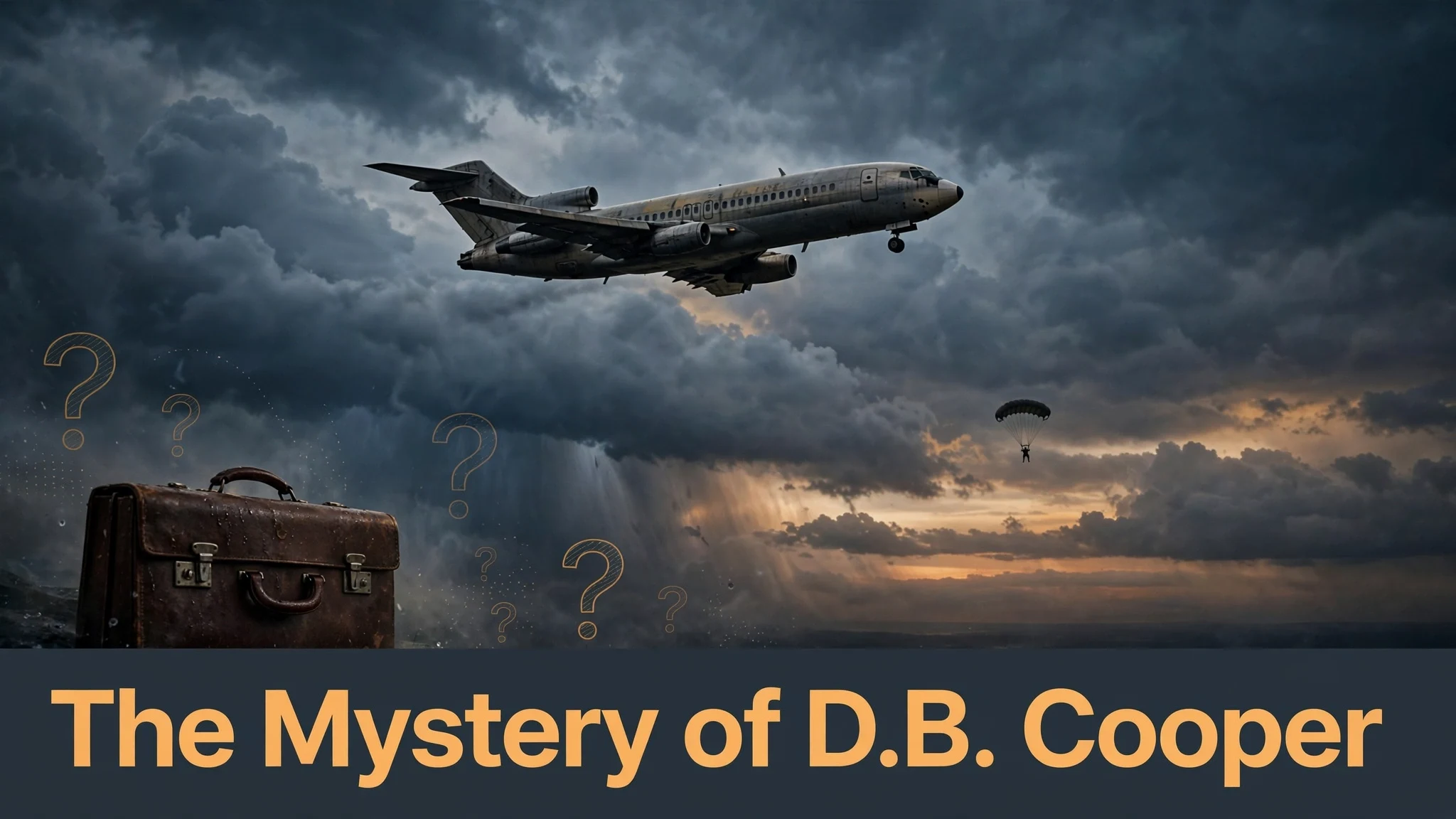
On a rainy afternoon in November 1971, a man in a dark suit boarded a plane in Portland, Oregon, ordered a drink, handed a note to a flight attendant, and became the most famous unsolved criminal in American history. He called himself Dan Cooper — the newspapers later misreported it as D.B. Cooper, and the wrong name stuck — and he claimed to have a bomb. He demanded two hundred thousand dollars in cash and four parachutes, and when the plane landed in Seattle, he got them. Then he told the crew to fly south, and somewhere over the forests of the Pacific Northwest, in the dark and the rain, he jumped out of the back of the plane, with the money strapped to his body, and was never seen again.
More than fifty years later, the case remains unsolved. The FBI investigated it for forty-five years, interviewed hundreds of people, examined thousands of clues, and finally closed the active investigation in 2016, without ever identifying the man or finding the money — except for a small bundle of rotting banknotes found on a riverbank in 1980, which only deepened the mystery. Dozens of people have been named as suspects, books and documentaries have proposed theories, and the case has become a legend, a symbol of the perfect crime, and a puzzle that refuses to be solved.
This article explains the mystery of D.B. Cooper in plain language: what happened on that flight, what the evidence shows, what the main theories are, why the case is so hard to solve, and what it tells us about crime, about myth, and about the limits of investigation. You do not need to know anything about aviation or about criminal investigation to follow it — only to have wondered, as millions of people have, what happened to the man who jumped out of a plane with two hundred thousand dollars and vanished into the night.
The Flight: What Happened on November 24, 1971
On November 24, 1971, the day before Thanksgiving, a man bought a one-way ticket from Portland to Seattle on Northwest Orient Airlines Flight 305, a Boeing 727, under the name Dan Cooper. He was described as a white man in his mid-forties, about six feet tall, wearing a dark suit, a white shirt, a black tie, and sunglasses, and carrying a briefcase. He took seat 18C, near the back of the plane, ordered a bourbon and soda, and waited. The flight was short — about thirty minutes — and the plane was less than half full, with thirty-six passengers and six crew.
Shortly after takeoff, Cooper handed a note to a flight attendant, Florence Schaffner. She assumed it was a phone number and put it in her pocket without reading it. Cooper leaned towards her and said, quietly, “Miss, you’d better look at that note. I have a bomb.” The note said, in capital letters, that he had a bomb in his briefcase and that he wanted two hundred thousand dollars in twenty-dollar bills, four parachutes, and a fuel truck waiting in Seattle. Schaffner took the note to the cockpit, and the crew, following their training, cooperated. The plane circled over Seattle while the money and the parachutes were gathered.
When the plane landed in Seattle, the passengers were allowed to leave, and Cooper received the money and the parachutes. He inspected them, then ordered the crew to fly to Mexico City, at low altitude, with the landing gear down and the rear stairway lowered — a feature of the Boeing 727 that allowed someone to exit from the back of the plane in flight. The plane took off again, with only Cooper and four crew members aboard, and flew south over the forests of Washington and Oregon, in darkness and rain. Somewhere over that forest, Cooper lowered the rear stairs and jumped, with the money strapped to his body, into the night. The crew felt a change in pressure, and when they landed in Reno, Nevada, Cooper was gone.
The Evidence: The Money, the Tie and the Parachutes
The evidence in the Cooper case is both tantalising and frustrating, because there is a great deal of it, and almost none of it has led to an identification. The most famous piece is the money: in 1980, a boy digging on a beach along the Columbia River found a bundle of twenty-dollar bills, rotting and stuck together, whose serial numbers matched the ransom money. About six thousand dollars was recovered, in three bundles. The discovery suggested that at least some of the money had ended up in the river, but it did not say how it got there, or whether Cooper had survived, or whether he had buried it, dropped it, or lost it in the jump.
Other evidence includes the tie Cooper left on the plane, which has been examined for DNA and for particles that might reveal where he worked or lived, and the parachutes: he took two of the four parachutes, one of which was a training parachute that had been sewn shut and would not have opened. The fact that he took the sewn-shut parachute has led to speculation that he was not an experienced skydiver, or that he was in a hurry, or that he did not inspect the parachutes carefully. The bomb, if there was one, was never found, and it is not known whether it was real or a bluff. The briefcase Cooper carried was never recovered.
The FBI collected thousands of fingerprints, interviewed hundreds of suspects, and followed up on thousands of tips. None of them led to an identification. The case file is enormous, and the evidence is real, but it has not been enough, because the man left so little behind: no photograph, no real name, no clear description beyond a general one, and no trace after the jump. That scarcity is part of what makes the case so enduring: there is enough evidence to keep the mystery alive, and not enough to solve it.
The Theories: Did He Live, Did He Die, Who Was He?
The main question is whether Cooper survived the jump. The conditions were terrible: it was night, it was raining, it was cold, he was jumping from a plane travelling at about two hundred miles an hour, at ten thousand feet, over dense forest, wearing a business suit and street shoes, with two hundred thousand dollars strapped to his body. Many experts, including experienced skydivers, believe he could not have survived, and that he died on impact or in the forest, and that his body was never found because the area is vast and remote. The money found on the riverbank supports the idea that he, or at least the money, ended up in the river.
Others believe he survived, and that he planned the jump carefully, chose the location, and had a way out — a car, a accomplice, a plan. Supporters of this theory point to the fact that he knew about the 727’s rear stairs, that he asked for the plane to fly low and slow, that he was calm throughout the hijacking, and that he seemed to know what he was doing. They argue that a man who planned so carefully would not have made a suicidal jump, and that the money found on the river was planted, or was lost in the jump, while Cooper himself walked away.
A third group of theories focus on who he was: a former soldier, a former airline employee, a man with a grudge, a man who needed money. Dozens of people have been named as suspects, including a man who confessed on his deathbed, a man who was identified by his family, and a man who wrote a book claiming to be Cooper. None of these claims has been proven, and the FBI has said that none of the named suspects matched the evidence. The identity of Cooper remains unknown, and it is possible that it will never be known, because the man who jumped may have taken his real name with him into the forest.
The Suspects: The Men Who Might Have Been Cooper
Over the years, many men have been proposed as D.B. Cooper, and each proposal has attracted believers. One of the most famous is Richard Floyd McCoy, a former soldier and experienced skydiver who hijacked a plane in a similar way five months after Cooper, and who was caught. McCoy denied being Cooper, and the FBI concluded he was not, but his similarity to the crime has kept the theory alive. Another is Duane Weber, who told his wife on his deathbed that he was Cooper, and whose wife later found evidence she believed supported the claim, but the FBI found no match.
Another is Kenneth Christiansen, a former airline employee who was identified by his brother after his death, and who, supporters argue, had the knowledge, the appearance, and the motive. The FBI investigated Christiansen and did not find a match. There have been others: a man who was a paratrooper, a man who worked for Boeing, a man who lived near the jump site. Each theory has its evidence, and each has its gaps, and none has been proven. The FBI, in closing the case, said that none of the suspects they investigated matched the physical evidence, including the DNA from the tie.
The reason so many suspects have been proposed is that the description of Cooper is general enough to fit many men, and the crime is famous enough that many families have a story about a relative who might have been him. That is part of the legend: Cooper has become a figure onto whom people project their own stories, their own relatives, their own ideas about who would do such a thing. The real Cooper, whoever he was, has been lost behind the many Coopers that people have imagined, and that may be the final irony of the case: that the man himself is less real, now, than the myth he created.
Why the Case Is Still Unsolved After Fifty Years
The Cooper case remains unsolved for several reasons, and they are worth understanding, because they explain why some mysteries endure. The first is the lack of evidence: Cooper left almost nothing behind, and what he left — a tie, a note, a few fingerprints — has not been enough to identify him. The second is the environment: the jump site is a vast, dense forest, in a remote area, where a body could disappear without a trace, and where a search, even a thorough one, could miss a man who died there.
The third is the passage of time. Witnesses have died, memories have faded, and the physical evidence has degraded. The tie, which was the best source of DNA, has been handled by many people over the years, and the DNA recovered from it is partial and contested. The money, which was the best clue, has mostly never been found, and the small amount that was found raises more questions than it answers. Time has not helped the case. It has made it harder.
The fourth is the nature of the crime itself. Cooper was calm, he was polite, he did not hurt anyone, and he vanished. That has made him a folk hero to some people, and it has made the case a story rather than a manhunt. The FBI investigated it seriously for forty-five years, but the public imagination has turned it into a legend, and a legend is harder to solve than a crime, because a legend does not need an answer. It needs only a mystery, and the Cooper case has that in abundance.
The Legend: Why We Cannot Let Cooper Go
The D.B. Cooper case has become more than a crime. It has become a part of American culture, a story told in books, films, television shows and songs, a symbol of the lone figure who outwits the system and disappears. Part of the appeal is the audacity: a man in a suit, with a briefcase, who hijacks a plane, gets what he wants, and jumps into the night, with no violence and no one hurt. Part of it is the mystery: the fact that he was never caught, never identified, and never found, which leaves the story open, and allows anyone to imagine their own ending.
Part of it is also the time in which it happened. 1971 was a different era, before airport security as we know it, before the hijackings that changed air travel, before the world became more guarded. Cooper’s crime belongs to that era, and it could not happen today, because the planes have changed, the security has changed, and the rear stairs of a 727 can no longer be opened in flight. That impossibility makes the story feel like a relic, a glimpse of a world that is gone, and that adds to its romance.
The legend also says something about how we think about crime and about heroes. Cooper did not hurt anyone, he did not take a life, and he asked for money from a corporation, not from a person. That makes it easier to admire him, or at least to be fascinated by him, than it would be to admire a violent criminal. The admiration is not entirely rational, and it is not entirely harmless — Cooper broke the law, and he put lives at risk — but it is understandable, and it is part of why the case has endured. We are drawn to the man who got away, and we are drawn to the mystery that was never solved.
What We Know, What We Do Not, and What May Happen Next
What we know is this: on November 24, 1971, a man calling himself Dan Cooper hijacked a plane, received two hundred thousand dollars and four parachutes, and jumped from the plane over the Pacific Northwest, and was never seen again. A small amount of the money was found on a riverbank in 1980. The FBI investigated for forty-five years and closed the active case in 2016, without identifying him. Those are the facts, and they are not in dispute.
What we do not know is almost everything else: whether he lived or died, who he was, where the money went, and what happened in the forest that night. Those questions have been asked for fifty years, and they have not been answered, and it is possible that they never will be. New evidence could still emerge — a piece of the money, a document, a confession that can be verified — but the passage of time makes it less likely, not more, and the case may remain unsolved forever.
That is, in the end, the most honest thing to say about D.B. Cooper: that we do not know, and that we may never know, and that the not-knowing is part of why the story matters. It is a reminder that the world is larger than our ability to explain it, that a man can vanish into a forest on a rainy night and leave behind only a mystery, and that some stories do not have an ending, however much we want one. Cooper jumped, and he disappeared, and the rest is speculation, and speculation is not the same as knowledge. The case is unsolved, and it may stay that way, and that is the truth of it.
My Take:
My honest view is that the D.B. Cooper case endures not because it is the most important crime in history — it is not, and no one was hurt, which is part of why it is remembered fondly — but because it is the perfect mystery: a man, a plan, a jump, and a disappearance, with just enough evidence to keep the story alive and not enough to solve it. I think that balance is the key. A mystery with no evidence is forgotten. A mystery with too much evidence is solved. Cooper’s case has exactly the right amount of evidence to be endlessly discussed and never resolved, and that is why, fifty years later, people are still writing books, making documentaries, and naming suspects. The mystery is the point, and the mystery is self-sustaining.
What I find most interesting is the way Cooper has become a folk hero, and how uncomfortable that should make us. He broke the law, he threatened people with a bomb, and he put lives at risk, and yet he is admired, or at least regarded with affection, because he was calm, because he was polite, and because he did not hurt anyone. I understand the admiration, and I share some of it, because there is something compelling about a person who outwits a system and disappears. But I also think it is worth remembering that the admiration depends on the fact that no one was hurt, and that if someone had been, the story would be very different. The legend is built on luck as much as on skill, and luck is not a moral quality.
I am also struck by the money found on the riverbank, because it is the one piece of physical evidence that is both real and unexplained, and it has generated more theories than any other clue. Did Cooper bury it? Did he drop it in the jump? Did it wash down the river from where he died? Did someone else put it there? Each theory is plausible, and none can be proven, and the bundle of rotting banknotes has become a symbol of the case itself: a real thing, found by chance, that raises more questions than it answers. I think that is a fitting image for the whole mystery — a small, damp, decaying clue, found by a boy on a beach, that has kept a legend alive for forty years.
On the question of whether he lived or died, my instinct is that he probably died, because the conditions were terrible and the jump was, by any reasonable measure, extremely dangerous. A night jump, in rain, in a suit, over forest, with money strapped to his body, is not a plan that inspires confidence, however calm the man was on the plane. But I am not certain, and the uncertainty is part of what makes the case interesting. The experts disagree, the evidence is ambiguous, and the possibility that he survived — that he walked out of the forest, changed his clothes, and lived a quiet life — is just plausible enough to keep the story alive. I think that is the right attitude: to hold both possibilities, to admit that we do not know, and to resist the temptation to pick the version that makes the best story.
The suspects are the part I find least convincing, because each one is proposed with enthusiasm and then fails to match the evidence, and the pattern has repeated for decades. A deathbed confession, a brother’s memory, a family story — these are human, and they are understandable, but they are not evidence, and the FBI, which investigated them seriously, found none of them credible. I think the proliferation of suspects says more about us than about Cooper: that we want an answer, that we want the mystery to have a name, and that we will supply a name if one is not available. The real Cooper may have been none of the men named, and may have been a person no one has ever thought of, and that is a humbling thought, because it means the answer may be lost, not hidden.
Finally, I think the case matters because it is a reminder of the limits of investigation, and of knowledge itself. The FBI spent forty-five years, interviewed hundreds of people, and followed thousands of leads, and they could not identify a man who hijacked a plane in front of witnesses, left a tie and fingerprints, and jumped from a plane that was being tracked. That is not a failure of the FBI. It is a measure of how little it takes to disappear, if you plan carefully, and how much of what we know depends on a person leaving a trace. Cooper left almost no trace, and that is why he is still unknown. It is a sobering thought, and it is also a fascinating one, because it shows that the world is larger and stranger than our systems for understanding it, and that a single person, on a rainy night, can still slip through the net and vanish into legend.
I also think about the flight crew, who are often forgotten in the telling of this story, because they were the people who were actually there, who were threatened, and who had to keep calm and follow their training while a man with a supposed bomb told them what to do. They did their jobs, they kept the passengers safe, and they landed the plane, and then they watched a man jump out of the back of it into the night. Their calm professionalism is part of why no one was hurt, and it deserves to be remembered alongside the mystery. The legend is about Cooper, but the competence that kept everyone safe belonged to the crew.
One more thought: the case is a reminder that some stories do not have an ending, and that the lack of an ending is not a failure. We want every mystery solved, every question answered, every criminal caught, and the world does not always oblige. A man can jump out of a plane on a rainy night and vanish, and fifty years of investigation can fail to find him, and that is the truth of it. The story remains, not because we have solved it, but because we have not, and the not-knowing is what keeps it alive. That is frustrating, and it is also, in a strange way, honest: the world is larger than our ability to explain it, and some of its stories will always end in the dark, over a forest, in the rain.
Frequently Asked Questions
Who was D.B. Cooper?
Nobody knows. He called himself Dan Cooper when he bought his ticket; newspapers misreported it as D.B. Cooper. He was described as a white man in his mid-forties, about six feet tall, wearing a dark suit and sunglasses. Despite a 45-year FBI investigation, he was never identified.
What did D.B. Cooper do?
On 24 November 1971, he hijacked Northwest Orient Flight 305 from Portland to Seattle, claiming to have a bomb. He demanded $200,000 in $20 bills and four parachutes, received them in Seattle, then ordered the plane to fly south and parachuted out over the forests of the Pacific Northwest, never to be seen again.
Did D.B. Cooper survive the jump?
It is unknown. Many experts believe he died, because the jump was at night, in rain and cold, over dense forest, in a business suit. Others believe he survived because he planned carefully. The only money ever found was about $6,000 in rotting bills on a Columbia River beach in 1980, which does not settle the question.
Was any of the ransom money ever found?
Yes, a small amount. In 1980, a boy found three bundles of $20 bills, about $6,000, on a beach along the Columbia River, with serial numbers matching the ransom. The rest of the $200,000 has never been found.
Why is the D.B. Cooper case still unsolved?
He left very little evidence — a tie, a note, some fingerprints — and the jump site is a vast, remote forest where a body could vanish. Witnesses have died, memories have faded, and none of the many named suspects matched the physical evidence. The FBI closed the active investigation in 2016.
Could a D.B. Cooper hijacking happen today?
Almost certainly not in the same way. Airport security is far stricter, and the Boeing 727’s rear stairway, which Cooper used to jump, can no longer be opened in flight on modern aircraft. The crime belongs to a different era of air travel.