How to Prepare for a Wildfire in 2027: A Simple Guide
In this post
- Know Your Risk and Your Local Warnings
- Make an Evacuation Plan With Your Family
- Pack a Go-Bag and Keep It Ready
- Prepare Your Home: Defensible Space
- During a Wildfire: When to Leave and What to Do
- After the Fire: Smoke, Safety, and Recovery
- Wildfire Smoke and Your Health: What to Know
- Community Preparation: Neighbours, Fire Services, and Local Plans
- Animals in a Wildfire: Pets, Livestock and Wildlife
- My Take:
A wildfire can move faster than a person can run, and it can change direction with the wind in a matter of minutes. That is why preparation matters more than bravery. The families who survive a wildfire best are not the ones who fight the fire themselves; they are the ones who had a plan, who knew when to leave, who had a bag ready, and whose home had been prepared in advance. This guide explains, in simple words, how to prepare for a wildfire in 2027, before it happens, while it is happening, and after it has passed.
Wildfires are becoming more common in many parts of the world, because of hotter summers, drier vegetation, and stronger winds. Areas that once rarely saw wildfire — in parts of Europe, North America, Australia, and elsewhere — are now at risk. Even if you have never seen a wildfire, it is worth knowing the basics, because a fire can start far away and reach your area quickly, and the smoke alone can be dangerous for children, older people, and anyone with breathing problems.
This guide is for anyone who lives in or near a wildfire-prone area, for families with children or elderly relatives, and for anyone who wants to be ready. It does not replace official advice from your local fire service or emergency authority, which should always be followed first. It is a starting point, to help you make a plan, to prepare your home, and to know what to do when the warning comes.
Know Your Risk and Your Local Warnings
The first step is to know whether you live in a wildfire-prone area, and what the local warning system is. In many countries, fire services publish maps showing fire risk, and they issue warnings by level — for example, a fire danger rating that goes from low to extreme, or an evacuation warning that tells residents to prepare to leave, to leave now, or that it is too late to leave. Learn the system for your area, and learn what each level means, before fire season begins.
Sign up for local emergency alerts on your phone, and follow your local fire service on social media or on its official website. Many areas have an app or a text alert service that will warn you about a fire near you. Make sure your phone is charged, and that you have a way to receive alerts if the power goes out, such as a battery radio. Do not rely on a single source of information; if you hear a warning, check it with an official source, and act on it.
Talk to your neighbours, especially if you are new to the area. Long-time residents often know which roads are safe, which areas are at risk, and how quickly a fire can spread in local conditions. Your local fire service may also offer a home assessment, in which a firefighter visits your property and advises you on how to reduce the risk. That advice is free in many areas, and it is worth taking.
Make an Evacuation Plan With Your Family
An evacuation plan is a simple agreement: if a wildfire threatens, who does what, where do you go, and how do you stay in touch? Sit down with your family and decide on two escape routes from your home, in case one road is blocked by fire or by traffic. Choose a meeting point outside the danger area — a relative’s house, a school, a community centre, or a town that is known to be safe — and make sure everyone knows the address and how to get there.
Decide who is responsible for what. One person may be responsible for the children, another for the pets, another for the go-bag, and another for turning off the gas and the electricity if there is time. Practise the plan, especially with children, so that they know what to do and do not panic. A practice run, even a short one, can make a real evacuation much calmer, because the family has already done it once.
Plan for pets and livestock as well. Have carriers, leads, food, and water ready for pets, and know where you can take them. For livestock, know in advance where you can move animals, and do it early, before the fire is close. Do not wait until the last minute to decide what to do with animals, because that is when mistakes happen.
Pack a Go-Bag and Keep It Ready
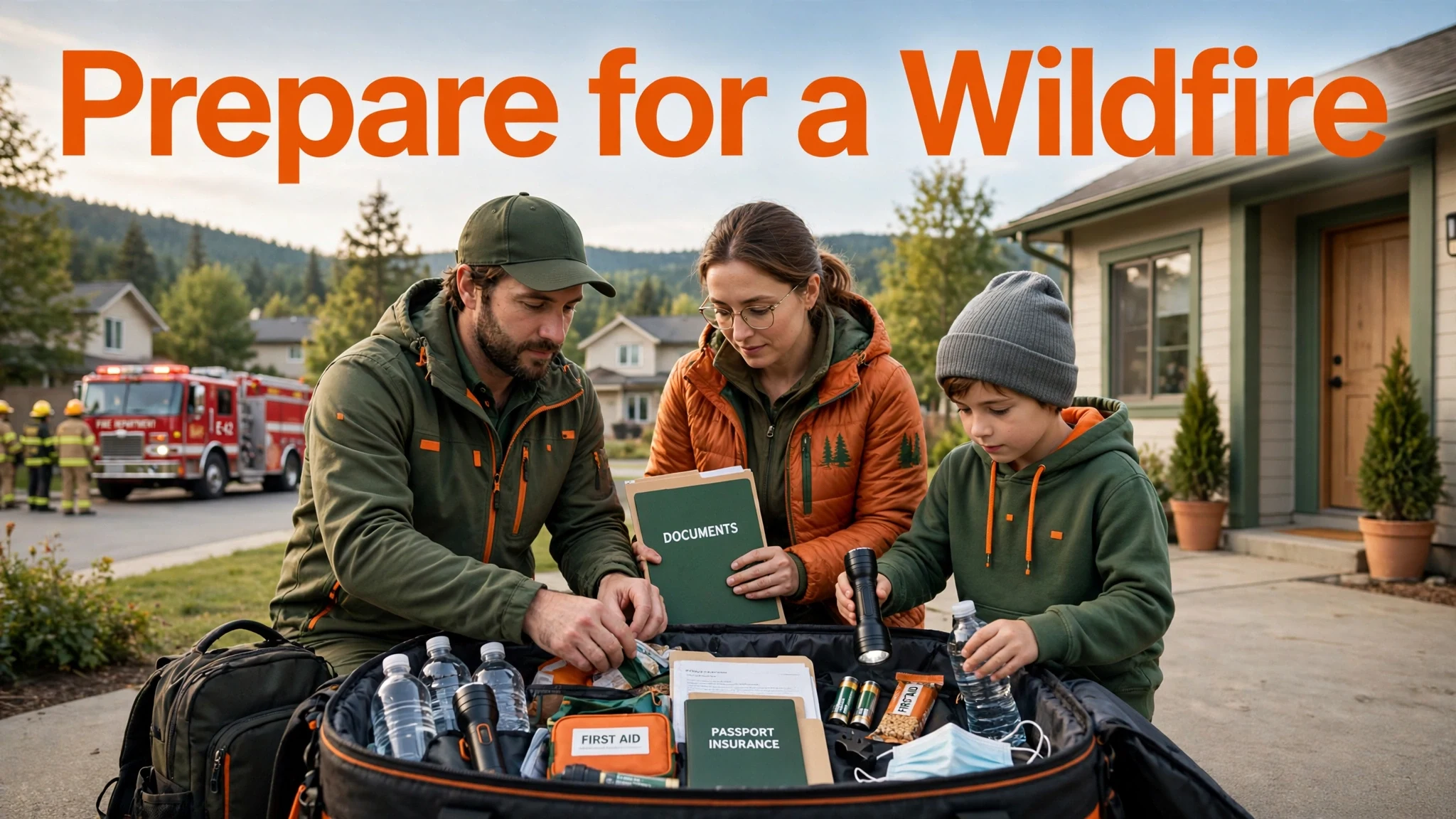
A go-bag is a bag that is packed and ready to take with you if you have to leave in a hurry. It should be kept by the door, or in the car, during fire season, so that you can grab it and go. The bag should contain the essentials you would need for a few days away from home, and it should be light enough to carry.
Include important documents, or copies of them, in a waterproof folder: identity cards, passports, insurance papers, medical records, and a list of important phone numbers. Include medicines, a first-aid kit, and any medical equipment you need. Include water, non-perishable food, a torch, a battery radio, a phone charger, and a change of clothes. Include cash, because card machines may not work if the power is out. Include items for children, such as nappies, formula, or a comfort toy, and items for pets, such as food and a lead.
Check the go-bag regularly, and replace food, water, and medicines before they expire. Make sure everyone in the family knows where the bag is, and that the car has enough fuel. During fire season, keep the fuel tank at least half full, because petrol stations may be closed or may run out of fuel during an evacuation. A full tank is a simple form of preparation that can make a large difference.
Prepare Your Home: Defensible Space
Defensible space is the area around your home that is cleared of flammable material, so that a fire has less fuel to burn and firefighters have room to work. The exact rules vary by country and by local fire service, but the principles are the same: keep the area closest to your house clear of dry leaves, firewood, and flammable plants, and keep trees and shrubs trimmed so that they do not touch the house or overhang the roof.
Clean your gutters, because dry leaves in a gutter can catch fire from embers carried by the wind. Embers, not flames, are the most common cause of homes burning in a wildfire, because they can travel long distances and land on a roof, in a gutter, or through a vent. Use ember-resistant vents if you can, keep windows closed during a fire, and remove flammable items from decks, balconies, and porches.
If you are building or renovating, consider fire-resistant materials for the roof, the walls, and the decking, and consider double-glazed windows, which are more resistant to heat. These changes can be expensive, but they can make a home much more likely to survive a fire. Even small changes — moving firewood away from the house, mowing dry grass, and clearing leaves — can help, and they are worth doing before fire season, not during it.
During a Wildfire: When to Leave and What to Do
When a wildfire threatens, the most important rule is to leave early. Do not wait to see the flames, do not wait to pack, and do not wait to see what your neighbours do. If you receive an evacuation order, or a warning to leave now, leave immediately, following the route given by the fire service. Traffic during an evacuation can be heavy, and a road that is clear now may be blocked in an hour.
If you are told to prepare to leave, use the time to load the car, to close all windows and doors, to turn off the gas if you have been advised to do so, and to leave sprinklers or hoses in a safe place if the fire service has advised it. Do not stay to fight the fire unless you are trained, equipped, and have been advised to do so by the fire service. A garden hose will not stop a wildfire, and staying behind can put you and the firefighters who may have to rescue you at risk.
If you are caught in a fire while driving, do not drive through smoke or flames. Pull over in a clear area, turn on your headlights, close the windows and vents, and stay in the car, which will protect you from radiant heat for a short time. Call emergency services if you can, and wait for help. If you are on foot and a fire is close, move to a clear area, such as a road, a river, or a burnt area, and lie low, covering your mouth and nose with a damp cloth if you can. These are last-resort actions, and they are no substitute for leaving early.
After the Fire: Smoke, Safety, and Recovery
After a wildfire has passed, the danger is not over. Smoke can remain in the air for days, and it can cause breathing problems, especially for children, older people, and people with asthma or heart conditions. Stay indoors if the air quality is poor, keep windows closed, and use an air purifier if you have one. Check official air quality reports before you go outside, and wear a mask if you are advised to do so.
Do not return home until the authorities say it is safe. A burnt area can contain hot spots, fallen power lines, unstable trees, and damaged gas lines. When you do return, wear sturdy shoes, gloves, and a mask, and be careful of ash, which can contain harmful chemicals. Do not let children play in ash, and wash your hands and clothes after being in a burnt area.
Recovery after a wildfire takes time, and it is not only about rebuilding a house. It is about dealing with loss, with insurance claims, with paperwork, and with the emotional impact of the fire. Talk to your family, to your neighbours, and to support services in your area. Many communities offer help after a wildfire, including counselling, financial advice, and practical support. Accepting help is not a weakness; it is a part of recovery, and it can make the long process of rebuilding easier.
Wildfire Smoke and Your Health: What to Know
Wildfire smoke is not only unpleasant; it is a health risk, and it can affect people far from the fire itself. Smoke contains tiny particles, gases, and chemicals that can irritate the eyes, nose, and throat, and that can worsen asthma, heart disease, and other conditions. Children, older people, pregnant women, and people with breathing or heart problems are at particular risk, and they should take extra care when air quality is poor.
To protect yourself, check the air quality index for your area, stay indoors when it is poor, keep windows and doors closed, and use an air purifier if you have one. If you must go outside, wear a well-fitting mask, such as an N95 mask, if one is available and if you have been advised to use one. Avoid strenuous exercise outdoors when the air is smoky, and seek medical help if you develop breathing difficulties, chest pain, or a persistent cough. Smoke can travel hundreds of kilometres, so even if the fire is far away, the air in your area may still be affected.
Community Preparation: Neighbours, Fire Services, and Local Plans
Wildfire preparation is not only an individual task; it is a community task. Talk to your neighbours about your evacuation plan, share information about vulnerable people who may need help, and know who in your street has a car, a generator, or medical training. Many communities have a local fire plan, a community meeting point, or a volunteer fire service, and taking part in those plans can make the whole area safer.
Your local fire service is your best source of advice, and it is worth building a relationship with them before fire season. Attend a community information session, ask for a home assessment, and follow the fire service on social media. Firefighters would rather visit your home in advance, to give advice, than to visit it during a fire, to rescue you. That advice is free, it is practical, and it can save your life.
Animals in a Wildfire: Pets, Livestock and Wildlife
People are not the only ones at risk when a fire approaches, and animals need a plan of their own. Pets should be part of the evacuation plan from the start: carriers kept where they can be found quickly, leads by the door, and a go-bag with food, water, and any medicine the animal needs, because a frightened cat hiding under a bed can cost precious minutes. Livestock are harder, since moving horses or cattle needs trailers, time, and a safe destination arranged in advance, and some farmers are forced into the painful choice of opening gates so animals can run rather than leaving them locked in a burning field. Wildlife usually flees on its own, and the best help a person can give is to stay out of its way, leave water out at a safe distance, and never approach an injured animal, which may be frightened and dangerous. After the fire, local shelters and wildlife carers often need donations and volunteers, and that help is part of recovery too.
My Take:
My honest view is that wildfire preparation is not about fear; it is about respect for a force that is faster, hotter, and less predictable than most people imagine. A wildfire is not a campfire, and it is not a fire in a fireplace. It is a wall of heat and smoke that can move at the speed of a car, that can jump a road, and that can create its own weather. Respecting that force means preparing for it, not ignoring it, and it means leaving early, not staying to watch. I think too many people underestimate wildfire because they have never seen one, and that underestimation is the most dangerous thing of all. Preparation is the opposite of panic; it is calm, it is practical, and it saves lives.
I also believe that the most important part of preparation is the plan, not the equipment. A go-bag is useful, a cleared garden is useful, but a family that knows where to go, who does what, and how to stay in touch is far more likely to survive than a family with a perfect bag and no plan. I would urge every family in a fire-prone area to sit down together, to make a plan, and to practise it, even if it feels awkward or unnecessary. The practice is what makes the real evacuation calmer, and calm is what saves lives when the warning comes. A plan that is written down, shared, and practised is worth more than any single piece of equipment.
Another point I care about is the way we talk about staying to defend a home. In some countries, there is a tradition of staying to protect a property, and that tradition is respected, but it is also dangerous, and it should only be attempted by people who are trained, equipped, and prepared, and who have been advised to do so by the fire service. For most people, the right choice is to leave early, and to let the firefighters do their job. A house can be rebuilt; a life cannot. I think we need to say that clearly, without judgement, because the pressure to stay can be strong, especially for people who have lived in a home for many years. Leaving is not giving up; it is choosing life over property, and that is the right choice.
On the subject of defensible space, my view is that it is one of the most practical things a homeowner can do, and it is often overlooked. Clearing leaves from gutters, moving firewood away from the house, trimming trees, and keeping the area around the home clear are simple, low-cost actions, and they can make a real difference. I would like to see more communities help each other with this work, especially for older people or for neighbours who cannot do it alone. A street where every home has defensible space is a street that is safer for everyone, and that is a community effort, not only an individual one.
I also think that we need to talk more about smoke, because smoke kills more people than flames in many wildfires, and it affects people far from the fire itself. A family that lives a hundred kilometres from a fire can still suffer from poor air quality, and children, older people, and people with breathing problems are at particular risk. Checking air quality, staying indoors, and using a mask when advised are simple steps, but they are often forgotten in the focus on flames. I would urge everyone in a fire-affected area, even if the fire is far away, to pay attention to the air, and to protect the most vulnerable members of their family.
Finally, I believe that recovery after a wildfire deserves as much attention as preparation. A community that has lost homes, that has lost a school, or that has lost a neighbour needs time, support, and practical help to rebuild, and that help should not stop when the fire is out. Insurance claims, rebuilding, and emotional recovery can take years, and the people who have been through a fire should not be forgotten once the news moves on. If you live in a fire-prone area, get to know your neighbours, support your local fire service, and be ready to help after a fire, not only before it. That is what a community is for, and it is what makes recovery possible. I would also add that recovery includes children, who may be frightened long after the fire is out, and who need reassurance, routine, and someone to talk to. A child who has lost a home or a school needs time to feel safe again, and parents, teachers, and neighbours can help by listening, by keeping routines as normal as possible, and by seeking professional support if the fear does not fade. That care is part of recovery, and it is as important as rebuilding a house.
I also want to add a word about smoke, because it is the part of a wildfire that affects the most people, and it is often underestimated. A fire can be a hundred kilometres away, and the smoke can still make the air in your town unhealthy, especially for children and for older people. Checking the air quality, staying indoors, and using a mask when advised are simple steps, but they are easy to forget when the flames are not visible. I would urge everyone to pay attention to the air, not only to the fire, and to protect the most vulnerable people in their family and in their neighbourhood.
One more thought is about community, because no family prepares for a wildfire alone. Neighbours who know each other, who share information, and who help each other are safer than neighbours who do not. Know who in your street needs help to evacuate, know who has a car, and know where your community meeting point is. A street that prepares together is a street that survives together, and that is a simple truth that is worth remembering before fire season begins.
I also think the firefighters themselves deserve a word, because preparation guides naturally focus on what residents should do, and the people who run towards the fire can fade into the background. Many of them are volunteers, leaving their jobs and families to work long shifts in heat, smoke, and danger, and they carry the effects of that work long after the fire season ends, in their lungs and in their minds. A community can support them in practical ways: by clearing defensible space so their job is safer, by following evacuation orders so they are not risking their lives to rescue someone who stayed, and by supporting the local brigade with donations and thanks. Respect for firefighters is not only a feeling; it is shown in the choices residents make before the fire ever arrives.
Frequently Asked Questions
When should I evacuate during a wildfire?
Leave early, as soon as you receive an evacuation order or a warning to leave now. Do not wait to see the flames. Early evacuation is the safest choice, and it gives firefighters room to work.
What should be in a wildfire go-bag?
A go-bag should contain documents, medicines, water, food, a torch, a battery radio, a phone charger, cash, a change of clothes, and items for children and pets. Keep it by the door during fire season and check it regularly.
What is defensible space?
Defensible space is the area around your home cleared of flammable material, so a fire has less fuel and firefighters have room to work. It includes clearing leaves, trimming trees, moving firewood, and cleaning gutters.
Is it safe to stay and defend my home from a wildfire?
Only if you are trained, equipped, and advised to do so by the fire service. For most people, leaving early is the safest choice. A house can be rebuilt; a life cannot.
How dangerous is wildfire smoke?
Wildfire smoke can cause breathing problems, especially for children, older people, and people with asthma or heart conditions. Stay indoors when air quality is poor, keep windows closed, and follow official advice on masks and air purifiers.
What should I do after a wildfire?
Do not return home until authorities say it is safe. Be careful of hot spots, fallen power lines, and ash, which can contain harmful chemicals. Seek support for recovery, including counselling and help with insurance claims.