Mystery of the Missing Ship Mary Celeste
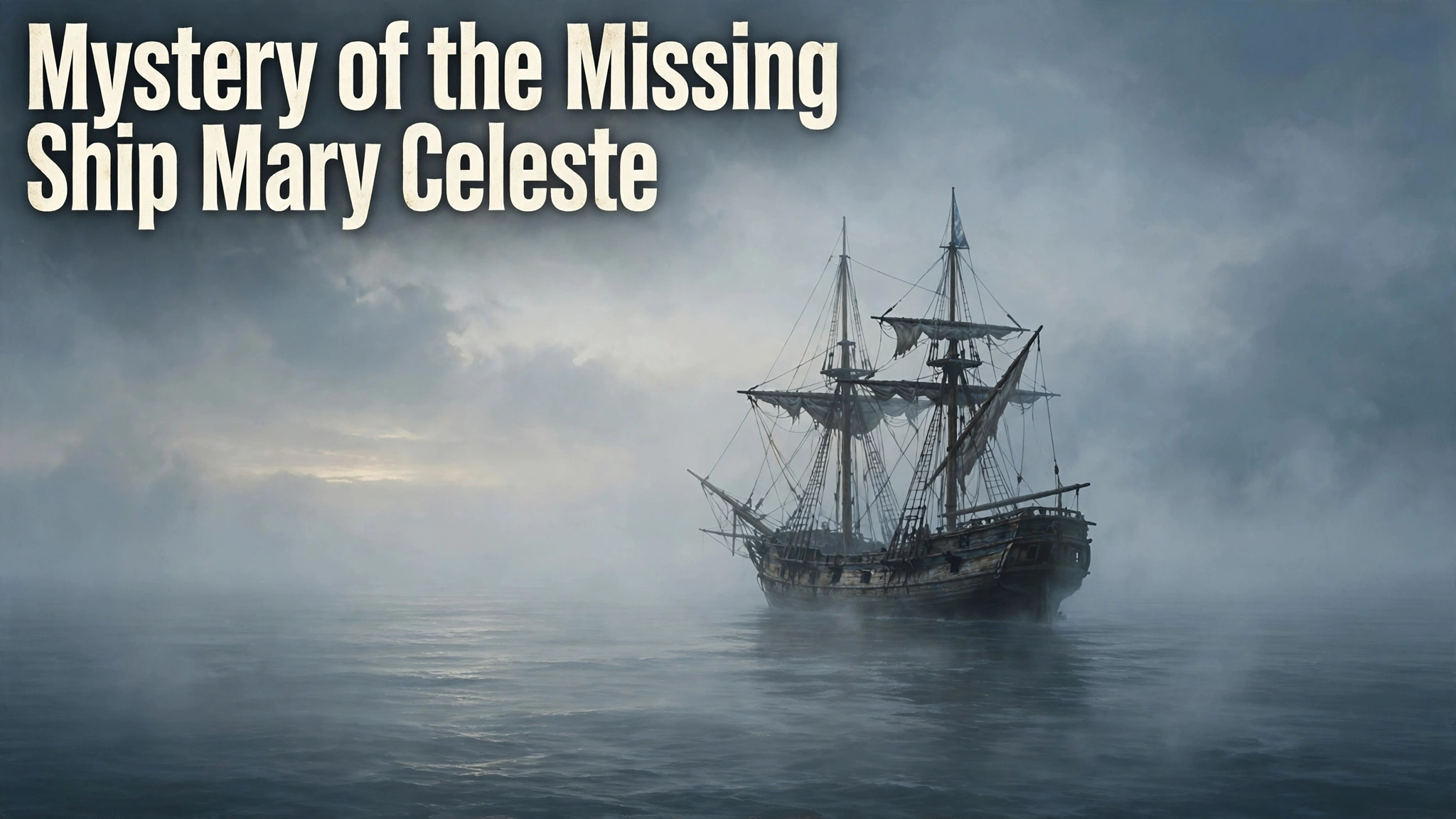
In this post
On 4 December 1872, the crew of the brigantine Dei Gratia spotted a ship drifting in the Atlantic Ocean between the Azores and Portugal. It was the Mary Celeste, a merchant vessel that had left New York almost a month earlier bound for Genoa in Italy, carrying a cargo of industrial alcohol. When sailors from the Dei Gratia boarded her, they found a scene that has puzzled the world ever since: the ship was seaworthy, her cargo largely intact, her crew’s belongings still in place, food and water aboard, and yet not a single person was on board. The lifeboat was gone, one pump was disassembled, and some sails were damaged, but there was no sign of violence, no distress message, and no clue strong enough to explain where ten people had gone. The Mary Celeste became the most famous ghost ship in history, not because of what was found, but because of what was missing.
The mystery endures for a simple reason: the evidence rules out the easy explanations while leaving several difficult ones open. There was no storm damage severe enough to sink her, no fire that consumed the ship, no pirate attack that looted her, and no mutiny evidence that fits the known crew. Later writers invented lurid details, including sea monsters, that were never in the original records, and those inventions still confuse readers today. This guide separates what is actually known from what was imagined later, walks through the voyage day by day as far as records allow, and weighs the main theories fairly, including the one most modern researchers favour. The Mary Celeste story is best understood not as a supernatural puzzle but as a human one: a series of reasonable decisions, made under fear and uncertainty at sea, that ended in tragedy.
The Ship, the Cargo, and the Crew
The Mary Celeste was a brigantine, a two-masted sailing vessel, built in Nova Scotia in 1861 under a different name and later renamed. By 1872 she was owned in New York and captained by Benjamin Briggs, an experienced and respected mariner from Massachusetts, who sailed with his wife Sarah and their two-year-old daughter Sophia, along with a crew of seven men. Briggs was known as a capable, religious, and careful captain, not a reckless one, which makes the mystery harder: this was not a ship run by an incompetent or unstable commander. The crew, largely from northern Europe and America, had good reputations, and there is no credible evidence of serious conflict aboard before departure.
The cargo was 1,701 barrels of commercial alcohol, a form of denatured alcohol used in industry, loaded in New York for delivery to Genoa. That cargo matters to the leading theory, because alcohol can release flammable vapour, and a leak or a perceived risk of explosion could frighten even an experienced crew. The ship also carried provisions for a long voyage, including food and water, and the personal belongings of the captain’s family. When the Dei Gratia crew boarded, they found the ship’s log with its last entry dated 25 November, about ten days before discovery, placing her roughly 400 nautical miles from the Azores at that point. The log showed nothing alarming, which deepens the puzzle: whatever happened appears to have happened suddenly, after a period of normal sailing.
The Voyage and the Discovery
The Mary Celeste left New York on 7 November 1872, after a delay caused by weather and repairs. The early part of the voyage seems to have been rough, with poor weather in the Atlantic, but the ship made progress toward Europe. The last log entry, on 25 November, recorded a position and ordinary conditions. After that, there is a gap until 4 December, when the Dei Gratia, under Captain David Morehouse, encountered her drifting. Morehouse knew Briggs, and the two captains had reportedly dined together before departure, which makes the discovery more personal and more credible: Morehouse had no reason to invent a mystery about a friend’s ship.
The boarding party found the ship in a strange but not catastrophic state. Her sails were partly set and partly damaged, her rigging was in some disarray, and one of her two pumps had been taken apart, suggesting the crew had been trying to deal with water in the hold. The lifeboat, normally carried on deck, was missing, and a rope appeared to have connected it to the ship at some point. The cargo was mostly intact, though some barrels were empty or damaged, and the crew’s belongings, including valuables, remained aboard, which argues strongly against piracy: pirates rarely leave cargo and valuables behind. The ship’s chronometer and sextant were missing, which the crew would have taken if leaving in the lifeboat to navigate. There was water in the hold, but not enough to sink her. The Dei Gratia crew sailed her to Gibraltar, where an investigation and salvage proceedings began, and where suspicion initially fell on the rescuers themselves before evidence cleared them.
What the Evidence Rules Out
The Gibraltar investigation, and later research, ruled out several popular explanations. Piracy is unlikely because nothing valuable was taken and the ship was not damaged in the way an attack would cause. Mutiny is unlikely because the crew had no known motive, the captain’s family would have been at risk, and a mutinous crew would more likely have taken the ship or its valuables rather than abandoning it in a small boat. A sudden storm is unlikely to explain a complete abandonment, because the ship survived and remained seaworthy, and experienced sailors do not usually abandon a sound ship for a small open boat in rough seas unless they believe the ship is about to sink or explode.
Supernatural explanations, including sea monsters, giant squid, and later inventions such as a crew eaten by a sea creature, have no evidence at all and mostly come from fiction written decades after the event. One famous fictional story, published in 1884 and presented as if it were a true account, invented details that many readers later mistook for fact, including a different captain’s name and dramatic scenes that never appeared in the official record. Historians warn readers to be careful with such stories: they are entertaining, but they are not evidence. Similarly, claims that the crew was found in strange positions or that the ship’s food was untouched in a sinister way are exaggerations. The real evidence is quieter and more human: a seaworthy ship, a missing lifeboat, and a crew that left in a hurry, taking navigational instruments, and never returned.
The Leading Theories
The theory most modern researchers consider strongest involves the alcohol cargo. Alcohol vapour can build up in a hold, and a leak, a broken barrel, or a sudden release of vapour could have led the crew to fear an explosion. If Captain Briggs believed the ship might explode, ordering everyone into the lifeboat, tethered to the ship by a rope while the danger passed, would have been a cautious and understandable decision. If that rope then parted, or if weather separated the boat from the ship, the crew would have been left in a small open boat in the Atlantic, with limited provisions, facing almost certain loss. This theory explains the missing lifeboat, the missing navigational instruments, the disassembled pump, and the lack of violence, and it fits Briggs’s character as a careful captain protecting his family. It cannot be proven, because the lifeboat was never found, but it fits more of the evidence than any rival theory.
Other theories have been proposed and debated. One suggests a waterspout, a tornado-like column over water, struck the ship, damaged sails, and frightened the crew into the lifeboat, after which the ship recovered and drifted away. Another suggests that the crew mistook the amount of water in the hold for a sinking emergency, perhaps because the pump was faulty, and abandoned a ship that was not actually sinking. A third suggests a combination: rough weather, a leaking cargo, and a faulty pump together created a false impression of imminent disaster. Less likely theories include an attack by a sea creature, a mass disappearance caused by some unknown natural phenomenon, and foul play by the Dei Gratia crew, which was investigated at the time and found unsupported. The honest conclusion is that we will probably never know exactly what happened, because the only witnesses were lost with the lifeboat, but the alcohol-vapour and false-alarm theories remain the most consistent with the physical evidence.
The Investigation, Salvage, and Aftermath
After the Dei Gratia crew brought the Mary Celeste to Gibraltar, a formal inquiry examined the ship, the cargo, and the rescuers themselves. Salvage law meant the Dei Gratia crew could claim a reward for saving the vessel, which initially made some officials suspicious that they might have had a motive to invent or exaggerate the mystery. That suspicion was investigated and not supported by evidence: the Dei Gratia crew’s account was consistent, the ship’s condition matched their description, and there was no sign they had taken valuables or harmed anyone. The inquiry ultimately awarded salvage, though less than claimed, and the ship itself was later sold, repaired, and returned to service under different owners, eventually wrecking off Haiti in 1885. The Mary Celeste’s later career is often forgotten, but it underlines an important point: the ship was sound enough to sail again, which makes the decision to abandon her even more poignant.
The fate of the missing people was never resolved by the inquiry, and no trace of the lifeboat or its occupants was ever reliably found. Reports of sightings, bodies, or wreckage surfaced over the years, but none could be verified as connected to the Mary Celeste, and many were almost certainly unrelated or invented. Families of the crew waited for news that never came in a conclusive form, a painful uncertainty that modern readers can easily underestimate. In an age without instant communication, a ship overdue at its destination could mean delay, wreck, or disappearance, and weeks passed before even the basic facts were known. The Gibraltar proceedings, the newspaper reports, and the later fictional retellings all shaped public memory, but the human core remained unchanged: ten people left a sound ship in a small boat and were never seen again.
Why the Mystery Still Captivates
The Mary Celeste endures in popular culture because it combines a real historical puzzle with an image that is easy to picture: an empty ship sailing on without its crew. It has inspired novels, films, songs, and countless articles, and the phrase ghost ship is now linked to it in the public mind, even though the ship itself was never supernatural. Part of the fascination is emotional: Captain Briggs’s wife and young daughter were aboard, which makes the loss feel more personal than an abstract maritime accident. Part of it is intellectual: the case is a perfect example of how evidence can be clear about what did not happen while remaining silent about what did, which invites every generation to propose a new theory.
The case also teaches a useful lesson about history and myth. Details get added, exaggerated, or invented over time, especially when a story is retold for entertainment, and those additions then get quoted as facts by later writers. Careful readers learn to ask where a detail comes from: is it in the ship’s log, the Gibraltar inquiry, or a contemporary newspaper, or does it first appear in a story written years later? That habit applies far beyond the Mary Celeste, to every famous mystery. The real story, stripped of invention, is sadder and more human than the legends: ten people, including a family, made a decision at sea that they believed would save them, and it did not. Remembering them as real people, rather than as characters in a ghost story, is the most respectful way to keep the mystery alive.
There is also a maritime safety lesson hidden in the mystery that modern sailors still study, even though ships have changed completely. The Mary Celeste case shows how a perceived emergency can be more dangerous than the actual condition of a vessel, because fear changes decision-making under isolation and stress. Modern safety training therefore emphasises verifying a danger before abandoning ship, communicating with other vessels where possible, keeping lifeboats and safety equipment ready but not rushing into them, and practising drills so that a crew reacts calmly rather than panicking when alarms sound. A captain today has radios, satellite communication, and rescue services that Briggs did not have, yet the human challenge remains the same: distinguishing a real sinking or fire from a false alarm, a faulty gauge, or a cargo vapour scare, while responsible for lives that depend on that judgement. Studying the Mary Celeste with that lesson in mind turns a ghost story into practical wisdom, and it honours the crew by learning from the very uncertainty that cost them their lives.
My Take:
My own view is that the alcohol-vapour theory, combined with a tethered lifeboat that came loose, is the most convincing explanation, not because it is dramatic, but because it is the least dramatic theory that fits the facts. I am always suspicious of mysteries where the most exciting explanation is also the least supported, and the Mary Celeste is a textbook case of that problem. Sea monsters and supernatural disappearances make better headlines, but they explain nothing about the pump, the lifeboat, the navigational instruments, or the intact cargo. A frightened but rational captain, worried about an explosion, ordering his family and crew into a lifeboat for safety, explains all of those details in one human decision. That is why I favour it, even though I accept it cannot be proven.
I also think Captain Briggs deserves more sympathy than he usually gets in retellings. Some versions of the story imply he panicked or made a foolish mistake, but put yourself in his position: you are responsible for your wife, your toddler, and seven crew members, you are carrying a cargo that can release flammable vapour, you have a pump problem, and you cannot be sure whether the danger is real or imagined. Waiting aboard a ship you believe might explode is not bravery; it is gambling with other people’s lives. Leaving temporarily, staying close to the ship on a rope, is exactly the kind of cautious decision a responsible captain would make. If the rope parted or the weather changed, that cautious decision became fatal through bad luck, not through incompetence. History should judge decisions by what the decision-maker knew at the time, not by what we know afterwards.
Another point I feel strongly about is the damage done by fictional retellings that presented themselves as fact. The 1884 story that invented details about the Mary Celeste is still quoted today, more than a century later, by people who have never checked the original inquiry. That should make all of us more careful readers. When a mystery story includes vivid dialogue, exact thoughts of people who died, or dramatic scenes with no source, we should ask how the writer could possibly know those things. If they could not, the story is fiction, however well written. The Mary Celeste does not need invented drama; the true facts, an empty ship, a missing family, and a voyage that ended in silence, are dramatic enough on their own.
I am also struck by how the Mary Celeste story reveals the limits of historical knowledge. We want a single answer, a neat explanation that closes the case, but some events simply do not leave enough evidence for certainty. The lifeboat was never found, the crew left no message, and the sea kept no record. Accepting that uncertainty is not a failure; it is honest history. It also makes the case a good test of critical thinking: can we hold several theories in mind, weigh them against evidence, and say that one is most likely while admitting we may never be sure? That skill matters far beyond old shipwrecks, because modern mysteries, from accidents to online rumours, present the same challenge.
I also think the Mary Celeste case is a good reminder that the sea itself is a powerful and unforgiving environment, even for experienced sailors. Modern readers, used to large ships with engines, radios, and rescue services, can forget how isolated a sailing ship in 1872 truly was. There was no way to call for help, no helicopter rescue, and no guarantee that another ship would pass. A small open lifeboat, even with provisions and navigational instruments, faced enormous waves, cold, thirst, and the sheer scale of the Atlantic. Whatever decision Captain Briggs made, it was made in a world where help was not coming quickly, and where a single broken rope or a change in weather could turn a temporary precaution into a final separation. That context should temper any judgement of his actions.
Finally, I think the most respectful way to remember the Mary Celeste is to remember the people, not just the puzzle. Benjamin and Sarah Briggs and their daughter Sophia, along with seven crew members whose names are less often repeated, were real people with families waiting for news that never came in a reassuring form. Their story ended in the Atlantic in December 1872, and no theory can change that. What we can do is tell their story accurately, without inventing monsters or villains, and let the mystery remind us how quickly a normal voyage can turn, how hard decisions at sea can be, and how much we owe to the evidence when we try to understand the past. That is a sadder ending than a ghost story, but it is a truer one, and truth is what makes this mystery worth revisiting.
If you take one habit from this story into your wider reading, let it be the habit of checking a source before repeating a dramatic detail. The internet has made the Mary Celeste problem worse, because a vivid invented fact can travel around the world in minutes, while a careful correction in an archive or a scholarly article travels slowly and reaches far fewer people. When you encounter a new claim about this case, or about any historical mystery, ask three simple questions: who first reported it, what evidence did they offer, and have independent experts checked it? If the answers are vague, the claim should stay in the category of interesting rumour, not move into the category of fact. That discipline does not spoil the mystery; it protects it, because a mystery that is honestly unsolved is far more fascinating, and far more respectful to those who died, than a mystery that is falsely solved for the sake of a headline.
The Mary Celeste also raises a question about how we treat uncertainty in public history. Museums, documentaries, and school lessons often feel pressure to give a single answer, because audiences prefer neat endings, but the honest answer here is a ranked list of possibilities with the alcohol-vapour and false-alarm theories at the top and supernatural claims at the bottom. Presenting the case that way is not less entertaining; it is more honest, and it teaches visitors to think like historians, weighing evidence rather than choosing a favourite story. If a museum or programme claims certainty about the Mary Celeste without new evidence, that certainty itself should be treated as a warning sign about its reliability. Good history, like good science, is comfortable saying what it does not know, and that comfort is a strength, not a weakness.
Frequently Asked Questions
What happened to the crew of the Mary Celeste? No one knows for certain, because the crew and lifeboat were never found. The most widely supported theory is that the crew left in the lifeboat fearing an explosion from the alcohol cargo, or believing the ship was sinking, and then became separated from the ship and were lost at sea.
When was the Mary Celeste found? The Mary Celeste was found drifting in the Atlantic on 4 December 1872 by the crew of the brigantine Dei Gratia. Her last log entry was dated 25 November 1872, so the crew had disappeared sometime in the days between those dates.
Was the Mary Celeste attacked by pirates? Piracy is considered unlikely because the cargo and the crew’s valuables were largely intact when the ship was found. Pirates would normally have taken valuables and cargo rather than leaving a seaworthy ship drifting with its goods aboard.
Why is the Mary Celeste called a ghost ship? It is called a ghost ship because it was found sailing without any crew aboard, yet still seaworthy and with cargo and belongings in place. The term describes the eerie image of an empty ship, not a supernatural claim about the vessel itself.
Did sea monsters or supernatural forces cause the Mary Celeste mystery? There is no evidence for supernatural explanations, and many dramatic details come from fiction written years after the event rather than from the ship’s log or the official inquiry. Historians treat such stories as entertainment, not evidence.
What cargo was the Mary Celeste carrying? The Mary Celeste was carrying 1,701 barrels of commercial alcohol bound from New York to Genoa in Italy. The nature of that cargo is central to the leading theory, because alcohol vapour could have led the crew to fear an explosion.