What Causes Tsunamis? Explained Simply
In this post
- The Main Cause: Undersea Earthquakes
- Landslides, Volcanoes, and Other Causes
- How a Tsunami Travels Across the Ocean
- The Warning Signs: What to Look For
- What to Do If a Tsunami Is Coming
- Tsunami Warning Systems and How They Have Improved
- Famous Tsunamis in History: What They Taught Us
- Tsunamis and Climate: Is the Risk Changing?
- My Take:
A tsunami is not a normal wave. A normal wave is made by wind blowing across the surface of the sea, and it affects only the top few metres of water. A tsunami is made by a sudden movement of the sea floor, or by a large object falling into the sea, and it moves the entire depth of the ocean, from the surface to the bottom. That is why a tsunami can travel across an ocean at the speed of a jet plane, and why it can arrive at a coast as a wall of water many metres high, with the power to destroy buildings, to carry ships inland, and to change a coastline in minutes.
The word “tsunami” comes from Japanese, and it means “harbour wave”, because tsunamis were often noticed first in harbours, where the water would rise or fall suddenly. In English, tsunamis are sometimes called “tidal waves”, but that name is misleading, because tsunamis have nothing to do with tides. They are caused by sudden, powerful events under or near the sea, and understanding those causes is the first step to understanding how to stay safe.
This guide explains, in simple words, what causes a tsunami, how it travels, what the warning signs are, and what to do if you are near the coast when one is coming. It is written for anyone who lives near the sea, who travels to coastal areas, or who simply wants to understand one of nature’s most powerful forces.
The Main Cause: Undersea Earthquakes
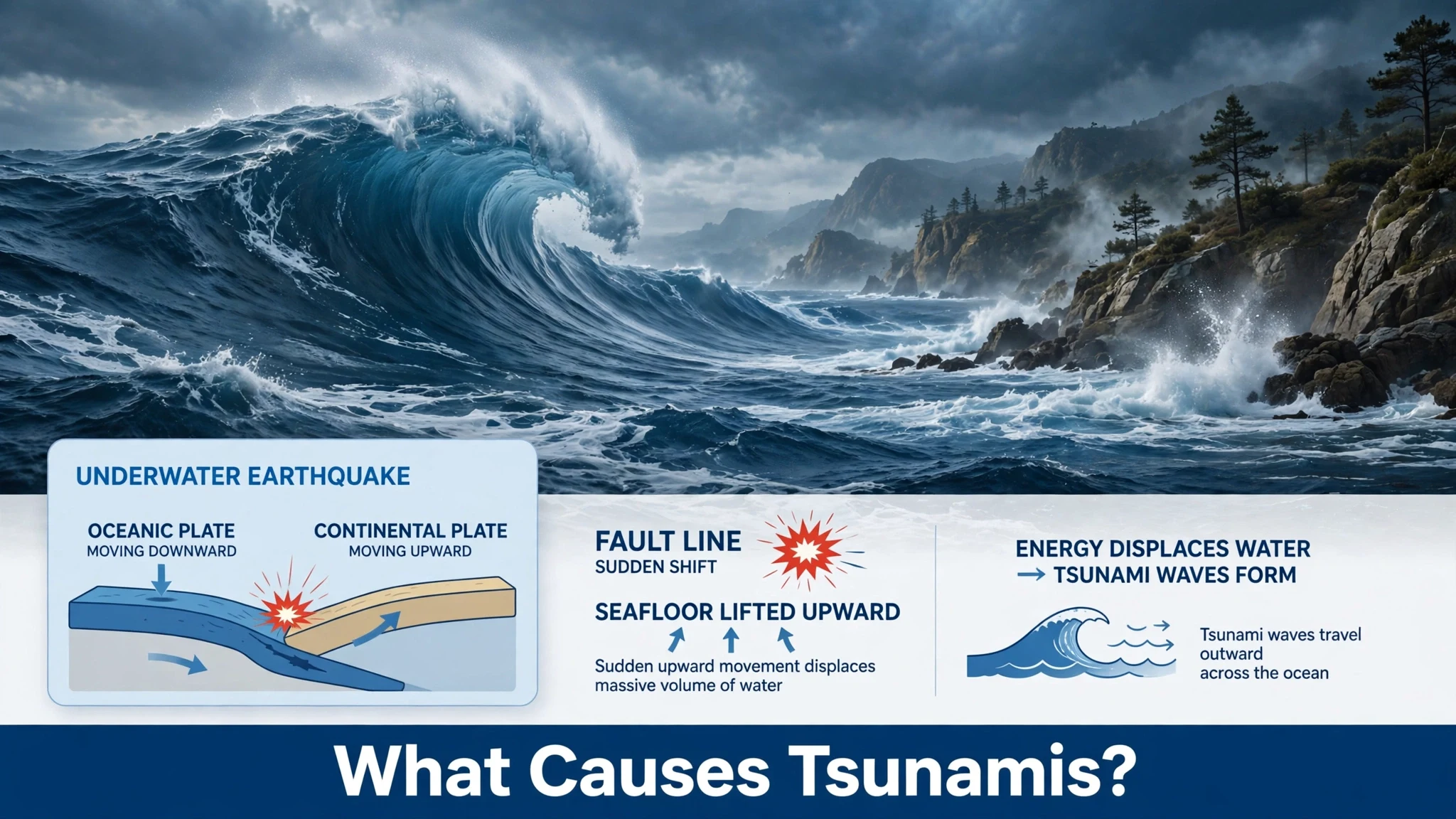
Most tsunamis — about four out of five — are caused by large undersea earthquakes. The Earth’s crust is made of plates that move slowly, and where two plates meet, pressure builds up over years or decades. When that pressure is released suddenly, the sea floor can move up or down by several metres in a few seconds. That sudden movement pushes a huge volume of water out of the way, and that water becomes a tsunami.
Not every undersea earthquake causes a tsunami. For a tsunami to form, the earthquake usually needs to be large — generally magnitude 7 or above — and it needs to move the sea floor vertically, up or down, rather than sideways. An earthquake that moves the ground sideways is less likely to displace water, and is therefore less likely to cause a tsunami. The depth of the earthquake also matters: a shallow earthquake near the sea floor is more likely to cause a tsunami than a deep earthquake far below the surface.
The most destructive tsunamis in recent history were caused by undersea earthquakes. The 2004 Indian Ocean tsunami, which killed more than 200,000 people in countries around the Indian Ocean, was caused by a massive earthquake off the coast of Sumatra, Indonesia. The 2011 tsunami in Japan, which caused the Fukushima nuclear disaster, was caused by a large earthquake off the north-east coast of Japan. Both events showed how a single earthquake, in the right place, can affect coastlines thousands of kilometres away.
Landslides, Volcanoes, and Other Causes
Earthquakes are the most common cause, but they are not the only one. A large landslide, either under the sea or on land near the coast, can also cause a tsunami, by pushing a large volume of water out of the way. An undersea landslide can be triggered by an earthquake, by a volcanic eruption, or by the collapse of a slope that has become unstable. A landslide on land, such as a cliff falling into the sea, can also displace water and create a wave that travels to nearby coasts.
Volcanic eruptions can cause tsunamis in several ways. An eruption under the sea can displace water directly. The collapse of a volcanic island, or the side of a volcano falling into the sea, can also displace a large volume of water. The eruption of the Hunga Tonga-Hunga Ha’apai volcano in Tonga in January 2022 caused a tsunami that was felt across the Pacific, and it showed that volcanic tsunamis can be powerful and can travel long distances, even when the eruption itself is far from populated coasts.
In rare cases, a meteorite falling into the ocean could cause a tsunami, though this has not been observed in modern times. Human activities, such as an underwater explosion, could also displace water, but the tsunamis caused by natural events are far larger and far more dangerous. The key point is that a tsunami is caused by a sudden, large displacement of water, whatever the source, and the larger the displacement, the larger the tsunami.
How a Tsunami Travels Across the Ocean
In the open ocean, a tsunami is almost invisible. The wave may be less than a metre high, and it may be spread over a hundred kilometres or more, so a ship at sea would hardly notice it passing. But the wave is moving very fast — as fast as 700 to 800 kilometres per hour in deep water, which is similar to the speed of a jet plane — and it carries an enormous amount of energy. Because the wave moves the entire depth of the ocean, it loses very little energy as it travels, and it can cross an entire ocean without becoming much smaller.
As the tsunami approaches shallow water near a coast, it slows down, and the energy that was spread over a deep ocean is compressed into a smaller volume of water. The wave grows taller, sometimes to ten, twenty, or even thirty metres, and it arrives as a fast-moving wall of water, or as a series of waves that flood inland. The first wave is not always the largest; later waves can be larger, and the flooding can continue for hours, with waves arriving every few minutes.
That is why a tsunami is so dangerous: it is not a single wave that comes and goes, but a series of waves, each one capable of carrying debris, of destroying buildings, and of pulling people and objects back out to sea as the water recedes. The water does not only come in; it also goes out, with great force, and that return flow can be just as dangerous as the arrival.
The Warning Signs: What to Look For
There are two kinds of warning signs for a tsunami: natural signs that you can see and feel, and official warnings issued by authorities. The natural signs are the most important, because they can give you minutes to act, and minutes can save lives. If you are near the coast and you feel a strong earthquake — one that makes it hard to stand, that lasts for more than twenty seconds, or that causes damage — do not wait for an official warning. Move to high ground immediately, or to a tall, strong building, and stay there until the authorities say it is safe.
Another natural warning sign is a sudden change in the sea. If the water at the coast suddenly recedes, exposing the sea floor, fish, and boats, that is a sign that a tsunami may be coming, and that the water will return with great force. If you see the sea behaving strangely, or hear a loud roaring sound from the ocean, like a train or a jet, move to high ground immediately. Do not go to the beach to look at the exposed sea floor, and do not wait to take photographs; the water can return in minutes, and it can be deadly.
Official warnings are issued by tsunami warning centres, which use seismic sensors, sea-level sensors, and buoys to detect a tsunami and to predict where it will go. In the Pacific, the Pacific Tsunami Warning Center issues warnings for many countries. In the Indian Ocean, a warning system was built after the 2004 tsunami. In other regions, national authorities issue warnings. If you receive an official tsunami warning, follow it immediately, and do not return to the coast until the warning is cancelled.
What to Do If a Tsunami Is Coming
If you are near the coast and you feel a strong earthquake, or you see the sea recede, or you receive a tsunami warning, the rule is simple: move to high ground, and move fast. Go to a place that is at least 30 metres above sea level, or at least two kilometres inland, if you can. If you cannot reach high ground, go to the top floor of a tall, strong building, and stay there. Do not go to a low-lying area, do not stay in a car near the coast, and do not try to outrun the wave in a vehicle if the road is congested.
Take your family, your go-bag if it is ready, and your phone, but do not waste time packing. The most important thing is to move. If you are in a school, a hotel, or a workplace near the coast, follow the evacuation plan for that building, and follow the instructions of staff and emergency services. If you are with children, hold their hands, keep them calm, and move together.
After the first wave, do not return to the coast. Later waves can be larger, and the flooding can continue for hours. Wait for the official all-clear, and listen to local authorities. If you are trapped, call emergency services, stay in a safe place, and wait for help. Do not try to swim in tsunami water, which is full of debris, and which can carry you out to sea.
Tsunami Warning Systems and How They Have Improved
After the 2004 Indian Ocean tsunami, which killed more than 200,000 people, many countries invested in tsunami warning systems. These systems use seismic stations to detect earthquakes, deep-ocean buoys to detect changes in sea level, and communication networks to send warnings to coastal communities. The goal is to give people as much time as possible to evacuate, and to make sure the warning reaches everyone, including tourists, fishermen, and people who do not speak the local language.
Warning systems have improved, but they are not perfect. A tsunami generated close to the coast — a local tsunami — may arrive within minutes, before an official warning can be issued, which is why natural warning signs are so important. A tsunami generated far away — a distant tsunami — may take hours to arrive, which gives more time for an official warning, but also creates a risk that people will ignore the warning because the sea looks calm.
Education is therefore as important as technology. Communities in tsunami-prone areas are taught to recognise the natural signs, to know the evacuation routes, and to practise evacuation drills. Schools, hotels, and workplaces in coastal areas often have tsunami evacuation plans, and visitors should ask about them when they arrive. A warning system is only useful if people know what to do when they hear it.
Famous Tsunamis in History: What They Taught Us
History has many examples of tsunamis, and each one taught the world something new. The Lisbon earthquake of 1755 caused a tsunami that struck Portugal, Spain, and North Africa, and it changed how Europeans thought about natural disasters. The 1896 tsunami in Japan, known as the Meiji Sanriku tsunami, killed thousands of people and led to the first tsunami warning systems in Japan. The 1946 tsunami in Hawaii, caused by an earthquake in Alaska, led to the creation of the Pacific Tsunami Warning Center.
The 2004 Indian Ocean tsunami was the deadliest in modern history, and it led to the creation of warning systems in the Indian Ocean, to new building codes in coastal areas, and to a greater awareness of tsunami risk around the world. The 2011 tsunami in Japan led to changes in nuclear safety, in coastal defences, and in evacuation planning. Each disaster was a tragedy, but each one also led to improvements that have saved lives since. Remembering that history is part of preparing for the next tsunami.
Tsunamis and Climate: Is the Risk Changing?
Tsunamis are caused by earthquakes, landslides, and volcanoes, not directly by climate change, but climate change can affect the risk in indirect ways. Rising sea levels mean that a tsunami of the same height will flood further inland than it would have in the past, because the starting point is higher. Warmer oceans and changing weather can also affect coastal erosion, which can make a coastline more vulnerable to flooding. Scientists are studying these links, and coastal planners are taking them into account when they design defences and evacuation routes. The key point is that a coastline that was safe fifty years ago may be less safe today, and evacuation plans should be reviewed regularly.
My Take:
My honest view is that tsunamis are frightening not only because they are powerful, but because they are invisible until it is almost too late. In the open ocean, a tsunami is a wave less than a metre high, moving at the speed of a jet, and a ship would not notice it. At the coast, it becomes a wall of water that can destroy a town in minutes. That contrast — between invisibility and destruction — is what makes tsunamis so dangerous, and it is why education matters more than any single piece of technology. A person who knows the natural warning signs, who knows to move to high ground after a strong earthquake, and who does not wait for an official warning, is far more likely to survive than a person who waits to see the wave.
I also believe that the 2004 Indian Ocean tsunami changed the world in a way that is still felt today, because it showed how unprepared many countries were, and how many lives could have been saved by a warning system and by public education. The warning systems that were built afterwards, in the Indian Ocean and in other regions, are a direct result of that disaster, and they are a reminder that we learn from tragedy, even when the learning comes too late for those who died. I think we should honour that lesson by continuing to invest in warning systems, in education, and in evacuation drills, not only in the years after a disaster, but in the quiet years when the sea looks calm.
Another point I care about is the way we talk about tsunamis to children and to visitors. A child who lives near the coast should know what to do if the ground shakes, in the same way they know what to do if there is a fire. A tourist who visits a coastal area should be told about the evacuation route, in the same way they are told about the fire exit in a hotel. That information is not frightening; it is empowering, because it gives a person a plan, and a plan reduces panic. I would like to see tsunami education treated as a normal part of life in coastal areas, not as a special topic that is only discussed after a disaster.
On the subject of science, my view is that understanding how a tsunami works makes it less mysterious and more manageable. A tsunami is not a punishment, and it is not a mystery; it is a physical process, caused by a sudden movement of water, and it follows rules that scientists understand. That understanding does not make the wave less powerful, but it does make it more predictable, and predictability saves lives. I think science communication matters here: when scientists explain a tsunami in simple words, when they show how it travels and why it grows near the coast, they give people the knowledge they need to act. That is a public service, and it should be valued as highly as the warning system itself.
I also think that we need to remember the human side of tsunamis, not only the science. A tsunami destroys homes, schools, and livelihoods, and it leaves communities to rebuild for years. The recovery after a tsunami is long, and it involves not only rebuilding buildings, but rebuilding lives, supporting families who have lost loved ones, and helping children who have been traumatised. If you live in a tsunami-prone area, get to know your neighbours, support your local emergency services, and be ready to help after a disaster, not only before it. That community spirit is what makes recovery possible, and it is what turns a warning system into a living, human network.
Finally, I believe that the most important lesson from tsunamis is a simple one: when the earth shakes near the coast, move to high ground, and do not wait. That rule is easy to remember, it costs nothing, and it can save your life. Teach it to your children, share it with visitors, and remember it yourself, even if you have lived near the sea for years without seeing a tsunami. The sea is beautiful, and it is generous, but it is also powerful, and respecting that power is the best way to enjoy it safely. I would also add that this rule should be taught to tourists as clearly as it is taught to residents, because a visitor who does not know the local warning signs is at greater risk than a local who has practised an evacuation. Hotels, guesthouses, and tour operators should tell visitors about the evacuation route when they arrive, in the same way they tell them about the fire exit, and that simple step could save lives.
I also want to add a thought about history, because the tsunamis of the past have taught us lessons that are still saving lives today. The warning systems, the evacuation routes, and the building codes that exist now are the result of tragedies that should never have happened, and they are a reminder that we learn from loss. I think we should honour that learning by keeping the systems working, by practising evacuations, and by teaching the next generation what to do. A warning system that is not maintained, or a plan that is not practised, is not a warning system at all.
One more point is about rising sea levels and changing coasts. A tsunami that floods a certain distance today may flood further in the future, because the sea level is higher and the coastline has changed. That means evacuation plans should be reviewed, not only after a disaster, but regularly, as the coast changes. It also means that building in a low-lying coastal area should be done with care, with an understanding of the risk, and with a plan for evacuation. The sea will always be powerful, and our job is to live with it wisely, not to pretend that it is not.
A final thought on preparedness: a tsunami is rare, and most people who live near the sea will never experience one, but the cost of being unprepared is so high that a few minutes of learning is worth it. Know the natural warning signs, know your evacuation route, and teach them to your family. That knowledge costs nothing, it takes only a few minutes to learn, and it could save your life and the lives of the people you love. The sea gives us food, beauty, and joy, and respecting its power is the best way to keep enjoying it safely for years to come.
Frequently Asked Questions
What causes a tsunami?
Most tsunamis are caused by large undersea earthquakes that move the sea floor up or down, displacing a huge volume of water. Landslides, volcanic eruptions, and, rarely, other sudden events can also cause tsunamis.
Is a tsunami the same as a tidal wave?
No. A tsunami has nothing to do with tides. It is caused by a sudden displacement of water, usually by an earthquake, while tides are caused by the gravitational pull of the moon and the sun.
How fast does a tsunami travel?
In deep ocean, a tsunami can travel at 700 to 800 kilometres per hour, similar to a jet plane. It slows down as it approaches shallow water near the coast, but it grows taller.
What are the warning signs of a tsunami?
A strong earthquake near the coast, a sudden receding of the sea exposing the sea floor, a loud roaring sound from the ocean, and an official tsunami warning are all signs. If you notice any of these, move to high ground immediately.
What should I do if a tsunami warning is issued?
Move to high ground at least 30 metres above sea level, or at least two kilometres inland, or to the top floor of a tall, strong building. Do not return to the coast until the authorities say it is safe, as later waves can be larger.
Can a tsunami be predicted?
Scientists can detect an earthquake and a tsunami after it forms, and warning centres can predict where it will go and when it will arrive, but they cannot predict exactly when an earthquake will happen. Natural warning signs are therefore essential.