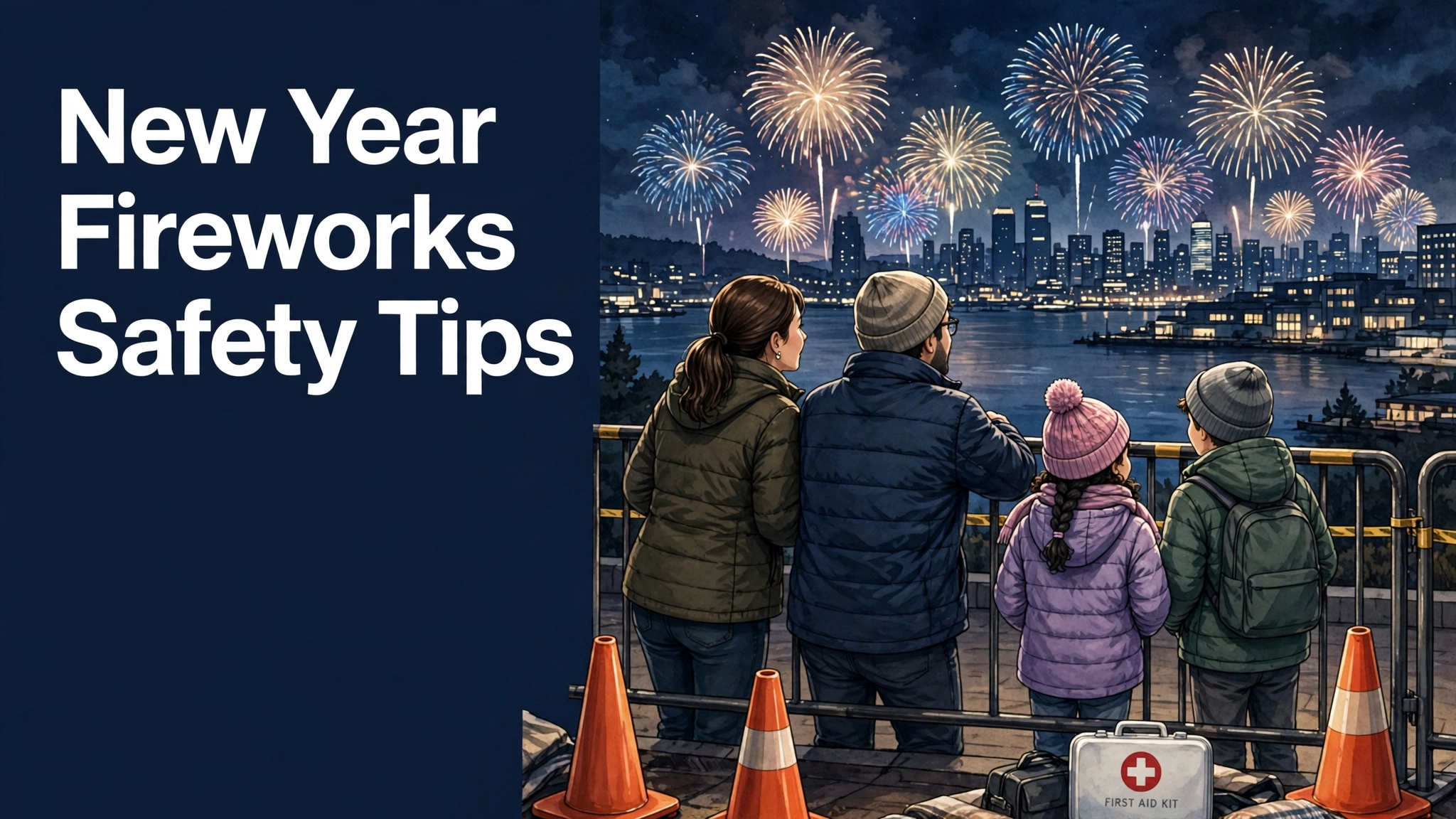
New Year Fireworks Safety Tips 2027
In this post
- Choose a Professional Display Whenever You Can
- If You Use Fireworks at Home: Laws, Buying and Setting Up
- Sparklers, Children and the Risks People Underestimate
- Protecting Pets, Wildlife and Neighbours
- After the Display: Cleanup, Injuries and Emergency Actions
- Quiet Fireworks and Alternatives for Sensitive Celebrations
- My Take:
Fireworks are the sound and light of New Year: bursts of colour against a dark sky, crowds counting down together, and a shared gasp as each display reaches its finale. They are also, by their nature, explosives, and every year they cause injuries, fires, and distress to people and animals, many of which could have been prevented. Enjoying fireworks safely does not mean giving up the celebration. It means making a few sensible choices: choosing professional displays where possible, following local laws, keeping a safe distance, protecting children and pets, and knowing what to do if something goes wrong. This guide offers general safety information for New Year fireworks in 2027. It is not a substitute for local laws or professional advice, and readers should always check the rules that apply in their own area, because fireworks laws vary widely by country, region, and city.
The most important safety fact about fireworks is also the simplest: professional displays are far safer than home fireworks. Professional displays are planned by licensed operators, set up at safe distances, checked for weather and wind, and supervised by fire and safety personnel. Home fireworks, even small ones, carry risks from faulty products, incorrect handling, wind changes, and bystanders standing too close. Many safety organisations therefore recommend attending a public display rather than setting off fireworks at home, and that advice is worth following, especially for families with children. A public display offers a bigger, better show, without the risk, cost, and cleanup of home fireworks, and it allows everyone to enjoy the celebration without worrying about safety.
That said, home fireworks are legal in many places, and many people will use them. For those readers, this guide explains how to reduce risk, while being clear that no home use is risk-free and that local laws must be followed first. Laws may restrict which fireworks can be bought, where and when they can be used, who can buy them, and how close they can be to buildings, roads, and animals. Breaking those laws can result in fines and, more importantly, can put neighbours and emergency services at risk. Checking local rules before buying or using fireworks is not bureaucracy. It is the first safety step, and it should never be skipped.
Choose a Professional Display Whenever You Can
Attending a professional New Year display is the safest and often the most spectacular way to enjoy fireworks. Professional shows use larger, more impressive fireworks than home products, choreographed to music and designed to be seen from a distance, which means the audience enjoys a better view without being near the launch site. Organisers also manage crowds, provide barriers, first aid, and emergency access, and monitor weather conditions, postponing or adjusting the show if wind or rain makes it unsafe. For families, professional displays remove the stress of handling explosives while children are nearby, and they allow parents to focus on enjoying the evening rather than supervising fireworks.
Choosing a good display requires a little planning. Check official event pages for start times, viewing areas, entry requirements, and any ticket or booking needs, because popular displays, especially in major cities, may have controlled viewing zones or require advance booking in recent years. Arrive early to secure a good viewing spot, especially with children, and choose a spot with a clear view, an easy exit route, and access to facilities such as toilets and food stalls. Avoid standing under trees, near buildings, or in areas marked as restricted, and follow stewards’ instructions, even if a different spot looks tempting. Stewards are there to keep the audience at a safe distance from falling debris, and ignoring barriers puts everyone at risk.
For children at professional displays, preparation makes the experience enjoyable rather than frightening. Explain what will happen, including loud bangs and bright flashes, before the show starts, and consider ear protection for young children, such as ear defenders or earplugs designed for children, because fireworks can be loud enough to cause discomfort or, with repeated exposure, hearing damage. Keep children close in crowds, agree on a meeting point in case you are separated, and dress them warmly with a hat and gloves, because standing still on a cold night chills children quickly. A child who is warm, can hear comfortably, and understands what is happening will enjoy fireworks far more than one who is cold, startled, and lost in a crowd.
If You Use Fireworks at Home: Laws, Buying and Setting Up
If home fireworks are legal in your area and you choose to use them, start by checking local laws carefully. Find out which categories of fireworks are permitted for public use, whether there are restrictions on times, such as a curfew after midnight, and whether fireworks are banned near hospitals, animal shelters, thatched roofs, or other sensitive areas. Some areas require notification of neighbours, especially those with animals, and some cities ban home fireworks entirely, permitting only professional displays. Ignorance of the law is not a defence, and a New Year celebration that breaks the law and disturbs neighbours is a poor start to the year. When in doubt, choose a professional display instead.
Buy fireworks only from licensed, reputable sellers, and never buy from unlicensed street sellers, online sellers without clear safety information, or sellers offering altered or professional-grade fireworks to the public. Check that fireworks carry safety markings required in your country, that packaging is undamaged, and that instructions are in a language you understand. Store fireworks in a cool, dry place, away from heat, flames, and children, in their original packaging, and never store them in a pocket, near a fire, or in a car boot for long periods. Keep fireworks dry, because damp fireworks may fail to light properly and then ignite unexpectedly, and never attempt to modify, combine, or dismantle fireworks. A firework that has been altered is unpredictable and far more dangerous than one used as intended.
Setting up safely is as important as buying safely. Choose a flat, open area away from buildings, trees, overhead wires, dry grass, and parked cars, with enough space for the safety distances stated on each firework’s instructions, which vary by type and size. Clear the area of flammable materials, keep a bucket of water, a hose, or a fire extinguisher nearby, and designate one responsible adult as the person who lights fireworks, sober and focused, while other adults supervise children and spectators. Spectators, especially children, should stand well behind the lighting area, at the distance recommended on the packaging, and should never approach a firework that has been lit. Light fireworks one at a time, using a long lighter or taper, standing to the side rather than leaning over the firework, and moving away promptly after lighting. Never relight a firework that fails to go off; leave it for a long time, as instructions advise, often at least 30 minutes, then soak it in water and dispose of it safely, following local guidance.
Sparklers, Children and the Risks People Underestimate
Sparklers look harmless, especially compared with rockets and large fireworks, but they are one of the most underestimated risks of New Year celebrations. Sparklers burn at extremely high temperatures, commonly reported as hot enough to melt metal and cause serious burns, and they remain hot after they appear to have gone out. Children, who are naturally drawn to sparklers because they are small, bright, and handheld, are at particular risk, because they may hold them too close to their face, clothing, or another child, or may pick up a hot sparkler stick after use. Safety organisations in several countries advise that sparklers should not be given to young children, and that older children should use them only with close adult supervision, wearing gloves, holding them at arm’s length, and keeping them away from faces, hair, and clothing.
If sparklers are used, follow simple rules strictly. Only one sparkler per person at a time, never wave sparklers near others, never run with a sparkler, and never hold a sparkler close to another person’s face. Provide a bucket of water for used sparklers, and place each spent sparkler in the water immediately, because the wire remains hot and can burn skin or ignite materials. Keep a first-aid kit nearby, and know how to treat a burn: cool the burn with cool running water, cover it loosely, and seek medical help for large, deep, or facial burns, or for burns on a child. This is general first-aid information only; serious burns need professional medical attention promptly, and emergency services should be called if a burn is severe, if a person is in shock, or if a firework has caused an eye injury.
Children and fireworks in general require clear boundaries. Children should never light fireworks, never handle fireworks except for sparklers under strict supervision where appropriate, and never be allowed to play with fireworks packaging, matches, or lighters. Adults should explain fireworks safety to children before the celebration, in simple terms: fireworks are not toys, we watch from a safe distance, we never touch a firework that has been lit, and we tell an adult immediately if we find a firework on the ground. Setting these rules in advance, when children are calm, works far better than shouting instructions during a noisy display. Adults should also model safe behaviour themselves, because children copy what they see. An adult who lights fireworks carelessly, drinks while handling them, or encourages children to stand too close teaches children that fireworks safety does not matter, whatever words are said.
Protecting Pets, Wildlife and Neighbours
Fireworks cause significant distress to animals, and New Year is one of the hardest nights of the year for pets, wildlife, and livestock. Dogs, cats, horses, and other animals hear fireworks far more acutely than humans, and the unpredictable bangs, flashes, and smells can cause panic, escape attempts, injuries, and, in severe cases, lasting anxiety. Pet owners should plan ahead: keep pets indoors on New Year’s Eve, close curtains and windows to muffle sound and block flashes, provide a safe hiding place such as a covered crate or a quiet room, and stay with pets if possible, offering calm reassurance without excessive fuss, which can sometimes increase anxiety. Background music or television can help mask firework sounds, and a familiar blanket or toy provides comfort. Owners of animals with severe firework anxiety should consult a veterinarian well before New Year’s Eve about behavioural and, where appropriate, medical options, rather than waiting until the night itself.
Wildlife and livestock also suffer from fireworks, although their distress is less visible. Birds may flee roosts at night, disoriented by flashes and noise, and may collide with buildings or become separated from flocks. Livestock, especially horses, may panic and injure themselves on fences or in stables. Firework users should therefore avoid setting off fireworks near nature reserves, farms, stables, and animal shelters, and should consider the wider impact of their celebration beyond their own garden. Professional displays, sited away from sensitive areas and announced in advance, allow animal owners to prepare, while unexpected home fireworks give no such warning. Notifying neighbours, especially those with pets or livestock, before using home fireworks is a basic courtesy that allows them to protect their animals, and it is required or encouraged in some areas.
Neighbours in general deserve consideration on New Year’s Eve. Not everyone celebrates with fireworks, and some neighbours may be elderly, ill, working night shifts, or caring for young babies who need sleep. Keeping fireworks to a reasonable time window, following local curfews, avoiding excessively loud fireworks where quieter options exist, and cleaning up debris from streets and gardens afterwards are all part of being a good neighbour. Firework debris, including paper, plastic, and unexploded material, should be collected and disposed of safely, not left for others to clear or for animals to eat. A celebration that respects neighbours and animals is a better celebration, and it is more likely to be welcomed next year. The new year should begin with goodwill, not with complaints, damage, or frightened animals.
After the Display: Cleanup, Injuries and Emergency Actions
After fireworks, whether professional or home, cleanup and safety checks matter. For home fireworks, wait until all debris is cold before handling it, soak used fireworks in water, and dispose of them according to local guidance, never placing hot debris in a bin where it could start a fire. Check the launch area, gardens, roofs, and nearby streets for smouldering material, especially in dry weather, and check that no firework has landed on a roof, in guttering, or in dry vegetation, where it could smoulder unnoticed. If you find an unexploded firework, do not handle it, do not attempt to relight it, and contact local authorities or fire services for advice on safe disposal, following their instructions exactly.
Injuries from fireworks, although often preventable, require prompt, calm action. For burns, cool with cool running water, remove jewellery and loose clothing near the burn unless stuck, cover loosely with a clean, non-stick dressing, and seek medical help for burns that are large, deep, on the face, hands, feet, or genitals, or on a child. For eye injuries, do not rub the eye, do not apply pressure, and seek emergency medical help immediately, because firework eye injuries can threaten sight. For any serious injury, heavy bleeding, breathing difficulty, or loss of consciousness, call emergency services immediately and follow their instructions. This guide offers general information only and is not a substitute for professional first-aid training or medical advice; readers who regularly handle fireworks or attend displays may benefit from a basic first-aid course.
Finally, reflect on the celebration after it ends. If you attended a professional display, thank organisers, support local businesses, and share photographs and memories with friends. If you used home fireworks, note what worked well and what could be improved next year, such as buying fewer fireworks, choosing quieter options, notifying neighbours earlier, or deciding to attend a professional display instead. Many people who try home fireworks once decide that professional displays are more enjoyable, less stressful, and better value, especially when the cost of buying, setting up, and cleaning up home fireworks is added up. Whatever you choose next year, the goal remains the same: a New Year that begins with light, joy, and safety, for people, pets, and neighbours alike, and a celebration that everyone can remember happily.
Quiet Fireworks and Alternatives for Sensitive Celebrations
Not every celebration needs loud fireworks, and a growing number of displays now offer quieter or alternative options that suit sensitive audiences. Low-noise fireworks, designed to produce colour and light with reduced bangs, are used at some professional displays, especially those aimed at families with young children or near animal areas, and they offer much of the visual beauty with less distress. Drone light shows, where hundreds of illuminated drones form pictures and patterns in the sky, are another alternative gaining popularity in cities, producing spectacular, silent displays without explosives, smoke, or debris. Laser shows and projection shows offer similar visual excitement indoors or on buildings, and they can be enjoyed by people and animals who find fireworks frightening.
For home celebrations, alternatives include sparklers used safely outdoors where appropriate, glow sticks and LED wands for children, confetti poppers, and a midnight toast with sparkling drinks, all of which create a sense of occasion without explosives. A family that chooses a quieter celebration is not missing out. They are choosing a celebration that suits their household, their pets, and their neighbours, and that choice deserves respect rather than teasing. Organisers of public events can help by advertising quiet displays clearly, offering ear protection, and providing viewing areas further from launch sites for sensitive visitors. The future of New Year celebrations is likely to include more choice, not less, and that choice, between loud, quiet, and silent spectacles, is a welcome development for everyone who loves the lights but not the noise.
My Take:
My opinion on fireworks is that they are beautiful, thrilling, and far more dangerous than most people admit, and that our celebrations would be better if we were honest about that combination instead of pretending fireworks are either completely safe or completely unacceptable. I love a good fireworks display. There is something genuinely moving about standing in a crowd, counting down together, and watching the sky fill with colour at midnight. That shared moment, with strangers cheering together, is one of the few times modern life feels communal. But I also think that love for fireworks should come with respect for what they are: explosives, designed to burn and explode, handled in the dark, often by people who have been drinking. Respect is not the enemy of enjoyment. It is what makes enjoyment possible without regret.
I am firmly in favour of professional displays, and I think the argument for them is overwhelming. A professional display is bigger, better choreographed, safer, and often cheaper, per person, than a home display, because the cost is shared across a whole crowd. It also removes the worst risks: children near explosives, drunken handling, faulty products, and fireworks landing on roofs or in gardens. I do not understand why anyone with children would choose a small, risky home display over a large, safe public one, unless no public display is available. If your town offers a professional show, go to it. Enjoy it fully. Leave the explosives to the professionals, and spend your New Year’s Eve watching the sky instead of worrying about it.
On home fireworks, my view is not a ban, but a high bar. If home fireworks are legal where you live, and you choose to use them, then do it properly or not at all: check the law, buy from licensed sellers, set up with correct distances, designate a sober adult to light them, keep children and spectators far back, and clean up afterwards. Half measures, such as lighting fireworks while drinking, letting children hold sparklers unsupervised, or ignoring safety distances because the garden is small, are not harmless shortcuts. They are the decisions that lead to the injuries reported every January. A garden that is too small for safe distances is a garden that should not have fireworks at all, however disappointing that feels. Disappointment fades. A burn, an eye injury, or a house fire does not.
I feel particularly strongly about sparklers, because they are marketed, implicitly, as safe fireworks for children, when they are anything but. A sparkler burns hot enough to cause a serious burn in an instant, and it looks like a toy, which is a dangerous combination. I have seen parents hand sparklers to toddlers, take photographs, and not realise that the child is holding something hotter than a cooking pan. That is not bad parenting in the sense of cruelty. It is a failure of information, and it is why safety campaigns matter. If this guide prevents even one parent from giving a sparkler to a very young child, it will have been worth writing. Older children, with gloves, supervision, and clear rules, can enjoy sparklers safely, but young children should watch them from a distance, not hold them.
On pets and neighbours, my opinion is that fireworks users have a responsibility that extends beyond their own garden fence, and that responsibility is too often ignored. A dog that spends New Year’s Eve trembling under a bed, a horse that injures itself in panic, or an elderly neighbour who cannot sleep because of hours of explosions, are not acceptable side effects of someone else’s fun. They are harms, and they should weigh in the decision to use fireworks. Notifying neighbours, keeping displays short and within legal hours, choosing quieter fireworks where available, and considering professional displays, which are announced in advance, are not excessive demands. They are basic courtesy, and a celebration that ignores courtesy is a poor way to begin a year that is supposed to be about goodwill.
I am also sceptical of the idea that more fireworks mean a better New Year. The best displays I have seen were not the longest or the loudest. They were the ones with pauses, with variety, with music, and with a finale that felt earned rather than merely loud. A home display that fires dozens of rockets as fast as possible is not impressive. It is noisy, wasteful, and dangerous, and it leaves neighbours and animals stressed for no artistic gain. Restraint, in fireworks as in many things, is a sign of good taste. Fewer, better-chosen fireworks, set off safely and at a reasonable hour, will be remembered more fondly than a chaotic barrage that ends with someone injured or a garden on fire.
Finally, I believe New Year fireworks should be judged by the morning after, not by midnight itself. A good New Year celebration leaves you with happy memories, no injuries, no damage, no frightened animals, and no angry neighbours. A bad one leaves you with a story you wish you could undo. That test is simple, and it applies to every celebration, not only fireworks. If we all asked, before lighting anything, “Will I be glad I did this tomorrow morning?”, many of the worst fireworks decisions would never be made. Fireworks, enjoyed safely and respectfully, can be a wonderful start to a year. Enjoyed carelessly, they can ruin one. The choice is ours, every New Year’s Eve, and I hope readers of this guide choose the safer, kinder version, for themselves, for their children, for their pets, and for their neighbours.
One final habit I would encourage: check on your neighbours the morning after fireworks, especially elderly neighbours and those with pets, and help clear any debris that landed in their gardens. That small act turns a celebration into good citizenship, and it repairs any disturbance the night may have caused. A new year that begins with a knock on a neighbour’s door, asking if they and their animals are all right, and offering to help tidy up, is a year that has started with exactly the right spirit. Fireworks fade in seconds, but neighbourliness lasts, and it is neighbourliness, more than any display, that makes a community worth celebrating in.
Frequently Asked Questions
Is it safer to attend a professional fireworks display than to use fireworks at home?
Yes. Professional displays are planned by licensed operators at safe distances, with crowd management, first aid and weather monitoring. They offer a larger show without the risks of handling fireworks at home, and safety organisations commonly recommend them, especially for families.
What should I do if a firework fails to go off?
Never relight it. Leave it for a long time, as its instructions advise, often at least 30 minutes, then soak it in water and dispose of it following local guidance. If you find an unexploded firework, do not handle it and contact local authorities or fire services for advice.
Are sparklers safe for children?
Sparklers burn at extremely high temperatures and can cause serious burns, so they should not be given to young children. Older children should use them only with close adult supervision, wearing gloves, holding them at arm’s length, and placing used sparklers immediately in a bucket of water.
How can I protect my pet from New Year fireworks?
Keep pets indoors, close curtains and windows, provide a safe hiding place, stay with them if possible, and use background music or television to mask sounds. For animals with severe firework anxiety, consult a veterinarian well before New Year’s Eve about behavioural and medical options.
Do I need to check local laws before using fireworks at home?
Yes, always. Fireworks laws vary widely by country, region and city, covering which fireworks are permitted, when they can be used, and where they are banned. Check official local rules before buying or using fireworks, and choose a professional display if home use is restricted.
What first aid should I know for fireworks burns?
Cool burns with cool running water, cover loosely with a clean dressing, and seek medical help for large, deep, facial or childhood burns. For eye injuries, do not rub or press the eye and seek emergency help immediately. This is general information only; serious injuries need professional care promptly.