How Volcanoes Erupt Explained Simply
In this post
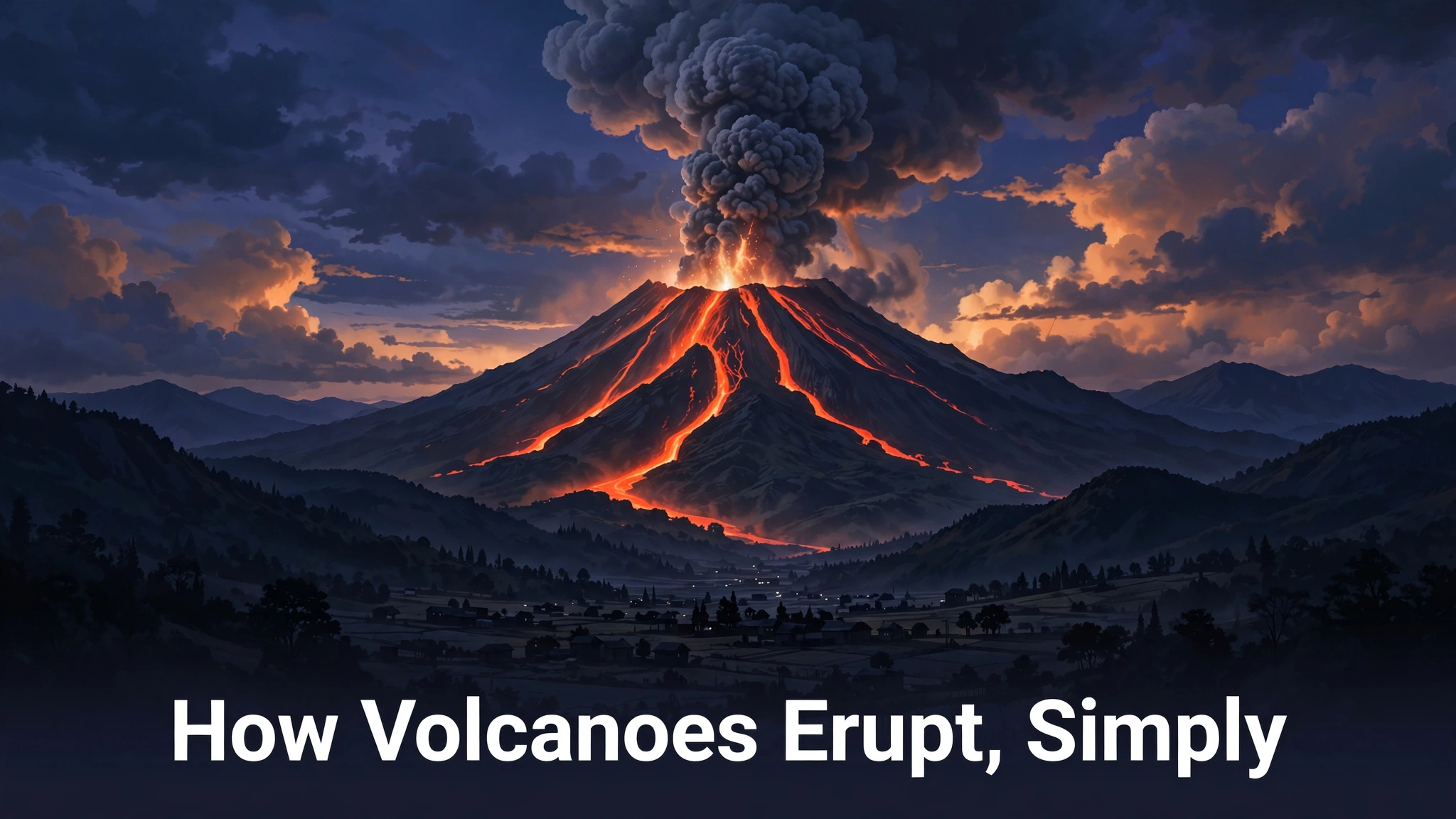
A volcano is not a mountain that happens to catch fire. It is a place where hot rock from inside the Earth finds a way to the surface. Deep below the crust, rock is so hot that it partly melts into a thick, slow-moving liquid called magma. Magma is lighter than the solid rock around it, so it rises, collects in a chamber, and pushes upward. When pressure builds enough, or when a crack opens, magma escapes. Once it reaches the surface, we call it lava. The eruption that follows can be a slow river of glowing rock, a towering fountain, or a violent explosion of ash and gas. The difference depends mainly on two things: how thick the magma is, and how much gas is trapped inside it.
Understanding volcanoes matters because they shape the planet. They build islands, create fertile soil, change climates, and also destroy towns in hours. People have lived near volcanoes for thousands of years because volcanic soil grows excellent crops and geothermal heat provides energy, even though the risk is real. Modern monitoring, evacuation plans, and hazard maps have saved many lives, but they work only if people understand the basic warning signs and respect exclusion zones. This guide explains, in plain language, what happens underground, why eruptions differ, what comes out of a volcano, and how scientists watch for the next one.
Inside the Earth: Where Magma Comes From
The Earth has layers: a thin crust on the outside, a thick mantle beneath it, and a core at the centre. The crust is broken into plates that move very slowly, a few centimetres a year, roughly as fast as fingernails grow. Most volcanoes form where plates meet or pull apart, or above a hotspot, a plume of hot material rising from deep in the mantle. At a spreading boundary, such as the Mid-Atlantic Ridge, plates pull apart and magma rises to fill the gap, often under the ocean. At a subduction zone, one plate slides beneath another, and water and other materials carried down lower the melting point of mantle rock, producing magma that rises toward the surface. At a hotspot, such as Hawaii, magma rises through the middle of a plate, far from any boundary, building a chain of volcanoes as the plate moves over the plume.
Magma is not pure liquid. It is a mixture of melted rock, solid crystals, and dissolved gases, mainly water vapour and carbon dioxide, with smaller amounts of sulphur dioxide and other gases. Its temperature is typically between about 700 and 1,200 degrees Celsius, depending on its composition. The exact composition matters enormously. Magma rich in silica, the main ingredient of quartz and sand, is thick and sticky. It traps gas bubbles, like a shaken bottle of thick honey with the cap on. Magma low in silica is runny, like warm syrup, and gas escapes easily. That single difference, thickness, explains much of why one volcano pours gentle lava while another explodes.
As magma rises, it collects in a magma chamber, a pocket a few kilometres below the surface. It may sit there for years, decades, or centuries, cooling slightly, crystallising, and mixing with new magma. Pressure builds as more magma arrives and as gas bubbles form when pressure falls. The surrounding rock can crack, letting magma move upward in narrow sheets called dykes. When magma reaches the surface through a vent, an eruption begins. If the path stays blocked, pressure may keep rising until the rock fails suddenly, which is one reason some eruptions begin with an explosion rather than a leak.
Why Some Eruptions Are Gentle and Others Explosive
Imagine two bottles. One holds runny liquid with the cap loose; gas escapes in a fizz. The other holds thick liquid with the cap tight; pressure builds until the contents burst out. Volcanoes work in a similar way. Runny, low-silica magma, typical of Hawaiian volcanoes, lets gas escape gradually. Lava flows out, sometimes in spectacular fountains, but rarely with a huge explosion. The lava can travel far, but it usually moves slowly enough, except on steep slopes, for people to move away, although it still destroys everything in its path.
Thick, high-silica magma, typical of volcanoes above subduction zones such as Mount St. Helens in the United States or Mount Pinatubo in the Philippines, traps gas. As magma rises, falling pressure lets gas bubbles grow, but the thick liquid cannot let them out fast enough. Pressure builds inside the bubbles and inside the chamber until the magma fragments violently into ash and pumice. The result is an explosive eruption that can blast rock kilometres into the air, collapse part of the volcano, and send a superheated cloud of gas and ash racing down the slope. This cloud, called a pyroclastic flow, is the deadliest part of many explosive eruptions, because it moves faster than any vehicle and its temperature can exceed several hundred degrees Celsius.
Water makes eruptions more explosive. If magma meets groundwater, a lake, or the sea, the water flashes to steam instantly, expanding enormously and shattering the magma. Eruptions at island volcanoes or under glaciers are therefore often especially violent and can produce huge ash columns and floods of meltwater. Scientists also watch the amount of gas escaping before an eruption, because a sudden change can signal that magma is moving. Gas alone does not predict an eruption with certainty, but combined with earthquakes and ground swelling, it forms a strong warning pattern.
What Comes Out: Lava, Ash, Gas, and Flows
Lava is the most famous product, but it is not the only one, and often not the most dangerous. Lava flows come in different forms. Pahoehoe lava has a smooth, rope-like surface and flows relatively easily. Aa lava is rough, broken, and jagged, and moves more slowly but is harder to walk on. Lava can also form tubes, tunnels that insulate the flow and let it travel far from the vent. Lava temperatures are high enough to ignite wood and melt metal, yet lava flows on gentle slopes often advance at walking pace, which is why most lava deaths involve people trapped by terrain, not outrun by the flow itself.
Ash is finely fragmented rock and volcanic glass, not the soft ash from a fireplace. Volcanic ash is hard, sharp, and heavy when wet. It can collapse roofs, contaminate water, damage lungs, and shut down aircraft engines, which is why ash clouds close airspace over wide areas. Ash can fall hundreds of kilometres from the volcano and, in large eruptions, circle the globe in the upper atmosphere, cooling the climate for a year or more by reflecting sunlight. The 1991 eruption of Mount Pinatubo, for example, is widely reported to have cooled global temperatures measurably for a period afterwards, a reminder that a single volcano can affect the whole planet.
Other hazards deserve equal attention. Lahars are mudflows of volcanic ash, rock, and water that race down river valleys, sometimes years after an eruption when heavy rain remobilises ash. Volcanic gases, especially sulphur dioxide, can harm lungs and form acid rain. Landslides and tsunamis can follow when a volcanic flank collapses into the sea, as happened at Anak Krakatau in 2018, an event reported to have generated a deadly tsunami. A complete picture of volcanic danger therefore includes not only the glowing crater, but the valleys, coasts, skies, and water supplies around it.
Famous Eruptions and What They Taught Us
History records eruptions that changed cities, climates, and science itself. The eruption of Mount Vesuvius in AD 79 buried Pompeii and Herculaneum under ash and pyroclastic flows, preserving them in extraordinary detail and teaching modern archaeologists and volcanologists how fast and deadly such flows can be. The 1815 eruption of Mount Tambora in Indonesia, one of the largest in recorded history, ejected so much material that the following year, 1816, became known as the “Year Without a Summer” in parts of Europe and North America, with crop failures and famine. That link between a distant volcano and global weather was a turning point in understanding climate.
In 1980, Mount St. Helens in Washington State erupted after weeks of earthquakes and visible swelling of its flank. A landslide removed the top of the mountain, releasing pressure and triggering a lateral blast that flattened forest over a wide area. Fifty-seven people were reported killed. The event transformed volcano monitoring in the United States, because scientists had watched the mountain closely yet the blast direction surprised many. It taught a lasting lesson: monitoring improves odds, but volcanoes can still behave in unexpected ways, and evacuation zones must account for uncertainty, not only for the most likely scenario.
More recent eruptions have taught different lessons. The 2010 eruption of Eyjafjallajokull in Iceland produced relatively little lava but a large ash cloud that closed much of European airspace for days, disrupting millions of travellers. It showed that economic impact does not track eruption size alone; location and wind matter. The 2021 eruption on La Palma in Spain destroyed homes and farmland over weeks, showing how a long, effusive eruption can be a slow disaster, not only a sudden one. Each event adds to a shared record that helps scientists recognise patterns, even though no two volcanoes are identical.
How Scientists Predict Eruptions
Volcano prediction is not like weather forecasting with a precise time and place. Scientists speak of forecasts, probabilities, and alert levels, not certainties. They watch four main signals. First, earthquakes: magma moving underground cracks rock and produces swarms of small earthquakes, often increasing in number and shallowness before an eruption. Second, ground deformation: as magma fills a chamber, the ground above swells by centimetres or more, measured by GPS, satellite radar, and tiltmeters. Third, gas: rising sulphur dioxide or changing gas ratios can indicate fresh magma approaching the surface. Fourth, heat and visual changes: satellite thermal images, crater lakes heating, or new cracks and steam vents.
When several signals increase together, alert levels rise and authorities may restrict access or evacuate nearby areas. When signals fade, alerts may fall again, sometimes without an eruption. That uncertainty frustrates residents, especially when evacuations disrupt work and farming, but it is honest: magma can stall underground and never erupt, or it can erupt with little warning if a flank fails. The safest approach is to treat alert levels as guidance from experts who know the specific volcano, follow official instructions promptly, and never enter an exclusion zone to photograph an eruption. Many volcano deaths involve people who returned too early or approached too closely.
Technology continues to improve. Satellite radar can now detect ground swelling at remote volcanoes that have no ground instruments. Drones can sample gas and map lava flows without risking a pilot. Machine learning tools help sort thousands of earthquakes quickly. Yet the core challenge remains: a volcano is a complex, hidden system, and its signals are noisy. Prediction will likely remain a matter of narrowing windows and reducing risk, not giving an exact hour. That is still enormously valuable, because even a few hours of warning can empty a town, while no warning can be catastrophic.
Living Near a Volcano: Risk, Benefit, and Respect
Millions of people live within reach of active volcanoes, and many do so by choice. Volcanic soil is among the most fertile on Earth, because ash weathers into minerals that plants need. In places such as Java, the slopes of volcanoes support dense farming communities. Geothermal energy provides electricity and heating in Iceland, New Zealand, and elsewhere. Tourism brings income. These benefits are real, and they explain why evacuation is not simply a matter of moving everyone permanently away. People weigh livelihood, home, and culture against a risk that may not materialise in their lifetime.
Living safely near a volcano means preparation, not fear. Households in hazard zones should know their evacuation route, keep a go-bag with documents, water, masks, and medicines, and know how to protect themselves from ash: stay indoors, seal windows, wear a mask and goggles if outside, and avoid driving in heavy ashfall. Farmers and businesses should know that ash can contaminate water and feed, and that roofs may need clearing. Communities should practise drills, as they do for earthquakes and floods. The most dangerous attitude is familiarity: after years without an eruption, residents may stop believing warnings, a problem volcanologists call the “cry wolf” effect when alerts are raised and nothing happens. Regular, honest communication from scientists helps, but personal responsibility matters too.
Climate change does not cause volcanoes, but it can interact with them. Melting glaciers can reduce pressure on a volcano and, over long timescales, may influence eruption timing in glaciated regions, though this effect is complex and still researched. Heavy rainfall can trigger lahars from old ash. These links are reasons to include volcanic hazards in broader disaster planning, not reasons to blame every eruption on climate. A volcano erupts because of processes inside the Earth; human activity shapes who is exposed and how prepared they are.
My Take:
My view is that volcanoes are the clearest proof that the Earth is alive, not in a poetic sense, but in a mechanical one. The ground we treat as solid is actually moving, melting, cracking, and rebuilding itself, and a volcano is simply the place where that activity becomes visible. I find that both humbling and reassuring. Humbling, because a city, a farm, or a road that feels permanent can be remade in a day by forces that do not negotiate. Reassuring, because the same forces built the land we live on, the soil we farm, and the islands many people call home. We tend to tell disaster stories as if nature attacked us, but volcanoes were there first. People chose to live beside them for good reasons, and the honest story is about trade-offs, not villains.
I also think volcano science teaches a lesson about uncertainty that we badly need elsewhere. Volcanologists do not pretend to know the exact hour of an eruption. They publish alert levels, they explain what they see, they say when signals are mixed, and they update their view as new data arrive. That honesty is sometimes mistaken for weakness, especially when an evacuation turns out to be unnecessary, but it is actually the strongest form of expertise: knowing the limits of your knowledge and acting anyway to protect lives. I wish more fields copied that model. A doctor, a forecaster, or a policymaker who says “we are fairly confident, but not certain, and here is what we will do if we are wrong” earns more trust than one who claims certainty and is later proved wrong. Volcanoes force that honesty because the cost of false certainty is measured in lives.
There is another lesson in how people respond to volcanic risk over time. Immediately after an eruption, everyone is alert, drills are taken seriously, and hazard maps are studied. Ten quiet years later, new homes appear in the hazard zone, evacuation routes are forgotten, and warnings are dismissed as overreaction. That cycle is human, and it repeats for floods, earthquakes, and fires as well. Breaking it requires something unglamorous: regular practice, plain-language updates, and leaders who do not treat preparedness as a one-time campaign. I think communities that live near volcanoes deserve consistent investment in monitoring and education, not attention only when ash is in the news. The quiet years are exactly when preparation matters most, because they are when complacency grows.
Finally, I am struck by how volcanoes connect local and global stories. A farmer on a volcanic slope, a traveller stranded by an ash cloud in another continent, and a climate scientist measuring a cool summer are all part of the same event. That connection should change how we think about distance. A volcano in Indonesia can affect harvests in Europe; ash from Iceland can close airports across a continent; a tsunami from a collapsing island flank can cross an ocean. We live on one connected planet, and volcanoes make that abstraction concrete. My advice is simple: learn the basics, respect the hazard, support monitoring and evacuation planning, and never treat a volcano as a backdrop for a photograph. Admire it from a safe distance, understand what it is telling you, and remember that the most beautiful landscapes on Earth are often the ones still being made, and still capable of remaking everything around them.
I also want to be direct about tourism, because it is where admiration turns into risk. Every eruption produces images of people standing far too close, drones flying into ash, and visitors crossing barriers for a better view. Social media rewards the closest shot, but a volcano does not care about followers. Pyroclastic flows, toxic gas, and sudden explosions do not give a warning pose. If you visit a volcanic area, follow local guidance, stay on marked paths, check the alert level that morning, and leave immediately if officials tell you to. A photograph is never worth a life, and the best volcano photograph is often taken from a viewpoint that experts have already judged safe. Respect is not the opposite of wonder; it is the condition that lets wonder continue.
There is also a question of fairness that volcano stories often overlook. When a volcano erupts in a wealthy country, monitoring, evacuation, and rebuilding receive funding quickly, and the world watches. When a similar eruption happens in a poorer region, the same monitoring may be absent, evacuation routes may be poor, and rebuilding may take years, even though the people at risk did nothing to cause the eruption. That inequality is not caused by volcanoes, but volcanoes expose it brutally, because a few hours of warning can mean the difference between life and death, and warning systems cost money. I think international support for volcano monitoring, especially in densely populated volcanic regions in Asia, Africa, and Latin America, is one of the most cost-effective forms of disaster aid available. A seismometer, a GPS station, and a trained local scientist do not make headlines, but they save lives quietly, year after year, and they deserve funding even when no eruption is in the news.
Finally, I want to return to the soil, because it is where risk and reward meet most directly. A farmer who plants on a volcanic slope is not ignorant of danger; they are making a rational calculation that fertile soil, reliable water, and a home place outweigh a risk that may not occur in their lifetime. Outsiders who urge them to leave permanently often ignore what leaving would cost: land, livelihood, community, and identity. The better approach is to support that farmer’s choice with knowledge, hazard maps in plain language, evacuation drills that respect farming calendars, and insurance or support that does not punish people for living where they have always lived. Volcanoes will continue to erupt, people will continue to live near them for good reasons, and the task is not to end that relationship, but to make it safer, more informed, and more respected. That is a modest goal, but for a force as powerful as a volcano, modesty, preparation, and respect are exactly the right response.
One last point for readers who live far from any volcano: volcanic risk is not only local. Ash clouds disrupt flights, sulphur gases affect climate, and supply chains for food, electronics, and travel can be interrupted by an eruption on another continent, as Europe learned in 2010. That global reach means volcano monitoring and research are not a niche interest for people who live on volcanic slopes; they are a shared infrastructure, like weather forecasting, that benefits everyone who flies, eats imported food, or depends on a stable climate. Supporting that infrastructure, and paying attention to its warnings even when the volcano is far away, is a small, practical form of global citizenship, and it costs far less than the disruption of being unprepared.
Frequently Asked Questions
How do volcanoes erupt in simple terms? Magma rises from below the crust and collects underground. When pressure builds and a crack opens, magma reaches the surface as lava, gas, and ash. Thick magma with trapped gas causes explosive eruptions, while runny magma causes gentler lava flows.
What is the difference between magma and lava? Magma is melted rock underground. Once it erupts onto the surface, the same material is called lava. The name changes with location, not with composition.
Can scientists predict volcanic eruptions? Scientists can forecast increased likelihood using earthquakes, ground swelling, gas changes, and heat, but they cannot give an exact time. Alert levels and evacuations reduce risk even when timing remains uncertain.
What is the most dangerous part of a volcanic eruption? For explosive volcanoes, pyroclastic flows, fast clouds of hot gas and ash, are often deadliest. Ashfall, lahars, landslides, and tsunamis can also cause major harm far from the crater.
Why do people live near volcanoes? Volcanic soil is very fertile, geothermal energy is available, and tourism brings income. Many communities accept a managed risk in return for livelihood, home, and culture, with monitoring and evacuation plans.
Do volcanoes affect the climate? Yes, large explosive eruptions can inject ash and sulphur gases high into the atmosphere, reflecting sunlight and cooling global temperatures for a period. Smaller eruptions usually have only local effects.