Lost City of Atlantis: Evidence vs Myth
In this post
Atlantis is the most famous lost city that may never have existed. It appears in films, novels, video games, and documentaries as a gleaming island empire, sunk beneath the sea in a single day and night, waiting to be found. The story is compelling because it combines a moral warning, a technological marvel, and a treasure hunt. But the evidence for a real Atlantis, as a sunken continent or advanced city, is not merely thin; it is absent in the form that popular culture presents it. What we do have is a specific ancient text, a plausible historical inspiration, and centuries of reinterpretation. Separating those three layers, what Plato wrote, what archaeology shows, and what later writers invented, is the only honest way to answer the question: did Atlantis exist?
The short answer, supported by mainstream historians and archaeologists, is that there is no verified evidence for Atlantis as Plato described it: a large island empire beyond the Pillars of Hercules, with a powerful navy, advanced engineering, and a sudden sinking around 9,000 years before Plato’s time. No sunken city matching that description has been found, no contemporary record corroborates it, and the geological record shows no sunken continent in the Atlantic in that period. That does not mean the story is worthless. It means its value lies in what it reveals about Plato’s philosophy, about real Bronze Age disasters that may have inspired it, and about why humans keep searching for lost golden ages.
What Plato Actually Wrote
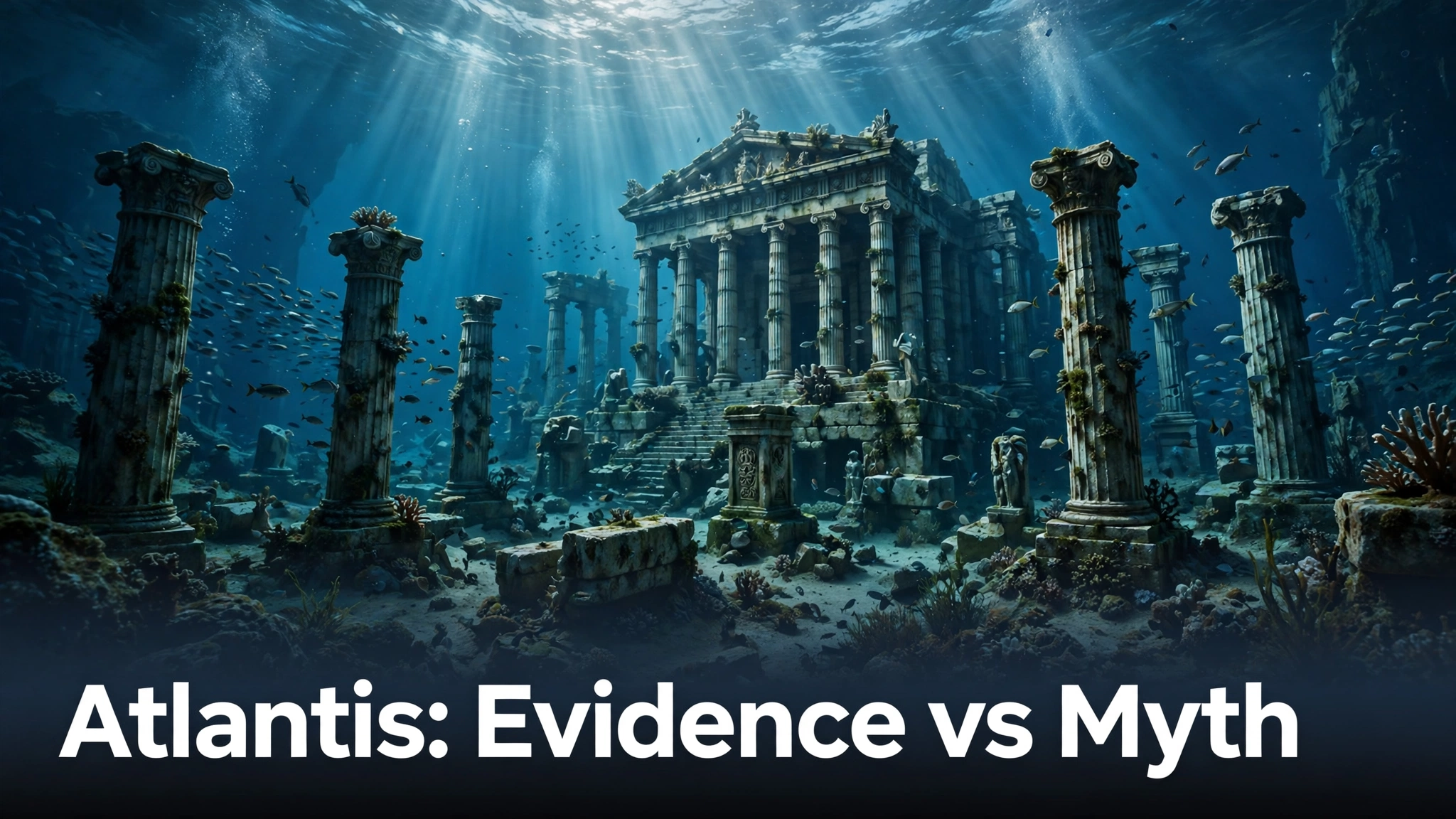
Atlantis comes from two dialogues by the Greek philosopher Plato, Timaeus and Critias, written in the fourth century BCE. In these works, Plato’s characters describe Atlantis as a story passed down from Egyptian priests, through the Athenian lawgiver Solon, to Plato’s family. Atlantis is presented as a large island, larger than Libya and Asia combined in ancient terms, beyond the Pillars of Hercules, the Strait of Gibraltar, with a central island, concentric rings of land and water, a great temple to Poseidon, and a powerful empire that attempted to conquer Athens and was defeated. After its defeat, in a single day and night of earthquakes and floods, Atlantis sank beneath the sea.
Several details matter for judging the story. First, Plato places Atlantis about 9,000 years before his own time, which would be roughly 9,600 BCE, long before the Greek city-states, writing, or the kind of empire he describes. No archaeological evidence supports a large island empire of that date in the Atlantic. Second, the dialogues are philosophical works, not histories. Plato uses stories, myths, and dialogues to explore ideas about ideal states, justice, and hubris. The Atlantis story is paired with a story about an idealised ancient Athens, which defeats Atlantis through virtue and discipline. That pairing strongly suggests a moral and philosophical purpose: Atlantis represents a wealthy, powerful, but corrupt empire that falls because of its arrogance, while Athens represents the virtuous state that resists it. Third, Critias is unfinished. The story breaks off before its conclusion, which has fuelled speculation, but also means we do not have Plato’s full intended ending.
Plato himself, through his characters, claims the story is true, not invented. That claim has been debated for centuries. Some ancient writers treated Atlantis as history; others, including Aristotle, Plato’s own student according to later reports, are said to have treated it as invention. The honest position is that we cannot know Plato’s private intention with certainty, but we can judge the story by its content and context. A story that serves a clear philosophical purpose, that is transmitted through a chain of sources no one can verify, and that describes a society anachronistic for its claimed date, should be treated as a philosophical myth until independent evidence appears. So far, it has not.
The Santorini Theory and Real Bronze Age Disasters
The most plausible historical inspiration for Atlantis is the Minoan civilisation on Crete and the volcanic eruption on the island of Thera, now Santorini, in the second millennium BCE. The Minoans were a sophisticated Bronze Age culture, with palaces, writing, trade networks, and art, centred on Crete in the Aegean Sea. Around the sixteenth century BCE, with exact dating debated, Thera erupted violently, in one of the largest volcanic events in human history, burying the town of Akrotiri under ash and possibly generating tsunamis that damaged Minoan coastal sites. The Minoan civilisation declined in the following centuries, though the eruption alone did not end it; Mycenaean Greeks, earthquakes, and internal changes also played roles.
The parallels are striking: an advanced island civilisation, a volcanic catastrophe, a sudden disappearance, and a sea-based empire. It is plausible that memories of Thera, passed down and reshaped over centuries, influenced Plato’s story, or that Plato drew on general knowledge of Aegean disasters when crafting his myth. But parallels are not identity. Thera is a small Aegean island, not a large Atlantic continent. The Minoans did not attempt to conquer Athens in the way Plato describes, and their decline was gradual, not a single-day sinking. Akrotiri, preserved under ash like Pompeii, is a real, excavated town, and visiting it shows what a Bronze Age disaster actually looks like: houses, streets, pottery, and frescoes, not concentric rings of gold and orichalcum, the mysterious metal Plato mentions.
Other real events may also have fed the myth: floods in the Black Sea region, the sinking of coastal settlements as sea levels rose after the last Ice Age, and the destruction of cities by earthquakes and tsunamis in the Mediterranean. The Mediterranean is seismically active, and many coastal towns have been submerged or destroyed. Those events, combined in oral tradition over centuries, could produce a story of a great city lost to the sea. That is how myths often form: not from a single invention, but from the merging of real memories, exaggeration, and moral storytelling. Atlantis may be a composite, not a place.
Claims, Locations, and Why They Fail
Over the centuries, Atlantis has been “found” in dozens of places: the Atlantic Ocean, the Mediterranean, the Caribbean, Antarctica, the Sahara, the North Sea, and even under the ice of Antarctica, in theories that require continents to move in ways geology does not support. Each claim typically follows a pattern: a feature on a map or sonar image looks like concentric rings, a stone structure looks artificial, or a local legend mentions a flood. On closer inspection, the feature turns out to be natural geology, a modern structure, or a misreading. The famous “Bimini Road” off the Bahamas, for example, is a natural formation of beachrock, not a paved road, according to geological study. Underwater structures off Yonaguni, Japan, are widely interpreted by geologists as natural sandstone formations, though some writers claim they are artificial.
The burden of proof for Atlantis is high, because the claim is extraordinary: a large, advanced empire, with writing, metalwork, and a navy, that vanished without leaving a clear archaeological trace, in a period when other civilisations left abundant traces. If Atlantis existed as Plato described, we would expect to find its pottery, its trade goods, its inscriptions, and its influence on neighbours, just as we find Minoan goods across the Mediterranean. We find none of that for Atlantis. We find, instead, a single literary source, Plato, and later writers quoting Plato. That is not independent corroboration; it is repetition.
Geology also rules out a sunken Atlantic continent. Plate tectonics shows that continents do not sink intact into the ocean in a day. The Atlantic seafloor is relatively young oceanic crust, formed at the Mid-Atlantic Ridge, not a drowned continent. Sea levels have risen and fallen, submerging coastal areas, but not a continent-sized landmass in historical or near-historical time. Claims that require a continent to sink rapidly contradict everything we know about how the Earth’s crust behaves. A small island can sink or be destroyed by a volcano or landslide, as Thera partly was, but a continent cannot disappear without a trace.
Why the Myth Persists: Psychology, Media, and Pseudoscience
Atlantis persists because it satisfies several human desires at once. It offers a golden age, a time when humans were wiser or more advanced, which flatters our sense that the present is a decline. It offers a mystery with a solution, a hidden city to be found, which appeals to our love of puzzles and treasure hunts. It offers a warning, that pride leads to fall, which feels morally satisfying. And it offers an alternative history, in which mainstream archaeology is hiding something, which appeals to distrust of experts. Each of these desires is understandable, but none is evidence.
Media amplifies the myth. Documentaries that present speculation as investigation, using dramatic music and phrases such as “could this be Atlantis?” without answering “no, the evidence says otherwise,” leave viewers with the impression that a discovery is imminent. Books and films that mix real archaeology with invented Atlantean technology, crystals, advanced energy, or alien contact, blur the line between fiction and history. Social media rewards the most sensational claim, not the most careful one. The result is a feedback loop: a new “discovery” is announced, it is shared widely, experts debunk it quietly, and the debunking receives far less attention than the original claim.
Pseudoscience also plays a role. Some Atlantis theories rely on misdated artefacts, mistranslated texts, or cherry-picked similarities between cultures, such as pyramids in Egypt and the Americas, which are explained by independent invention and basic geometry, not by a common Atlantean source. Others rely on esoteric traditions, such as nineteenth-century Theosophy, which claimed Atlantis through spiritual revelation rather than evidence. Those traditions are historically interesting, but they are not archaeological evidence. Distinguishing a testable claim from a revealed truth is essential: a claim that cannot be tested, or that explains away every contrary finding as a cover-up, is not science, however passionately it is held.
What Atlantis Teaches Us, Even If It Never Existed
Even as a myth, Atlantis teaches valuable lessons. First, it shows how Plato used story to think about politics. Atlantis is not only a lost city; it is a thought experiment about what happens when wealth, power, and empire corrupt a society. That question remains relevant: how do prosperous societies avoid arrogance, overreach, and collapse? Plato’s answer, through the virtuous Athens that defeats Atlantis, is discipline, law, and restraint. Whether one agrees with Plato’s politics, the story frames a debate that still matters, about empire, sustainability, and the limits of power.
Second, Atlantis teaches us about memory and disaster. Real societies do lose cities to volcanoes, earthquakes, floods, and sea-level rise. The Minoans, Pompeii, and many coastal towns are proof. Those losses enter oral tradition, are reshaped over generations, and become myths that preserve a kernel of truth: the sea can take what humans build. In an age of rising sea levels and climate change, that kernel is urgent. Coastal cities today face a slower version of Atlantis’s fate, not in a day, but over decades, as seas rise and storms intensify. The myth, read as a warning about hubris and vulnerability, is more useful than a literal treasure hunt.
Third, Atlantis teaches us about evidence. The difference between a compelling story and a proven history is independent corroboration, physical remains, and consistency with geology, chronology, and neighbouring cultures. Atlantis fails those tests, while Thera, Crete, and Pompeii pass them. Learning to apply those tests, to ask “who else recorded this, what physical trace remains, does the date fit, does the geology allow it?” protects us from many false claims, not only about Atlantis, but about health, history, and science in general. Skepticism, in this sense, is not cynicism; it is a tool for finding what is actually true.
Atlantis in Modern Culture: Films, Books, and False Discoveries
Atlantis has become a cultural shorthand for a lost, advanced world, appearing in Jules Verne’s Twenty Thousand Leagues Under the Seas, in Disney’s Atlantis: The Lost Empire, in countless novels, and in video games where players explore sunken temples and recover crystal technology. Each retelling adds details Plato never wrote: advanced energy crystals, flying machines, underwater domes, and survivors who founded Egypt, the Americas, or other civilisations. Those additions are fiction, but they are often repeated as if they were part of the original story, which confuses readers who later encounter Plato’s actual text and find it far simpler and more philosophical. The gap between Plato’s Atlantis, a Bronze Age-style empire with walls, canals, and temples, and the science-fiction Atlantis of modern media, with lasers and anti-gravity, shows how a myth grows by accretion, with each generation adding its own technology and anxieties.
False discoveries follow the same pattern. Every few years, a news story announces that Atlantis has been found, based on a sonar image, a satellite photo, or a structure on the seafloor. The image is usually a natural formation, a modern wreck, or a misinterpreted geological feature, but the headline travels faster than the correction. In Spain, a site near Donana has been proposed as Atlantis, based on marshland patterns and ancient settlement evidence, but mainstream archaeologists note that the evidence points to a real, but ordinary, ancient settlement, not to Plato’s continent. In the Atlantic, the Mid-Atlantic Ridge has been scanned extensively, and no sunken city has been found. The pattern is consistent: excitement, announcement, expert review, and a quiet conclusion that the feature is natural or unrelated. Readers who follow only the announcement, not the review, come away believing Atlantis is on the verge of discovery, when in fact the evidence has moved in the opposite direction for decades.
My Take:
My view is that we should love Atlantis as a story and stop pretending it is a place waiting to be found. The story is beautiful, it has lasted more than two thousand years, and it has inspired art, literature, and imagination in ways few philosophical myths have. That longevity is itself an achievement. But loving a story does not require believing it literally, and believing it literally, in the face of absent evidence, does a disservice to real history. The Minoans, the people of Akrotiri, and the many real communities lost to volcanoes and floods deserve attention more than an invented empire, because their stories are true, their artefacts are real, and their lessons are grounded in evidence. We do not need Atlantis to be real to learn from it; we need to read it well.
I also think the Atlantis hunt reveals a discomfort with ordinary history. Real archaeology is slow, fragmentary, and often unglamorous: pottery shards, postholes, sediment layers, and careful dating. It rarely produces a gleaming city intact under the sea. The Atlantis fantasy promises a shortcut: one discovery that rewrites everything, one city that proves ancient humans were more advanced than we thought. That shortcut is tempting because it flatters us and spares us the slow work of understanding the past. But the slow work is the work that actually teaches us. A pottery shard, correctly dated and placed in a trade network, tells us more about human life than a fictional temple of gold. If we want wonder, real archaeology provides it in abundance, without inventing a continent.
There is also a responsibility issue. Atlantis theories have sometimes been used to support racist or nationalist claims, by attributing achievements of one culture to a lost superior race, or by claiming a particular nation is the heir of Atlantis. Plato’s story has been misused in that way, especially in the nineteenth and twentieth centuries, and that misuse should make us cautious. A myth that can be bent to claim superiority for one group over others needs careful handling, not uncritical celebration. The antidote is evidence-based history, which shows that achievements, pyramids, writing, navigation, metallurgy, arose independently in many cultures, through human ingenuity in different places, not through a single lost source. That plural history is more impressive, and more just, than a single Atlantean origin.
Finally, I think the most honest ending to the Atlantis story is not “we will find it one day,” but “we have already found what matters.” We have found Thera, Akrotiri, Knossos, and Pompeii. We have found that the sea does swallow cities, that empires do fall through hubris, and that stories preserve those truths long after the cities are gone. Atlantis, as a myth, will continue to inspire, and that is fine, provided we label it as myth and enjoy it as myth. The moment we present it as history without evidence, we mislead readers, waste research effort, and obscure real discoveries. So enjoy the films, read Plato, visit Santorini, and marvel at the real Bronze Age world. But do not fund an expedition to find a continent that geology says cannot be there, and do not mistake a beautiful story for a sunken city. The truth, in this case, is more interesting than the treasure, because it is true.
I want to add one more reflection, about why I am not sad that Atlantis is probably not real. Some people feel disappointed when a mystery is debunked, as if a door has closed. I feel the opposite. Debunking Atlantis opens a larger door: to the real Aegean, to the real science of volcanoes and sea-level change, to the real question of how societies remember disaster. Those doors lead to places we can actually visit, study, and learn from, not to a city that recedes every time we look for it. A myth that points to real history is more valuable than a myth that points only to itself. Atlantis, read well, points outward, to Thera, to Plato’s Athens, to our own coastal cities, and to the choices we make about power and humility. That is a journey worth taking, even if it never ends at a sunken temple.
One final thought concerns curiosity itself. Searching for Atlantis is not foolish; curiosity is how discoveries are made, and many real discoveries began as hunts for something else. The difference is in how the search responds to evidence. A good search changes course when evidence points elsewhere, follows the pottery, the geology, and the dating, even when they lead away from the original dream. A poor search ignores contrary evidence, moves the goalposts, and treats every debunking as proof of a cover-up. Atlantis hunters who follow the first path often become good archaeologists, studying Thera, Crete, or coastal change, and their work is valuable. Those who follow the second path remain stuck, repeating the same claims for decades. The lesson for any mystery, not only Atlantis, is to let evidence redirect you. Curiosity that follows evidence is science; curiosity that refuses evidence is only a story, and stories, however beautiful, should not be mistaken for places on a map.
A related point is about how we handle disappointment when a favourite mystery does not survive evidence. It is natural to feel let down when Atlantis turns out to be a myth rather than a place, just as it is natural to feel let down when a medical miracle, a historical secret, or a scientific breakthrough turns out to be overstated. That disappointment, handled well, can become a deeper curiosity: if not Atlantis, then what really happened at Thera, what did the Minoans actually build, how did Plato actually think? Those questions lead to real places, real artefacts, and real ideas, which are more durable than any single treasure. Handled poorly, disappointment turns into denial, and denial turns into conspiracy, where every contrary finding is treated as suppression. The choice between those two responses, curiosity redirected versus denial entrenched, determines whether a debunked myth makes us wiser or merely more stubborn. I hope readers of this article choose curiosity, because the real past, with all its complexity, is more rewarding than any single lost city.
Frequently Asked Questions
Did Atlantis really exist? There is no verified archaeological or geological evidence for Atlantis as Plato described it. Mainstream historians treat it as a philosophical myth, possibly inspired by real Bronze Age disasters such as Thera.
What did Plato write about Atlantis? In Timaeus and Critias, Plato describes Atlantis as a large island empire beyond the Strait of Gibraltar, defeated by an idealised Athens, then sunk in a single day and night of earthquakes and floods.
Is Santorini the real Atlantis? Santorini, ancient Thera, is the most plausible inspiration, because its volcanic eruption devastated a Bronze Age town. But Thera is a small Aegean island, not a large Atlantic continent, and its decline was gradual, not a single-day sinking.
Has Atlantis been found underwater? No verified Atlantean city has been found. Claimed sites, such as Bimini Road and Yonaguni, are interpreted by geologists as natural formations, not artificial cities.
Why do people still search for Atlantis? The story combines a golden age, a mystery, a moral warning, and a treasure hunt. Media, fiction, and distrust of experts keep the search alive, even though evidence remains absent.
What can we learn from Atlantis if it is a myth? Atlantis teaches about hubris, empire, disaster memory, and evidence. It warns that prosperous societies can fall, and it shows how real disasters become myths over centuries, a lesson relevant to modern sea-level rise.