The Mystery of the Nazca Lines, Explained
In this post
- What the Nazca Lines Are
- Who Made Them, and When
- How They Were Made Without Aircraft
- The Theories: Why Were They Made?
- The Sensational Claims, and Why They Are Wrong
- Visiting, Preserving, and What the Lines Mean Today
- The Desert Itself: Why the Lines Survived
- Walking the Lines: What Visitors See Today
- The Nazca People: Who They Were Beyond the Lines
- My Take:
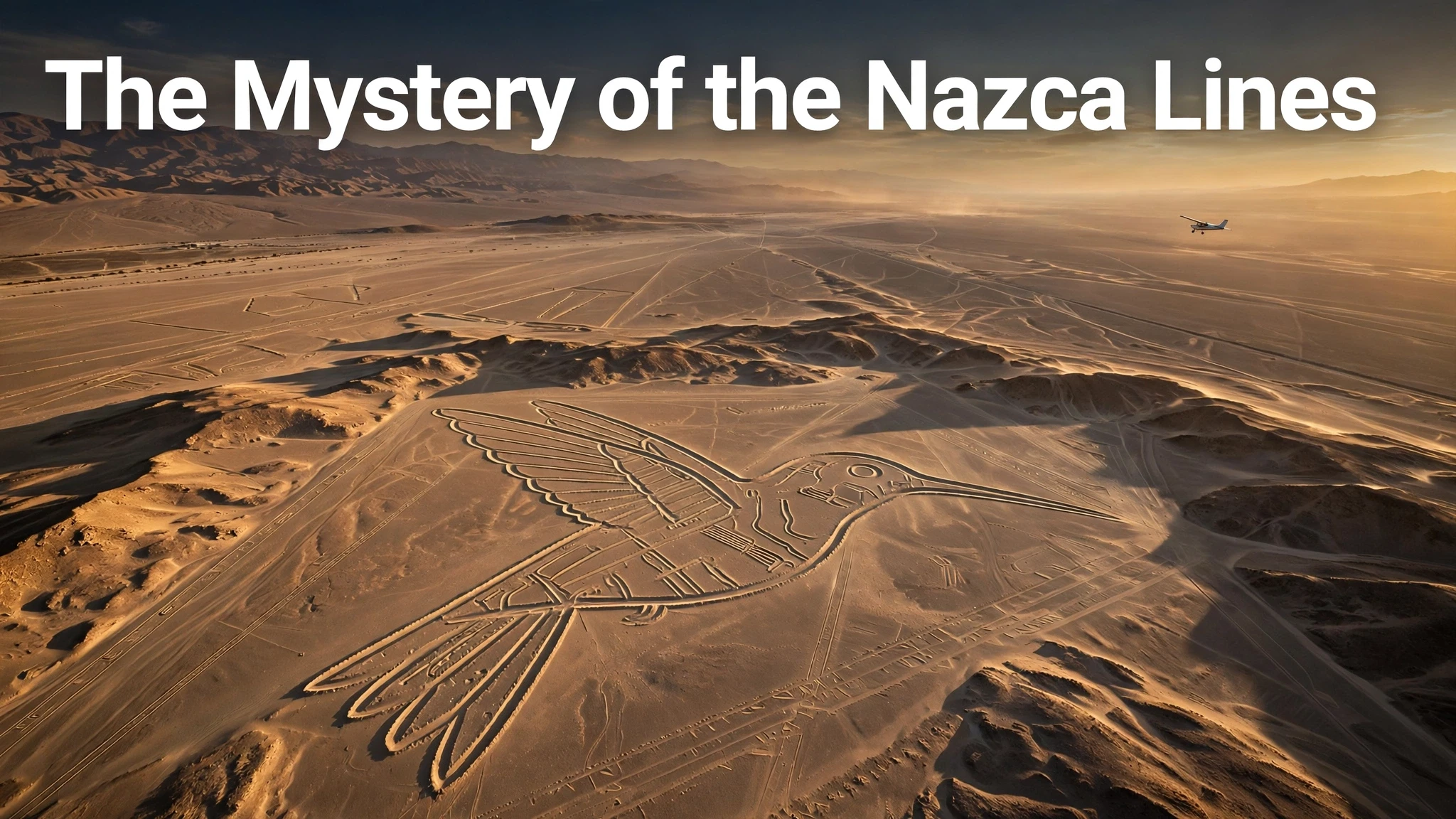
In the desert of southern Peru, there are drawings so large that they can only be seen properly from the air. A hummingbird, a monkey, a spider, a condor, and dozens of other figures, some hundreds of metres long, are etched into the dry earth, along with straight lines that run for kilometres, and geometric shapes that cover the plain. They are called the Nazca Lines, and they were made by a people who lived more than a thousand years ago, who had no aircraft, no maps, and no way to see their work from above. How they made them, and why, is one of the great mysteries of archaeology.
This guide explains the mystery of the Nazca Lines: what they are, who made them, how they were made, and the theories about their purpose. It covers the discovery, the research, and the claims that have been made, from the scientific to the sensational, and it is honest about what is known and what is not. The Nazca Lines are a real, visible wonder, and they are worth understanding, not only as a mystery, but as a achievement of a people who left a mark on the earth that has lasted for centuries.
What the Nazca Lines Are
The Nazca Lines are a collection of geoglyphs, large designs made on the ground, in the Nazca Desert in southern Peru, about 400 kilometres south of Lima. They cover an area of about 80 kilometres, and they include hundreds of figures, lines, and geometric shapes. The figures include animals, such as a hummingbird, a monkey, a spider, a condor, a dog, and a lizard, as well as human figures, plants, and abstract shapes. Some figures are over 300 metres long, and the longest lines run for kilometres across the desert. The lines were made by removing the dark, reddish stones from the surface, exposing the lighter soil beneath, creating a contrast that is visible from the air.
The lines are remarkably well preserved, because the desert is one of the driest places on Earth, with almost no rain, little wind, and a stable climate. That is why designs made more than a thousand years ago are still visible today. The Nazca Lines were designated a UNESCO World Heritage Site in 1994, and they are one of Peru’s most famous attractions, visited by thousands of people each year, who fly over them in small aircraft to see them properly. From the ground, they are difficult to appreciate, because they are so large, and that is part of the mystery: why make something you cannot see?
Who Made Them, and When
The Nazca Lines were made by the Nazca people, a culture that lived in southern Peru from about 100 BCE to 600 CE. That date is established by pottery, by radiocarbon dating of materials found at the site, and by the style of the figures, which matches Nazca art. The Nazca were farmers, who lived in a desert and depended on irrigation, and they were skilled in pottery, textiles, and engineering. They built the lines over several centuries, adding new figures and lines over time, and the designs changed as the culture changed.
It is important to be clear that the lines were not made by a single person, or in a single year. They were a long-term project, built by a community, over generations, and they were probably made by people working on the ground, using simple tools, stakes, and ropes, to lay out the designs. The Nazca had no writing, so there is no document that explains the lines, and that is why their purpose is a mystery. We know who made them, and when, but we do not know why, and that gap is the heart of the mystery.
How They Were Made Without Aircraft
One of the most common questions about the Nazca Lines is how they were made without aircraft, since they can only be seen properly from the air. The answer is simpler than it seems, and it does not require advanced technology. The Nazca people could have laid out the designs using stakes, ropes, and simple surveying, by scaling up a small drawing to a large size on the ground. That is a technique that has been used for centuries, and it is how large designs, from gardens to buildings, have been laid out. A small model, a set of measurements, and a team of workers could create a figure hundreds of metres long, without ever seeing it from above.
Experiments have shown that this is possible. Researchers have recreated Nazca figures using only simple tools, and they have found that the work is laborious but not mysterious. The lines are not perfectly straight, and the figures are not perfectly proportioned, which suggests that they were made by people on the ground, not by a precise, high-technology method. The idea that the lines could only have been made with aircraft, or with help from outside, is a modern myth, and it underestimates the skill of the Nazca people. They were capable of remarkable work with simple tools, and the lines are evidence of that skill, not of something else.
The Theories: Why Were They Made?
There are several theories about the purpose of the Nazca Lines, and none is proven. The most widely accepted theory, proposed by the German archaeologist Maria Reiche, who spent decades studying the lines, is that they were related to astronomy and to water. Reiche believed that the lines pointed to the sun, the moon, and the stars, and that they were part of a calendar, marking the solstices and the seasons. That theory is supported by the alignment of some lines with astronomical events, though not all lines align, and the evidence is debated.
Another theory is that the lines were related to water, which was the most precious resource in the desert. Some researchers believe that the lines marked underground water sources, or that they were part of rituals to bring rain. The Nazca depended on irrigation, and water was central to their survival, so a connection to water is plausible. A third theory is that the lines were ceremonial paths, walked in procession, as part of religious rituals. A fourth is that they were markers for travellers, or for different groups. Each theory explains some of the evidence, and none explains all of it, which is why the purpose remains a mystery. The most likely answer is that the lines had more than one purpose, and that different lines served different functions.
The Sensational Claims, and Why They Are Wrong
The Nazca Lines have attracted sensational claims, most famously the idea that they were made by, or for, extraterrestrials, as landing strips for alien spacecraft. That idea was popularised by Erich von Däniken in his book Chariots of the Gods, and it has been repeated in television and in popular culture. It is not supported by evidence. The lines are not landing strips: they are shallow, they are on uneven ground, and they are not suitable for landing anything. The figures are not visible from space, and they were made with simple tools, by a known culture, at a known time. The alien theory is a myth, and it is a disservice to the Nazca people, because it suggests that they could not have made something remarkable on their own.
Other sensational claims include the idea that the lines are a giant map, a code, or a message to the gods. These claims are also unproven, and they are often based on a selective reading of the evidence. The scientific approach is more modest, and more honest: the lines were made by the Nazca people, over centuries, for purposes that were probably religious, astronomical, and practical, and we do not know exactly what those purposes were. That is not a failure. It is an honest statement of what we know, and it respects the people who made the lines, by crediting them with the skill to create something extraordinary.
Visiting, Preserving, and What the Lines Mean Today
The Nazca Lines are a UNESCO World Heritage Site, and they are protected, but they are also vulnerable. The desert is fragile, and the lines can be damaged by vehicles, by construction, and by climate change. In recent years, there have been incidents of damage, including a truck driver who drove across the lines, and a Greenpeace protest that damaged a figure. These incidents have highlighted the need for protection, and for responsible tourism. Visitors are encouraged to fly over the lines, rather than walking on them, and to respect the site.
For Peru, the lines are a source of pride, and a major tourist attraction, and they are a reminder of the country’s rich pre-Inca history. For archaeologists, they are a puzzle that continues to yield new discoveries: in recent years, new figures have been found, using drones and satellite imagery, and the total number of known geoglyphs continues to grow. For the rest of us, the Nazca Lines are a wonder, a reminder that people in the past were capable of remarkable things, and that some mysteries endure, not because we lack information, but because the people who made them left no explanation. That endurance is part of their value, and it is why they continue to fascinate.
The Desert Itself: Why the Lines Survived
The Nazca lines survived because of the desert itself, because the Nazca desert is one of the driest places on Earth, and it has a climate that preserves, rather than destroys. It rains very little, often less than a few millimetres a year, and the wind is gentle, and the ground is covered with dark stones, which protect the lighter soil beneath, from erosion. The lines were made by removing those dark stones, and exposing the pale earth, and because the desert is so dry, and so still, the lines have remained visible, for centuries, with very little change.
The desert also has a hard, crusty surface, called desert pavement, which forms over time, and which protects the ground, from wind, and from rain. That pavement is fragile, and it can be damaged, by footsteps, or by vehicles, which is why the lines are protected, and why visitors are not allowed to walk on them. The survival of the lines is a combination of luck, and geography: a desert that is dry, still, and stable, and a people who made marks, that were simple, and durable, and that did not need maintenance. It is a reminder that the environment shapes history, and that a place can preserve the past, for far longer than anyone could have imagined, if it is left alone.
Walking the Lines: What Visitors See Today
Walking the Lines: What Visitors See Today is where many people form their lasting opinion of the Nazca lines, so it pays to understand what is really going on here instead of guessing.
The Nazca people who made the lines long before modern times often comes up first when people discuss the Nazca lines, and the reason is simple: it is easy to understand, easy to try, and easy to explain to someone else. A good way to judge the Nazca people who made the lines long before modern times is to ask what it does well and what it leaves out, since every part of the Nazca lines makes trade-offs and naming them sharpens judgement. A common mistake is rushing past the Nazca people who made the lines long before modern times, so slowing down and giving it a fair try usually leads to a better judgement about the Nazca lines than a quick first impression.
What makes the dry desert that preserved the lines for centuries worth studying inside the Nazca lines is the way it balances simplicity and depth, because beginners can use it at once while experienced readers still find something new. Sharing the dry desert that preserved the lines for centuries with a friend or reading what others noticed about it can open up angles that were missed, and discussion is one of the fastest ways to deepen a grasp of the Nazca lines. Choosing the dry desert that preserved the lines for centuries over a flashier option is often the wiser move, because substance lasts longer than novelty, and the Nazca lines is best enjoyed when quality comes before hype.
With walking the lines: what visitors see today understood, the next part of the Nazca lines becomes easier, because you now have a reference point to compare new ideas against.
The Nazca People: Who They Were Beyond the Lines
The Nazca Lines are famous, but the people who made them are less well known, and understanding them is essential to understanding the lines themselves. The Nazca were a culture that flourished in southern Peru, from about 100 BCE to 600 CE, and they were skilled farmers, potters, and weavers, who lived in a desert, and who learned to survive in a harsh environment. They built underground aqueducts, called puquios, which brought water from the mountains, and which are still used today, and they created pottery with vivid colours, and textiles with intricate designs, which are among the finest of the ancient Americas. They were not a primitive people. They were sophisticated, organised, and creative, and the lines are only one part of their achievement.
Their society was organised around chiefdoms, with leaders, priests, and craftspeople, and they traded with neighbouring cultures, exchanging pottery, textiles, and food. They had a religion that centred on nature, on water, and on fertility, and their art is full of images of animals, plants, and supernatural beings, which reflect their beliefs, and their relationship with the desert. The lines, with their images of animals, and their geometric shapes, are part of that religious world, and they should be understood in that context, not as an isolated mystery, but as an expression of a culture, and its beliefs. To understand the lines, you must understand the people, and their world.
The Nazca also faced a changing climate, and their civilisation declined, in part because of drought, and environmental change, which made it harder to farm, and to survive. That decline is a reminder that even a sophisticated culture is vulnerable to climate, and that the desert, which preserved the lines, also made life difficult. The Nazca adapted, for centuries, by building aqueducts, by storing water, and by farming carefully, but eventually, the climate changed too much, and the culture faded, leaving behind the lines, the pottery, and the aqueducts, as evidence of what they had achieved. That story is both inspiring, and cautionary, and it is relevant today, as we face our own climate challenges.
Archaeology has taught us a great deal about the Nazca, through excavations, through the study of their pottery, and through the analysis of their aqueducts, and that knowledge continues to grow. New discoveries, such as the finding of new lines, and new settlements, are still being made, with the help of drones, and satellite imagery, and they are adding to our understanding. The Nazca are not a mystery to be solved, and then forgotten. They are a culture to be studied, and appreciated, and their achievements, including the lines, are a testament to human ingenuity, and creativity, in a difficult environment. That is a story worth telling, and worth learning.
Finally, remember that the lines are not the whole story, and that focusing only on them can distort our understanding of the Nazca. The people, their art, their farming, and their survival are equally important, and they are what make the lines meaningful. Learn about the Nazca as a people, and the lines will make more sense, not as an alien mystery, but as a human achievement, made by people who lived, worked, and believed, in a desert, more than a thousand years ago. That is the real wonder of the Nazca Lines: not that they are unexplained, but that they were made, by human hands, with simple tools, and with a purpose that we are still trying to understand.
My Take:
The first time I saw a photograph of the Nazca hummingbird, I had the same thought everyone has: how could people who couldn’t fly make something you can only see from the air? It’s a good question, and it has a better answer than most people expect. They didn’t need to fly. They needed stakes, ropes, and a small drawing scaled up, and that’s a technique humans have used for centuries. The mystery isn’t how they made it. It’s why they made it, and that’s a harder question, and a more interesting one.
Here’s what I think is most important to say clearly. The Nazca Lines were made by the Nazca people. Not by aliens, not by a lost civilisation, not by visitors from another world. By farmers in southern Peru, over centuries, with simple tools. The alien theory is popular because it’s exciting, but it’s also insulting, because it says that a remarkable achievement couldn’t have been made by the people who actually made it. The Nazca were skilled, they were organised, and they were capable of extraordinary work. Crediting them with that work is not only accurate, it’s respectful. The lines are theirs, and they deserve the credit.
I’ll be honest about the purpose, because the honest answer is that we don’t know, and that’s fine. The lines might have been a calendar, or a water ritual, or a ceremonial path, or all of those things at different times. Different lines may have had different purposes, and the meaning may have changed over the centuries they were built. I think we should be comfortable with that uncertainty, rather than forcing a single explanation onto hundreds of designs made over generations. A mystery with several plausible answers is not a failure. It’s a sign that the past was complex, and that we should respect that complexity.
What moves me most is the scale of the effort. These lines were made over centuries, by people who would never see the finished work from above, who worked on the ground, in a desert, moving stones by hand. They did it because it mattered to them, because it was part of their religion, their calendar, or their community. That commitment, to a project larger than any single lifetime, is remarkable, and it’s a reminder that people in the past thought in longer terms than we often do. They built for the future, and for the gods, and for each other, and the lines are still there, a thousand years later, because they did.
So if you visit, or if you look at the photographs, remember that. The lines are not a puzzle to be solved by a clever theory. They’re a achievement by a real people, in a real place, for reasons that mattered to them. Fly over them, look at the hummingbird, the monkey, and the spider, and appreciate the skill it took to make them. The purpose may remain a mystery, and that’s alright. Some things are worth wondering about, and the Nazca Lines are one of them. They’ve lasted for centuries, and they’ll be there for centuries more, whether we understand them or not.
Making the lines was simpler than you might think, and that simplicity is part of what makes them remarkable. The people of Nazca did not need machines, or surveying instruments. They needed a plan, and a way to mark it on the ground, and the desert itself did the rest. They cleared the dark stones from the surface, exposing the pale earth beneath, and they piled the stones along the edges, to mark the lines. For the straight lines, they used wooden stakes, and ropes, and they sighted along them, to keep the lines true over kilometres. For the figures, they likely worked from a small design, scaled up, using a grid, or a series of stakes, and they checked their work from the surrounding hills, where the figures become visible.
New discoveries are still being made, and they show that the story is not finished. In recent years, researchers using drones have found more than a hundred new figures, on hillsides, that were too faint to see from the ground, and too small to be noticed from the air, and those figures are simpler, and older, than the famous ones, and they suggest that the tradition of making ground pictures lasted far longer than we thought. Each new figure adds a piece to the puzzle, and it also reminds us that the desert still holds secrets, and that a place we thought was fully mapped can still surprise us. The lines were made by people, with simple tools, and with patience, and they are still being found, by people, with new tools, and with the same patience. That continuity, across two thousand years, is the real wonder of Nazca.
The people are what matter most, and that is the point I would leave you with, because it is easy to focus on the lines, and to forget the people who made them, and to treat the Nazca as a mystery, rather than as a culture. The Nazca were farmers, artists, and engineers, who survived in a desert, who built aqueducts that still work, and who created art that is still beautiful, and the lines are only one part of that achievement. I would urge you to learn about them as people, not only as makers of a mystery, because that learning will make the lines more meaningful, and it will remind you that history is not only about puzzles, but about people, and their lives.
I also think we should be honest about the sensational claims, because they distract from the real story, and they do a disservice to the Nazca. Theories about aliens, about ancient astronauts, and about lost civilisations are entertaining, but they are not supported by evidence, and they imply that the Nazca could not have made the lines themselves, which is both wrong, and disrespectful. The Nazca were capable, intelligent, and creative, and they did not need help from aliens to create something extraordinary. They did it themselves, with simple tools, and with patience, and that is more impressive than any alien theory. Trust the evidence, and respect the people.
Another point I would make is about preservation, because the lines are fragile, and they are threatened by climate change, by development, and by human activity, and they need to be protected. A footprint, a vehicle track, or a building can damage a line that has survived for two thousand years, and that damage is irreversible. If you visit, follow the rules, stay on the paths, and respect the site, because it is a world heritage, and it belongs to everyone, and to future generations. Preservation is not only the job of archaeologists. It is the job of every visitor, and every person who cares about history.
And the final thing I would say is to see the lines, if you can, from the air, and from the ground, because each view teaches something different. From the air, you see the scale, and the design. From the ground, you see the stones, the desert, and the effort, and you understand how they were made, by people walking, clearing, and placing stones, one by one. That understanding is humbling, and it is inspiring, and it is a reminder that great things can be made by ordinary people, with patience, and with purpose. The Nazca Lines are a human achievement, and they deserve to be understood as such, with respect, and with wonder, for the people who made them.
Frequently Asked Questions
What are the Nazca Lines?
The Nazca Lines are hundreds of giant figures, lines, and shapes etched into the desert in southern Peru, including animals such as a hummingbird, monkey, and spider. Some are over 300 metres long and can only be seen properly from the air.
Who made the Nazca Lines?
The Nazca people, who lived in southern Peru from about 100 BCE to 600 CE, made the lines over several centuries. The date is confirmed by pottery, radiocarbon dating, and the style of the figures.
How were the Nazca Lines made without aircraft?
They were likely made by scaling up small drawings using stakes, ropes, and simple surveying, a technique used for centuries. Experiments have shown this is possible with simple tools, and the lines are not perfectly straight, suggesting ground-level work.
What were the Nazca Lines for?
Their purpose is not proven. Theories include an astronomical calendar, water rituals, ceremonial paths, and markers. The most likely answer is that different lines had different purposes, and that their meaning changed over time.
Were the Nazca Lines made by aliens?
No, there is no evidence for that. The lines were made by the Nazca people with simple tools, they are not landing strips, and they are on uneven ground. The alien theory underestimates the skill of the people who made them.
Can I visit the Nazca Lines?
Yes, visitors usually fly over the lines in small aircraft from Nazca town. The site is a UNESCO World Heritage Site, and visitors are asked not to walk on the lines, because the desert surface is fragile and easily damaged.