The Mystery of the Lost Colony of Roanoke, Explained
In this post
- The Colony: Who They Were and Why They Came
- The Return: An Empty Colony and a Single Word
- The Theories: Where Did They Go?
- The Evidence: Archaeology, DNA, and Documents
- Why the Mystery Has Lasted for Four Hundred Years
- What We Know, What We Do Not, and What It Means
- Daily Life in the Colony Before It Vanished
- The Search Today: Digs, Documents and DNA
- Roanoke in Culture: Books, Films, and the Story We Tell
- My Take:
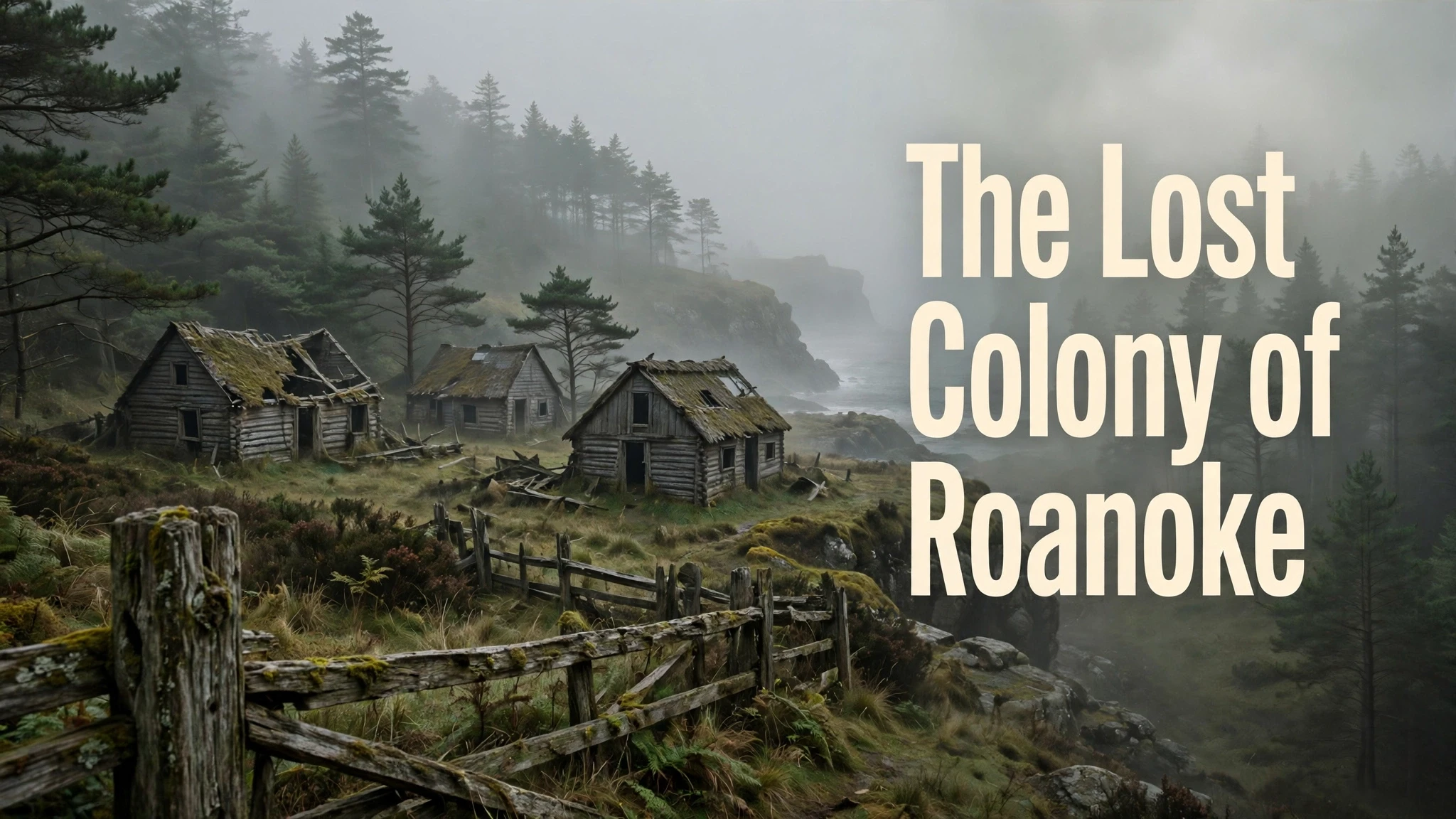
In 1587, more than a hundred English settlers landed on Roanoke Island, off the coast of what is now North Carolina, and built a colony. Three years later, when a supply ship returned, the colony was empty. The houses were gone, the people were gone, and the only clue was a single word, carved into a fence post: CROATOAN. No bodies were found, no sign of a battle, and no message explaining where they had gone. It is one of the oldest mysteries in American history, and it has never been solved.
This guide explains the mystery of the Lost Colony of Roanoke: who the settlers were, why they came, what happened, and the theories about where they went. It covers the evidence, the archaeology, and the claims that have been made, and it is honest about what is known and what is not. The Lost Colony is not only a mystery. It is a story about ambition, about a new world, and about people who vanished, leaving only a word behind.
The Colony: Who They Were and Why They Came
The Roanoke colony was part of England’s first attempt to settle America, organised by Sir Walter Raleigh, who had been given a charter by Queen Elizabeth I to establish a colony in the New World. The first attempt, in 1585, had failed, when the settlers returned to England after a difficult year. The second attempt, in 1587, was different: it included families, including women and children, and it was intended to be a permanent settlement. Among the settlers was John White, an artist and the colony’s governor, and his daughter Eleanor, who gave birth to Virginia Dare, the first English child born in America.
The settlers landed on Roanoke Island, off the coast of North Carolina, in July 1587, and they built houses, planted crops, and tried to establish relations with the Native peoples of the area. They were dependent on supplies from England, and they were in a difficult position: they had arrived late in the season, their food was limited, and they were in a land they did not understand. White returned to England in August 1587 to fetch supplies, leaving the settlers, including his daughter and granddaughter, behind. He intended to return quickly, but he was delayed for three years, by war with Spain and by a lack of ships. When he finally returned, in 1590, the colony was gone.
The Return: An Empty Colony and a Single Word
When John White returned to Roanoke in August 1590, he found the settlement dismantled, not destroyed. The houses had been taken down carefully, the fences were still standing, and there was no sign of a struggle, no bodies, and no graves. The settlers had agreed, before White left, that if they moved, they would carve the name of their destination into a tree, and if they left in distress, they would carve a cross above it. White found a single word carved into a fence post, CROATOAN, and the letters CRO carved into a tree, with no cross. Croatoan was the name of an island to the south, now Hatteras Island, and the home of a Native people who were friendly to the English.
White wanted to sail to Croatoan to search for the settlers, but a storm forced his ship to return to England, and he never found them. He never saw his daughter or his granddaughter again. The word CROATOAN is the central clue in the mystery, and it is also the most frustrating, because it is a single word, with no explanation, and it could mean many things: that the settlers went to Croatoan, that they were taken there, or that they left a message for someone who would understand it. White believed they had gone to Croatoan, and that they were alive, but he could not prove it, and no one ever found them.
The Theories: Where Did They Go?
There are several theories about what happened to the Lost Colony, and each has evidence and problems. The first, and the most widely accepted, is that the settlers moved to Croatoan Island and lived with the Croatoan people, intermarrying and assimilating. That would explain the word, the lack of a cross, and the careful dismantling of the houses, which suggests a planned move, not a disaster. It would also explain later reports, from the Jamestown colony, of people who spoke of English settlers living with Native peoples, and of a man who claimed to have seen English people in the area. Archaeological evidence, including English objects found on Hatteras Island, supports this theory, though it does not prove it.
A second theory is that the settlers were killed, either by a hostile Native group, or by the Spanish, who were active in the area. That would explain their disappearance, but it does not explain the lack of bodies, the lack of a cross, or the careful dismantling of the houses. A third theory is that they moved inland, to the mainland, and lived with another Native group. A fourth is that they died of disease or starvation, and their bodies were removed. A fifth is that they attempted to sail back to England and were lost at sea. Each theory has supporters, and none has been proven, because the evidence is thin, and the colony left almost no trace. The most likely answer is that they assimilated, but it is not certain.
The Evidence: Archaeology, DNA, and Documents
The evidence for the Lost Colony comes from three sources: documents, archaeology, and oral tradition. The documents are the accounts of John White, and of later colonists at Jamestown, who reported hearing of English people living with Native groups, and who sent expeditions to find them, without success. The archaeology is more recent: excavations on Hatteras Island have found English objects, including a sword, a ring, and pottery, dating to the late sixteenth century, which suggest an English presence there. Excavations on Roanoke Island have found evidence of the colony, but no clear sign of what happened to its people.
DNA studies have also been attempted, with researchers looking for English ancestry among Native peoples of the area, particularly the Lumbee, who have long claimed descent from the Lost Colony. The results have been inconclusive, partly because the genetic record is complex, and partly because the evidence is old. Oral tradition, from Native communities, includes stories of English settlers who joined them, and those stories are part of the evidence, though they are difficult to verify. The picture that emerges is suggestive but not conclusive: the settlers probably went to Croatoan and lived there, but the proof is not definitive, and the mystery remains.
Why the Mystery Has Lasted for Four Hundred Years
The Lost Colony has lasted as a mystery for more than four hundred years, because it is a perfect story: a group of people, including women and children, who vanished without a trace, leaving only a single word. It is a story that invites speculation, because the evidence is thin, and the possibilities are many. It has been retold in books, in films, in television, and in folklore, and each retelling adds a new layer. It is also a story about the beginning of America, about the first English settlement, and about the encounter between Europeans and Native peoples, which makes it historically important, not only mysterious.
The mystery has also lasted because it is unsolvable in the usual sense. There is no document that explains what happened, no grave that can be found, and no survivor who told the story. The evidence is fragmentary, and the most likely answer, assimilation, is difficult to prove, because assimilation leaves few traces. That is why the Lost Colony remains a mystery, and why it will probably remain one, even as archaeology improves. A mystery that cannot be solved is frustrating, but it is also enduring, because it leaves room for imagination, and for the hope that the settlers survived, and that their descendants are still among us.
What We Know, What We Do Not, and What It Means
What we know is this: a colony of more than a hundred English settlers was established on Roanoke Island in 1587, and when John White returned in 1590, it was empty, with the word CROATOAN carved into a post, and no sign of distress. What we do not know is where they went, what happened to them, and whether they survived. The most likely theory is that they moved to Croatoan Island and lived with the Native people there, but that theory, while supported by some evidence, is not proven. Other theories, including death by disease, attack, or starvation, cannot be ruled out, though they explain the evidence less well.
What the Lost Colony means is a matter of perspective. For some, it is a tragedy, a story of people abandoned by their governor and lost in a new world. For others, it is a story of survival, of people who adapted, who joined a new community, and who lived. For historians, it is a reminder that the early history of America is not only about the colonies that survived, but about the ones that did not, and about the encounters that left few records. The Lost Colony is a mystery, but it is also a history, and its value is in what it tells us about ambition, about survival, and about the people who were willing to cross an ocean for a new life, and who vanished, leaving only a word.
Daily Life in the Colony Before It Vanished
There is more to daily life in the colony before it vanished than first appears, and a little patience here reveals patterns in the lost colony of Roanoke that keep showing up in later sections of this guide.
A common mistake is rushing past the English settlers who landed on Roanoke Island in 1587, so slowing down and giving it a fair try usually leads to a better judgement about the lost colony of Roanoke than a quick first impression. The test of the English settlers who landed on Roanoke Island in 1587 is whether it could be recommended to someone else, and if the answer is yes, then it has done exactly what good the lost colony of Roanoke is supposed to do. Many experienced people point to the English settlers who landed on Roanoke Island in 1587 early on, because it illustrates the main idea of the lost colony of Roanoke before any detail gets complicated or confusing.
Choosing John White, the governor who sailed back for supplies over a flashier option is often the wiser move, because substance lasts longer than novelty, and the lost colony of Roanoke is best enjoyed when quality comes before hype. A useful example inside the lost colony of Roanoke is John White, the governor who sailed back for supplies, which shows the subject from a practical angle rather than a theoretical one, so the lesson stays visible. The value of John White, the governor who sailed back for supplies becomes clearer when it is compared with a weaker alternative, because the contrast shows which details matter most inside the lost colony of Roanoke and which are only decoration.
The word CROATOAN carved into a wooden post often comes up first when people discuss the lost colony of Roanoke, and the reason is simple: it is easy to understand, easy to try, and easy to explain to someone else. A good way to judge the word CROATOAN carved into a wooden post is to ask what it does well and what it leaves out, since every part of the lost colony of Roanoke makes trade-offs and naming them sharpens judgement. A common mistake is rushing past the word CROATOAN carved into a wooden post, so slowing down and giving it a fair try usually leads to a better judgement about the lost colony of Roanoke than a quick first impression.
Taken together, these examples show that daily life in the colony before it vanished is less about perfection and more about paying attention, which is a theme that runs through all of the lost colony of Roanoke.
The Search Today: Digs, Documents and DNA
The search for Roanoke continues today, and it uses methods that the first searchers could not have imagined: archaeology, documents, and DNA. Archaeologists dig at sites on Roanoke Island, and on the mainland, looking for artefacts, such as pottery, and tools, that might have belonged to the colonists, and they use ground-penetrating radar, to find buried structures, without digging. Historians search archives, in England, and in America, for documents, that might mention the colonists, or their descendants, and they re-read old records, with new eyes, looking for clues that were missed.
DNA is the newest tool, and it is the most intriguing, because it can, in theory, trace the descendants of the colonists, through their genes, and through the genes of the Native peoples, with whom they may have lived. Researchers have collected DNA samples, from people, whose family histories suggest a connection to Roanoke, and they are looking for markers, that might link them to the English colonists. The results, so far, are inconclusive, and they may never be conclusive, because the evidence is old, and fragmentary, and because DNA cannot tell a whole story, on its own. But the search continues, and it is a reminder that history is not closed, and that new evidence, and new methods, can reopen old mysteries, and bring them to life, again.
Roanoke in Culture: Books, Films, and the Story We Tell
Roanoke is not only a historical mystery. It is a story that has been retold, in books, in films, in television, and in popular culture, and each retelling says something about the time in which it was made, and about what the story means to us. In the nineteenth century, Roanoke was told as a romantic tragedy, a story of brave settlers, lost in a wilderness, and of a mystery that could not be solved. In the twentieth century, it was told as a horror story, with theories of massacre, of cannibalism, and of supernatural forces, which reflected the fears of the age. In the twenty-first century, it is told as a story of contact, of assimilation, and of the complex relationship between Europeans and Native Americans, which reflects a more nuanced understanding of history.
Books have been the main way the story has been told, from early histories, to novels, to children’s books, and each has shaped how the public understands Roanoke. A novel may invent dialogue, characters, and motives, and it may present a theory as fact, and a reader who does not know the difference may believe it. That is a risk, but it is also a strength, because a novel can make history vivid, and can bring the settlers to life, in a way that a scholarly article cannot. The best books about Roanoke are honest about what is known, and what is not, and they use imagination to fill the gaps, without pretending that the gaps are filled. The worst present a theory as truth, and they mislead.
Television and film have also told the story, often with a focus on horror, or on mystery, because those genres are popular, and because Roanoke lends itself to them. A television series may present the colony as haunted, or as the victim of a supernatural force, and that can be entertaining, but it can also distort the history, and make it harder to understand what actually happened. The most famous recent example is a season of a popular horror series, which used Roanoke as its setting, and which introduced the story to a new audience, but which also presented a fictional version, with witches, and ghosts, that has little to do with the historical evidence. That is fine, as entertainment, but it should not be confused with history, and viewers should be aware of the difference.
The story is also told in places: in museums, in historic sites, and in the town of Roanoke itself, where visitors can see the fort, the exhibits, and the landscape, and can imagine what life was like for the settlers. Those places are valuable, because they ground the story in a real location, and they remind us that the mystery happened in a real place, to real people. A visit to Roanoke, or to a museum, can make the history feel real, in a way that a book or a film cannot, and it is worth doing, if you have the chance. The landscape, the coast, and the sense of isolation are still there, and they help you understand why the colony was vulnerable, and why it disappeared.
Finally, remember that the story we tell about Roanoke says as much about us as it does about the settlers, and that is why it continues to be retold. Each generation finds a new meaning in it: a tragedy, a horror, a mystery, or a story of contact and survival. That retelling is part of history, and it is worth studying, because it shows how we understand the past, and how the past changes, as we change. Read the books, watch the films, and visit the places, but always ask: what is known, what is imagined, and what does this version say about the people who told it? That question will make you a better reader, and a better thinker, and it will help you understand not only Roanoke, but history itself.
My Take:
I keep coming back to the word. CROATOAN. Not a sentence, not a letter, not a plea for help. A single word, carved into a fence post, by people who knew someone would come looking. That restraint is what makes the mystery so powerful. They didn’t write that they were in danger. They didn’t write that they were leaving. They wrote a name, a place, and they trusted that it would be enough. And then a storm kept the search ship away, and the trail went cold for four hundred years. A single word, and a storm, and a mystery that has never been solved.
Here’s what I think is most often misunderstood. People imagine the colony was attacked, that there was a massacre, and that the empty settlement is evidence of violence. But the evidence points the other way. The houses were taken down carefully. The fences were standing. There was no cross carved above the word, which was the agreed signal for distress. That looks like a planned move, not a disaster. A people who were attacked don’t dismantle their houses neatly. A people who are leaving, who have decided to go somewhere safer, do. I think the word is not a cry for help. It’s a forwarding address, and that’s a very different story.
I’ll be honest about the theories, because they’re often presented as if one of them must be right. The truth is that the evidence is thin, and the most likely answer, that the settlers lived with the Croatoan people, is supported but not proven. A sword on Hatteras Island, a ring, some pottery: these are suggestive, not conclusive. DNA studies are inconclusive. The Jamestown reports are second-hand. I think we should be comfortable with that uncertainty, rather than pretending we know. The mystery endures because the evidence is incomplete, and that’s not a failure. It’s the nature of history.
What moves me most is the human side, and it’s the part that’s easy to lose in the theories. John White left his daughter and his granddaughter, Virginia Dare, the first English child born in America, on that island, and he never saw them again. He spent the rest of his life trying to return, and he never found them. That grief is real, and it’s part of the story. The settlers weren’t symbols. They were people, with families, who made a choice to cross an ocean, and who vanished. Remembering that, remembering the people behind the word, is more important than solving the puzzle.
So my advice, if you want to understand Roanoke, is to start with the word, and to sit with it for a while. Don’t rush to a theory. Read John White’s account, look at the map, and imagine a group of people dismantling their houses, carving a name into a post, and walking away toward a place they hoped would be safer. That’s the story, as far as we know it. The rest is speculation, and speculation is fine, as long as we admit that’s what it is. The Lost Colony may never be solved, and that’s alright. Some mysteries endure because the people in them deserve to be remembered, not because the puzzle needs an answer.
The Native peoples are the part of the Roanoke story that is most often left out, and they are the part that matters most, because they were there before the English arrived, and they were there after the English disappeared. The Croatoan, who lived on the island that is now Hatteras, were allies of the colonists, and the word carved into the fence post was their name, and the colonists had agreed, before they left, that if they had to move, they would go to Croatoan, and carve the name as a sign. That agreement is recorded, and it is the strongest clue we have, and it suggests that the colonists did not vanish. They moved, and they lived with the Croatoan, and their children, and their children’s children, became part of that community.
Archaeology on Hatteras Island has begun to support that idea, with finds of English objects, such as gun parts, and pottery, in places where the Croatoan lived, and with evidence of a settlement that mixed English and Native life. The evidence is not conclusive, and it may never be, because four centuries is a long time, and the coast has changed, and much has been lost to the sea. But the theory is a kinder one than the old stories of massacre, or starvation, because it suggests that the colonists survived, by joining the people who knew how to live on that coast, and that their descendants are still there, in the families of Hatteras. A mystery does not always end in tragedy. Sometimes it ends in a new beginning, and that is a better story, and a more honest one, than the one we were told.
The retelling is what interests me most, because Roanoke is not only a mystery about what happened. It is also a story about how we tell stories, and about how each generation finds a new meaning in the same events. A nineteenth-century writer saw a romantic tragedy. A twentieth-century filmmaker saw horror. A twenty-first-century historian sees a story of contact, and assimilation. All of them are looking at the same evidence, and all of them see something different, because they bring their own time, their own fears, and their own hopes to the story. That is not a flaw. It is how history works, and it is why Roanoke continues to fascinate, centuries after the colony disappeared.
I also think we should be honest about the difference between history and entertainment, because the two are often confused, and the confusion matters. A novel, a film, or a television series may be entertaining, but it is not history, and it should not be treated as if it were. A book that invents dialogue, a film that invents ghosts, and a series that invents witches are all telling a story, but they are not telling the truth, and a viewer who believes them will misunderstand what happened. Enjoy the entertainment, but check the history, and be aware of the difference. That awareness is a form of respect, for the settlers, for the Native Americans, and for the truth, however incomplete it may be.
Another point I would make is about the Native American perspective, because for a long time, the story of Roanoke was told only from the European point of view, and the Native Americans were seen as either helpers, or enemies, or a mystery, rather than as people with their own history, and their own agency. That is changing, and modern historians are paying more attention to the Croatan, and to the other peoples who lived in the area, and to the possibility that the settlers joined them, and lived among them. That perspective is important, because it reminds us that the story is not only about Europeans, but about the people they met, and about the complex, often tragic, history of contact. Listen to that perspective, and the story becomes richer, and more honest.
And the final thing I would say is to visit, if you can, because a place can teach you what a book cannot. The coast, the island, and the sense of isolation are still there, and standing there, you can imagine what it was like to be a settler, far from home, in a new world, with no way back. That imagination is valuable, and it is a reminder that history happened in real places, to real people, and that the mystery of Roanoke is not only a puzzle to be solved, but a human story, of hope, of fear, and of survival. Read, watch, and visit, and let the story stay with you, as it has stayed with so many others, for more than four hundred years.
Frequently Asked Questions
What happened to the Lost Colony of Roanoke?
When John White returned in 1590, the colony was empty, with the word CROATOAN carved into a fence post. The most likely theory is that the settlers moved to Croatoan Island and lived with the Native people there, but it has never been proven.
What does CROATOAN mean?
Croatoan was the name of an island, now Hatteras Island, and of the Native people who lived there. The settlers had agreed to carve their destination if they moved, and the absence of a cross above the word suggested they did not leave in distress.
Who were the Roanoke settlers?
The 1587 colony included more than 100 English settlers, including families, women, and children. John White was the governor, and his granddaughter Virginia Dare was the first English child born in America.
Was the Lost Colony attacked?
There is no evidence of an attack: no bodies, no sign of a struggle, and the houses were dismantled carefully. The evidence suggests a planned move rather than a massacre, though an attack cannot be completely ruled out.
Is there archaeological evidence for Roanoke?
Excavations on Hatteras Island have found English objects from the late 1500s, including a sword and pottery, suggesting an English presence. Excavations on Roanoke Island have found the colony site, but no clear evidence of what happened to its people.
Why is the Lost Colony still a mystery?
The evidence is thin: a single word, a few documents, and inconclusive archaeology. The most likely answer, assimilation with Native peoples, is hard to prove, so the mystery has lasted for more than 400 years.