Oldest Lighthouse in the World: History
In this post
Ask for the oldest lighthouse in the world and you will get two different answers, depending on whether you mean the oldest ever built or the oldest still standing and working. The oldest ever built, as far as history records, was the Pharos of Alexandria in Egypt, one of the Seven Wonders of the Ancient World, built more than 2,000 years ago and now lost to earthquakes. The oldest lighthouse still in use today is widely considered to be the Tower of Hercules in A Coruna, Spain, a Roman lighthouse whose core dates back nearly 1,900 years and which still guides ships into port. Both deserve the title in different ways, and understanding why there are two answers tells the whole story of lighthouses: how they began, how they evolved, and why they still matter in an age of satellites and GPS.
Lighthouses are among the oldest aids to navigation in human history, because the problem they solve is timeless. Ships approaching land at night or in bad weather need to know where the coast, rocks, and harbour entrances are, and a tall light visible from far out to sea answers that need simply and reliably. Before lighthouses, sailors used fires on hills, beacons on cliffs, and lights in temples or towers near ports. The step from a bonfire on a hill to a purpose-built tower with a maintained light was a major advance in safety and trade, and it allowed ports to receive ships after dark and in poor conditions. This guide traces that story from ancient Egypt and Rome to modern automated lights, and explains what makes the oldest survivors so remarkable.
The Pharos of Alexandria: Wonder of the Ancient World
The Pharos of Alexandria was built on the island of Pharos, at the entrance to the harbour of Alexandria in Egypt, during the reign of Ptolemy I and completed under his son Ptolemy II, in the third century BC. Alexandria was one of the great trading cities of the ancient world, and its harbour was busy, shallow in places, and dangerous for ships unfamiliar with its approaches. The Pharos solved that problem with height: ancient accounts describe a tower of three tiers, rising to a remarkable height for its time, with a light at the top that could be seen from far out to sea. At night the light came from a fire, and by day smoke served as a marker. Some accounts also describe a mirror or polished bronze that reflected light, though the details are debated and no complete contemporary plan survives.
The Pharos stood for many centuries, surviving repairs and modifications under Roman and later rulers, and it became a symbol of Alexandria itself. Its name gave us the word pharos, still used in some languages for a lighthouse, and its image appeared on coins. Earthquakes gradually damaged it, and by the medieval period it was in ruins, with its stones later reused in other buildings, including a citadel built on the same site. Underwater remains near the site are believed to include blocks from the Pharos, though scholars continue to debate exactly which stones belong to it. The Pharos matters not only because it was first, but because it set a pattern: a tall, purpose-built tower, maintained by a port city, guiding ships with light. Every lighthouse since follows that idea, even if the technology has changed completely.
The Tower of Hercules: Rome’s Light Still Burning
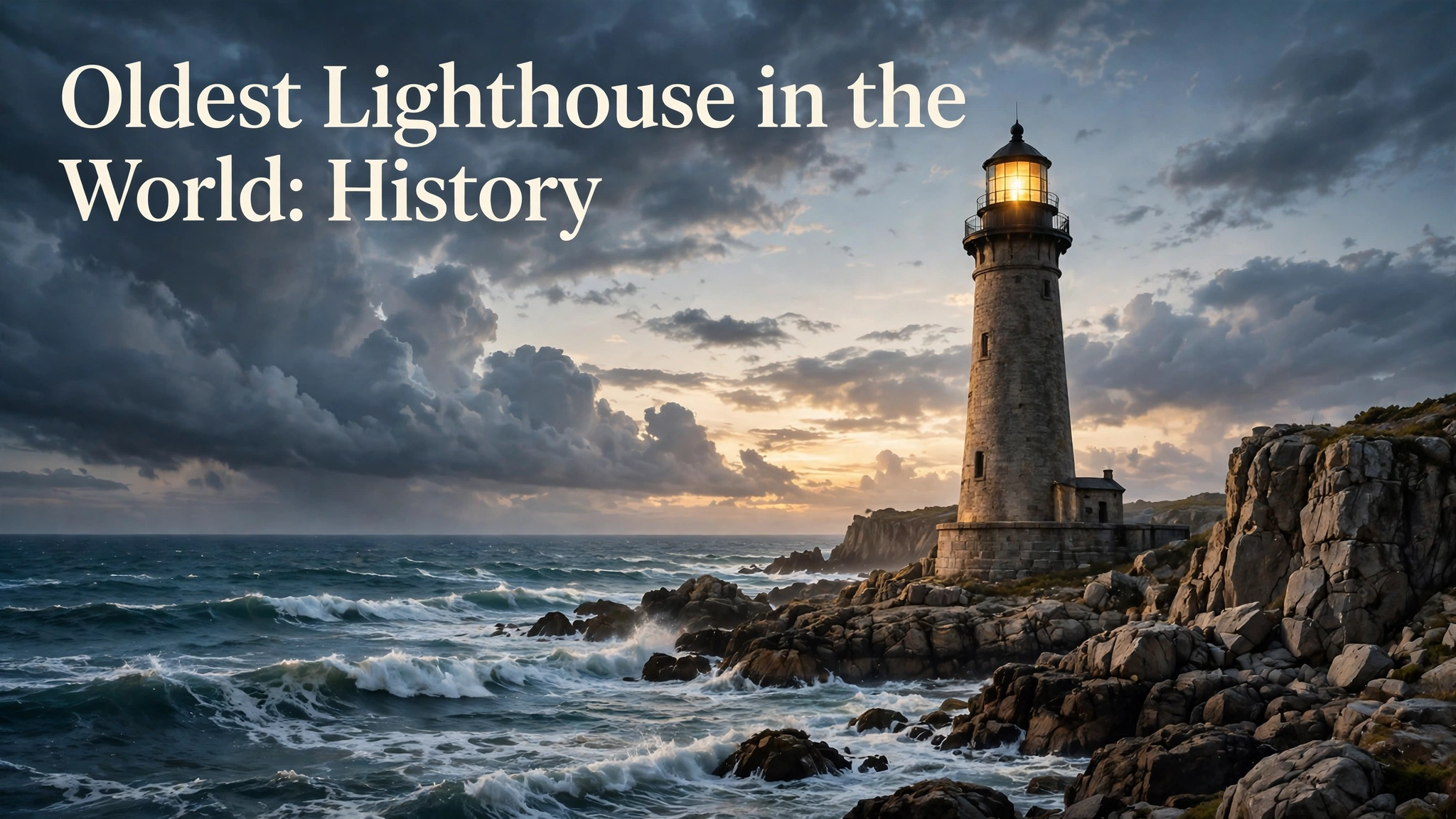
The Tower of Hercules, in A Coruna on the north-west coast of Spain, is the oldest lighthouse still in operation, and it is a UNESCO World Heritage Site. Its Roman core was built in the late first century AD, traditionally attributed to the Roman period when the port was an important trading station, and it was restored and heightened in the eighteenth century under the direction of the engineer Eusebio Giannini, who encased the Roman tower in a new outer structure while preserving much of the original inside. The result is a lighthouse that is both ancient and working: visitors can climb inside, see Roman masonry, and understand how the tower was built, while ships still use its light today.
The Tower of Hercules is about 55 metres tall and stands on a rocky headland overlooking the Atlantic. Its light, now electric and automated like most modern lighthouses, has a characteristic pattern that mariners recognise. The tower’s survival is remarkable because so few Roman lighthouses remain: most were abandoned, collapsed, or replaced as ports changed and empires fell. The Tower of Hercules survived because A Coruna remained an important port, because later rulers valued the tower enough to maintain and restore it, and because its solid Roman construction, with a central core and an external ramp in its original form, was built to last. It is also linked to legend: local tradition says the hero Hercules built the tower after defeating a giant, a story that gives the lighthouse its name and adds to its cultural appeal, even though the real builders were Roman engineers.
Other Ancient and Early Lighthouses
Beyond the Pharos and the Tower of Hercules, other ancient lights show how widespread the idea became. The Romans built lighthouses at Dover in Britain, where the remains of a Roman lighthouse still stand near Dover Castle, and at Boulogne in France, where a Roman lighthouse known as the Tour d’Ordre stood until the seventeenth century. In the eastern Mediterranean, lighthouses guided ships to ports in Greece, Asia Minor, and North Africa, though few survive above ground today. These towers were often built at harbour entrances, on islands, or on headlands, and they used open fires or oil lamps, maintained by keepers who lived nearby and kept the flame burning through the night.
In the medieval period, lighthouse building continued more slowly, often through monasteries, port towns, and guilds that maintained lights as a charitable or commercial duty. The famous lighthouse at Cordouan in France, built in the sixteenth and seventeenth centuries on a rocky island at the mouth of the Gironde estuary, is one of the oldest French lighthouses still working and is noted for its elaborate Renaissance design, including a chapel inside. In Britain, early lighthouses such as those at St Bees and elsewhere were often simple towers with coal fires on top. The Eddystone lighthouse off Plymouth, first built in the late seventeenth century and rebuilt several times after storms destroyed earlier versions, became a test case for engineering in exposed sea conditions, and its later versions, designed by John Smeaton and others, pioneered the use of interlocking stone blocks that could withstand waves. Each of these lights tells a story of local need, engineering ambition, and the constant battle between builders and the sea.
How Lighthouse Technology Changed
For most of history, lighthouse lights were open fires, candles, or oil lamps, which were dim, smoky, and hard to see far away. The great change came in the eighteenth and nineteenth centuries with better optics and fuels. The Fresnel lens, invented by the French physicist Augustin-Jean Fresnel in the 1820s, used a series of prisms to focus light into a powerful beam, dramatically increasing the range of a lighthouse without needing a larger flame. Suddenly a single lamp could be seen for twenty miles or more, and lighthouses could be given distinctive flashing patterns, so mariners could tell one light from another at night. This was a revolution in safety, and Fresnel lenses, many still in place as historic artefacts, are now admired as beautiful engineering in their own right.
Later changes included better fuels, from whale oil and colza oil to kerosene and then electricity, and the automation of lighthouses in the twentieth century, which removed the need for resident keepers. The life of a lighthouse keeper, romanticised in stories, was in reality lonely, disciplined, and demanding: keepers cleaned lenses, maintained fuel supplies, wound clockwork mechanisms that rotated lenses, kept logs, and stayed alert through storms. Automation, using electric lights, sensors, and remote monitoring, made lights more reliable and cheaper to run, but it also ended a way of life. Today most major lighthouses are unmanned, monitored from shore, and maintained by visiting technicians, while their historic buildings are preserved as museums, visitor attractions, or heritage sites.
Famous Lights: Eddystone, Cordouan, and Beyond
Some individual lighthouses became famous because of the engineering challenges they overcame. The Eddystone Rocks, off the coast near Plymouth in England, are a reef that wrecked many ships, and the first lighthouse there, built in 1698, was swept away in a great storm along with its builder. Later versions improved steadily, and John Smeaton’s Eddystone lighthouse, completed in 1759, pioneered interlocking granite blocks shaped like a dovetail, so waves could not easily pull the tower apart. That design influenced lighthouse building worldwide and showed that a tower in the open sea needed not just height but a shape and foundation that could work with waves rather than simply resist them. Smeaton’s tower stood for more than a century before being replaced, and its upper part was rebuilt on land as a monument.
The Cordouan lighthouse in France, at the mouth of the Gironde estuary, is another landmark, notable for its elaborate design that combined a lighthouse with a chapel and royal apartments, reflecting the prestige its builders attached to the project. Begun in the sixteenth century and completed in the seventeenth, Cordouan is one of the oldest lighthouses in France still in service and is now recognised for its heritage value. In the United States, the oldest surviving lighthouse is often cited as the Boston Light, first built in 1716 and rebuilt after destruction during the American Revolutionary War, which still operates today with a keeper in a ceremonial role. Each of these lights shows a different answer to the same problem, adapted to local rocks, tides, politics, and pride, and together they form a global heritage of maritime engineering.
Lighthouses Today: Heritage, Tourism, and Safety
In an age of GPS, satellite navigation, and electronic charts, some people ask whether lighthouses are still needed. The answer from maritime authorities is yes, as a backup and as a visual aid. Electronic systems can fail, be jammed, or give wrong positions, while a lighthouse is a simple, independent reference that a mariner can see and trust. Lighthouses also mark dangers that charts alone cannot convey in poor visibility, and they help small vessels without sophisticated electronics. Many countries therefore maintain their lighthouse networks, even as they automate them, because redundancy in navigation saves lives. A ship that loses GPS in fog still needs a light to steer by, and lighthouses provide that light without depending on satellites or power grids at sea.
Lighthouses have also become cultural icons. They appear in art, literature, films, and photography as symbols of guidance, hope, and endurance, and many are now popular tourist destinations. Visitors climb the Tower of Hercules, tour the Cordouan lighthouse by boat, and visit museums at Eddystone’s predecessors and other historic lights. Preservation groups work to protect lighthouse buildings, lenses, and keeper’s cottages, which face threats from coastal erosion, storms, and neglect. For travellers, visiting an old lighthouse is a way to connect with maritime history: standing at the top, looking out to sea, and imagining the keepers who maintained the light through winter storms gives a vivid sense of how much depended on a single flame, and how much still depends on the simple idea of a light in the dark.
Travellers planning a lighthouse visit should also remember that these are working aids to navigation as well as heritage sites, and that access can be limited by weather, tides, and safety rules. The Tower of Hercules is accessible in a city setting, while Cordouan and Eddystone require boat trips that depend on sea conditions, and many remote lights can only be viewed from shore. Checking opening times, tide tables, and local guidance before travelling avoids disappointment and respects the operational needs of the light. Guided tours, where available, add far more than a climb alone, because guides explain the lens, the light’s characteristic pattern, and the history of wrecks the light was built to prevent. A visit prepared in that way becomes not just a photograph opportunity but a genuine encounter with maritime history, engineering, and the human effort that kept ships safe for centuries.
My Take:
My view is that the Tower of Hercules deserves more fame than it usually gets, because it is easy to celebrate a lost wonder like the Pharos and harder to appreciate a working survivor. The Pharos was taller, more famous, and more beautiful in its prime, but it is gone, known only through descriptions, coins, and disputed underwater stones. The Tower of Hercules is still there, still working, and still climbable, which makes it a living link to Roman engineering rather than a legend. When I think about what makes a historic site special, I value that continuity: a building that has done the same job, guiding ships, for nearly 1,900 years, across empires, languages, and technologies, is extraordinary in a way that a ruin, however famous, cannot match. If you visit only one old lighthouse, I would choose the one that still lights the sea.
I also think lighthouse history teaches a useful lesson about technology. We tend to assume new technology replaces old technology completely, but lighthouses show the opposite: GPS did not abolish lighthouses, it made them a backup, and that backup role is still vital. The same pattern appears elsewhere: printed maps still matter when phones fail, and simple tools still matter when complex systems break. The Fresnel lens was a high-tech breakthrough in its day, yet its principle, focusing light efficiently, is still elegant and still taught to engineers. Progress in navigation has been additive, not simply substitutive, and lighthouses remind us that reliability often matters more than novelty. A light that works in a storm, without satellites, is not old-fashioned; it is resilient.
Another opinion I hold is that the lives of lighthouse keepers deserve more attention than the towers themselves sometimes receive. Keepers are often romanticised as lonely heroes staring at the sea, but their real work was disciplined and technical: cleaning a huge lens to perfection, because a smudge could dim a beam for miles; maintaining fuel and clockwork; keeping accurate logs; and staying calm during storms that shook the tower. That work, done night after night with little recognition, saved countless lives. Automation was the right choice for safety and cost, but something was lost when keepers left: a human presence watching the sea, noticing changes, and caring for a light as a personal responsibility. Museums that preserve keeper’s cottages and logs help keep that human story alive, and I think they are as important as the towers.
I am also struck by how lighthouses connect local history to global trade. A lighthouse at A Coruna, Dover, or Alexandria was never just a local building; it was part of a network that allowed ships from distant ports to arrive safely, trade goods, and carry ideas. The oldest lighthouses therefore mark the growth of connected economies and cultures, long before modern globalisation. When we preserve a lighthouse, we are preserving evidence of that early connectivity, and of the engineering ambition that made it possible. That is why UNESCO recognition for the Tower of Hercules matters: it is not just about one tower in Spain, but about a shared maritime heritage that belongs to everyone who depends on the sea.
I also think lighthouse preservation deserves practical support, not only admiration. Coastal erosion, rising sea levels, and stronger storms threaten many historic lights, and maintaining a stone tower in the sea is expensive and technically difficult. Decisions about which lighthouses to preserve, which to automate fully, and which to decommission involve real trade-offs between heritage, safety, and cost. I believe the best approach is to protect the most historically significant lights as working heritage, where they continue to aid navigation while welcoming visitors and teaching maritime history, and to record others thoroughly before they are lost. A lighthouse that is maintained, visited, and understood has a far better future than one that is simply photographed and forgotten.
Finally, I believe lighthouses endure in culture because they speak to a simple human need: guidance in darkness. Whether you are a sailor in fog, a traveller on a coast, or simply someone who loves the image of a light that does not go out, lighthouses offer a reassuring symbol that is grounded in real function. They are not merely metaphors; they are working buildings that have saved lives. That combination of symbolism and practicality is rare, and it explains why lighthouses appear in so many stories, photographs, and paintings. The oldest lighthouses, from the lost Pharos to the still-burning Tower of Hercules, remind us that the best inventions are often the simplest: a tall tower, a bright light, and someone, or now something, keeping it burning through the night.
That simplicity is worth carrying into other areas of life as well. We often assume that a difficult problem requires a complicated solution, yet lighthouses solved one of humanity’s oldest dangers, ships striking rocks in the dark, with height, light, and reliability, maintained night after night. Modern navigation adds layers of sophistication, but it still depends on that same principle: give people a clear, trustworthy reference when they are uncertain, and they can find their way. Whether the reference is a lighthouse beam, a well-marked path, or honest information in a confusing situation, the value lies in clarity and constancy. The oldest lighthouses teach that lesson in stone and light, and they will keep teaching it as long as ships sail and people look for guidance in the dark.
Another fascinating aspect of lighthouse history is the international cooperation it required, because ships from many nations depended on lights maintained by other countries. Mariners needed reliable information about light characteristics, positions, and changes, and that need led to published lists of lights, international agreements, and shared standards that predated many modern forms of global cooperation. A lighthouse in Spain, France, or Egypt was therefore not only a national asset but part of an international safety network, and its keepers served sailors of every flag. That cooperative spirit, built around a simple shared interest in preventing wrecks, remains a model for how countries can work together on safety and heritage today, even when they disagree on other matters. The light itself does not ask about nationality; it simply warns and guides, and that universality is part of its enduring appeal.
Frequently Asked Questions
What is the oldest lighthouse in the world? The oldest lighthouse ever built was the Pharos of Alexandria in Egypt, from the third century BC, now lost. The oldest lighthouse still standing and working is widely considered to be the Tower of Hercules in A Coruna, Spain, with a Roman core from the late first century AD.
Is the Tower of Hercules still working? Yes, the Tower of Hercules still functions as a lighthouse guiding ships into A Coruna, though its light is now electric and automated. It is also a UNESCO World Heritage Site and open to visitors.
What happened to the Pharos of Alexandria? The Pharos stood for many centuries but was gradually damaged by earthquakes and fell into ruin by the medieval period. Its stones were reused in later buildings, and possible remains lie underwater near the original site.
How did ancient lighthouses produce light? Ancient lighthouses used open fires, and later oil lamps, at the top of a tower. The fire was visible at night and smoke served as a daytime marker, though the range was far shorter than modern lights with Fresnel lenses and electricity.
What is a Fresnel lens? A Fresnel lens, invented by Augustin-Jean Fresnel in the 1820s, uses prisms to focus a lamp’s light into a powerful beam, greatly increasing a lighthouse’s range. It allowed lighthouses to have distinctive flashing patterns so mariners could identify each light.
Do we still need lighthouses with GPS? Yes, maritime authorities maintain lighthouses as a reliable visual backup. GPS can fail or be inaccurate, while a lighthouse provides an independent, visible reference that helps ships navigate safely, especially in poor visibility.