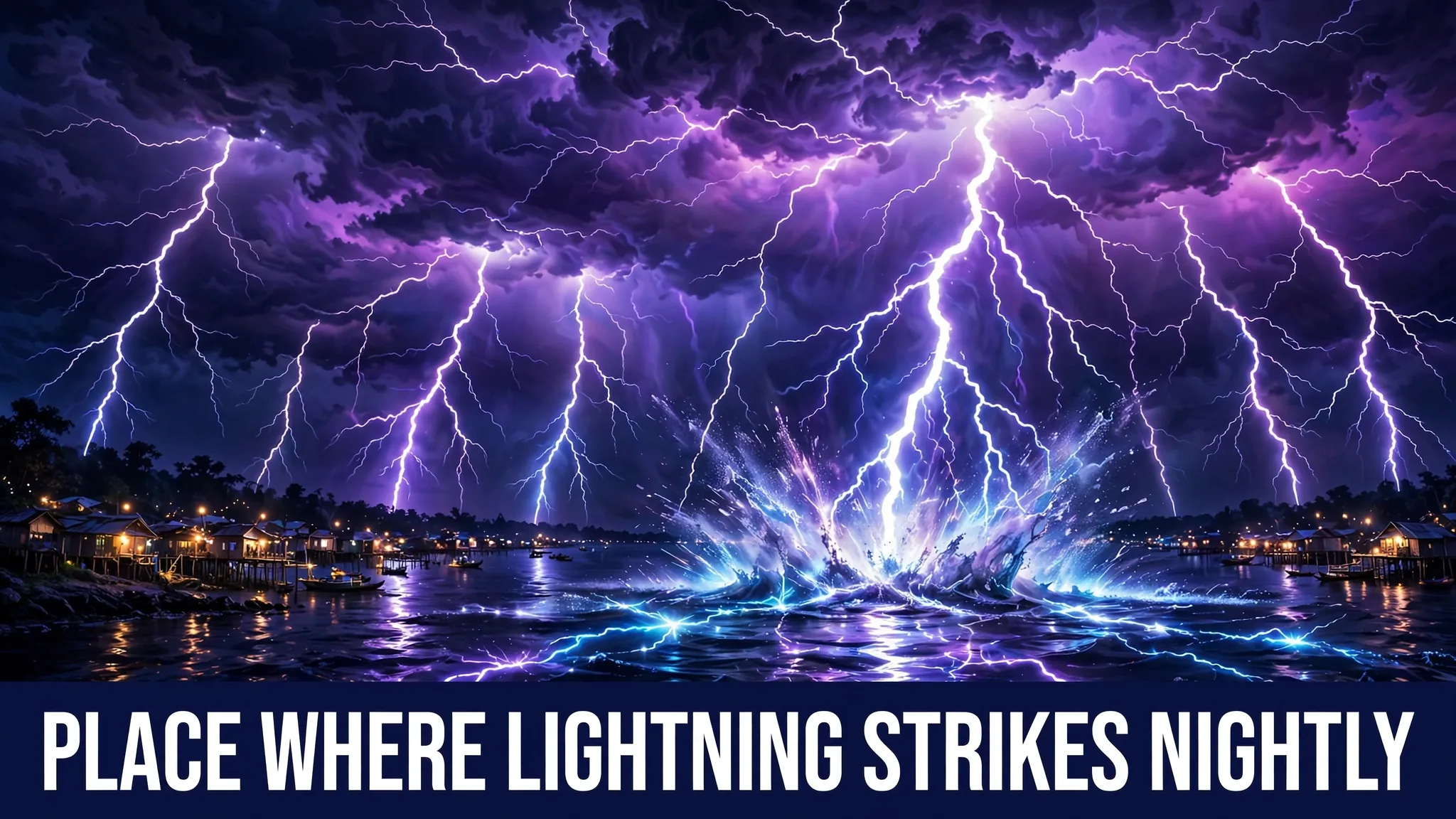
Place Where Lightning Strikes Nightly
In this post
Come and stand at the water’s edge with me. The sun has just gone down over Lake Maracaibo, the fishing boats are coming in, and the air still smells of warm mud and swamp grass. Nothing looks unusual yet. Give it a little while.
Then it starts. A pulse of light blooms inside a cloud, far across the water — no sound, no warning. A pause. Another pulse, brighter. Within the hour the whole southern horizon is flickering like a faulty lamp, and it will keep flickering long after we have gone to sleep.
Plenty of travellers cross the world hoping to catch one good storm. Ours keeps an appointment almost every night.
Stepping Ashore at the Lake
We are in the north-west of Venezuela, in the state of Zulia. Lake Maracaibo sprawls across more than 13,000 square kilometres of hot, low country, and in the north it opens into the Caribbean Sea. Sail south across that wide water and the shores soften into marshland, where the Catatumbo River slides quietly into the lake.
That swampy meeting point — river mouth, flat bog, open lake — is our grandstand. Everything on this journey happens in the sky directly above it.
Waiting for the Dark
All afternoon, without us noticing, the stage has been getting ready. The tropical sun has been beating on the lake for hours. The water is warm. The air hanging over it is thick with moisture, the way air feels just before a monsoon breaks.
Time your visit well and the wait is short. Come around October, in the wettest stretch of the year, and the storm performs at full strength. Arrive in January or February and even this sky takes its rest — those are its quietest months. In the driest weeks you may even get flashes with no rain beneath them at all, dry lightning rolling silently over the marshes.
So we wait. The village lights come on. The first stars appear. And then, somewhere out over the river mouth, the clouds begin to glow from inside.
The Show Begins
Nobody applauds. The lightning does not need encouragement.
On a working night, the display runs for nine or ten hours, from shortly after dark until the small hours of the morning. Count the flashes with me for a moment and the numbers stop feeling real: between 16 and 40 in a single busy minute. Stretch that across the storm’s fiercest hour and you reach something like 280 strikes. Multiply it across the 140 to 160 nights a year when the storm shows up, and the yearly total climbs to roughly 1.2 million discharges.
Yet stand where we are standing and you will mostly hear nothing. Nearly all of this electricity leaps from one part of a cloud to another, very high above the ground, rather than striking down at the earth. The thunder that belongs to those flashes has so far to travel that it fades away on the road. What reaches us is light — wave after wave of silent light.
A storm you watch instead of hear. It feels less like weather and more like the sky breathing.
Asking the People Who Live Here
Ask around the shore and the names come quickly. In the language of the Barí people, one of the Indigenous peoples of this region, Catatumbo means “House of Thunder” — the thunder is not a visitor here, it owns property. Others call the phenomenon the Everlasting Storm.
Long before anyone measured it, people used it. The flashes are so bright and so faithful that they can be picked out from as far as 400 kilometres away, far out at sea, and for centuries sailors steered by that glow on the horizon. A lighthouse that nobody built and nobody has to light: the Lighthouse of Maracaibo, the Maracaibo Beacon. The naturalist Alexander von Humboldt put it in writing in 1826, and in 1841 the geographer Agustín Codazzi described navigators guiding themselves by its position at the mouth of the lake. The Wayuu, Yukpa and Barí communities had understood the light long before any European thought to describe it.
Zulia has never treated the storm as a curiosity. It is printed on the state’s flag and worked into its coat of arms — lightning, chosen as the emblem of a whole region.
I will be honest about the detail that charms me most on this whole trip: it is that flag. Regions usually put mountains, rivers or heroes on their banners. Zulia put the wildest thing in its sky. There is something quietly wonderful about a people who looked up at a storm that never leaves and decided — yes, that one is ours.
Asking Why, Somewhere Around Midnight
By now the question has followed us all evening: why here? Why this lake, this river mouth, this same patch of sky, night after night, while the rest of the world gets a thunderstorm only now and then?
Stand in the dark a little longer and the answer assembles itself from three things that meet over this water every single evening.
The first is fuel. All that daytime sun has warmed the lake and the swampy plains, and the air above them is loaded with moisture. Warm, wet air is what thunderstorms eat.
The second is a cold push. The lake does not lie on open flatland. High ridges — the Andes, the Perijá Mountains and the Mérida Cordillera — wrap around the lowland on three sides. When night falls, chilled air slides down off those heights and pours out across the water.
The third is the trap. Those same mountains form the walls of an enormous bowl, so the warm lake air cannot escape sideways. When the cold night flow arrives, the warm air has exactly one direction left to go: up. It climbs fast and hard, piling into towering storm clouds.
High inside those clouds, droplets freeze into ice crystals and soft hail. The frozen grains crash into one another millions of times, and every collision rubs electric charge apart inside the cloud — the way a jumper crackles with static on a dry day, except scaled up to the size of the sky. When the stored charge grows beyond what the cloud can hold, it jumps. Flash. The collisions keep charging, the charge keeps growing, and it jumps again.
Nothing about this machinery ever moves away. The bowl stays. The lake keeps breathing out warm, wet air. So by the following dusk the whole apparatus has rebuilt itself, ready for another night.
One older explanation pointed lower, at the ground: methane gas, seeping up from the swamps and the oil deposits under the region, was said to feed the lightning. The storm’s behaviour argues against it — the flashes follow the calendar of winds and rains, not the swamps — and today most researchers credit the meeting of the winds, the warm lake and the ring of mountains instead.
The Night the Sky Refused
Every long journey has one night that goes wrong. Ours came years before we arrived.
In early 2010, a severe drought gripped Venezuela — and from January to March, the famous flashes over Lake Maracaibo simply ceased. Night after night, the sky above the river mouth stayed dark, the way skies do in ordinary places. For people who had steered boats by that light all their lives, the darkness itself felt like a bad omen, and talk spread that the Everlasting Storm might have gone out for good.
It had not. The drought had cut off the machine’s fuel supply: without the usual rain and moisture, the nightly collision of warm and cool air could no longer raise its giant clouds. When the rains returned, the lightning returned with them, as if it had only been waiting offstage.
Forever, it turns out, has conditions. Change the water, change the wind, and even the House of Thunder can fall quiet.
Counting the Flashes from Far Above
Count from a boat, the way we have been doing, and you lose track before midnight. So scientists counted from orbit.
A research team led by Dr Rachel Albrecht worked through sixteen years of readings from a lightning sensor aboard a NASA satellite, comparing hotspots across the entire planet. Lake Maracaibo finished first. NASA’s analysis put the figure at more than 233 flashes per square kilometre per year — some counts place it nearer 250 — comfortably ahead of the spot that used to hold the title, near Kabare in the Democratic Republic of the Congo. The phenomenon also holds a Guinness World Record for the highest concentration of lightning anywhere on Earth.
One last claim deserves a careful step. All this lightning manufactures a great deal of ozone gas — that part is not in doubt. Whether any meaningful amount of that ozone reaches the protective ozone layer high above the Earth is where agreement stops; scientists are still arguing about it, so the storm’s admirers should not claim more than the evidence carries.
Dawn is coming up now over the water. The lake flattens into silver, the boats head out, and above the river mouth the clouds are already beginning their slow day’s work of gathering. Tonight, in all likelihood, the show runs again.
Frequently Asked Questions
Where exactly are we standing for this storm? On the shore of Lake Maracaibo in north-western Venezuela. The lightning builds mainly above the marshy ground where the Catatumbo River flows into the lake, at its southern end.
How many nights a year can a visitor expect the show? On roughly 140 to 160 nights a year, and on those nights the display commonly runs for nine to ten hours after dark.
Why is there so little thunder to go with the flashes? Most of the lightning jumps between parts of the clouds themselves, high above the ground, instead of striking the earth. The light reaches watchers easily; the sound usually fades before it does.
What does the word Catatumbo mean? In the language of the Barí people it means “House of Thunder”. The phenomenon is also called the Everlasting Storm and the Lighthouse of Maracaibo.
Did the storm really stop once? Yes. During a severe drought, from January to March 2010, the flashes ceased completely, and many feared the phenomenon had ended. The lightning returned when the rains did.
Is any place on Earth more electric than this one? No. Satellite measurements give Lake Maracaibo the highest lightning density in the world — more than 233 flashes per square kilometre per year in NASA’s analysis — and it holds the Guinness World Record for the highest concentration of lightning.
Sources
- Wikipedia, “Catatumbo Lightning”: https://en.wikipedia.org/wiki/Catatumbo_lightning
- NASA Earthdata, “Dr. Rachel Albrecht” — research on Earth’s lightning hotspots: https://earthdata.nasa.gov/news/data-user-stories/dr.-rachel-albrecht
- Atlas Obscura, “Relampago del Catatumbo”: https://www.atlasobscura.com/places/relampago-del-catatumbo
- The picture on this page is an original illustration made for Talha M Blog.