Town Where Fish Rain Yearly
In this post
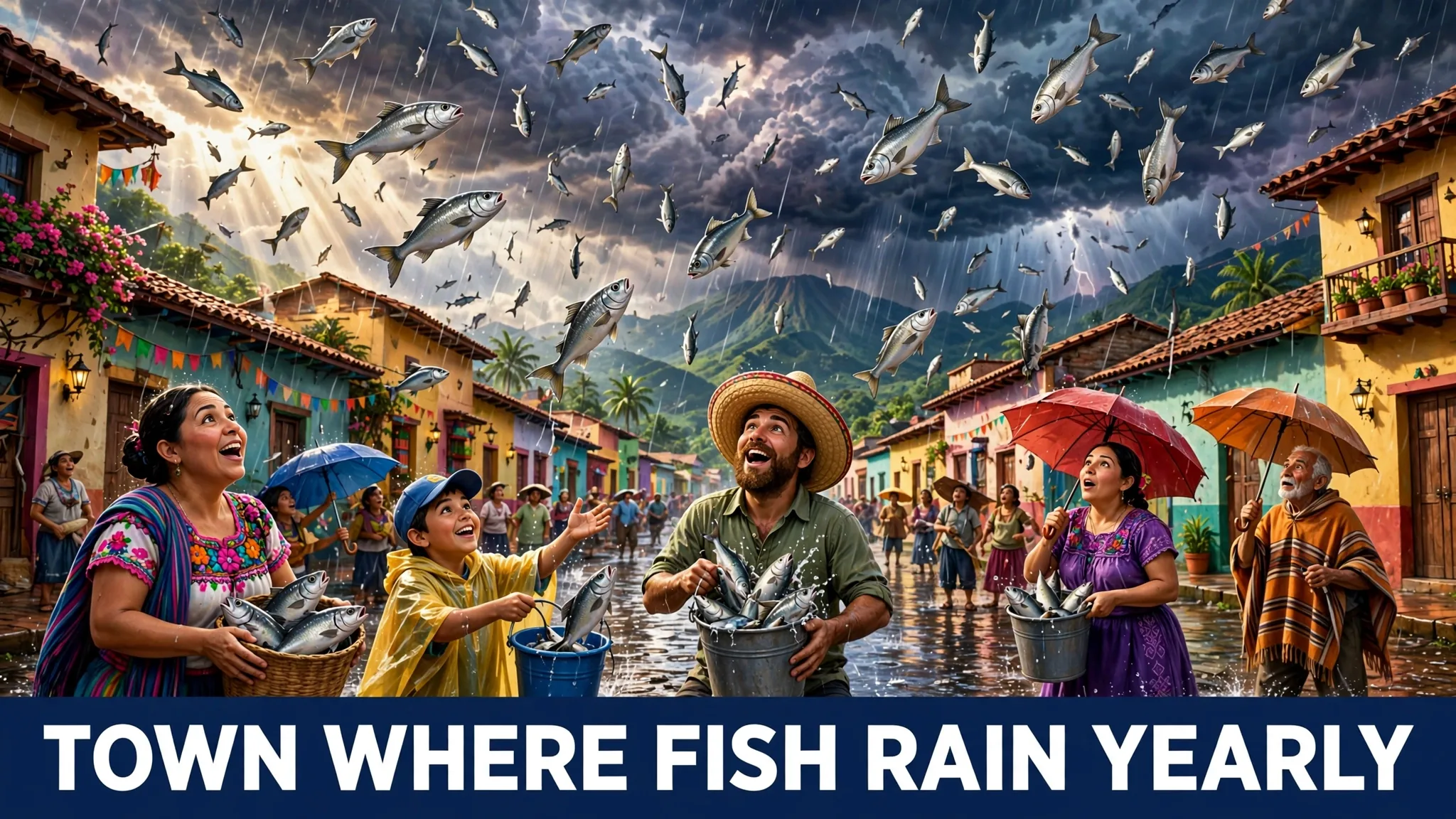
Imagine the heaviest rain of the year is hammering on your roof. Thunder shakes the windows, and nobody dares to step outside. Then, slowly, the storm moves away. You open your door, look at the wet street — and the street is moving. Hundreds of small silver fish are flapping and bouncing on the ground, in the gardens, even out in the fields. They were not there before the rain. Now they are everywhere, and they are alive.
This is not a fairy tale. It is what people in Yoro, a town in the Central American country of Honduras, say happens there every single year. They call it the Lluvia de Peces — Spanish for “Rain of Fish”. Reports of it go back to the 1800s, well over a hundred years. And to this day, nobody on Earth can fully explain it.
What People Say Happens In Yoro
The reports follow the same pattern almost every time. In the rainy season, usually around May or June, a huge storm rolls over the Yoro area, with rain so heavy that everyone stays indoors until it passes.
When the sky clears and people step outside, they find the ground covered with fish. The ground is left alive with hundreds of small silver fish, still living, flipping and struggling on the wet earth. It is said to happen at least once a year, and in some years twice.
Yoro is not a seaside town; it sits inland, away from the coast. And here is the detail that makes the story so hard to laugh away: the fish, people point out, are not the kinds normally found in the streams and rivers near the town. If a simple local flood had dropped them there, they should look like local fish. They do not — and that one strange fact has kept this mystery alive for generations.
The Legend Of The Priest Who Prayed For Food
Every town protects its favourite story, and in Yoro the favourite story is about a priest. It is important to say this clearly: this part is a legend — a tale the town has retold for generations — not a proven historical record. But it is a beautiful tale, and the people of Yoro hold it close to their hearts.
Father José Manuel Subirana was a Spanish Catholic priest who arrived in Honduras in 1855 and stayed until his death in 1864. In the legend, the priest saw how poor and hungry the people around him were, and his heart broke for them. So he prayed — not for an hour, but for three days and three nights — asking God for a miracle that would bring food to the poor.
At the end of his long prayer, the story says, a dark cloud gathered over the area, and fish fell from the sky, feeding everyone. And from that day on, the wonder has returned every year.
Is it history? No surviving record proves it. Is it loved? Completely. In Yoro, the fish are not treated as a freak accident of weather. They are treated as a gift — food that arrives from above for people who need it. That feeling explains everything the town does next.
A Festival For A Falling Miracle
Most towns celebrate a harvest or a holy day. Yoro celebrates falling fish.
Since 1998, the town has held an annual Festival de Lluvia de Peces — the Festival of the Rain of Fish. Its date is not fixed on the calendar, because the festival follows the weather: it is held around the time of the first major rainfall of the season, in May or June.
The celebration includes a parade and a carnival, and during the parade a figure of Father Subirana is carried proudly through the streets. The festival honours both the mystery in the sky and the priest in the legend, and it has carried the name of this small Honduran town all over the world.
Idea One: Wind That Steals Fish From The Sea
Now to science, which has tried hard to solve this puzzle. The most famous explanation is the waterspout.
A waterspout is a spinning column of air, like a small tornado, that forms over water. Its whirling winds can lift small, light things out of the water — and sometimes that includes little animals. The idea is simple: a waterspout picks up small fish, carries them through the air, and lets them fall when the wind weakens, so it looks as if fish have rained from the sky.
Around the world, this probably does explain many strange stories of “animal rain”, which have been reported for centuries and usually involve fish or frogs. But Yoro is a hard case for this idea. The nearest ocean water, the Atlantic, is roughly 72 kilometres — about 45 miles — away. A waterspout would have to gather the same kind of fish in the open sea, every year at almost the same time, carry them all the way inland, and drop them on the same area. Even people who like this theory admit that is a great deal to ask of the weather.
Idea Two: A Hidden River Under The Town
The second idea sounds less exciting, but many researchers find it stronger: perhaps the fish never fall at all. Perhaps they swim up.
The trail leads back to the 1970s, when a team from National Geographic travelled to Yoro to look into the phenomenon. The team witnessed the event and examined the fish scattered on the ground after a storm — yet clear proof that the fish had actually dropped out of the sky stayed out of reach. What the team did notice about the fish themselves was remarkable, and it is the detail this whole mystery turns on: the fish were freshwater fish, and they were completely blind.
A blind fish is a fish built for darkness. That points away from sunny rivers and the open sea, and towards water that never sees daylight — underground rivers and cave systems flowing beneath the town. The theory says these hidden fish live below Yoro all year round. When the great rains come, floodwater forces its way into their dark world and pushes the fish up to the surface. When the water drains away, the fish are left stranded on streets and fields — exactly where a surprised town finds them after the storm.
It fits the season. It fits the blindness. It fits the strange fact that the fish are not local river fish. But it has never been completely proven either: nobody has fully mapped the underground home of these fish and shown it to the world.
So Do Fish Really Fall From The Sky In Yoro?
Here is the honest answer, after more than a century of reports: nobody knows for certain.
What is solid is this: year after year, the people of Yoro really do find large numbers of small, live fish on the ground after heavy storms, and they have reported this since the 1800s. What is not proven is the falling itself. National Geographic has noted that, despite the famous name, the fish do not appear to actually fall from the sky — the evidence fits them arriving some other way, most likely pushed up from below.
So two good ideas stand face to face: the wind that carries, and the river that rises. And the little blind fish of Yoro keep their secret.
Maybe that is why the town loves its festival so much. Once a year, the storm comes, the wet ground sparkles with silver, and everyone is reminded that the world still holds wonders science has not finished explaining — and that a good legend, like Father Subirana’s, can feed the heart while everyone waits for the answer.
Frequently Asked Questions
Where does the fish rain happen? In and around Yoro, a town in the department of Yoro in Honduras, a country in Central America.
When does it happen? During the rainy season, usually around May or June. Reports say it happens at least once a year, and in some years twice.
Do fish really fall from the sky there? That is the famous claim, but it has never been proven. Live fish are certainly found on the ground after heavy storms. Experts are divided between waterspouts carrying fish through the air and underground rivers pushing fish up to the surface.
Why do people connect the fish rain with a priest? Local legend says that Father José Manuel Subirana, a Spanish priest in the 1800s, prayed for three days and three nights asking for food for the poor, after which fish fell from the sky. It is a beloved legend, not a proven record.
What is the Festival de Lluvia de Peces? It is an annual festival held in Yoro since 1998, timed with the season’s first major rainfall. It includes a parade and a carnival, and celebrates both the phenomenon and the legend of Father Subirana.
Sources
- Atlas Obscura, “Lluvia de Peces (Rain of Fish)”: https://www.atlasobscura.com/places/lluvia-de-peces-the-rain-of-fish
- Wikipedia, “Lluvia de peces”: https://en.wikipedia.org/wiki/Lluvia_de_peces
- The picture on this page is an original illustration made for Talha M Blog.