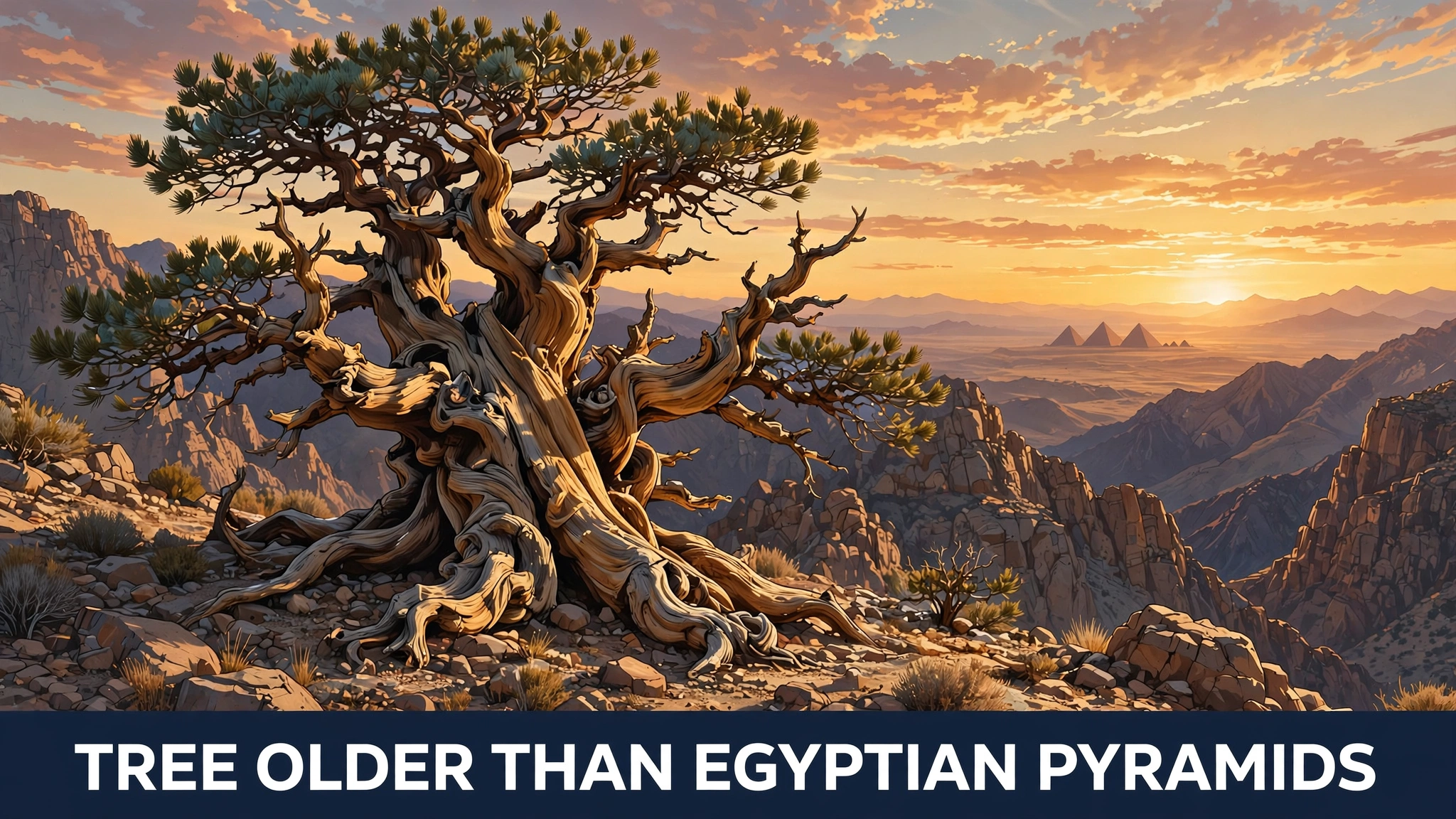
Tree Older Than Egyptian Pyramids
In this post
The Great Pyramid of Giza is so old that even the ancient Romans treated it as an antique. Yet on a cold, rocky mountainside in California, there is a living tree that is older still. It pushed its first green shoot out of the soil roughly three centuries before the first pyramid stone was laid — and it is alive today, still growing, still making needles, still quietly adding one thin ring of wood at a time.
Its name is Methuselah, and its story is one of the most amazing in all of nature: how a tree can survive for nearly five thousand years, how scientists proved its age without harming it, and how an even older tree was lost forever because of one terrible mistake.
Older Than The Pyramids Of Egypt
Methuselah is a Great Basin bristlecone pine, a slow and stubborn species that grows high in the White Mountains of eastern California, inside the Inyo National Forest. Based on its tree rings, scientists estimate that it began life as a tiny seedling around the year 2833 BCE. The Great Pyramid of Giza, by comparison, was built around 2560 BCE. So when Egyptian workers were hauling stones for the pharaoh, this pine was already a tree of nearly three hundred summers.
The tree takes its name from Methuselah, the long-lived figure of the Bible, who is said to have reached 969 years of age. The pine has outlived its namesake five times over. Guinness World Records describes it as the oldest named individual tree in the world, dated at more than 4,800 years old — 4,856 years as of 2024 — and it is still going.
One word matters here: individual. Methuselah grew from a single seed into a single tree, and that same tree has stood on its mountainside ever since. Some living things, like the quaking aspen colony known as Pando, spread by cloning themselves from one root system, and such colonies may be far older as a group. But as one single, continuous life, this bristlecone pine is almost beyond belief.
How A Scientist Counted Its Years Without Cutting It Down
For most of history, nobody knew the tree existed. Its age was revealed by Edmund Schulman, a scientist at the University of Arizona who spent years hunting for the oldest trees in America, studying their rings to read the climate of the past. This science of dating trees by their rings is called dendrochronology, because trees in seasonal climates grow one new ring of wood each year: a wide ring in a good, wet year, a painfully thin one in a drought.
In 1957, Schulman took a core sample from the tree — a pencil-thin tube of wood drawn out with a special borer, so the tree was not felled or badly hurt. Counting the rings in that slim core, he found 4,789 of them. The age was later checked and confirmed by dendrochronologist Tom Harlan at the University of Arizona’s Laboratory of Tree-Ring Research, by matching the ring patterns against those of other ancient trees and dead wood, a method called crossdating. The grove where the tree stands was named the Schulman Grove in his honour; Schulman himself died just a year after the discovery, in 1958.
Those rings are more than a birthday count. Because dead bristlecone wood survives on the dry slopes for thousands of years, scientists have linked the rings of living trees with older and older dead pieces to build a climate record stretching back more than 9,000 years, as Guinness notes — a year-by-year diary of rain, drought and cold written in wood.
A Home So Harsh That Almost Nothing Else Survives
Here is the first surprise: Methuselah does not live in a gentle, well-watered paradise. It lives in one of the toughest neighbourhoods a tree could choose. The Ancient Bristlecone Pine Forest sits at around 3,050 metres — about 10,000 feet — above sea level, where the air is thin, the winters bite hard, fierce winds bend the trees into twisted sculptures, and the pale rocky ground, much of it a limestone rock called dolomite, holds very little water or food for roots.
Almost nothing else wants to live up there. And that, strangely, is protection. With hardly any bushes or grass between the pines, wildfire finds little fuel and rarely sweeps through. The cold, dry air keeps most insects and fungi — the usual killers of old trees — weak and scarce. The bristlecones did not win a kind home. They won an empty one, where the enemies that end most trees’ lives simply cannot follow.
The Secrets Of Living For Five Thousand Years
Slow down. That is the bristlecone’s whole philosophy. In such a cold, dry and stressful place, the trees grow very, very slowly — sometimes adding less wood in a century than a garden tree adds in a single year. Dendrochronologist Peter Brown, who keeps a database of the world’s oldest trees, explains that the oldest trees tend to grow in just such stressful, marginal places, and that this hardship is exactly what makes them grow so slowly and last so long.
Slow growth makes the wood incredibly dense and heavy with resin. Rot, fungi and boring insects struggle to get through it, so the tree resists decay the way a stone resists weather. The trees are also careful with their leaves: a bristlecone can keep the same needles for up to forty years, instead of spending energy growing a fresh set every season.
The strangest trick of all is how a bristlecone can be mostly dead and completely alive at the same time. Scientists call it sectored architecture. As the tree ages, parts of it die off, until only a narrow ribbon of living bark climbs the trunk, joining a patch of living roots below to a small tuft of green branches above. The rest of the tree may be bare, bleached, beautiful dead wood — yet along that one living strip, water and food still flow, and the tree carries on. That is why these ancient pines look like twisted ghosts. They are not dying. They are travelling light.
Prometheus, The Even Older Tree That Was Cut Down
Methuselah is not the oldest bristlecone ever found. It is the oldest one we did not lose.
On Wheeler Peak in Nevada, another bristlecone grew, nicknamed Prometheus. In 1964, a young graduate student and geographer named Donald Rusk Currey was studying the history of ice-age glaciers there, and he wanted ring samples from the old pines. Accounts differ on some details — his coring tool reportedly got stuck or broke in the tree, or could not reach deep enough — but the outcome is agreed: with permission from the US Forest Service, the tree was cut down so its rings could be counted across a full slice of the trunk.
Only then did anyone learn what had been done. The rings numbered at least 4,862, and later estimates put the tree at about 4,900 years old or more — older than Methuselah, the oldest single living thing known on Earth at the time. Nobody involved had known its age before the saw started. A polished slab of Prometheus is still kept at the Great Basin Visitor Center in Nevada, and its home grove now lies within Great Basin National Park, created in 1986. The shock of the loss changed how these trees are treated forever: never again would an ancient bristlecone be felled just to count its years.
Why Nobody Will Tell You Which Tree It Is
You can visit the forest. You can walk the trail that winds through Methuselah’s own grove, in the Inyo National Forest, and stand among dozens of ancient, twisting pines. But no sign will tell you which one is Methuselah, and the rangers will not say. The US Forest Service keeps the tree’s exact location secret, and Guinness explains why: to shield it from vandalism and from the damage that too many feet and hands can do. After Prometheus, nobody was willing to gamble with the oldest life on Earth a second time.
Methuselah is not even the only secret in those mountains. Guinness records that another bristlecone, sampled by Schulman himself and crossdated years later by Tom Harlan, is even older — about 5,074 years old as of 2024, currently the oldest verified living tree in the world. It has no famous name and no marked trail. Perhaps that is fitting. The lesson of this whole story is that the longest life on Earth belongs to a tree that grows almost invisibly slowly, in a place almost nothing else can stand, kept safe at last not by fences or fame — but by being left quietly alone.
Frequently Asked Questions
How old is Methuselah, exactly? When Edmund Schulman cored it in 1957, he counted 4,789 annual rings. It has been adding rings since then, so today the tree is roughly 4,850 years old, having sprouted around 2833 BCE — about three centuries before the Great Pyramid of Giza was built.
Is Methuselah really the oldest living thing on Earth? It is the oldest named individual tree with a confirmed age. Clonal colonies, where many trunks share one root system, may be older as a group, and scientists have verified one unnamed bristlecone in the same mountains as slightly older than Methuselah. Among single trees that grew from one seed, these pines stand alone.
Can I go and see Methuselah? You can visit the Ancient Bristlecone Pine Forest in California’s Inyo National Forest and walk the trail through its grove. But the tree itself is deliberately unmarked, and the US Forest Service keeps its exact location secret to protect it, so visitors must simply enjoy the whole ancient grove.
Why was Prometheus cut down? Graduate student Donald Rusk Currey was researching ice-age glaciers in 1964 and needed the tree’s rings for his study. After trouble with his coring tool, he received Forest Service permission to fell it. Only after it was cut did the ring count reveal it was about 4,900 years old — the oldest known living thing of its time.
How do bristlecone pines live for so long? Several tricks work together: they grow extremely slowly in a cold, dry, high home where insects, fungi and wildfire are rare; their dense, resin-rich wood resists rot; they keep their needles for decades to save energy; and they can survive with only a thin strip of living bark connecting roots to branches, even when most of the trunk is dead.
Sources
- Guinness World Records, “Oldest Living Tree Species”: https://www.guinnessworldrecords.com/world-records/oldest-living-individual-tree
- HISTORY, “Where Is the Oldest Tree?”: https://www.history.com/articles/oldest-tree
- US National Park Service, “Hike to the Wheeler Peak Bristlecone Grove”: https://www.nps.gov/thingstodo/hike-to-the-wheeler-peak-bristlecone-grove.htm
- US Forest Service, “Inyo National Forest”: http://www.fs.usda.gov/detail/inyo/specialplaces/?cid=stelprdb5129900
- The picture on this page is an original illustration made for Talha M Blog.