Porsche Taycan Turbo S Diagram
In this post
Morning: The Silent Start
It is 7 in the morning. The street is still half asleep. A white Porsche Taycan Turbo S sits in the driveway, plugged in overnight like a phone on a nightstand. The driver walks up, unplugs the cable, and gets in. There is no key to turn, no engine to warm up. A screen wakes. A soft chime sounds. That is it. The car is ready.
I will be honest: I did not expect an electric car to make me smile like this. I grew up thinking a Porsche had to growl. The Taycan does not growl. It hums, very softly, like a fridge in another room. But the moment the driver touches the pedal, all doubts vanish. The car moves at once, smooth and strong, with no waiting and no fuss.
The Taycan was Porsche’s first series-production electric car, shown to the world in 2019. The name comes from a word that means a lively young horse. That fits. This car feels young and full of energy, even when it is standing still. It looks like a Porsche, with the same sloping roof and round headlights the company has used for decades. Only the silence gives away that something new is going on.
Midday: The City Test
By midday, the car is in the city. Traffic lights. Roundabouts. Narrow streets full of delivery vans. This is where many fast cars feel bored and clumsy. The Taycan does not. Its electric motors give instant push, so gaps in traffic are easy. The car slips forward the moment the driver asks. There is no waiting for gears. There is no jerk. It feels like the car reads minds.
Parking is easy too. The Taycan is a four-door sedan, so it is bigger than a small hatchback, but cameras and sensors help the driver place it neatly. The steering feels light at low speed and firm at high speed. That change happens on its own. The driver does not need to press anything. The car simply adapts, like a good pair of shoes that fits whether you walk or run.
Inside, the cabin stays calm. The seats are firm and supportive. The screens show what matters: speed, battery, and a map. Nothing flashes for attention. A passenger could read a book or talk on the phone without raising their voice. For a car with this much power, that calm feels almost strange. Then you remember: there is no engine under the bonnet making noise. There are two electric motors, one at the front and one at the back, and they make almost no sound at all.
Afternoon: The Open Road
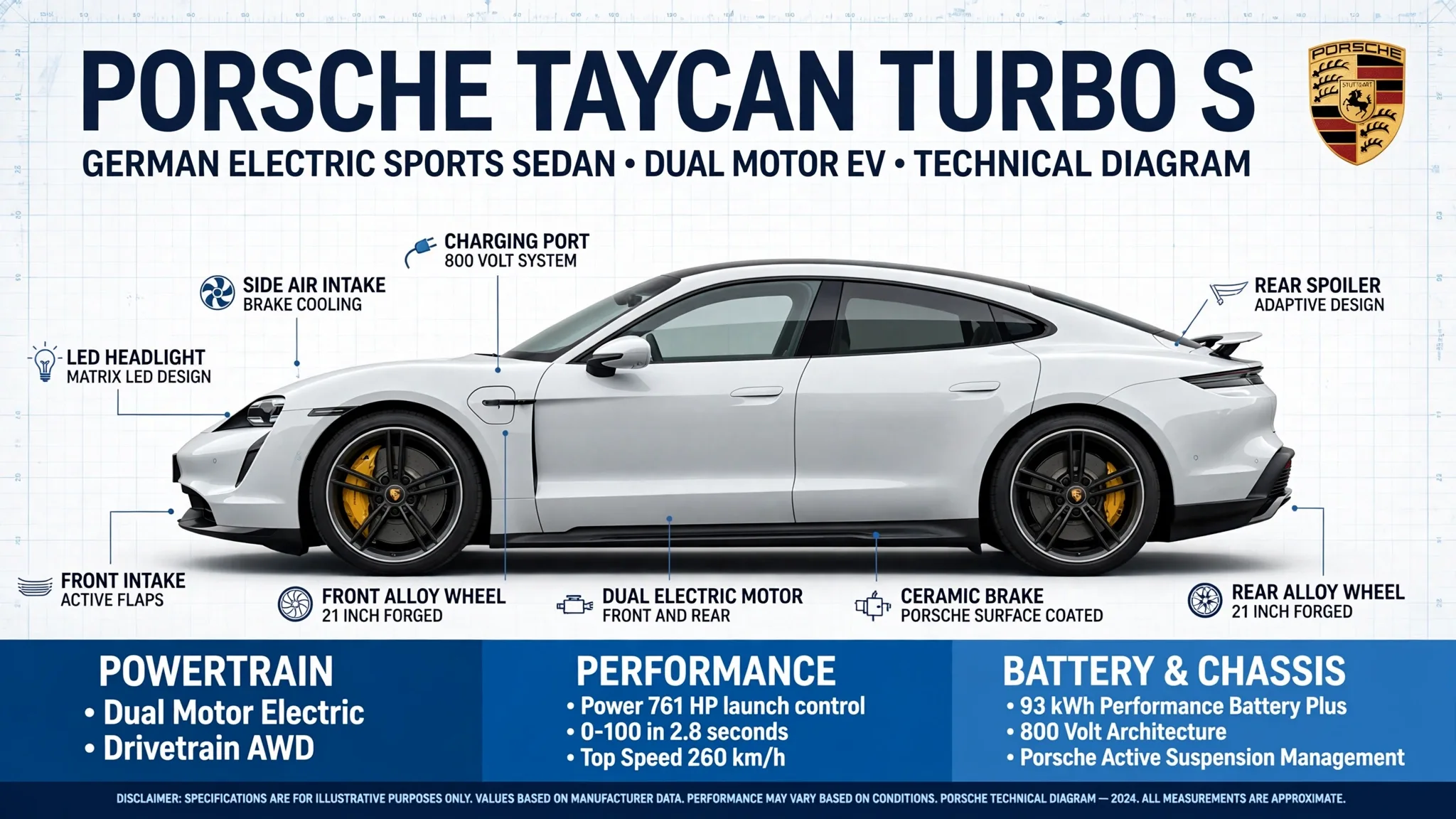
After lunch, the road opens up. This is the part of the day the Taycan was built for. The driver finds a clear stretch and presses the pedal harder. The car answers with a force that pushes everyone gently back into their seats. This is launch control at work. Launch control is a mode that gives the car its maximum power for a standing start. In this mode, the Taycan Turbo S makes 761 horsepower.
The numbers tell the story plainly. The car goes from 0 to 100 kilometres per hour in 2.8 seconds. Its top speed is 260 kilometres per hour. All-wheel drive sends power to all four wheels, so the car grips the road even when the driver asks for everything at once. The push is strong, but it is also smooth. There is no sudden bang. It feels like being pressed by a giant, gentle hand.
Corners are where the Taycan surprises people most. Its battery is a 93 kWh unit that sits low in the floor. That low weight keeps the car flat when it turns. It does not lean like a tall car. It stays level, like a cat crouching before it runs. The driver can carry speed through a bend and feel the car hold its line. For a heavy electric sedan, that balance is a real achievement.
Why the Shape Matters
Look at the Taycan from the side and you will notice how smooth it is. The roof slopes gently into the back. The door handles sit flush with the body. Even the wheels are shaped to let air pass cleanly. None of this is an accident. A smooth shape means the air slips past instead of pushing back. Less pushback means the car uses less energy, and less energy means the battery lasts longer on every trip.
The shape also keeps the cabin quiet. At speed, wind noise is often the loudest sound in an electric car, because there is no engine to cover it. Porsche shaped the body and sealed the cabin to keep that noise down. The result is a car that feels calm at speeds where other cars start to roar with wind. That calm is part of the luxury. You pay for speed, but you also pay for peace, and the shape delivers both.
Evening: Plugging In and Looking Back
Evening comes. The car returns home with charge to spare. The driver plugs it in again. A small light blinks. The day is done. Charging at home overnight is the secret habit of electric car life. Most days, the car starts each morning full, and the driver never thinks about fuel stations at all. On long trips, fast chargers fill the battery while the driver rests. It takes planning, but it becomes routine fast.
So what kind of car is the Taycan Turbo S, after a full day with it? It is not a toy. It is not a science project. It is a proper Porsche that happens to run on electricity. It is fast without being loud. It is comfortable without being soft. It carries four people and their bags, and it can still outrun almost anything on the road.
Prices vary by market, year, and options, and the Turbo S sits near the top of the Taycan family. But the real point of this car is what it proved. It proved that an electric car can feel like a Porsche. Not a copy. Not a compromise. The real thing, with a silent heart. If you ever get the chance to ride in one, take it. A silent car that pushes you back into your seat is something you remember. When the driver walks away at night and the car sits quietly in the dark, it feels less like the end of something old and more like the start of something good.
Common questions
Is the Porsche Taycan Turbo S fully electric?
Yes. It has two electric motors and a battery, and no petrol engine.
How fast is the Taycan Turbo S?
It goes from 0 to 100 kilometres per hour in 2.8 seconds, and its top speed is 260 kilometres per hour.
How big is the battery?
It has a 93 kWh battery that sits low in the floor of the car.
What does launch control do?
Launch control is a mode that gives the car its maximum power, 761 horsepower, for a standing start.