Bugatti Bolide Track Technical Diagram
In this post
1600 horsepower. 0 to 100 in 2.2 seconds. Top speed 500 kilometres per hour. Read those numbers again. Slowly. They do not sound like a car. They sound like a rocket that someone forgot to point at the sky. That is the Bugatti Bolide. It is not a car you buy for school runs. It is not a car you park at a shopping mall. It is a machine built for one place only: the race track.
Bugatti showed the Bolide to the world in 2020. The name comes from a French word for a racing car, a fireball on wheels. The car lives up to that name. It takes the mighty W16 engine from the Chiron and puts it in a body that is far lighter and far more extreme. The result is something that sits between a road car and a racing car. It is closer to the racing side.
The Numbers Sound Unreal
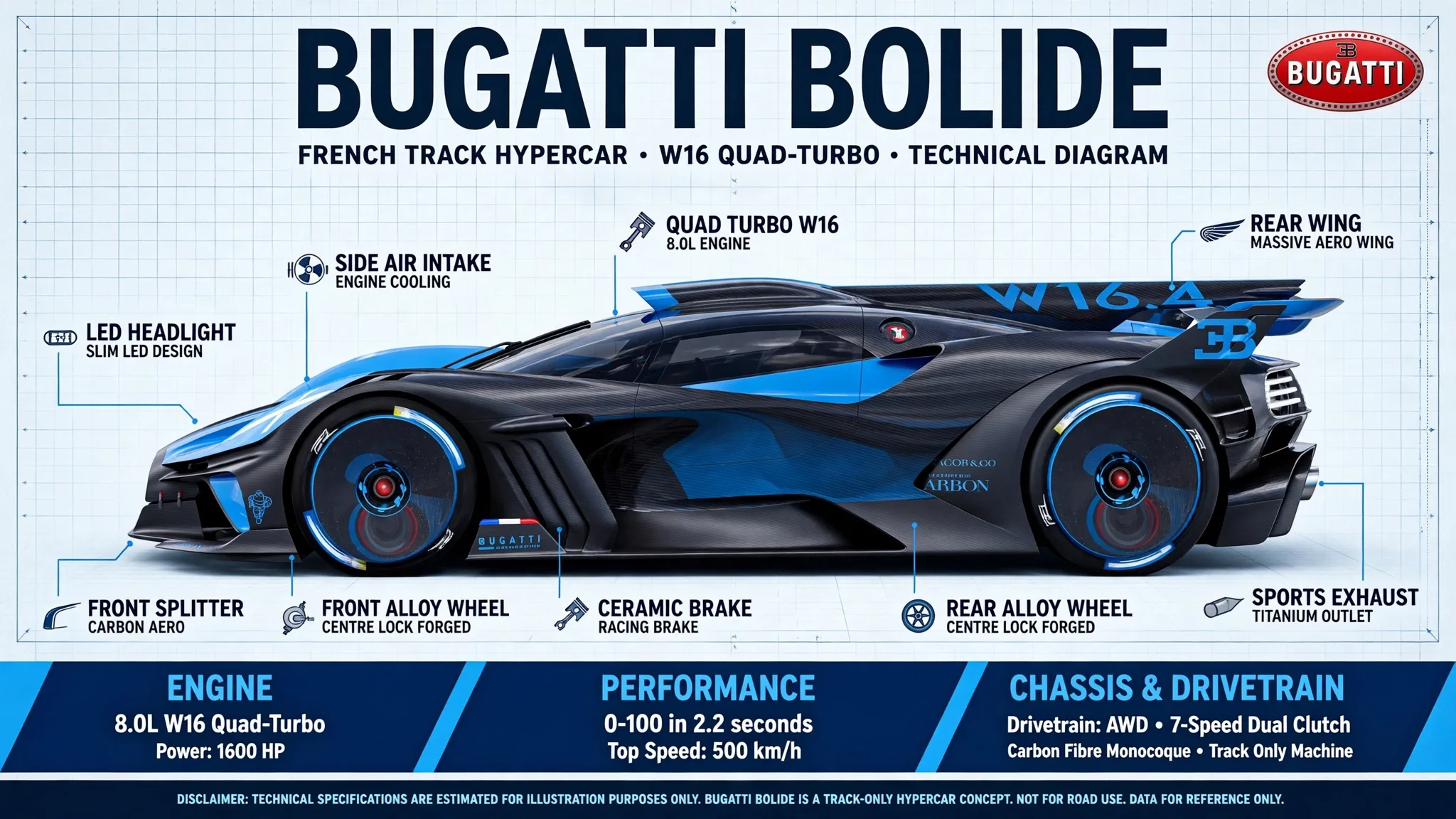
Let us start with the engine, because everything about this car starts there. The Bolide has an 8.0-litre W16 engine with four turbochargers. W16 means sixteen cylinders arranged in a W shape. Most cars have four or six cylinders. Some fast cars have eight or twelve. Sixteen is almost unheard of. Four turbochargers push huge amounts of air into those cylinders. The result is 1600 horsepower.
What does 1600 horsepower mean? A normal family car has around 100 to 150. A strong sports car might have 400 or 500. The Bolide has more than three times that. It is like comparing a house cat to a lion. Both are cats. Only one of them makes the ground shake.
The speed numbers are just as wild. The car goes from 0 to 100 kilometres per hour in 2.2 seconds. Blink, and you miss it. The top speed is 500 kilometres per hour. That is faster than a small plane at takeoff. At that speed, the world outside would look like a blur. Only a handful of machines on earth can do this, and almost none of them have number plates.
Why You Cannot Drive It to Work
Here is the catch. You cannot drive the Bolide on a normal road. It is a track-only machine. Track-only means it was not built to follow road rules. It has no number plate. It does not meet the rules for lights, bumpers, and noise that road cars must follow. It lives on race tracks, where the only rule is speed.
Why would Bugatti build a car you cannot drive to the shops? Because a race track removes limits. On the road, a car must be comfortable. It must be quiet enough for neighbours. It must ride over bumps without breaking. On a track, none of that matters. The engineers could ask one simple question: how fast can we go? The Bolide is their answer.
This also means very few people will ever drive one. Bugatti built only a tiny number of them. Prices vary by market, year, and options, but no price tag can capture what this car is. It is not transport. It is a statement. It says: this is how far engineering can go when nothing holds it back.
A Body Built From Air and Carbon
Speed is not just about power. Weight matters just as much. A heavy car needs more power to move. A light car flies with less effort. Bugatti knew this, so the Bolide’s body is made largely from carbon fibre. Carbon fibre is a material that is stronger than steel but far lighter. Racing cars and aeroplanes use it for the same reason. It lets engineers build a body that is stiff and safe without being heavy.
The shape is extreme too. Look at the diagram and you will see a car that seems to be made of wings. A huge rear wing presses the back of the car onto the track at speed. The low nose cuts through the air. Air flows over, under, and through the body in careful paths. At 500 kilometres per hour, air is not soft. It hits like a wall. The Bolide’s shape turns that wall into a force that holds the car down instead of lifting it up. Without that grip, the car would feel like it wanted to fly. With it, the car stays planted.
All-wheel drive helps too. Power goes to all four wheels, so none of them is overwhelmed. The car can put its enormous power onto the track without spinning its wheels uselessly. It is a team effort: engine, body, wings, and wheels all working at once.
What It Feels Like From the Driver’s Seat
Sit inside the Bolide and the world shrinks. The seat is low, close to the floor. A racing harness holds you tight instead of a normal seatbelt. The steering wheel is small and covered in buttons. Through the windscreen, you see a long bonnet and the track stretching ahead. There is no luxury here. No soft music system, no cup holders, no leather smell like a grand tourer. Just the essentials, done properly.
When the engine starts, the whole car trembles slightly. You feel it through the seat and the pedals. That tremble is a promise. It tells you that something enormous is awake behind you, waiting for your foot. On a track, that feeling is the whole point.
The Engine That Time Forgot
There is something sad and beautiful about the Bolide. The W16 engine is a dying breed. The world is moving toward electric motors and smaller engines. They are cleaner and simpler. But they do not sound like a W16. They do not shake the ground the same way. The Bolide may be one of the last great celebrations of this kind of engine.
When the Bolide runs, sixteen cylinders fire in a rhythm that feels more like music than machinery. Four turbos whistle as they spin. The exhaust note is deep and angry. Drivers who have heard it say it stays in their memory for years. That sound is part of why people love cars like this. It is not just speed. It is feeling. It is the sense that a thousand small parts are working together perfectly, and you are sitting in the middle of it.
The Bolide will never be common. It will never be cheap. It will never be practical. It does not need to be. Some cars exist to take children to school. Some exist to cross continents in comfort. This one exists to show what happens when engineers are told to dream without limits. Personally, I think cars like this exist to remind us what engineers dream about at night. And that dream, loud and wild and a little bit crazy, is worth celebrating.
Common questions
Is the Bugatti Bolide road legal?
No. It is a track-only machine, built for race tracks and not for normal roads.
How fast is the Bugatti Bolide?
It goes from 0 to 100 kilometres per hour in 2.2 seconds, and its top speed is 500 kilometres per hour.
What engine does the Bolide have?
It has an 8.0-litre W16 engine with four turbochargers, making 1600 horsepower.
How many Bolides were built?
Bugatti built only a very small number of them, which makes the car extremely rare.