Lotus Emira Sports Technical Diagram
In this post
Most fast cars today try to win the same contest. More power. More speed. Bigger numbers on the page. Every year, a new car arrives with a few more horsepower than the last one, and everyone nods as if that is the only way forward. The Lotus Emira quietly walks away from that contest. It does not try to be the strongest car in the room. It tries to be the lightest, the simplest, and the most enjoyable to drive. That choice makes it different from almost everything else on this list, and that difference is exactly why it deserves attention.
Lotus is a small British company from Hethel, England, with a long history in racing. Its founder, Colin Chapman, believed in a simple idea: make cars light, and everything else becomes easier. A light car stops faster. It turns faster. It uses less fuel. It does not need a giant engine to feel quick. The Emira, launched in 2021, carries that idea into the modern world. It is also the last petrol-powered car Lotus planned to build, which gives it a special place in the company’s story.
Less Weight, More Joy
Weight is the enemy of fun in a car, even though people rarely talk about it. A heavy car feels lazy in corners. It leans. It pushes wide. The driver has to fight it. A light car feels awake. It changes direction the moment you ask. It dances where a heavy car lumbers. The Emira was designed around this truth from the very first sketch.
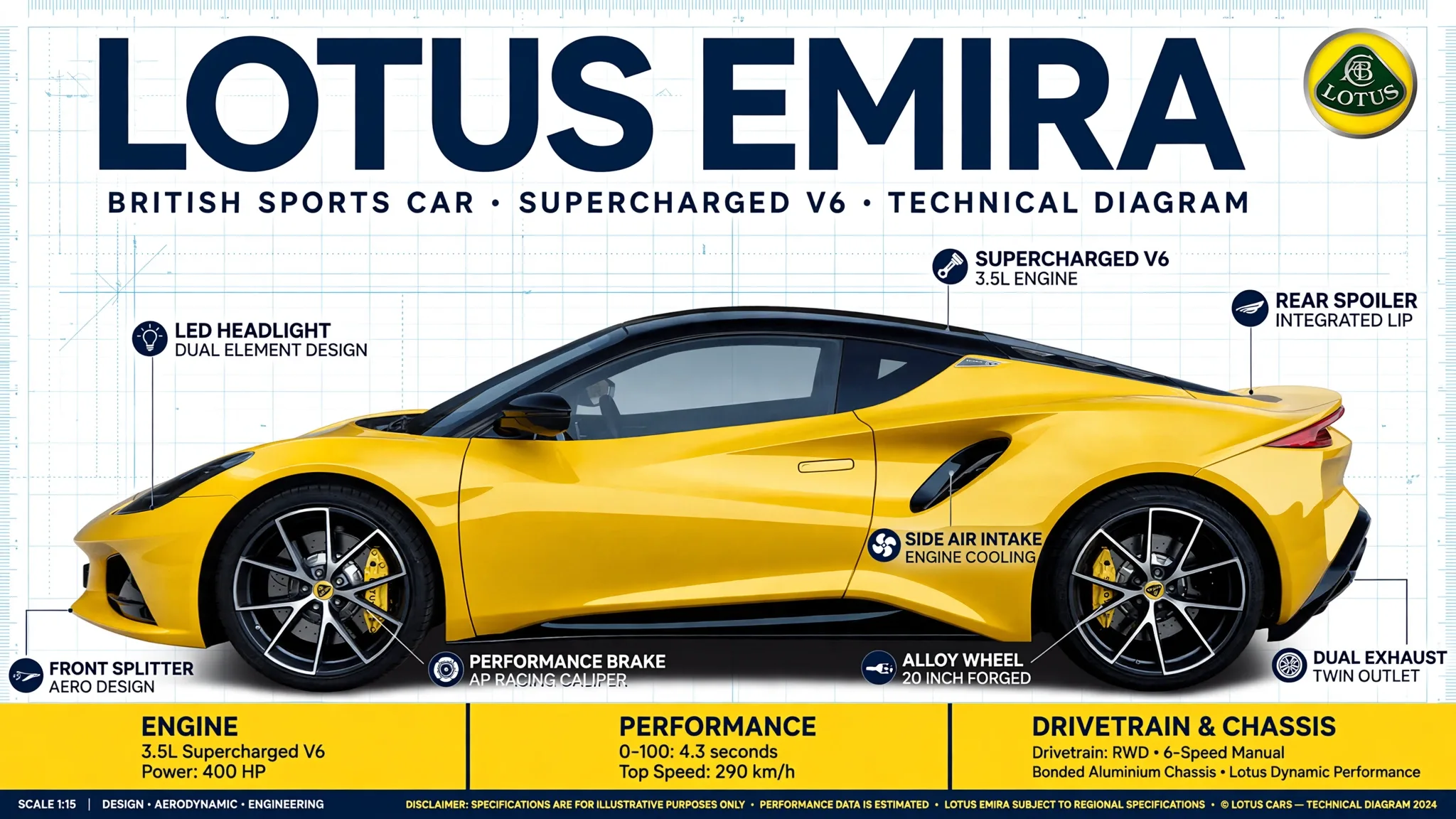
The body is made from bonded aluminium, which is light and strong. The shape is smooth and low, with no wild wings or strange angles. Look at the diagram and you will see a car that looks fast even standing still, but not because it is shouting. It looks fast because every line flows into the next one, like water running downhill. Nothing sticks out. Nothing wastes energy.
In my view, Lotus got one thing right that many others forget: light beats loud. A car with a smaller engine but a lighter body can feel faster on a winding road than a heavier car with twice the power. Power helps on a straight road. Lightness helps everywhere else. And most real roads are full of corners, hills, and surprises, not endless straights.
The Engine Sings, It Does Not Shout
Under the rear body sits a 3.5-litre supercharged V6 engine. A supercharger is a small pump, driven by the engine itself, that pushes extra air in so the engine can make more power. It is a simple, honest kind of power. There are no electric motors helping here. No turbos waiting to wake up. Just a petrol engine, a pump, and a direct connection to the driver’s foot.
The numbers are modest by supercar standards, and that is the point. The Emira makes 400 horsepower. It goes from 0 to 100 kilometres per hour in 4.3 seconds. Its top speed is 290 kilometres per hour. Those numbers will not break records. But on a real road, they are more than enough to make your heart beat faster. The car is rear-wheel drive, which means the back wheels do the pushing while the front wheels do the steering. That split gives the car a natural balance that drivers love. It feels like the car is working with you, not dragging you along.
Best of all, the Emira can be had with a proper manual gearbox. A manual gearbox means the driver changes gears by hand, with a stick and a clutch pedal. It takes practice. It takes attention. And it gives something no automatic can give: a feeling of being truly connected to the machine. Every gear change is a small decision. Every perfect change is a small victory. For drivers who love driving itself, not just speed, that connection matters more than any number on a spec sheet.
A Car You Can Actually Use
Many beautiful sports cars are hard to live with. They are too low for speed bumps. Too wide for narrow streets. Too stiff for long trips. The Emira tries to be different. It has reasonable ground clearance for a sports car. The cabin has room for two adults and their weekend bags. The seats are comfortable enough for a long drive, not just a quick blast. You can see out of it properly, which sounds small but matters every time you park or join a busy road.
This everyday side is what makes the Emira special in a quiet way. It is a car you could drive to work on Monday and take to a winding mountain road on Sunday. It does not demand a race track to make sense. It makes sense on the roads most of us actually drive. That is a rare gift. Many supercars feel bored below high speed. The Emira feels alive at any speed, because its lightness and balance are always there, working for you.
The interior matches that idea. It is modern without being confusing. There is a screen for music and maps. The controls are simple to reach. The materials feel solid. It feels like a car built by people who drive, for people who drive. Nothing is there just to impress a passenger. Everything is there to help the driver enjoy the road.
Why Small Numbers Can Win
It is easy to laugh at 400 horsepower when other cars offer 1000. But numbers on a page do not tell the whole story. A light car with 400 horsepower can feel quicker in corners than a heavy car with far more power. It brakes later. It turns sooner. It asks less of its tyres. On a twisty road, the driver of the lighter car is smiling while the driver of the heavier car is working hard just to keep up.
Prices vary by market, year, and options, and the Emira sits in a different world from million-pound hypercars. That is part of its charm. It is a reminder that joy does not have to cost a fortune. It does not have to come with a thousand horsepower. Sometimes it comes from a light body, a sweet engine, a manual gearbox, and a road full of bends.
So if you ever get the chance to drive one, do not judge it by its numbers alone. Judge it by how it makes you feel after ten minutes behind the wheel. Do you want to turn around and drive the same road again? If the answer is yes, then the car has done its job. And by that measure, the little Lotus from Hethel might just be one of the cleverest sports cars of its time. After all, what is the point of a fast car if it does not make you want to keep driving?
Common questions
How fast is the Lotus Emira?
It goes from 0 to 100 kilometres per hour in 4.3 seconds, and its top speed is 290 kilometres per hour.
What engine does the Emira have?
It has a 3.5-litre supercharged V6 engine, with rear-wheel drive.
Is the Emira a supercar?
It is a sports car rather than a supercar. It focuses on light weight and driving fun instead of maximum power.
Can the Emira be used every day?
Yes, more easily than most sports cars. It has reasonable comfort, visibility, and space for daily driving.