Trine Dyrholm: The Life Story Behind Denmark's Leading Actress
In this post
Trine Dyrholm is the actress Denmark turns to when a story needs a woman who is strong, complicated, and completely real. She has been acting since she was a child, she has sung, she has won more awards than almost any other Danish actress, and she has played mothers, wives, lovers, and leaders with an honesty that makes audiences feel they know her, even when the character she plays is doing something shocking. Her face is familiar to viewers in Denmark, in Germany, and in many other countries, and her work is a model of what a long and serious acting career can look like.
She was born in Odense, a city on the island of Funen, and she grew up in a home where music and theatre mattered. She sang as a child, she recorded a song when she was fourteen, and she went on to study at the Danish National School of Performing Arts. She did not become famous overnight. She built her career one role at a time, in theatre, in film, and in television, and she chose roles that challenged her, not roles that would simply make her famous. That patience shaped her, and it is why her performances feel so deep and so true.
What makes her story worth telling is the range in it. She has played a young woman in a family torn apart by secrets, a mother in a war-torn country, a woman who falls in love with her stepson, and many other characters who are hard to play and hard to forget. This is the story of a Danish girl who became her country’s leading actress by working hard, by being brave, and by never settling for easy roles.
A Childhood in Odense
Trine Dyrholm was born on 15 April 1972 in Odense, Denmark. Odense is a city on the island of Funen, known as the birthplace of the writer Hans Christian Andersen, and known for its old streets, its harbour, and its long tradition of culture. Trine grew up there with her family, and her childhood was full of music, school, and the theatre. Her parents encouraged her to sing and to perform, and she showed a talent for it from an early age.
As a child, Trine was lively and confident. She liked to sing, she liked to perform, and she liked to be on a stage. When she was fourteen years old, she took part in the Danish Melodi Grand Prix, the competition to choose Denmark’s song for the Eurovision Song Contest, and she sang a song called Danse i måneskin, which means Dance in the Moonlight. The song was a hit in Denmark, and it made her a household name as a teenager. She was suddenly famous, but she was still a schoolgirl, and she had to learn how to handle attention at a very young age.
She also acted as a child, appearing in films and in theatre, and she learned the craft of acting from the ground up. She was not just a singer. She was a performer who could sing, act, and dance, and who loved the stage. Her family supported her, but they also kept her grounded. They wanted her to finish school, to think about her future, and to make her own choices. That support gave her confidence, and it also gave her a sense of balance that would help her later, when fame came again and the work became more serious.
School in Odense gave her a solid start, but she was also drawn to the world of theatre and film. She wanted to learn more, to grow as an actress, and to take on roles that were more challenging than the ones she had played as a child. She applied to the Danish National School of Performing Arts in Copenhagen, and she was accepted. She studied there, and she graduated in 1995, at the age of twenty-three. She was ready to build a career as a serious actress, and she did so with patience and with determination.
Theatre School and the First Serious Roles
Trine studied at the Danish National School of Performing Arts in Copenhagen, one of the most respected theatre schools in Denmark. She learned about acting, about voice, about movement, and about the craft of telling a story on a stage. She was a serious student, and she worked hard. She was not the most polished student, but she was one of the most determined. She wanted to learn, and she wanted to be good. Her teachers noticed her talent, her energy, and her ability to play characters who were strong and complex.
After she graduated in 1995, she began to work in Danish theatre and film. She appeared in theatre productions in Copenhagen, and she was praised for her ability to hold a stage with quiet power. She did not need big gestures. She could stand still and let the audience come to her, and that was a rare gift. She also appeared in films, and she began to build a reputation as a serious and talented actress who could play difficult roles with honesty and with depth.
One of her early film roles was in The Celebration, released in 1998, a film directed by Thomas Vinterberg, about a family gathering that turns into a nightmare when a son reveals a terrible secret about his father. Trine played a woman named Helen, the sister of the son who tells the secret, and her performance was praised for its warmth and its honesty. The film was a huge success, it won awards at the Cannes Film Festival, and it brought Danish cinema to the attention of the world. Trine was part of that success, and it was a turning point in her career.
She continued to work in theatre and in film, and she won her first Bodil Award, Denmark’s most important film prize, for her work in the years that followed. She was becoming one of Denmark’s best-known actresses, and she was respected by directors and by other actors for her talent and her professionalism. She did not choose easy parts. She chose parts that challenged her, and that made her grow. That choice shaped the rest of her career.
The Celebration and Danish Cinema
The Celebration, known in Danish as Festen, was a film that changed Danish cinema. It was the first film made under the Dogme 95 rules, a set of rules created by Lars von Trier and Thomas Vinterberg that said films should be made simply, without special effects, without artificial light, and with a handheld camera. The film was about a family, about secrets, about abuse, and about the pain of telling the truth. It was a hard film to watch, but it was also a powerful one, and it won the Jury Prize at the Cannes Film Festival in 1998.
Trine Dyrholm played Helen in the film, and her performance was a key part of its success. Helen was a woman who was trying to hold her family together, who loved her brother, and who was caught between loyalty to her father and loyalty to the truth. Trine played her with a mix of warmth and sadness, and audiences felt her pain. She was not the main character, but she was a character who mattered, and her performance showed that she could play a complex woman with depth and with honesty.
The film brought Trine to the attention of a wider audience, in Denmark and in other countries. It showed that she was not just a former child singer. She was a serious actress, capable of playing difficult roles in important films. She was invited to appear in more films, and she began to work with some of the best directors in Denmark. She was in her mid-twenties, and she was building a career that would last for decades.
In the years that followed, she appeared in many Danish films, including In Your Hands, and other productions that showed her range. She could play comedy, she could play drama, and she could play characters who were strong and vulnerable at the same time. She won more Bodil Awards, and she became one of the most awarded actresses in Danish history. She was a star in Denmark, but she was also a working actress, and she took her work seriously.
In a Better World and International Praise
In 2010, Trine Dyrholm appeared in In a Better World, a film directed by Susanne Bier, about two families in Denmark and in Africa, about revenge, about forgiveness, and about the choices people make when they are hurt. Trine played Marianne, a woman whose marriage is falling apart, whose son is being bullied, and who is trying to hold her family together. Her performance was praised for its honesty and its depth, and the film won the Academy Award for Best Foreign Language Film in 2011, as well as the Golden Globe for Best Foreign Language Film.
The film brought Trine to the attention of a wider international audience. It was shown in many countries, and critics praised her performance as one of the best in the film. She was not the main character, but she was a character who mattered, and her performance showed that she could play a woman in pain with great subtlety and great power. She won awards for her work, and she became known outside Denmark as a serious and talented actress.
She also appeared in other international productions during this time, including A Royal Affair in 2012, a film about the Danish court in the eighteenth century, about a queen who falls in love with the king’s doctor, and about the price of that love. Trine played a supporting role in the film, and her performance was praised. The film was nominated for an Academy Award for Best Foreign Language Film, and it brought Danish cinema to a wider audience again. Trine was part of that success, and she was proud of it.
She continued to work in Danish and in international film, and she won more awards, including the Silver Bear for Best Actress at the Berlin Film Festival in 2016 for her performance in The Commune, a film about a group of people who live together in a commune in Copenhagen in the 1970s. The award was a huge honour, and it recognised her as one of the best actresses in Europe. She was in her forties, and she was at the height of her powers as an actress.
The Commune, Queen of Hearts and Bold Choices
In 2016, Trine starred in The Commune, a film directed by Thomas Vinterberg, about a couple in Copenhagen who invite a group of friends to live with them in a large house, and about the way that experiment changes their lives. Trine played Anna, a television presenter who starts the commune, and her performance won her the Silver Bear for Best Actress at the Berlin Film Festival. It was a major award, and it showed that she was one of the best actresses in Europe. She played Anna with a mix of warmth and sadness, and audiences felt her pain as her marriage fell apart.
In 2019, she starred in Queen of Hearts, a film directed by May el-Toukhy, about a successful lawyer named Anne who falls in love with her teenage stepson, Gustav, and about the terrible consequences of that love. It was a shocking and difficult film, and Trine’s performance was at its centre. She played Anne as a woman who was successful, intelligent, and in control, but who was also lonely and unhappy, and who made a terrible choice that destroyed her family. Her performance was praised by critics, and the film won awards at the Sundance Film Festival. It was a brave role, and it showed that Trine was not afraid to play characters who were flawed, who made mistakes, and who were hard to like.
She also appeared in other films during this time, and in television series, including The Legacy, a Danish series about a family and an art collection, and other productions that showed her range. She could play a mother, a wife, a lover, a leader, and many other characters, and she could do it with the same honesty and the same depth. She was becoming one of the most respected actresses in Europe, and she was proud of that.
Her willingness to take on bold and difficult roles is one of the hallmarks of her career. She does not choose easy parts. She chooses parts that challenge her, that make her uncomfortable, and that force her to think deeply about the character. That choice has made her one of the most interesting actresses in Denmark, and it is why directors keep casting her in important films. She is not afraid to be unlikable, and she is not afraid to show the dark side of a character. That bravery is rare, and it is what makes her performances so powerful.
A Life in Theatre, Film and Song
Trine Dyrholm’s career is not just about film. She has also worked in theatre, and she has continued to sing. She has appeared in theatre productions in Copenhagen, and she has been praised for her ability to hold a stage with quiet power. Theatre is important to her, because it is where she learned her craft, and it is where she can test herself in front of a live audience. She plays in productions that challenge her, and she brings the same honesty to the stage that she brings to film.
She has also continued to sing, and she has released music and performed in concerts. Singing was her first love, and she has never forgotten it. She sings in a warm and honest voice, and her fans love her for it. She does not sing to be a pop star. She sings because she loves music, and because it is part of who she is. That love of music is a big part of her story, and it is why she is such a complete performer.
She has won many awards in Denmark, including multiple Bodil Awards and Robert Awards, and she has won awards in other countries too. She is one of the most awarded actresses in Danish history, and she is respected by directors and by other actors for her talent and her professionalism. But she does not talk much about awards. She talks about the work, about the characters, about the directors, and about the joy of telling a story well. That focus on the work, rather than on the prizes, is a big part of who she is.
She lives in Copenhagen, and she is a mother, a partner, and an actress who values her privacy. She gives interviews when she has a new project, she talks about her work with intelligence and warmth, and then she goes home to her family and her life. That privacy is important to her, and it is one of the reasons her performances feel so honest. She does not use her private life to sell her work. She lets the work speak for itself.
Denmark’s Leading Actress
Trine Dyrholm is now regarded as Denmark’s leading actress, a woman who has been working for more than thirty years, who has won more awards than almost any other Danish actress, and who is still at the height of her powers. She has played in films that have won Academy Awards, she has won the Silver Bear in Berlin, and she has been praised by critics in many countries. She is a star in Denmark, and she is respected in Europe and in the world.
Her influence on Danish cinema is large. She was part of The Celebration, which changed Danish film, she was part of In a Better World, which won an Oscar, and she was part of Queen of Hearts, which shocked and moved audiences around the world. She has shown that a Danish actress can play in the most important films, in the most difficult roles, and can do it with honesty and with power. She is proud of Denmark, and she often talks about it, about its culture, and about the way it shaped her.
As she moves into her fifties, Trine is still a working actress, still choosing roles, still learning. Her story is not finished, and her fans wait with hope for whatever she does next. She is an actress, a singer, and a woman who started as a child star and became a serious artist, and her story is one of the most inspiring in European acting. She shows that you can start young, you can grow, you can change, and you can become better with time. That is a hopeful message, and it is why her story matters.
The Legacy and a Career That Keeps Growing
Trine Dyrholm’s work in television is as important as her work in film. She starred in The Legacy, known in Danish as Arvingerne, a Danish series about a family and an art collection, about a mother who dies and leaves her art to her children, and about the conflicts that follow. Trine played a woman named Gro, and her performance was praised for its warmth and its honesty. The series was a success in Denmark and in other countries, and it showed that Trine could carry a long television story, with many episodes, and keep the audience engaged from start to finish. She was not just a film actress. She was a television actress too, and a very good one.
She has also worked in German film and television, and she has become known in Germany as a serious and talented actress. She speaks German, and she has appeared in German productions, bringing the same honesty and the same depth to her work in a language that is not her own. That ability to work in different languages and different cultures is a hallmark of her career, and it is why she is respected in many countries, not just in Denmark. She is a European actress, in the truest sense, a woman who belongs to many places at once.
Her awards tell part of her story, but they do not tell all of it. She has won multiple Bodil Awards, Denmark’s most important film prize, and multiple Robert Awards, and she has won the Silver Bear in Berlin. She is one of the most awarded actresses in Danish history, and she is respected by directors and by other actors for her talent and her professionalism. But she does not talk much about awards. She talks about the work, about the characters, about the directors, and about the joy of telling a story well. That focus on the work, rather than on the prizes, is a big part of who she is, and it is why directors love working with her.
She has also become a mentor to younger Danish actors, sharing her knowledge, her experience, and her advice with people who are starting out. She is known for being generous on set, for helping other actors, and for creating a warm and supportive atmosphere. That generosity is a big part of her reputation, and it is one of the reasons she is loved by the people she works with. She is not just a great actress. She is a great colleague, and a great person to work with, and that matters in a world where film sets can be stressful and difficult places.
My Take:
When I think about Trine Dyrholm, the first thing I feel is respect for her longevity. She has been acting since she was a child, she was famous at fourteen, and she is still acting in her fifties, still winning awards, still choosing bold roles. That is a long time, and it is a hard thing to do. Many child stars burn out, they lose their way, they stop working. Trine did not do that. She grew up, she learned, she studied, and she became a serious actress. That takes a kind of strength that is easy to miss, because it does not look like strength. It looks like patience, like hard work, like showing up day after day, year after year. I admire that, because it is the kind of strength that lasts.
I admire her most for Queen of Hearts, because it is a film that made me uncomfortable, and that discomfort taught me something. Anne is a woman who does a terrible thing. She falls in love with her stepson, she lies about it, and she destroys her family. It is hard to watch, and it is hard to like Anne. But Trine plays her in a way that makes me understand her, even when I do not approve of her. I see her loneliness, I see her unhappiness, and I see how a successful woman can still feel empty inside. That is a brave performance, because it does not ask me to like Anne. It asks me to understand her, and that is a harder and more important thing. I respect Trine for taking that role, because many actresses would have been afraid to play a woman like Anne. She was not afraid.
What moves me about her is the way she plays mothers. In In a Better World, she plays a mother whose son is being bullied, whose marriage is falling apart, and who is trying to hold her family together. She plays that pain with such honesty that I feel it. I have never been in her exact situation, but I have felt the pain of trying to hold a family together when things are falling apart. Watching her, I felt understood. That is what great acting does. It takes a life that is very different from mine and makes me feel that it is my life too. Trine does that again and again, in film after film, and I am grateful for it.
I also think about her as a child singer, and how strange it must have been to be famous at fourteen. She sang Danse i måneskin, and suddenly everyone in Denmark knew her name. She was a schoolgirl, and she was a star, and she had to learn how to handle that. Many child stars do not handle it well. They lose themselves, they stop growing, they become stuck as the child they were. Trine did not do that. She went to theatre school, she learned her craft, and she became a serious actress. She did not let her early fame define her. She defined herself, by her work, and that is a lesson for anyone who becomes famous young. Fame is not the end. It is the beginning, and what you do after it matters more than the fame itself.
I love the way she sings, too. She started as a singer, and she has never forgotten that. Her voice is warm and honest, and when she sings, I feel the same honesty that I feel when she acts. She does not perform a song to show off. She sings it because music has always been home to her, and that feeling comes through in every note. That is why she feels like a complete performer to me, not just an actress who can sing, but an artist who lives in music as well as in drama.
I also think about the Silver Bear she won in Berlin for The Commune, and how much that award must have meant to her. It was a recognition from outside Denmark, from one of the most important film festivals in the world, that she was one of the best actresses in Europe. She had worked for twenty years to get there, and she had earned it. I am glad she won it, because it showed the world what Danish audiences had known for a long time: that Trine Dyrholm is a great actress, and that her work deserves to be seen by everyone.
If I have a sadness in her story, it is that she is not as well known outside Denmark as she should be. People in Britain know Borgen, and they know The Killing, but they do not always know Trine Dyrholm, even though she is one of the best actresses in Denmark. That is not her fault. It is the fault of a world that often overlooks quiet talent, and that only notices people when they are in a big hit. But I am glad that Queen of Hearts and The Commune brought her to a wider audience, and I hope that more people discover her work in the years to come. She deserves to be known by everyone who loves good acting.
I also learn from her that it is all right to change. She started as a child singer, she became a theatre actress, she became a film actress, and she is still changing, still growing, still learning. She did not stay in one place. She kept moving, kept learning, and kept growing, and that is why she is still relevant in her fifties. Many people are afraid to change. They want to stay the same, to do the same thing forever. Trine shows that change is good, that growth is good, and that you can become better with time. That is a hopeful message, and I want to remember it.
For a young reader, I think the lesson from Trine is simple: learn your craft, work hard, and be patient. She spent years in theatre school, years in small roles, and years building her career one role at a time. She did not become a star overnight, and she did not need to. She became good first, and then she became famous. That is the right order. If you want to be an actor, or a singer, or anything else, learn first, work hard, and be patient. The world will notice you when you are ready, and when it does, you will be ready for it. That is what Trine teaches me.
In the end, I think Trine Dyrholm is a reminder that a long career is built on good choices, one at a time. She chose The Celebration, she chose In a Better World, she chose The Commune, she chose Queen of Hearts, and each choice made her better. She did not choose easy roles. She chose hard roles, and she played them with honesty and with courage. I am grateful for her, and I hope she keeps acting for many years to come. The world needs more actresses like her, actresses who are honest, brave, and true. When I watch her, I do not just see a character. I see a woman who loves her work, and who does it with all her heart.
I also think about the way she works in German, and how remarkable it is to act in a language that is not your own. Acting is hard in your own language. It is even harder in a foreign language, because you have to think about the words and the feelings at the same time. Trine does it in Danish and in German, and she does it well. That is not just talent. It is hard work, and it is a willingness to be a beginner again and again. I respect that, because many people are afraid to be beginners. They want to be good at everything at once. Trine was willing to be bad, to make mistakes, and to learn, and that is why she is so good now.
There is another side to her that I want to mention, and that is her generosity on set. Actors who have worked with her say that she is kind, that she listens, and that she helps other actors to be their best. That is a rare quality, and it is one that matters a great deal in film, where sets can be stressful and where actors can feel alone. Trine creates a warm atmosphere, and she makes the people around her feel safe. That safety allows them to take risks, to try new things, and to be honest in their performances. I think that is a kind of leadership, and it is one that I admire. She does not just act well herself. She helps others to act well too.
I also think about The Legacy, and how it shows a different side of her. In that series, she plays Gro, a woman who is part of a family that is fighting over art, over money, and over love. It is a long story, with many episodes, and Trine carries it with a warmth and a humour that is different from her film roles. She shows that she can be funny, she can be light, and she can be part of an ensemble, not just the star. That versatility is rare, and it is why directors keep casting her in different kinds of stories. She is not just one kind of actress. She is many kinds, all at once.
I think about the young actors who look at Trine and see a role model. They see a woman who started as a child singer, who studied, who worked in small roles, who waited, and who became Denmark’s leading actress. That story tells them that they do not have to be famous at twenty to have a great career. They can learn, they can grow, and they can become better with time. That is a hopeful message in a world that often tells young people that they must succeed young or not at all. Trine proves that wrong, and I am glad she does. Her career is a long one, and it is still going, and that is the best kind of career.
I also want to say something about her voice, because it is often mentioned, but not always in the right way. Trine has a warm voice, and when she sings, I feel the same honesty that I feel when she acts. She is not trying to prove anything with a song. She is simply sharing a part of herself that has been there since she was a child in Odense, and that sharing is what makes her performances feel whole.
I also think about the way she has stayed close to her roots in Odense, even as she became famous in Copenhagen and in Berlin. She talks about her home town, about Hans Christian Andersen, about the streets where she grew up, and about the way that place shaped her. That loyalty to home is a beautiful thing, and it is one that I admire. She did not forget where she came from, even when she became Denmark’s leading actress, and she carries Odense with her in every role she plays.
I also think about the way she has stayed true to Odense, to the city where she was born, and to the people who shaped her there. She does not pretend to be from somewhere else. She is from Odense, she is proud of it, and she carries it with her in every role. That pride in home is a beautiful thing, and it is one that I admire, because it shows that you do not have to leave your home behind to become great. You can carry it with you, and it can make you stronger.
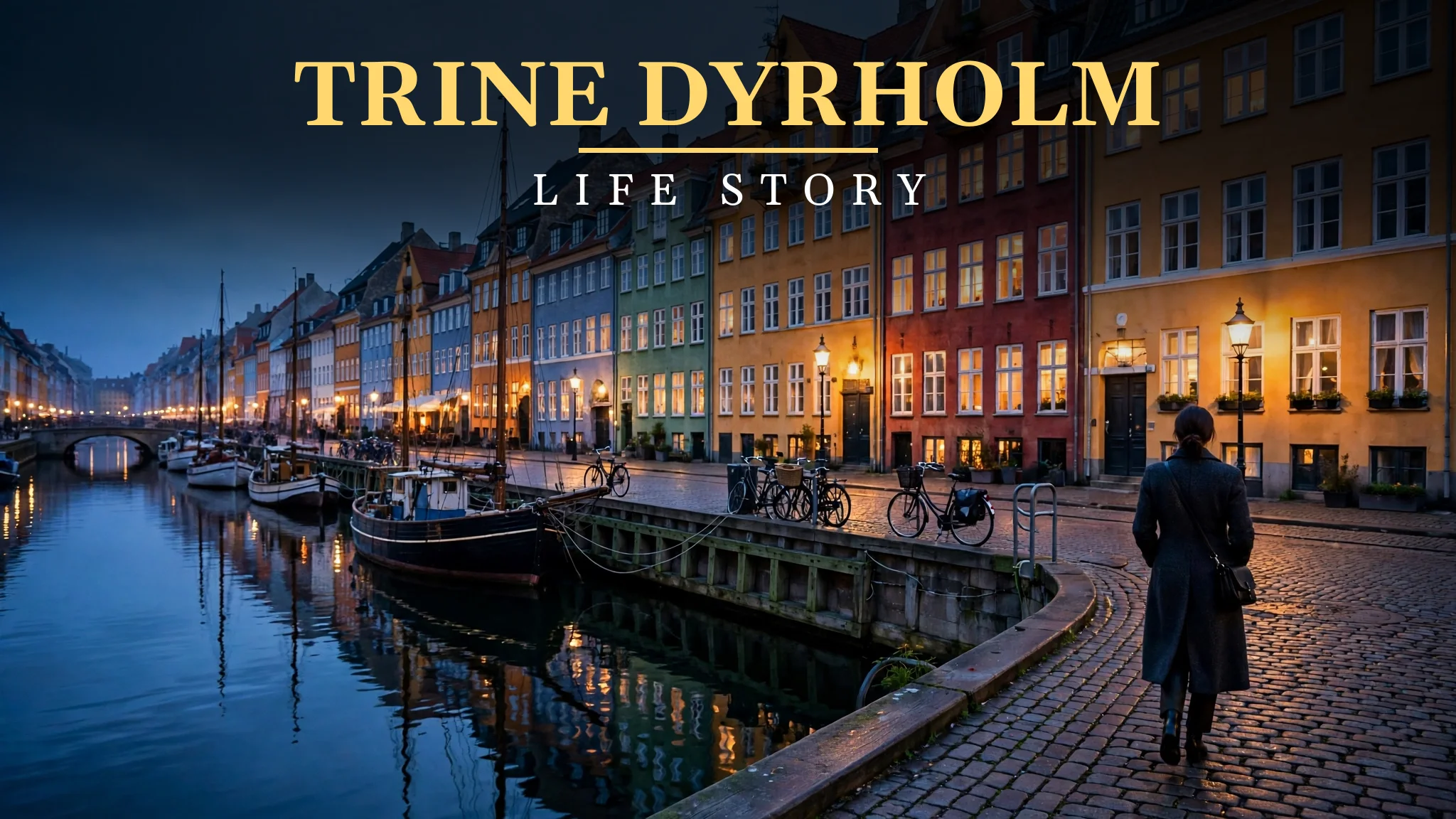
One more thought stays with me. I think about the canal in the image, with its colourful houses and its quiet water at dusk, and how it fits Trine. She is like that canal: calm on the surface, but deep underneath, with a history that goes back a long way, and with a beauty that you only see if you stop and look. I hope she keeps flowing, keeps working, and keeps showing the world what a Danish actress can do. She is a star, but she is a star who never forgot where she came from, and that is the best kind of star.
Frequently Asked Questions
Where was Trine Dyrholm born and how old is she?
Trine Dyrholm was born on 15 April 1972 in Odense, Denmark, which makes her 54 years old in 2026. She grew up in Odense, sang as a child, and graduated from the Danish National School of Performing Arts in 1995.
What is Trine Dyrholm most famous for?
She is most famous for her roles in The Celebration in 1998, In a Better World in 2010, The Commune in 2016, and Queen of Hearts in 2019. She is regarded as Denmark’s leading actress and has won more Bodil Awards than almost any other Danish actress.
Did Trine Dyrholm sing as a child?
Yes, she sang as a child, and at fourteen she took part in the Danish Melodi Grand Prix with the song Danse i maaneskin, which became a hit in Denmark. She has continued to sing throughout her career, alongside her work in theatre and film.
What award did Trine Dyrholm win in Berlin?
She won the Silver Bear for Best Actress at the Berlin Film Festival in 2016 for her performance in The Commune, playing Anna, a television presenter who starts a commune in Copenhagen in the 1970s.
What is Queen of Hearts about?
Queen of Hearts, released in 2019, is about Anne, a successful lawyer played by Trine, who falls in love with her teenage stepson Gustav, with terrible consequences for her family. Her performance was praised by critics and the film won awards at Sundance.
Did Trine Dyrholm appear in In a Better World?
Yes, she appeared in In a Better World in 2010, directed by Susanne Bier, playing Marianne, a woman whose marriage is falling apart and whose son is being bullied. The film won the Academy Award for Best Foreign Language Film in 2011.
Where does Trine Dyrholm live now?
She lives in Copenhagen, Denmark, where she works in theatre, film, and television. She values her privacy, gives interviews when she has a new project, and continues to choose bold and challenging roles.


