The Mystery of the Somerton Man, Explained Simply
In this post
On the morning of 1 December 1948, a man was found dead on Somerton Beach in Adelaide, South Australia, leaning against a seawall as if he had simply fallen asleep. He had no wallet, no identification, no hat, and no obvious injuries. His clothes were good quality, his shoes were polished, and every label had been carefully cut out. For more than seventy years, nobody knew who he was, how he died, or why he was there. That is the heart of the Somerton Man mystery, and it is why the case still fascinates people all over the world.
What makes this story different from most unsolved cases is not one strange detail but a whole chain of them. A scrap of paper torn from a rare book was found hidden in a secret pocket of his trousers. That book was later found in a car, with a telephone number and a short string of letters that looked like a code. A woman who lived near the beach was shown his body, and witnesses said she looked as if she might faint. A suitcase believed to be his turned up at Adelaide railway station, full of clothes with the same labels removed. Each clue seemed to point somewhere, yet none of them ever quite joined up into a single clear answer.
For decades, amateur researchers, journalists, and police officers returned to the case again and again. Some believed the man was a spy, because the year was 1948, the Cold War was beginning, and secret codes and poison fitted the mood of the time. Others thought the story was simpler and sadder: a man who had travelled to Adelaide for a personal reason, perhaps to see someone, and died of natural causes that doctors of the time could not identify. The truth, as it slowly emerged, turned out to be somewhere between the grand spy theory and the quiet personal tragedy.
In recent years, modern science changed the case completely. DNA testing, which did not exist in 1948, allowed researchers to build a family tree for the unknown man and eventually to put a likely name to him. That breakthrough did not answer every question — the cause of death and the meaning of the code remain disputed — but it turned a nameless body on a beach into a real person with a family, a past, and a life before that final morning in Adelaide.
The Morning on Somerton Beach
The man was discovered early on Wednesday, 1 December 1948, on Somerton Beach, a popular swimming beach south of Adelaide. He was lying with his head resting against the seawall, his legs stretched out and crossed at the ankles. His head was turned slightly to one side. To a passer-by, he could easily have looked like a man sleeping off a long night, and indeed at least one person who saw him the evening before thought exactly that. It was only when he did not move, and did not respond, that the alarm was raised.
Police who arrived at the scene found a man who appeared to be in his forties, about 180 centimetres tall, with fair to reddish hair that was greying at the temples, and grey-blue eyes. He was clean-shaven and well-dressed in a way that suggested care rather than wealth: a white shirt, a red and blue tie, brown trousers, socks, and shoes that were in good condition. His hands were well kept, and there were no signs of a fight, no blood, and no weapon nearby. A half-smoked cigarette was found resting on his right collar, and an unsmoked cigarette was in his jacket pocket, along with a packet of cigarettes and some matches.
The details that troubled the police most were the small absences. There was no wallet, no money, no keys, and no identification of any kind. The labels had been removed from every item of clothing he wore, including his tie, which carried the name of a maker that had been partly cut away. His shoes had been resoled in a way that suggested they had been repaired, and one shoe had a distinctive pattern of wear. His teeth were in unusual condition, with some missing teeth and others in good shape, and his ears had a distinctive shape that doctors noted carefully. These physical details were recorded in the hope that someone, somewhere, would recognise the description and come forward. Nobody did, at least not in a way that could be proved.
The time of death was estimated as the early hours of the morning, though doctors could not be exact. The body showed no signs of violence, and the organs appeared normal in many respects, although the stomach and liver showed signs that puzzled the doctors. The man’s last meal appeared to have been a pasty, eaten some hours before death. A coroner later recorded that the cause of death was unknown, and that the man had probably died of poisoning, though no poison was ever identified in the tests available at the time.
The Hidden Scrap and the Rubaiyat
The most famous clue in the case was discovered during a second, more careful examination of the dead man’s clothing. Inside a small fob pocket of his trousers, stitched shut and easy to miss, police found a tiny scrap of paper. On it were two printed words: “Tamam Shud”. The words come from the Rubaiyat of Omar Khayyam, a collection of Persian poems translated into English by Edward FitzGerald in the nineteenth century, and they are often translated as “it is ended” or “the end”. The phrase appears on the last page of many editions of the book.
That single scrap changed the whole investigation. Police issued a public appeal for anyone who owned a copy of the Rubaiyat with its last page torn out. Weeks later, a man came forward to say that he had found such a book in the back seat of his unlocked car, which had been parked near the beach around the time of the death. The book was a rare 1941 edition, and its final page, bearing the words “Tamam Shud”, had indeed been torn out. The scrap from the dead man’s pocket matched the tear in that book.
Inside the back cover of the recovered book, police found two more things that deepened the mystery. The first was a local telephone number, written in pencil. The second was a short sequence of letters, written in a different hand, that appeared to be some kind of code. The letters were arranged in lines, with some letters crossed out, and codebreakers in Australia and overseas tried for years to make sense of them. Some believed the letters were the first letters of words in a message; others thought they might be random, or a code that could only be read with a key that no longer exists. No widely accepted solution has ever been found.
The telephone number led police to a woman who lived in a house on Moseley Street, not far from Somerton Beach. Her name was later reported as Jessie, or Jo, Thomson, and she became one of the most discussed figures in the case. When police showed her a plaster cast of the dead man’s head, witnesses said she reacted strongly and looked as if she might faint. She denied knowing the man, and she denied owning a copy of the Rubaiyat, although she later gave a copy to police that she said was hers. The question of whether she knew him, and if so how, has never been settled to everyone’s satisfaction.
The Suitcase at Adelaide Station
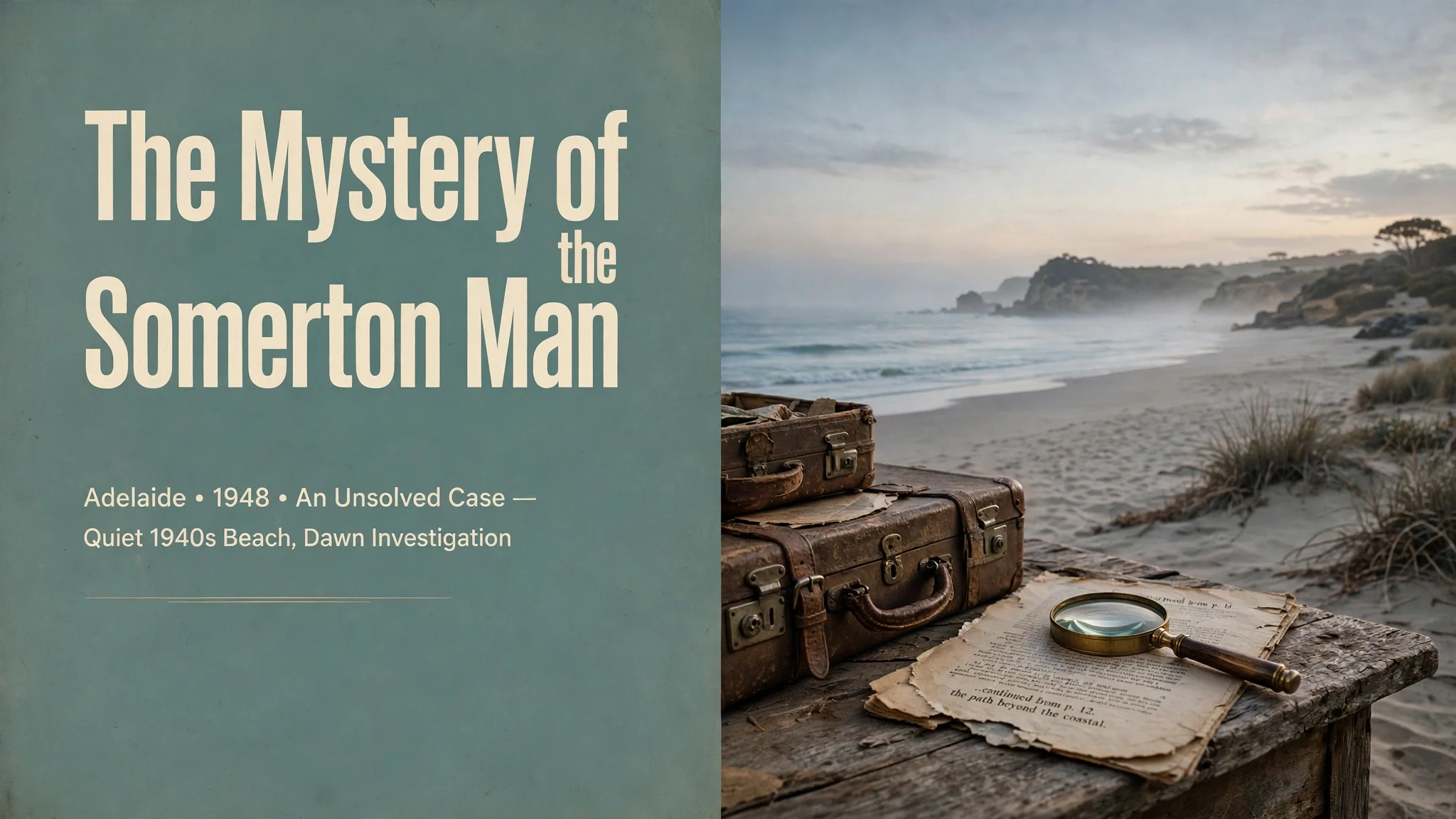
While the book and the code were making headlines, another clue appeared at Adelaide railway station. A brown suitcase had been left in the cloakroom there on 30 November 1948, the day before the body was found, and nobody had collected it. When police opened it, they found clothes that matched the dead man’s size, including a dressing gown with a distinctive pattern, a pair of slippers, trousers, shirts, and a shaving kit. Once again, every label had been removed, with one exception: the name “T. Keane” appeared on a tie, a laundry mark, and a singlet, and a laundry mark in another form appeared on other items.
The suitcase told investigators two things. First, the dead man had probably arrived in Adelaide by train, or at least had passed through the station, and had left his bag there while he went somewhere else. Second, whoever he was, he had taken unusual care to remove identifying marks from his belongings, or someone else had done it for him. The name “Keane” was investigated carefully. Police found a man of that name in the area, but he was alive, and there was no clear link to the dead man. The name may have been a false trail, a borrowed name, or simply the name of a previous owner of the clothes.
The contents of the suitcase also gave a picture of the man’s habits. The clothes were neat and well cared for, and the shaving kit suggested a man who looked after his appearance. There was a type of thread in the suitcase that matched the thread used to repair the dead man’s trousers, which strengthened the belief that the bag was his. There was also a jacket with stitching that suggested it had been made in America, which fed the idea that the man might have travelled from overseas, though this was never proved.
For the police, the suitcase was both helpful and frustrating. It confirmed that the man had planned to stay somewhere, or had recently arrived, yet it gave no address, no letter, no ticket stub, and no photograph. The railway cloakroom ticket had been lost, and no station worker could remember the man clearly. Like the book and the code, the suitcase was a clue that opened a door into a room with no further exits.
Poison, Spies, and the Cold War Theory
Because the man died without visible injury, the idea of poison took hold early. The coroner heard evidence that the man’s stomach and liver showed signs consistent with poisoning, and that his spleen was unusually large. Some doctors suggested a poison that leaves little trace, and the names of several poisons were discussed, including digitalis and a rare plant poison. None of these was confirmed by the laboratory tests of 1948, and later experts have pointed out that the symptoms could also fit natural causes, including a heart condition that was not recognised at the time.
The spy theory grew from the atmosphere of the year. In 1948, the Cold War was beginning, Australia was involved in secret defence work at Woomera, and the idea of a foreign agent operating quietly in Adelaide did not seem far-fetched. The removed labels, the secret pocket, the code, and the possible poison all fitted the image of a spy in a novel, and newspapers loved the story. Some researchers later claimed that the dead man had links to intelligence work, or that the woman on Moseley Street had connections to people involved in secret work. These claims have been repeated often, but the documentary evidence for them is thin, and other researchers regard them as speculation built on coincidence.
A more careful reading of the evidence suggests that the spy theory says as much about the fears of 1948 as it does about the man himself. Removing labels from clothes was not unknown among ordinary travellers who wanted to avoid laundry mix-ups, and a code-like string of letters could have been a personal shorthand rather than a state secret. The book itself was a popular gift edition, not a rare spy manual. None of this rules out the spy idea entirely, but it does mean the dramatic clues can also be read in ordinary ways, and that the most exciting explanation is not always the most likely one.
Other theories have been offered over the years. One is that the man took his own life, perhaps after a personal disappointment, and that the book and its final words were a deliberate farewell. Another is that he died of a sudden illness while visiting Adelaide for reasons that were never recorded. A third is that he was the victim of a crime that left no mark, carried out by someone who then removed his identification. Each theory explains some of the facts and struggles with others, which is why the case has never been closed in the public imagination, even as the science has moved forward.
The Woman on Moseley Street
Jessie Thomson, the woman whose telephone number was found in the Rubaiyat, remains the most human and most painful part of the story. She lived close to the beach with her husband and young son, and she worked as a nurse. When police first questioned her, she said she did not know the dead man, and she gave no reason why her number would be in his book. The strong reaction she was said to have shown when she saw the cast of his face has been interpreted in many ways: shock, recognition, fear, or simply distress at being shown the face of a dead stranger.
Later research added layers to her story. It was reported that she had once given a copy of the Rubaiyat to a man she knew, an army officer, and that this might explain how the book came to be in circulation. It was also reported that her son had features that some people thought resembled the dead man, which led to claims of a family connection. These claims were made long after the events, and they were based on photographs and impressions rather than on documents. They show how easily a mystery can grow new branches when the original facts are incomplete.
What is often forgotten in the retelling is that Jessie Thomson was a real person who lived with this story for the rest of her life. She was questioned by police, followed by journalists, and discussed by strangers for decades. She asked for privacy, and for many years she received very little of it. Whatever the truth about her connection to the dead man, the cost to her and her family is a reminder that unsolved cases are not puzzles for entertainment alone; they involve people who must live with unanswered questions and public suspicion.
In recent years, her family has spoken more openly, and researchers have tried to treat her story with greater care. The emerging picture is of a woman who may have known the dead man in a brief, ordinary way — perhaps through wartime Adelaide, when the city was full of servicemen and strangers — and who was frightened by the attention that followed. That reading does not solve the code or name the poison, but it does make the human side of the case easier to understand.
DNA and the Name That Finally Came
For most of the case’s history, the only hope of identifying the man was a photograph or a memory. That changed with DNA. In 2022, researchers at the University of Adelaide, led by Professor Derek Abbott, announced that DNA taken from hairs preserved with the body had allowed them to build a family tree, and that the evidence pointed to a man named Carl, or Charles, Webb. Webb was reported to have been born in Melbourne in 1905, to have worked as an electrical engineer and instrument maker, and to have moved to Adelaide at some point. The identification was based on genetic genealogy, matching the DNA to distant relatives and working backwards through family records.
The announcement was a major moment, but it also came with cautions that are important to keep in mind. The identification has been described as likely rather than absolutely certain by some commentators, and the work has not ended all debate. South Australian Police have treated the finding seriously, while noting that formal identification in a legal sense is a separate process. For the public, though, the name Carl Webb gave the Somerton Man something he had lacked for 74 years: a past, a birthplace, a trade, and a family who could finally know what had happened to a relative who had vanished.
The DNA work also raised new questions. If the man was Carl Webb, why did he travel to Adelaide, and why did he die on that beach? Records suggest he had been married, and that the marriage had ended, and some researchers have suggested that a personal crisis may have brought him to South Australia. The code in the book, if it is a code at all, has still not been explained, and the cause of death remains officially uncertain. DNA can name a person; it cannot always explain the last days of his life.
What the breakthrough does show is how forensic science has changed the fate of cold cases. Evidence that was preserved in 1948 — hairs, clothing, and careful notes — became useful in ways the original investigators could not have imagined. It is a reminder that keeping evidence, even when a case seems hopeless, can matter for generations, and that families of the missing may still get answers long after the headlines have faded.
Why the Case Still Matters Today
The Somerton Man case matters today for reasons that go beyond curiosity. It is a lesson in how investigations worked before DNA, fingerprints databases, and digital records, and how much depended on a sharp-eyed constable, a careful doctor, and a public appeal in a newspaper. It is also a lesson in how a story can grow: each retelling adds a detail, each documentary adds a theory, and after a while it becomes hard to tell which facts come from the police file and which come from later imagination.
For true-crime readers, the case is a warning against settling too quickly on a single dramatic explanation. The spy theory is exciting, but the evidence for it is circumstantial, and the quieter explanations — illness, personal distress, or an accident of timing — fit much of the same evidence. Good investigation means holding several possibilities open at once, and being willing to change your mind when new evidence arrives, as happened with the DNA identification.
For the families involved, the case matters in a simpler way: a man who died alone on a beach deserved a name, and his relatives deserved to know where he was. The long wait for that name shows how painful it is when a death goes unexplained, and how much a single answer can mean, even when other questions remain. That human core is the reason the story is still told, and why it should be told with care rather than as a ghost story.
My Take:
My honest view is that the Somerton Man case is most powerful when it is told as a human story first and a puzzle second, because the puzzle is what draws people in, but the human story is what stays with them. A man died alone on a beach in 1948, and for more than seventy years nobody knew his name. That fact alone should make any reader pause, because it could have happened to almost anyone who travelled alone in a time before mobile phones, bank cards, and digital footprints. I find the spy theories entertaining, and I understand why they took hold, but I think they have done the case a disservice by turning a real death into a kind of adventure story. When we reach for the most dramatic explanation, we risk forgetting that the man on the beach was somebody’s son, perhaps somebody’s husband, and certainly somebody whose absence was felt by people who never knew where he had gone.
I also think the police of 1948 deserve more credit than they usually receive in retellings. They noticed the cut labels, they found the hidden pocket, they traced the book, they followed the telephone number, and they preserved evidence that would matter three generations later. They worked without DNA, without computers, and without the instant communication we take for granted, yet they built a file that modern scientists could still use. That is not a story of failure; it is a story of careful work that was limited by the science of its time. When I read criticisms of the original investigation, I try to remember what tools were actually available in 1948, and how much harder it was to check a name, a train ticket, or a laundry mark when every enquiry meant a letter, a telephone call, or a knock on a door.
The part of the case that troubles me most is the treatment of Jessie Thomson. She was a young mother living near the beach, and she was pulled into a murder mystery she did not ask for. Whether she knew the dead man or not, the way her reaction to a plaster cast was retold again and again, as if a moment of shock were proof of guilt, feels unfair. People react to death in many ways, and a nurse who is shown the face of a dead stranger might well look distressed without having any secret to hide. I believe true-crime writing has a responsibility here: it should report what was actually seen and said, and it should mark clearly where evidence ends and guesswork begins. The Somerton Man story has too often blurred that line, and the people caught in it have paid the price.
On the DNA identification, my view is one of cautious hope rather than triumph. Naming the man as Carl Webb, if the genetic evidence holds, is a genuine breakthrough, and it gives his family something real after decades of silence. But a name is not a full answer. We still do not know why he was on that beach, what the letters in the book meant, or what killed him. I think it is important to say that plainly, rather than presenting the DNA result as the end of the mystery. Too many cold cases are declared solved the moment a name appears, when in truth only one question has been answered and several others remain. The honest position is to welcome the identification, to thank the scientists and the family members who gave DNA, and to admit that the rest of the story is still incomplete.
I also believe the case teaches a useful lesson about evidence and patience. The hairs that identified the man were kept for more than seventy years, through changes in police stations, laboratories, and governments. Somebody, at some point, decided not to throw them away. That small act of preservation is the reason a family finally has an answer. In a world that moves fast and deletes quickly, there is something worth remembering in that: keeping careful records, even when they seem useless, can matter far beyond the moment. I would like to see that lesson applied more widely, not only in police work but in how we keep family histories, medical records, and the stories of people who might otherwise be forgotten.
Finally, I think the lasting value of the Somerton Man story is that it reminds us how little we know about strangers. Every person on a beach, on a train, or in a queue has a history that we cannot see, and a single day can turn an ordinary journey into a mystery that lasts for generations. That is a humbling thought, and it is why I return to this case not for the code or the poison, but for the man himself. He deserved a name, and now he may finally have one. The rest — the book, the letters, the beach — will keep being discussed, and that is fine, as long as the discussion remembers that at the centre of it was a real person who died alone, far from home, on a summer morning in Adelaide.
One more thought stays with me, and it is about how we should treat the next mystery that captures the public imagination. It is easy to turn a cold case into entertainment, to rank theories as if they were contestants, and to forget that a family is waiting for a phone call that may never come. The Somerton Man case rewards patience more than speed: the answer, when it came, arrived after seventy-four years, from a laboratory rather than a headline. If there is a practical lesson, it is to protect evidence, to keep asking careful questions, and to resist the urge to declare a case closed before the facts are ready. A name is a beginning, not an ending, and the families who wait deserve that honesty even when the public wants a tidy finish. That patience, that care with evidence, and that respect for the people involved are the parts of this story I most want readers to carry away with them.
One more thought, about how impossible this case would be today, keeps coming back to me. A man found on a beach in 2026 would leave a trail within hours: a phone in his pocket, a bank card, a face on a dozen cameras, a DNA match in a database. The Somerton Man vanished into a world where a person could travel with cash, cut the labels from their clothes, and leave almost nothing behind, and that is why the mystery lasted for generations. I find that both reassuring and unsettling. Reassuring, because a family today would not wait seventy years for a name; unsettling, because the same trail that identifies the lost also watches the living. The case is a reminder of a trade we have already made, mostly without noticing, between privacy and being known.
Frequently Asked Questions
Who was the Somerton Man?
The Somerton Man was an unidentified man found dead on Somerton Beach in Adelaide on 1 December 1948. For decades he had no known name. DNA research announced in 2022 pointed to Carl, or Charles, Webb, a man born in Melbourne in 1905, though formal identification remains a careful legal process.
What does Tamam Shud mean?
Tamam Shud is a phrase from the Rubaiyat of Omar Khayyam, often translated as “it is ended” or “the end”. The words were printed on a scrap of paper found hidden in the dead man’s trouser pocket, torn from the last page of a copy of the book.
Has the code in the Rubaiyat ever been solved?
No widely accepted solution has ever been found for the short string of letters written in the recovered copy of the Rubaiyat. Codebreakers have tried many approaches, and some researchers doubt it is a code at all, suggesting it may have been personal shorthand.
What was the cause of death?
The cause of death was never firmly established. The coroner recorded it as unknown, with poisoning considered likely at the time, but no poison was identified by the tests available in 1948. Later experts have also raised natural causes as a possibility.
Who was Jessie Thomson?
Jessie Thomson was a woman who lived near Somerton Beach whose telephone number was found written in the recovered copy of the Rubaiyat. She denied knowing the dead man. Her reaction when shown a cast of his face has been much discussed, but it does not prove a connection.
Why is the Somerton Man case still famous?
It combines a nameless body, a torn page from a book of poetry, an unsolved code, a suitcase with labels removed, and a possible Cold War spy angle. The 2022 DNA development gave the story new life, while the cause of death and the code remain unexplained.