Tree That Bleeds Red Sap
In this post
You Land on an Island From Another Planet
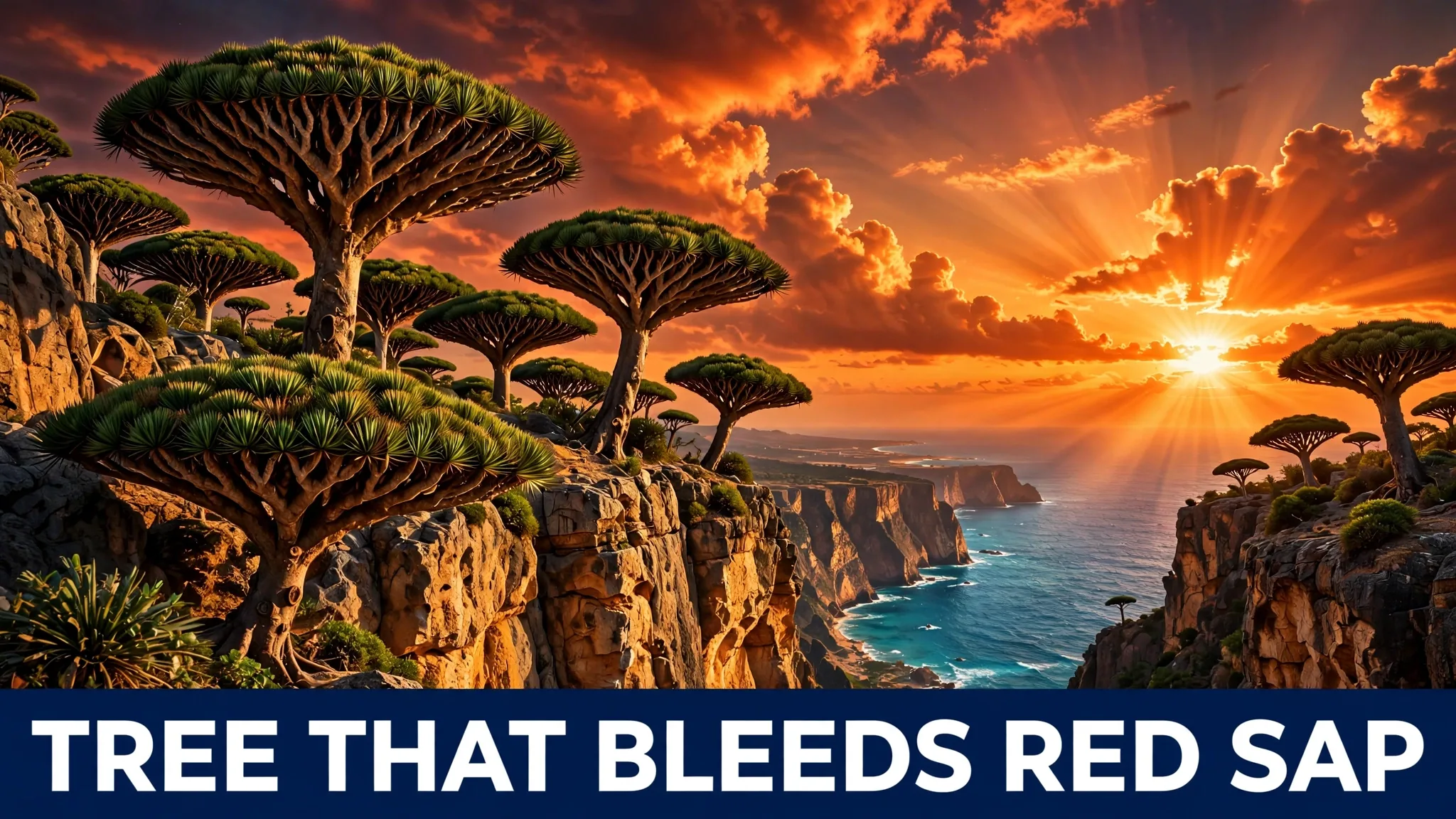
Your small plane drops through the clouds, and the land below does not look like anywhere else on Earth. Rocky plateaus. Pale limestone mountains. And scattered across the high ground, trees shaped like giant green umbrellas, standing in the wind as if someone planted a forest of mushrooms.
You have arrived on Socotra, an island belonging to Yemen, floating in the sea between Arabia and the Horn of Africa, roughly 380 kilometres off the Yemeni coast. People call it the “Galápagos of the Indian Ocean,” and within your first hour, you understand why.
Your guide drives you up into the hills, where the air turns cooler and mist drifts between the rocks. Then he stops beside a tree you will never forget: the dragon blood tree, known to science as Dracaena cinnabari.
The Moment the Tree “Bleeds”
Your guide takes a small knife and makes a shallow cut in the bark. You lean closer. Slowly, a thick bead pushes out of the wound — deep red, almost black at its heart, shining in the light like a drop of fresh blood.
Let us be honest with you right away, because the truth here is better than the myth: it is not blood at all. What you are watching is resin — a sticky, protective juice the tree produces when its bark is damaged. Think of it as the tree’s own bandage. The resin seals the cut, guards the wound against drying out, and hardens in the air. Local people call it “dragon’s blood,” and once you have seen that colour, you cannot blame them for the name.
Left alone, the red drops dry into dark, glassy lumps that can be collected from the trunk. A wounded tree, in other words, slowly paints itself red.
Why Does the Tree Wear an Umbrella?
Stand under one of these trees at midday and you feel it at once: the shade is deep and cool, while the ground just a few steps away bakes in the sun. That mushroom crown is not decoration. It is survival equipment.
Socotra is dry, rocky land. Rain is scarce, and water is life. The tree’s branches fork again and again, spreading upward and outward into one dense, flat-topped canopy — and that shape works like a clever machine:
- It catches the sky’s moisture. The wide crown gathers fog and mist moving through the hills, and the water runs down the branches and trunk into the soil at the tree’s feet.
- It shades its own roots. The tight canopy casts a broad shadow, which slows the sun from drying out the ground beneath, locking precious dampness into the soil.
- It shelters its neighbours. Smaller plants thrive in the cool, moist patch under the crown, in a land where almost nothing else can soften the heat.
To my mind, this is the most quietly brilliant design in the plant world — a tree that carries its own roof, catches its own rain, and then shares the shade with everything growing under it. No engineer handed it a plan. The dry island itself was the teacher, over a very, very long time.
A Red Treasure Older Than Empires
That red resin in your guide’s palm has been precious for thousands of years. The ancient civilisations of Greece and Rome recorded its medicinal and colouring powers, and traders carried it across the ancient world. Through the centuries, dragon’s blood has been used as a medicine, a dye, an incense, and an ingredient in varnish — and remarkably, it is still used in these ways today.
Old varnish recipes called for dragon’s blood as a rich red colouring, and writers about classic violins have long linked this resin to the deep, glowing red varnishes of Italy’s great instrument-making age — though the masters guarded their exact recipes, and the full truth of those mixtures is still argued over. What is certain is simpler: few natural substances on Earth give so deep a red, and people wanted it badly enough to sail to one of the most remote islands on the planet to get it.
On Socotra itself, families still gather the resin as their ancestors did. For the islanders, it remains a traditional remedy and their most important forest product — a gift the trees have given the island for as long as anyone can remember.
An Island That Kept Its Own Secrets
Why do such strange trees grow here and nowhere else? Because Socotra was left alone. Cut off from the mainland for ages, life on the island evolved in its own direction, like a story written in a language nobody else speaks.
The numbers, recorded by UNESCO, are startling:
- Socotra holds 825 plant species, and 307 of them — 37 per cent — grow nowhere else on Earth.
- 90 per cent of its reptile species are found only here.
- 95 per cent of its land snail species exist only on these islands.
UNESCO recognised this treasure step by step: the archipelago became a Man and the Biosphere Reserve in 2003, and a Natural World Heritage Site in 2008. The dragon blood tree is its flagship — the face of the island, printed on its story. And it grows wild in no other place. Every single one of these trees on Earth stands on this one small archipelago.
The Groves Are Growing Old
Now walk deeper into the forest with your guide, and look carefully. Something is missing.
Almost every tree around you is huge, wide-crowned and ancient. Researchers who measured the crowns estimate the average tree is around 300 years old, and some individuals have stood here for more than 500 years. But where are the young ones? Where are the saplings, the teenagers of the forest?
Hardly anywhere. And that is the quiet emergency of Socotra.
The goats get there first. Free-roaming goats wander the hills and hungrily eat dragon blood seedlings before they can grow. These trees grow painfully slowly — only about 2 to 3 centimetres a year — so a young tree spends many helpless years within a goat’s reach. Outside steep cliffs and fenced nurseries, very few survive. Scientists surveying the forests describe most of them as “over-mature”: old trees, and almost no youngsters coming up behind them.
The storms are getting stronger. In 2015, two powerful cyclones struck the island one after another, and another followed in 2018. Thousands of dragon blood trees — some of them centuries old — were torn out of the ground. Studies of the Arabian Sea show severe cyclones have grown more frequent in recent decades, and a top-heavy umbrella tree is exactly the wrong shape for standing against such winds.
The land itself is drying. Conservation experts believe increasing aridity — a slowly drying climate, possibly worsened by global climate change — is the deepest threat of all, shrinking the misty highland conditions these trees depend on.
Island families are fighting back the only way they can: with small nurseries, fenced with wood and wire, where seedlings grow safe from goats. Inside those fences, young trees are coming up again. It is slow, patient, hopeful work — matching the pace of a tree that measures its life in centuries.
Sunset Among the Ancients
Your day ends where it should: back on the high plateau, as the light turns gold. The mist comes in over the rocks. All around you, the umbrella crowns stand black against the evening sky, each one older than the villages in the valley, older than the ships that once came hunting for red resin, older than every story told about dragons.
One of these trees may have been a young sapling when traders of the Roman world were already buying its resin. It has watched storms, droughts, empires and centuries roll past — and if the young trees in those little fenced nurseries are given their chance, its grandchildren may stand here watching sunsets five hundred years from now.
You came to see a tree that bleeds. You leave thinking about a tree that waits.
Frequently Asked Questions
Does the dragon blood tree really bleed blood?
No. The red liquid is resin, a sticky sap the tree releases when its bark is cut or damaged. It works like a natural seal for the wound. It only looks like blood because of its deep red colour, which is why people named it “dragon’s blood.”
Where does the dragon blood tree grow?
It grows wild only on the Socotra archipelago, part of Yemen, in the north-western Indian Ocean near the Horn of Africa. It favours the higher limestone plateaus and mountain slopes, where mist and cooler air help it survive.
What was dragon’s blood resin used for?
Since ancient Greek and Roman times it has been valued as a medicine and a colouring substance. Over the centuries it has served as a dye, an incense, and a colouring ingredient in varnishes, and it is still used in traditional medicine, dyes, varnish and incense today.
Why is the dragon blood tree shaped like an umbrella?
The wide, dense canopy is an adaptation to dry land. It catches fog and mist and channels the water down to the soil at its roots, while its shade keeps the ground beneath cool and moist and shelters smaller plants.
Is the dragon blood tree endangered?
It is listed as Vulnerable on the IUCN Red List. Goats eat its seedlings, stronger cyclones uproot old trees, and the island’s climate is growing drier, so very few young trees survive to replace the ancient ones.
Sources
- UNESCO — Socotra Archipelago, Man and the Biosphere Programme: https://www.unesco.org/en/mab/socotra-archipelago
- Associated Press report on Socotra’s dragon blood trees, republished by Himalaya Times: https://english.himalayatimes.com.np/2025/05/90402/
- IntechOpen — “Dragon’s Blood Tree (Dracaena cinnabari): A Cenozoic Relict”: https://www.intechopen.com/chapters/87893