Volcano That Burns Bright Blue
In this post
2:00 a.m. — Boots, Torches and a Mountain in the Dark
The night shift at Kawah Ijen does not begin with a whistle or a factory bell. It begins at two o’clock in the morning, in cold darkness, at a small base camp called Paltuding in East Java, Indonesia.
One by one, the head torches switch on. A line of small lights starts moving up the mountain path. Some of those lights belong to tourists, wrapped in warm jackets, excited and a little nervous. But the lights at the front, the ones moving fastest, belong to the miners. For them, this climb is not an adventure. It is simply the way to work.
The path is about three kilometres long and steep, with an average slope of about 25 percent. The volcano rises 2,799 metres above the sea, and near the top the night air drops below 10 degrees Celsius, even in tropical Indonesia. The miners wear thin clothes and rubber boots. They have made this climb so many times that their feet know every loose stone.
Why start at such an ungodly hour? Because the famous thing on this mountain — the fire that burns bright blue — can only be seen in total darkness. And because, for the miners, the cool night is kinder than the burning daytime sun. A former miner named Dharma explained that most of the men prefer the night shift for exactly that reason. The night hides the fire’s secret and makes the work a little less cruel at the same time.
Down Into the Crater
After one and a half to two hours of climbing, the line of lights reaches the crater rim, about 2,386 metres above the sea. Then comes the harder part: the descent.
The path drops down inside the volcano, toward the shore of a strange turquoise lake. The smell arrives first. It is the smell of sulfur, sharp and rotten, like a thousand struck matches mixed with bad eggs. It catches the back of the throat. Eyes begin to water. Down near the vents at the bottom, thick clouds of gas roll across the rocks, and the miners walk straight into them, because that is where their work waits.
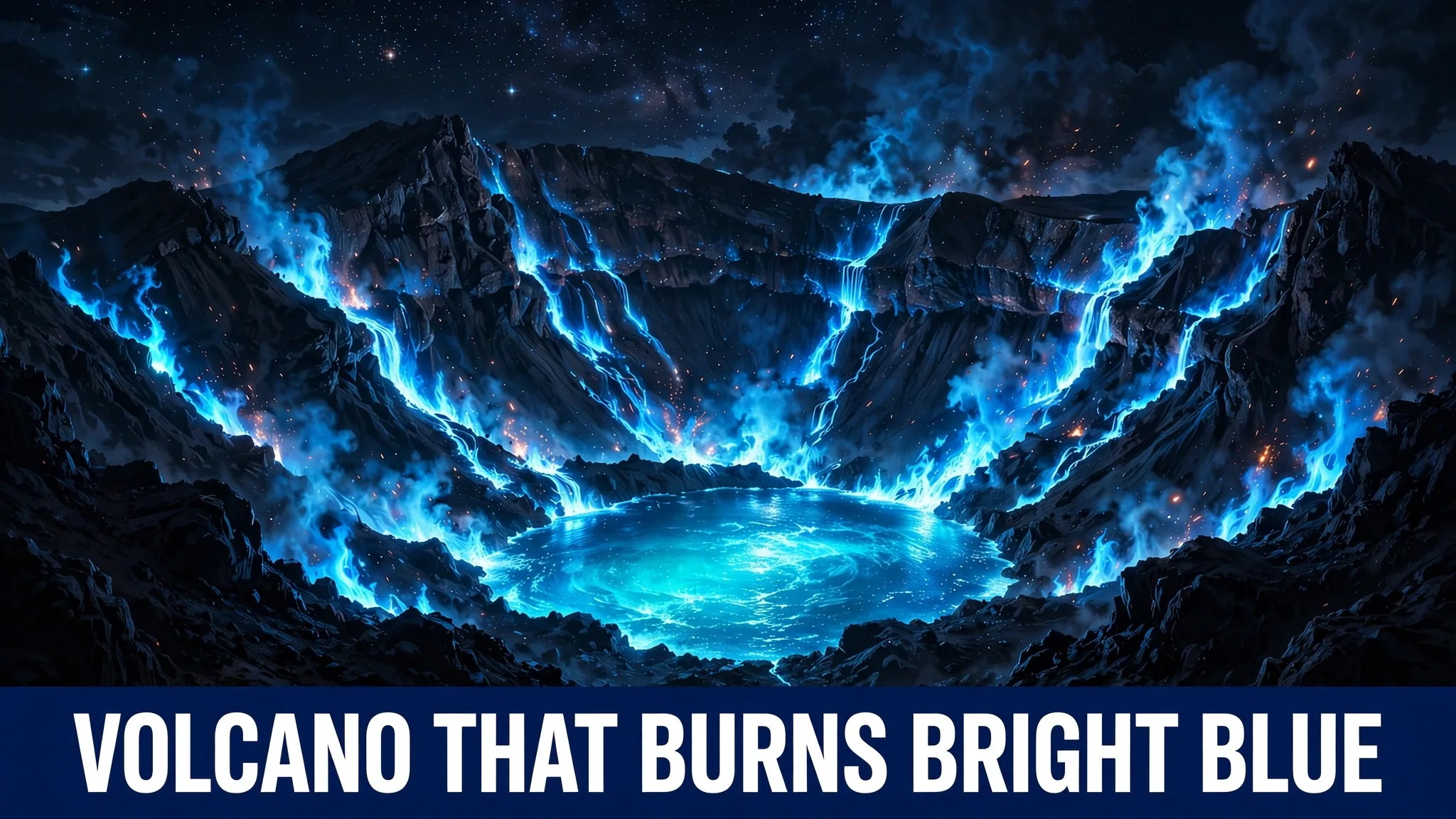
On the crater floor, something glows in the dark. Thin rivers of electric blue creep over the black rocks. Flames flicker out of cracks in the ground. This is the blue fire of Kawah Ijen, and the miners have been working beside it, night after night, since the 1960s.
The Fire Is Not Lava at All
Those glowing blue rivers look like lava flowing from another planet. They are not lava. Not even close.
Deep inside this volcano sits a hydrothermal system — water and gas heated by magma — that can reach more than 600 degrees Celsius. Sulfur-rich gases push their way up through cracks in the crater floor under very high pressure. The moment this superheated gas escapes and touches the oxygen in the air, it catches fire. And sulfur gas burns with a bright, electric-blue flame.
Some of the gas cools just enough to turn into liquid sulfur. This liquid flows slowly downhill over the rocks, still burning blue as it goes. That is what makes the famous “rivers of blue lava” in photographs. The rock underneath is not molten at all. It is the burning gas and liquid sulfur that paint the whole scene blue.
Scientists believe Ijen may be the only volcano in the world that regularly burns blue like this, because of its unusually large sulfur deposits and the intense heat underground. The flames are fairly soft, though. In daylight they are almost invisible, and the crater simply looks like it is smoking yellowish-white clouds. Only the deep darkness of night reveals the fire — which is why everyone on this mountain, tourist and miner alike, works to the volcano’s clock, not their own.
A Lake That Sits Beside the Fire
At the bottom of the crater, next to the burning vents, lies a lake of an almost unreal turquoise colour. It looks like a tropical swimming pool from a holiday poster. It is, in truth, one of the most dangerous bodies of water on Earth.
This is the world’s largest highly acidic crater lake. It holds about 36 million cubic metres of water, stretches roughly a kilometre across, and plunges about 200 metres deep. Its acidity has been measured at a pH below 0.3 — close to zero, and similar to battery acid. The colour comes from acids and dissolved metals leaking up from the volcano below.
The miners work on its shore every night, close enough to feel its warmth. Nobody swims. Nobody even dips a hand. The lake is beautiful the way a warning sign is beautiful: it tells you exactly what this mountain can do.
Devil’s Gold: The Real Work of the Night
So why do men climb into an active volcano, night after night, breathing poison? The answer is bright yellow and worth money.
The same sulfur gas that makes the blue fire is guided into a network of pipes set into the vents. Inside the pipes, the gas cools and condenses into molten sulfur, which runs out and hardens into jagged yellow slabs on the rocky ground. Local people have a grim nickname for it: “devil’s gold.”
The miners attack these slabs with iron rods, prising off heavy chunks. They load the sulfur into two baskets joined by a pole, the way farmers have carried loads for centuries. Then each man lifts the pole onto one shoulder — and the weight is shocking. A single load weighs between 70 and 90 kilograms. One former miner recalled that his loads averaged around 75 kilograms, and that he made the trip three times a day, every day, for three years.
Now picture the journey. A man with up to 90 kilograms of rock on one shoulder climbs up the steep inside wall of the crater, stone step by stone step, through gas clouds that make him cough. At the rim, he does not stop. He still has about three kilometres of mountain path to walk down before he reaches the weighing station at Paltuding, where his load is finally counted and paid for. Then many of the men turn around and climb back up to do it all again — two or three trips in a single shift.
Standing on that path at night, watching a miner pass with a load heavier than his own body, changes the way you see the famous photographs. In my view, the blue fire is only half of the Kawah Ijen story. The other half is a bent back, a scarred shoulder, and a man who keeps walking because his family is waiting at the bottom of the mountain.
What One Night Costs a Man
For this work, many miners earn roughly 10 to 15 US dollars a day. Strangely, that makes mining one of the better-paid jobs in the region — which tells you how few choices the villages around the volcano really have.
The pay may be the least of the price. Very few miners own a proper gas mask. Most work with a wet rag wrapped around the face, which does almost nothing against sulfur dioxide gas. Their eyes stream. Their skin burns and breaks. The coughing never fully stops. The baskets dig into the same shoulder, day after day, year after year, leaving deep scars and slowly crushing the shape of a man’s back. Some miners have done this labor for more than 25 years.
And yet the world’s hunger for their yellow rock never pauses. The sulfur they carry out of the crater ends up in everyday products — in matches and detergent, in gunpowder, and in the process that makes sugar white. Every night, ordinary objects in ordinary homes begin their journey on a miner’s shoulder, inside a volcano, in the dark.
The tourists, meanwhile, come in growing numbers — sometimes more than a thousand visitors in a single day during the busy season. They rent gas masks, take photographs of the flames and of the miners, and leave before breakfast. The miners stay.
Dawn — And the Fire Disappears
Slowly, the black sky above the crater turns grey, then pale gold. As the sunlight strengthens, something magical and slightly sad happens: the blue fire fades. Flame by flame, the electric rivers dim, until the crater looks ordinary again — just rocks, smoke and a shining turquoise lake. The fire is still burning down there. It will burn all day. But no human eye can see it until the darkness returns.
The tourists walk down the mountain, sleepy and thrilled, already looking at their photographs. The miners make their last trip down with the morning loads, shoulders aching, faces wrapped in rags. Tonight, at two o’clock, the line of little lights will climb the mountain again — and the volcano will light its blue fire for the men who work inside it.
Frequently Asked Questions
Why does the fire at Kawah Ijen burn blue?
The blue colour comes from sulfur gas, not from lava. Gas escapes from cracks in the crater at temperatures up to about 600 degrees Celsius and ignites when it meets oxygen in the air, and burning sulfur produces an electric-blue flame.
Is the blue lava at Kawah Ijen real lava?
No. The glowing blue “rivers” are made of burning gas and liquid sulfur flowing over ordinary rock. The rock itself is not molten. The liquid sulfur that runs downhill while still alight creates the illusion of blue lava.
Why can the blue fire only be seen at night?
The flames are relatively faint, so daylight washes them out completely and the vents look like ordinary yellowish-white smoke. The fire burns day and night, but it is only visible in total darkness, which is why hikes begin at about 2 a.m.
How much weight do the sulfur miners carry?
Each load of sulfur, carried in two baskets on a pole over one shoulder, weighs between 70 and 90 kilograms — often more than the miner’s own body weight. Many miners make two or three trips up out of the crater in a single shift.
How acidic is the Kawah Ijen crater lake?
It is the largest highly acidic crater lake in the world, with a measured pH below 0.3 — close to battery acid. The lake holds around 36 million cubic metres of water and is about 200 metres deep.
Sources
- IFLScience — “Kawah Ijen: A Volcanic World Of Blue Lava And Acid Lakes In East Java”: https://www.iflscience.com/blue-lava-and-battery-acid-lakes-adorn-the-ijen-volcano-of-indonesia-80390
- Kawah Ijen visitor guide — kawahijen.org: https://kawahijen.org/
- Inkstick Media — “‘Scars on My Body’: The Sulfur Miners at Indonesia’s Mount Ijen”: https://inkstickmedia.com/scars-on-my-body-the-sulfur-miners-at-indonesias-mount-ijen/