Voyager Golden Record: Where Is It Now in 2026?
In this post
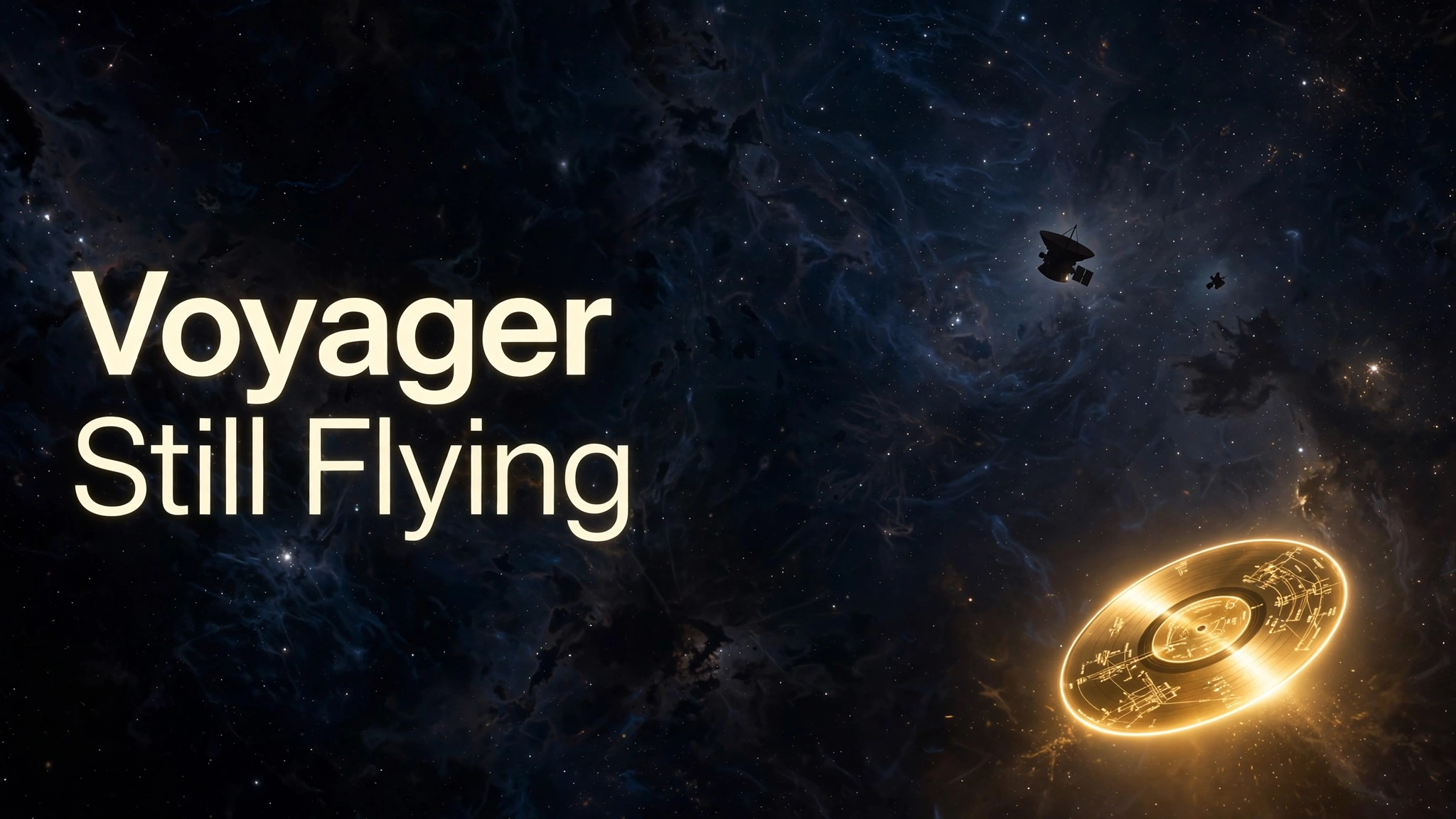
Right now, in late October 2026, the Voyager Golden Record is not in a museum, not in an archive, and not anywhere you can visit. It is bolted to the side of Voyager 1, the most distant human-made object in existence, drifting through interstellar space more than 15.8 billion miles from Earth, and heading for a milestone no spacecraft has ever reached. On 18 November 2026, Voyager 1 is expected to become the first human-made object to reach one light-day from Earth, about 16 billion miles, or about 25.9 billion kilometres, away. At that distance, a radio signal travelling at the speed of light will take a full 24 hours to make the one-way trip. A message sent from Earth on that day will not arrive until the next day, and any reply will take another day to come back. The record itself, a 12-inch gold-plated copper disc, is still there, still attached, still unplayed, and still travelling with the spacecraft that carries it. It has not been found by anyone. It has not been heard by anyone except, in copy form, by people on Earth. And it will keep travelling long after Voyager 1 stops talking to us.
That is the direct answer, but it needs unpacking, because the phrase where is it now hides several different questions. Where is Voyager 1 in space? How far is that in units a reader can feel? Is the spacecraft still working, or is the record now just silent cargo? What is actually on the record, and why was it made in that form? And how long can a copper disc with a gold coating survive in the emptiness between stars? Each of those questions has a different answer, and together they give a clearer picture than a single distance figure. The record is not lost. It is tracked, daily, by giant radio dishes on Earth, even though it is far too faint to see through any telescope. Its position is known precisely because its trajectory is known precisely. It is, in a strange sense, both the most remote object humans have ever made and one of the most carefully followed.
The live position in late 2026
Voyager 1 was launched on 5 September 1977 from Cape Canaveral, Florida, sixteen days after its twin, Voyager 2, which launched on 20 August 1977. Its original job was to study Jupiter and Saturn, and it was expected to last about five years. It flew past Jupiter in March 1979 and Saturn in November 1980, and a close pass by Saturn’s moon Titan bent its path upward and out of the plane of the planets, sending it on the faster, higher trajectory that made it the most distant spacecraft. It crossed the heliopause, the boundary where the Sun’s solar wind meets the interstellar medium, in August 2012, at about 121 astronomical units from the Sun. An astronomical unit is the average distance from Earth to the Sun, about 149.6 million kilometres, so 121 of those units was already an extraordinary distance. By late 2026, Voyager 1 is about 172 astronomical units from the Sun, and about 25.8 billion kilometres from Earth, travelling away from the Sun at about 61,000 kilometres per hour, or about 17 kilometres per second.
Direction matters as much as distance. Voyager 1 is heading, broadly, toward the constellation Ophiuchus, in the northern sky, though it will not reach another star for tens of thousands of years. It is not heading toward a particular planet or a known alien world. It is heading out, on a trajectory set by gravity assists in the 1970s, and it will keep going in that direction because there is almost nothing in interstellar space to slow it down or turn it. Voyager 2, by contrast, is about 13 billion miles from Earth, in a different direction, having visited Uranus and Neptune as well as Jupiter and Saturn. Both carry a Golden Record. This post tracks Voyager 1’s record, because Voyager 1 is the furthest, the fastest, and the one approaching the one-light-day milestone first, but readers should remember that there are two records in space, not one, travelling in different directions.
The signal delay is the most human way to feel the distance. In late October 2026, a one-way signal takes just under 24 hours, about 23 hours and 57 minutes in recent tracking summaries. By 18 November 2026, it will take a full 24 hours. That means the team on Earth cannot steer Voyager 1 in real time. They send a command, wait a day for it to arrive, and wait another day to see whether it worked. A two-day round trip for a single instruction is why the mission is run with great care, why commands are checked repeatedly before sending, and why a brief loss of contact, such as the one on 18 and 19 October 2026, when the Deep Space Network could not detect Voyager 1 during two scheduled attempts, causes concern even when contact returns, as it did on 20 October 2026. The spacecraft had put itself into safe mode and switched to backup thrusters after one group of thrusters went offline. Engineers were still investigating the cause in late October, and they expected more such glitches as the spacecraft ages.
Still talking, but with fewer instruments
Voyager 1 is still talking, but it is talking with a smaller voice than it once had. Its power comes from radioisotope thermoelectric generators, which convert heat from decaying plutonium into electricity. That power fades by about four watts every year, a tiny amount on Earth, but a decisive amount on a spacecraft that started with only a few hundred watts. To keep the spacecraft alive, engineers have switched instruments off one by one. The cosmic ray instrument was switched off on 25 February 2025. The low-energy charged particle instrument was switched off on 17 April 2026. As of late 2026, Voyager 1 has two science instruments still working: the magnetometer, which measures magnetic fields, and the plasma wave instrument, which listens to plasma waves in interstellar space. It sends data back at about 160 bits per second, an extremely slow rate by modern standards, through NASA’s Deep Space Network, a system of giant dishes in California, Spain, and Australia that take turns listening as Earth rotates.
In September 2026, engineers completed a power-saving operation nicknamed the Big Bang, in which they switched off three devices and replaced them with lower-power alternatives, to keep the remaining instruments running longer and to keep the spacecraft warm enough to function. Without that kind of triage, NASA has said, the spacecraft might have had only a few more months of useful power before an instrument would have had to be shut down entirely. With conservation, engineers believe Voyager 1 can keep at least one science instrument operating into the 2030s, though they warn that unforeseen problems could shorten that timeline. There is no firm switch-off date. The science mission will end gradually, instrument by instrument, as power falls, and engineering communication may persist for a while after the last science instrument goes dark. Eventually, the signal will become too faint to detect, or a critical system will fail, and Voyager 1 will fall silent. That silence, expected sometime in the 2030s on current estimates, will not mean the spacecraft has stopped moving. It will mean we can no longer hear it.
That distinction, between moving and talking, is central to the Golden Record’s future. The record does not need power. It does not need a transmitter. It does not need NASA. It is a physical object, bolted to a spacecraft that will keep drifting through the Milky Way for millions of years, whether or not anyone on Earth is listening. When Voyager 1 falls silent in the 2030s, the record will not fall silent with it, because it was never making sound in space. It was waiting, in silence, for a finder who may never come. That is a strange kind of longevity: the spacecraft’s active life is measured in decades, but the record’s passive life is measured in geological time.
What is actually on the record
The Golden Record is a 12-inch, or 30-centimetre, gold-plated copper phonograph record, sealed in an aluminium cover that carries etched instructions for how to play it. The cover also shows the Sun’s location relative to 14 pulsars, which are rapidly spinning, flashing stars that can serve as cosmic landmarks, and diagrams of a hydrogen atom, the most common element in the universe, to give a finder a reference for time and measurement. Inside the cover is a cartridge and a needle, so that a finder with no knowledge of Earth technology could, in principle, work out how to play the disc. The audio is meant to be played at 16 and two-thirds revolutions per minute, slower than an ordinary record, to fit more material onto one disc. The instructions are symbolic, not written in English, because the makers could not assume a finder would read any human language. Whether those symbols would actually be understood by a non-human intelligence is unknown, and this post does not claim otherwise. The cover is a hope, not a guarantee.
The contents were chosen by a committee chaired by astronomer Carl Sagan, with contributions from scientists, artists, musicians, and other specialists, working in less than nine months before launch. The record carries 115 analog-encoded images, spoken greetings in 55 languages, a 12-minute montage of the sounds of Earth, and about 90 minutes of music. The greetings range from ancient languages such as Sumerian and Akkadian, which have not been spoken as daily languages for thousands of years, to modern languages, ending with a greeting from Carl Sagan’s six-year-old son, Nick: Hello from the children of planet Earth. The sounds include surf, thunder, wind, rain, bird calls, whale songs, a kiss, footsteps, a heartbeat, a mother’s first words to a child, the sound of a Saturn V rocket lifting off, and Morse code. The music includes 27 tracks, from Bach’s Brandenburg Concerto No. 2 and Beethoven’s Fifth Symphony to Senegalese percussion, Australian Aboriginal songs, Javanese gamelan, Navajo night chant, Peruvian panpipes, Blind Willie Johnson’s Dark Was the Night, Cold Was the Ground, and Chuck Berry’s Johnny B. Goode. The images include diagrams of human anatomy and DNA, the Solar System, and photographs of landscapes, food, buildings, and people at work and play.
There are also two written messages, from United States President Jimmy Carter and United Nations Secretary-General Kurt Waldheim, and a recording of the brainwaves of Ann Druyan, the record’s creative director, made while she thought, among other things, about being in love. That brainwave recording is often singled out because it is so personal: a private human feeling, encoded as electrical activity, sent into interstellar space. The curators deliberately left out depictions of war, disease, crime, and poverty, a choice that has been debated ever since. Some critics argue that the record presents an idealised Earth, not a true one. Others argue that a first introduction should present what a civilisation hopes to be, not its worst failures. Both views are reasonable, and the record itself does not settle the argument. It is a selection, made under time pressure, by a small committee, from a planet of billions. No single disc could represent Earth fully, and this one does not claim to.
How long will the record last
The most quoted figure for the record’s survival is more than a billion years, based on a 1977 NASA assessment that the aluminium cover and the emptiness of interstellar space would protect the disc from radiation and erosion for that long. National Geographic, reporting in 2025, puts it more cautiously: the record is designed to endure for billions of years, and project manager Suzanne Dodd has said it will keep drifting for millions and even billions of years, long after communications end. Other summaries say hundreds of millions of years. The range reflects different assumptions about micrometeorite impacts, cosmic radiation, and the slow erosion of any material in space. No one can test a billion-year claim directly. The honest statement is that the record is built to last far longer than any human civilisation, far longer than the spacecraft’s electronics, and far longer than any signal we will ever receive from it. Whether the exact figure is hundreds of millions or more than a billion years does not change the practical meaning: the record will outlast us.
To feel that timescale, compare it with the distances ahead. NASA’s own summaries say it will take about 40,000 years for Voyager 1 to drift into the vicinity of another star system, passing within about 1.6 light-years of the star Gliese 445. A light-year is the distance light travels in one year, about 9.46 trillion kilometres, so 1.6 light-years is still an enormous gap, not a close encounter. Voyager 1 will not visit Gliese 445. It will pass at a distance that is still vastly larger than the whole Solar System. Around the same time, Voyager 2 will pass within about 1.7 light-years of the star Ross 248. After that, the Voyagers will keep drifting around the centre of the Milky Way, completing an orbit in about 225 million years, if they survive that long without a collision. A collision with anything large enough to destroy the record is extremely unlikely in the emptiness between stars, but micrometeorites will slowly pit the surface over eons. The record is not indestructible. It is durable, in the way a stone tool is durable: it will last until something, over a very long time, wears it away.
There is a second, quieter longevity to consider. The record’s contents are also preserved on Earth, in copies, reissues, and NASA’s online archive, so even if the flight copies were destroyed tomorrow, the music, greetings, and images would not be lost to humanity. What would be lost is the original object, travelling in space, as a physical message. That distinction matters for readers who ask whether the record is still in space. Yes, the flight copies are still in space, on Voyager 1 and Voyager 2. Copies on Earth are not the same thing, even though they contain the same sounds. The flight copies are the ones that matter for the story of a message in a bottle, because they are the ones that left the Solar System.
Why 18 November 2026 matters, and why it does not
The one-light-day milestone on 18 November 2026 is a genuine first, and it deserves attention. No human-made object has ever been one light-day from Earth before. It is a round number in a unit that connects distance with time, which makes it easier to grasp than 25.9 billion kilometres. When a signal takes a full day, the idea of distance becomes personal: you send a message today, it arrives tomorrow, and you cannot have a conversation, only an exchange of letters with a two-day delay. That is a poetic and a practical threshold, and NASA’s tracking pages will mark it. Readers who follow the mission should watch for it, not because the spacecraft will change on that day, but because it marks how far human engineering has reached in a single lifetime. Voyager 1 was launched when many of its current followers were not yet born, and it will reach one light-day when it is 49 years old.
At the same time, the milestone does not change the spacecraft’s science, its power, or the record’s fate. Voyager 1 will cross one light-day and keep going, at the same speed, in the same direction, with the same two instruments. It will not suddenly become a different mission, and the record will not suddenly become more or less likely to be found. The next milestones are less round but more meaningful in other ways: the point in the early 2030s when the last instrument may be switched off, the point in about 300 years when Voyager 1 reaches the inner edge of the Oort Cloud, the vast, distant shell of icy bodies around the Solar System, and the point in about 40,000 years when it passes near Gliese 445. Each of those is a different kind of marker: a human marker, a Solar System marker, and a stellar marker. The one-light-day date is the human marker, and it is worth celebrating precisely because it is human, not because nature cares about light-days.
There is also a risk in over-focusing on a single date. Voyager 1’s recent glitches, including the October 2026 loss of contact and the earlier memory fault that garbled data from November 2023, show that the spacecraft is fragile. Engineers expect more glitches between now and the summer of 2027, according to recent reporting. If Voyager 1 fell silent before 18 November 2026, the milestone would still be reached in terms of distance, but we would not hear about it in real time. If it falls silent in the early 2030s, as expected, the record will continue regardless. The mission’s value in 2026 is not only in its distance but in its data: magnetic field and plasma wave measurements from a region no other spacecraft has sampled directly. When those data stop, humanity will lose its only direct sensor in interstellar space, even though the record will carry on. That loss, not the light-day date, is the real end of the mission as a scientific enterprise.
How to follow it yourself
Readers who want to track Voyager 1 do not need a telescope. The spacecraft is far too faint to see, and no amateur instrument can detect its signal. The reliable route is NASA’s Voyager mission status pages and the Deep Space Network’s live tracking, which show distance, signal delay, and which instruments are on. Third-party trackers also show live distance, speed, and signal delay, and they are useful for a quick check, but they ultimately rely on NASA’s trajectory data. A reader checking on 31 October 2026 should expect a distance of about 25.8 to 25.9 billion kilometres from Earth, a one-way signal time of just under 24 hours, a speed of about 61,000 kilometres per hour, and two active science instruments. If a tracker shows a very different figure, check whether it measures distance from Earth or from the Sun, because those two numbers differ by about one astronomical unit, and check whether it measures miles or kilometres. Mixing those pairs is the most common source of apparent disagreement.
A second practical note: do not expect new photographs. Voyager 1’s cameras were switched off long ago to save power, and its last famous image, the Pale Blue Dot photograph of Earth taken in 1990, will remain its last. The mission in 2026 is a listening mission, not a seeing mission. Its instruments measure invisible things: magnetic fields, plasma waves, and the faint hum of interstellar space. That is less photogenic than a planet photograph, but it is scientifically rarer, because no other spacecraft is there to measure those things. Readers who follow the mission for pictures will be disappointed. Readers who follow it for the idea of a human object, carrying a golden record, drifting further than any other, will find the current phase, quiet, slow, and distant, to be the most moving phase of all.
My Take: The Record Was Never Really For Aliens
I think the Voyager Golden Record is misunderstood in a way that makes it smaller than it really is, and the misunderstanding is this: we talk about it as if its success depends on being found. If no alien ever finds it, we imply, it was a waste, a beautiful failure, a bottle thrown into an ocean with no shore. I believe that is the wrong test, and I believe the people who made it knew it was the wrong test, even if they did not say so in those words. The record was never really for aliens. It was for us, for the people who made it, and for the people who would later learn about it and ask what kind of civilisation would send a mixtape into the dark. Its audience was always, first, humanity itself, looking at itself from a distance and deciding what to include, what to leave out, and what to hope for. An alien finder, if one ever comes, would be a bonus. The real finder was already here, in 1977, in a room where a committee argued over Bach and Chuck Berry and whale songs, and decided that a planet in trouble could still make something hopeful.
My judgement is that the record’s greatest achievement is not its engineering, though the engineering is remarkable: a gold-plated copper disc, in an aluminium cover, with a needle and symbolic instructions, built to last a billion years. Its greatest achievement is its selection, and its selection is also its greatest flaw, and both halves deserve to be held at once. The selection is beautiful because it is generous. It includes greetings in 55 languages, from ancient Sumerian to a child’s hello. It includes music from many cultures, not just one. It includes the sounds of rain and surf and a kiss and a heartbeat, things that have nothing to do with technology and everything to do with being alive. It includes a brainwave recording of a woman thinking about love, which is either the most romantic or the most absurd thing ever sent into space, depending on your mood, and I think it is both, and that is why it works. It says, in effect, we are not just a species that builds rockets. We are a species that feels, sings, laughs, and wonders.
Its flaw is equally clear, and I do not want to soften it. The record leaves out war, disease, crime, and poverty, not because those things do not exist, but because the makers chose not to show them. That is understandable as a first introduction, and it is also dishonest as a portrait. A civilisation that sends only its best songs and its gentlest sounds is not lying exactly, but it is editing, and editing is a form of storytelling. If an alien did find the record and believed it completely, it would think Earth was a kinder, cleaner, more harmonious place than it is. I think that matters, not because aliens will judge us, but because we judge ourselves by the stories we send. When we tell a partial story and call it the whole story, we train ourselves to forget the parts we left out. The record should be celebrated and questioned in the same breath, because it is both a love letter and a press release, and love letters and press releases have different rules.
I also have a strong view about the timescale, because I think we use billion-year figures the way we use bar charts: to impress, not to understand. Saying the record will last a billion years sounds like forever, and it is meant to. But a billion years is not forever. It is a specific, finite time, during which stars will die, continents will move, and, if humanity survives, we will become something unrecognisable. The record will not be found by us in that future, because we will not be us. It will be found, if at all, by something else, or by no one, drifting through a galaxy that does not care about gold or copper. That is not depressing to me. It is clarifying. It shows that the record’s value does not depend on its survival. Its value depends on the act of making it, in 1977, by people who knew they would never know the outcome, and who made it anyway. That act, hopeful without evidence, is rarer than the engineering. Engineering can be replicated. Hope, under those conditions, cannot be faked.
If I had to choose what to tell a reader who asks where the record is now, I would not start with the distance, even though the distance is astonishing. I would start with the silence. The record is travelling in silence, on a spacecraft that is slowly losing power, that will fall silent itself in the 2030s, and that will then drift, unheard, for millions of years. That silence is not a failure. It is the condition of the whole enterprise. We sent a message into a space so large that a reply, if one ever came, would take longer than a human lifetime to arrive, and we sent it knowing that. That is either foolish or brave, and I think it is brave, because it refuses the logic that only things with a measurable return are worth doing. The record has no return on investment. It has no audience, no market, no metric. It has only a hope, and hope, in this case, was enough to build a golden disc and bolt it to a spacecraft and send it past Jupiter and Saturn and out of the Solar System entirely. That is a kind of faith I wish we showed more often, in smaller things, closer to home.
My final judgement is practical as well as poetic. We should follow Voyager 1 while we still can, not because the data will change daily life, but because following it trains a habit that is disappearing: paying attention to a slow, distant, unprofitable thing, simply because it is true and because it was made by us. When Voyager 1 falls silent, we will lose a sensor, but we will not lose the record, and we will not lose the lesson. The lesson is that a civilisation is measured not only by what it builds for itself, but by what it sends away, with no expectation of return, in the hope that someone, somewhere, someday, might understand it. That is a high standard, and it is one we should apply to our own messages, our own art, and our own lives, long before we worry about whether an alien will ever play a golden record in interstellar space.
Frequently Asked Questions
Voyager Golden Record: where is it now in 2026?
It is bolted to Voyager 1 in interstellar space, more than 15.8 billion miles from Earth in late October 2026, heading toward one light-day from Earth on 18 November 2026. A second identical record is on Voyager 2, about 13 billion miles from Earth in a different direction.
Is the Golden Record still in space?
Yes. Both flight copies are still in space, attached to Voyager 1 and Voyager 2. They have never been played since launch, and they are not in a museum. Copies on Earth contain the same sounds, but they are not the flight copies.
How far is Voyager 1 from Earth in 2026?
About 25.8 to 25.9 billion kilometres, or about 16 billion miles, from Earth in late October 2026, about 172 astronomical units from the Sun, travelling at about 61,000 kilometres per hour. A one-way radio signal takes just under 24 hours, rising to a full 24 hours on 18 November 2026.
How long will the Golden Record last?
NASA’s 1977 assessment put its survival at more than a billion years, protected by its aluminium cover and the emptiness of interstellar space. More cautious summaries say hundreds of millions to billions of years. The exact figure is untestable, but the record is expected to far outlast the spacecraft’s electronics and any human civilisation.
What is on the Golden Record?
115 images, greetings in 55 languages, a 12-minute montage of Earth sounds, about 90 minutes of music in 27 tracks, messages from President Jimmy Carter and UN Secretary-General Kurt Waldheim, and a brainwave recording. Music ranges from Bach and Beethoven to Senegalese percussion, Aboriginal songs, and Chuck Berry’s Johnny B. Goode.
When will Voyager 1 stop communicating with Earth?
There is no firm date. Engineers expect at least one science instrument to keep working into the 2030s with power conservation, but the spacecraft loses about four watts a year and could fall silent earlier if a critical system fails. After that, the spacecraft and its record will keep drifting silently.
Will anyone ever find the Golden Record?
No one knows, and the realistic expectation is that it may never be found. Voyager 1 will not pass close to another star for about 40,000 years, when it will pass within about 1.6 light-years of Gliese 445, still an enormous distance. The record was designed as a message of hope, not as a guaranteed contact.
Sources
- National Geographic — The Golden Records tell the story of Earth. Will alien worlds ever find them? (fetched 2026-10-31)
- DOGOnews — NASA’s Voyager 1 Spacecraft Approaches Deep Space Milestone (fetched 2026-10-31)
- The Economic Times — In 1977, NASA placed a gold-plated copper record on each Voyager; it carries 115 images, greetings in 55 languages, and instructions for playing it (fetched 2026-10-31)
- Orbital Radar — Where Is Voyager 1 Now? Live Tracker, Distance & Speed (fetched 2026-10-31)